The Antares is a great boat because the equipment is driven by customer feedback rather than a mass production mentality. Some changes are obvious as new technology dominates old. Some changes are driven by taste, such as rolling furling main vs traditional mainsail. And some changes seem to be driven by Voodoo. These are the ones that get debated the most. Despite this being a sailing boat, the choice of propellors is critical when docking or motoring through huge calms.
The boat has a default setting of Volvo folding props matched with the Volvo engines. The builders did this to have a propulsion system from one manufacturer. It is a good thought. The problem is that the Volvos don’t bite enough in reverse. As a novice docker of large boats I would rather have more control than less. It was an easy decision for me to find a different option. But as you can see from the email chains, it consumed many Antares owners’ time and thought. It is really fun to think about every bolt on the boat as you wait for it to splash and as Gail says – the less data, the more talk.
Dear Ted (Chief Designer Antares),
Have not had the pleasure of your responses in some time, but I have talked to Jeff and he referred me to you for a discussion on the Volvo folding props. I am of course mainly concerned about the loss of thrust in reverse (60-70% less efficient than in forward), and that this could create some safety issues. The prop is clearly designed to function well in forward with good smooth efficiency with a minimum of vibration under power, and to provide the least resistance under sail. I understand all the arguments about the small amount of time reverse is needed, the improved sailing characteristics, keeping the blades from fouling on lines and fisherman’s nets and so forth. I get that, but this prop seems to really compromise reverse performance to the extreme. In tight quarters, with windage, sometimes a good reverse is needed. There is a video on YouTube which shows this prop moving into reverse which is very elucidating. It shows the prop collapsing to about 50% of its full diameter and cavitating under higher engine loads. It crumbles up like a spider in a hot frying pan! This explains a greater than 50% loss of reverse power and a drag coefficient that slows max engine RPM down to about 1800 at full throttle. I challenged myself to try and find another option between a feathering prop and the Volvo folding prop that would provide the sailing and forward performance without giving up reverse performance in tight places.
As I am one that likes his cake to have and to eat, I began looking around for a more evenly engineered option and found the GORI folding prop which also has a video demonstration on youtube. This is also a three blade folding design, but it rotates through fold then reverses the blade as they are redeployed allowing for equal thrust in forward and reverse. Moreover, the opposite leading edge has an increased pitch which can function as an overdrive during low demand cruising applications to maximize fuel economy. To good to be true? Well that is why I am asking the master. This seems like a superior design, at least in balance, and I was hoping to have your assessment and input into this rather important issue. Okay, time to shoot holes in my theory.
Mr X
===================================================
Mr X,
It is interesting to me to observe the changes in expectation that seem to have occurred since I started working on this stuff in the early 70’s. At that time, sailboats generally had two blade props with blades as narrow as possible for low drag. They worked so/so in forward or reverse at low boat speed, you had to plan your docking maneuvers well in advance regardless of which direction you were going, but at hull speed they were reasonably efficient. Racing boats started to use simple two blade folders (Martec) which had less drag, less reverse thrust, more vibration, and a whole lot of mechanical issues associated with moving parts. They were nonetheless widely used. The exotic Maxprops became the thing for the high end racers and everyone was delighted with the thrust, in both directions, at low boat speed, and nobody cared if they were efficient or not, only having to get the boat to the course. Gori then came on the scene with geared blade props otherwise similar to the Martecs, thereby solving their severe problem ‘of one blade out/one blade in’ (really). This was what was practically available by 1980 or so and nothing much has changed beyond refinements.
Meanwhile, cruising boats stayed with fixed blade props and when a lot of along shore work was envisioned, they were frequently full three blade powerboat types which get better static thrust due to the blade area ratio but drag a lot when sailing.
There is really nothing fundamentally new on offer but there has been a change of values for cruising boats. The Maxprop changed expectations for maneuvering power though the bulk of opinion will have been be generated by sailors of limited voyaging experience. The faster sailing cats perhaps slant cruising parameters more towards what was race practice but their opportunity for extended power propulsion suggests efficiency should also be more important; a bit of a dilemma.
The fixed prop appears to have gone by the wayside for boats like the Antares so we are faced with evaluating a set of compromises in a very confused feathering/folding prop market.
The video of the Volvo prop is unfortunately meaningless, as would a video of any prop be without defined parameters. There are also liberties taken with the interpretation of what is actually demonstrated, such as the identification of ‘cavitation’, which could be the case but could also be evidence of tip aeration. The circumstances are much too complicated, subject to the vagaries of the installation and prevailing conditions, to draw any generalized conclusions about this prop or any other. For example, we do not know what the relationship is between the engine, reduction gear, prop diameter, prop pitch, designed boat speed, speed of boat through the water (in reverse), attained rpm, effective thrust at various rpm. The blades may be expected to partially fold in reverse as they rely on centrifugal force to extend them while reverse thrust tries to fold them. The folding is therefore actually a demonstration of reverse thrust. The boat is most likely tied to the dock, which renders the function unrealistic as pitch effectiveness is related to boat speed, whatever it may be in relation to shaft rpm, (which we also don’t know).
There is also a video posted of a Gori prop running in conditions it which produces ‘cavitation’ in the opinion of its owner, bobbing about alongside. (http://www.youtube.com/watch?v=GYAQLwe-Dks). If it is in fact cavitation that is being observed, that would be expected with a prop operating at less than the designed boat speed.
I consider this kind of video potentially of interest but the concomitant ‘conclusions’ are a most unfortunate and confusing occurrence. 100 yrs. of prop design development appear to be made irrelevant by the internet. I would observe the video, but then imagine myself in the company of a dozen lads in white coats, with degrees in fluid dynamics, employed by Volvo, Gori, Maxprop, whoever, and then try to just listen. Every company will have a marketing department that is setting the real targets in response to what is identifies as its particular customer expectations.
The Volvo prop has skewed blades (extended sweep curves to the trailing edges) which follow modern design practice to produce efficient and quiet thrust. They are also readily serviced by a front line engine manufacturer with world wide parts support in virtually every port, which is no small matter. They do suffer from compromised reverse thrust as do most other props.
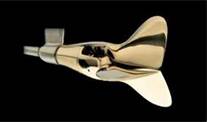
Gori Prop
The Gori prop would appear to have addressed some issues that we have identified, some limited blade twist (absent from the Maxprop), and better reverse thrust than that associated with folding and fixed props. There is always a price to pay and the blades have to be less than ideally shaped to pass each other at mid swing. As a result there can be no blade skew whatsoever which is not ideal. The ‘overdrive’ thing sounds like a lot smoke and mirrors, it would seem the blades just lodge in a particular state of partial deployment according to conditions. It may work. Equalized blades (Maxprop, Gori), by design compromise some forward thrust to benefit reverse thrust.
All the manufacturers claim to have the best stuff. We chose to offer the Volvo prop for a number of reasons related to generalities, by necessity, but for your personal application something else may be more satisfactory.
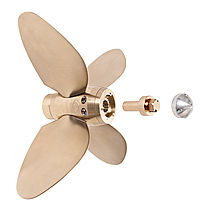
Max Prop
All these low drag props are compromised one way or another, I see no reason you shouldn’t ‘pick your poison’. The attached comparisons may help you with a decision. You may see that they are not particularly conclusive and no manufacturer’s claims appear to 100% supported. It is a tough call. They will all work one way or another. This is your boat and trying on some ideas of your own is appropriate.
I have no particular favourite and would probably revert to a fixed blade dinosaur just out of pique and nostalgia, and suffer the consequences no doubt. (Curiously, nobody seems to slag their fixed props on the internet.)
Regards,
Ted





 Designed by Team Twofish. Powered by