Archive | Boat Systems and Gadgets RSS feed for this section

iOS Sailing Apps

In 1992, I (Jason) sailed from New York to Florida; our GPS was a white brick attached to the lifelines that only displayed a Lat and Lon.  It was not networked, it had no charts or graphics, but it seemed like wonder technology.  It cost $1,000.  Six days after leaving the dock it beeped at the right time for our approach mark to West Palm Beach.

Now iOS apps offer a myriad of features, including GPS. Many have been tested aboard Two Fish.   Here is a list of the must haves, the OKs and the duds.

I think blue water cruisers are much safer with a proper chart plotter at the wheel.  If there had been a chart plotter on team Vestas they might have avoided the reef.  However, iOS apps offer many features and cheaper pricing, so they can be a primary for a budget cruiser and a back up on a decked-out boat.

This post is rather long so here is the MUST HAVE LIST

  1. An anchor drag alarm:  Anchor
  2. NMEA data view (NMEA to wifi hardware required):   Edo Instruments by Seamantech
  3. Weather app:  Weather Track
  4. Navigation app: Navionics
  5. Reference Programs


Anchor Drag Alarm

Anchor

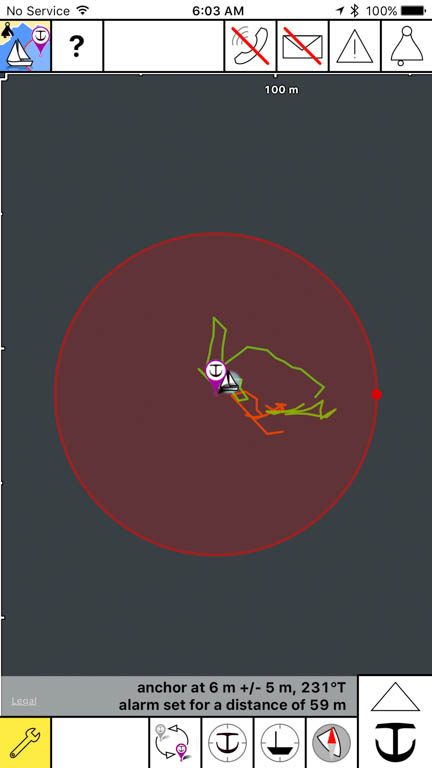
anchor-track-1-of-1The iOS app Anchor (link to iTunes store) best addresses our fear of dragging anchor while asleep on windy nights.   After dropping hook, you input into the app the distance to the anchor, the bearing to the anchor and the size of the safety circle.  It works without cell towers but if you are lucky enough to have an internet connection then you will see your location on a satellite view.  The photo to the left was taken without internet and in light air with current.  When the breeze built, the boat headed to the edges of the circle, but in light air we sat on the anchor.  The purple arrow is the anchor, the boat is Two Fish and the red circle  is the drag alarm range.  The great feature of this app is the ability to view the history of your location.  When you feel a big puff or a weird sensation in the middle of the night, you can quickly check the app and confirm the boat is still on the same arc.  I still go on deck to survey, but now my second wake up only requires a quick glance at the app.   A feature we don’t use because we often lack cell signal is messaging.  An iPhone with the Anchor app can SMS or email another iPhone onshore if the boat is dragging.  What do you do when you are four hours away on a hike and you get a message that the boat is dragging?  The only shortcoming of the app is a lack of an alarm for wind shifts.  This would be good in tidal streams or when you are counting on the trade winds.  The apps draws down the battery so we sleep with the iPhone plugged into our 12 volt USB outlets.  We have not experienced app crashes, but in tricky anchoring spots we will have both iPhones running the app.  Works on an iPad as well.  Must have app, will make anchoring much more relaxing.

Other apps we tested:

Boat Sentry:  This app was a runner up for our needs.  It has the ability to warn you of 180 degree shifts via a very flexible set of menus.  Not the easiest app to learn but powerful.  However it lacks the satellite view feature, which I found very useful when we had a internet connection.

Drag Queen:   Sassy name for the app but it lacks a graphical interface.  Prefer an easier format to read when being woken up at 2 am. Skip this app.

Our chart plotter has a simple anchor alarm but we do not use it because keeping the chart plotter on consumes too much electricity and the alarm noise is soft.  We bought our AIS for its low power anchor alarm but had to wait 3 years for the feature to become part of the software.  Even now, the iPhone alarms seem to dominate.

Wind Alarm

When anchored in Tonga, a gust hit our anchorage.  Our friends were woken up by an alarm warning them of the gusts.  The AIS confirmed that our friends were not dragging, but they saw another nearby boat traveling at 2.5 knots.  The other boat was dragging for sure.  We organized a rescue party and the boat was re-anchored.  Now on Two Fish we have a rule that 100% of the time at anchor or on a mooring ball we leave on the AIS and the wind alarm.   If I have anchored in light air, I will set the alarm at 25 knots.  If I am woken up and confirm all is good I reset the alarm at 5 knots higher.  With the AIS turned on we get two advantages: first, late night arrivals to the harbor can see Two Fish, and second, our instrument data is sent out via wifi, a segue into reviewing the group of  apps that can display wifi NMEA data on iOS. For non-techies, NMEA is the name for the data interface used to communicate between a boat’s data display instruments.

NMEA Data Viewer Apps
iRegatta

2016-10-24_16-27-19


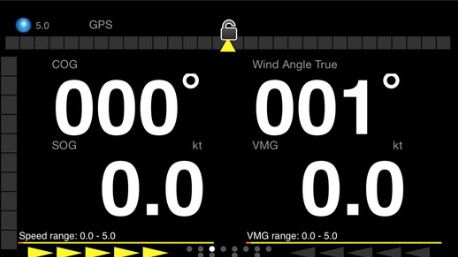
I like the ability while sailing or at anchor to quickly look at key data.  Wind speed, depth and true wind angle are favorites.  iRegatta will display most NMEA data transmitted on a wireless IP address.  In other words, if your chart plotter or AIS or add-on device transmits the NMEA data wirelessly,  you can use this application.  It is a bit like a chart plotter in your pocket.  It will also show AIS targets and try to calculate your polars.  This did not work for me, but it might be my fault.   I have used the app for a few years and it is a must have for me but there may be a better solution.

Seamantech (EDO Instruments)
2016-10-24_16-39-07

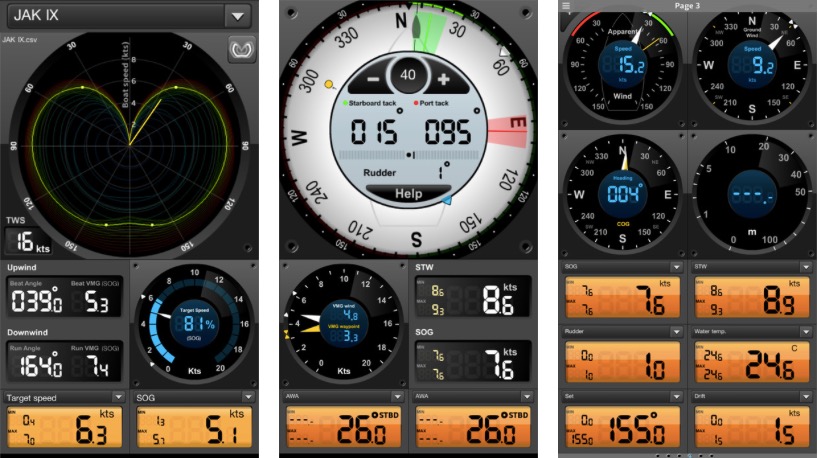
I just started using EDO instruments by Seamantech.  I give it a 10 out of 10 rating.    It is early days, but I think it will displace my regular use of iRegatta because of its more pleasing layout.   The app can also efficiently calculate polars by  recording data (wind speed, wind angle and boat speed) while sailing.  Over time, with enough data, the app will plot the top speeds for each angle and wind speed.  The user can correct the app if you think the data was corrupted by current or by surfing a wave.  You can also create different polars for different sail plans so you can really know the cost of tucking in the second reef.  Sounds like I will be busy doing some data recording next season.

By the way, rumor is they are coming out with a brand new app.

Furuno Chart plotter App
2016-10-11_16-41-16

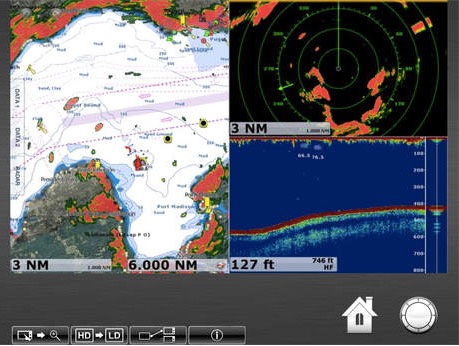
Furuno offers two apps that run on both iPhones and iPads.  After paying a king’s ransom for the hardware, the app is free.  The first is very useful and allows a duplicate image of the chart plotter to appear on the iPhone.  During my off-watch I enjoy checking on the helm without getting out of bed. Don’t worry, someone else is always at the helm on Two Fish.  I can see the radar and then change screens and see the chart with all of the wind data, course information, rudder angle and depth.  Whenever I connect the app, the chart plotter beeps, warning the helms person that big brother is spying.  I have disabled the ability for an app user to adjust the chart plotters.  This was a Gail requirement.  If you are lucky enough to have Furuno TZ’s, this gives you an extra chart plotter in the cabin, in the galley or even down in the bilge.  This is a most powerful app, but I only use it when sailing since I don’t want to run  the chart plotter while at anchor.  As a side note, I often notice large sport fish boats will leave their chart plotters on when docked with no one on board.  What’s up with that?  Furuno has another free app, NavNet Viewer, which streams data from the network.  It is passable but I prefer Seamantech’s viewer mentioned before.

Weather Apps

Most weather apps are driven by the same NOAA-produced GFS forecast data.  I have watched people open up four weather apps to reassure themselves of the weather for their upcoming trip, yet the apps are all using GFS data. So at times, what distinguishes them is presentation.

Some apps do allow a switch to the European model or the Canadian model.  For no good reason, we tend to prefer the GFS model. Additionally, Wind Guru and Predict Wind both massage the data, but I tend not to value their efforts.  I do not connect my iOS devices to the web while at sea, so I only use these apps while lingering onshore at our lunch stop before long trips.  If I see another sailor, we might grunt about the forecast being interesting, code word for lousy weather.

I do not value forecasts beyond 48 hours.  But we will delay if the forecast has seas on the nose of greater than 3 meters, wind on the nose of greater than 20 knots, and wind abeam or behind of greater than 35 knots.
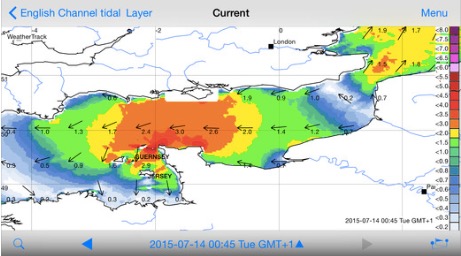
Weather Track

2016-10-24_16-48-10

Weather Track has all of the data I need to plan a passage. Wind speed, wind gusts, wave height and direction, ocean current, rain, lightning and more.  I find the display easy to read.  The program does some smart fetching of data from different servers.  It also has a passage planning feature which I do not use, because I prefer Predict Wind’s routing.  At sea, Weather Track coupled with X Gate can retrieve recent forecasts via SSB or Iridium phones.  We use SailMail while at sea, so I can’t review this feature.   Ocean currents are included with Weather Track, a feature which many apps lack. The source is OSCAR which replaces my earlier tedious downloading of the PDF’s  from the government server. (click here to see my 2014 post describing our use of OSCAR in Brazil)  Feeding the data go straight into the app is deluxe.   Additionally, you can purchase more detailed currents from TideTech.   Weather Track is a must have application.
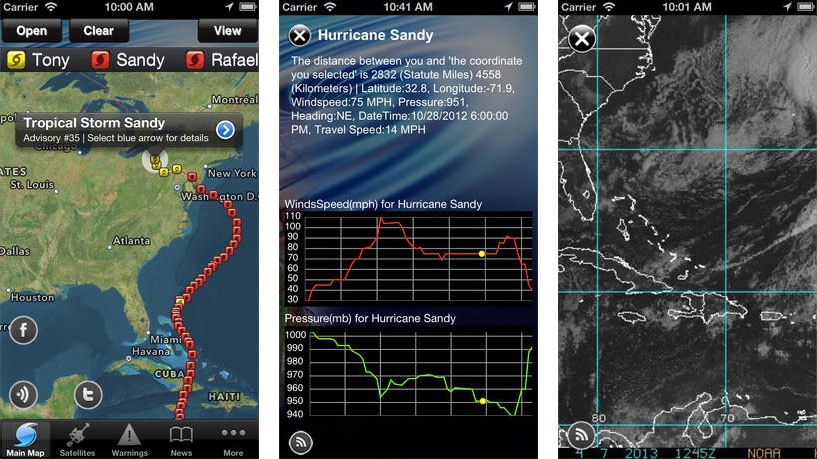
2016-10-28_16-16-50


Hurricane Tracker by Gencode:  We have tried to stay out of Hurricane regions, however, they can cross the path of the most careful sailor.  They arrive while your boat is on the hard or during a late trip down the US coast bound for the BVI.  We also watch the big hurricanes and hope they do not hurt our wonderful hosts on so many Caribbean islands.

Wind Guru

This app is rather ugly and was the benchmark years ago.  It looks like it is a shrunken web page rather than a full blown app. While visiting Uruguay we asked the Coast Guard about good weather since the national weather bureau was on strike.    The Coast Guard handed us a print out from the wind guru website.  The app market has moved on and this app is extinct and Windy replaces it with better presentation and more power.  We view this website when in one location wondering if it will be a windy week at anchor rather than for passage planning.
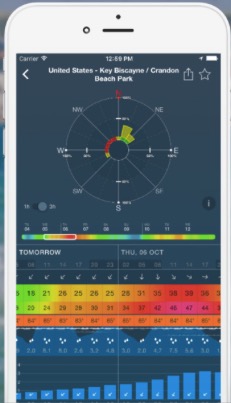
Windy

2016-10-26_16-01-23

Windy has a beautiful set-up and is good for single spot monitoring.  Is it going to be too windy at my anchorage this week for paddleboarding?  Will it rain during the shoreside BBQ?  These are important questions in my life.  I realize there are plenty of similar apps in this  crowded space but this one works best for me.  I wish it had radar and weather buoys.
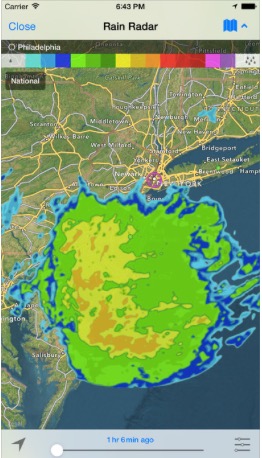
Willy Weather

2016-10-27_10-43-52

Willy Weather has radar and tides.  Since the Furuno radar is pretty good at showing rain cells we do not use online radar too often.  However, when I am on smaller boats without radar it adds a nice measure of safety to have access to radar.  Tide tables are built into our chart plotter so we tend not to use other apps frequently for tide data.  In locations with massive tidal concerns I prefer to get the tide tables from the local authority.  We still carried an Eldridge guide while cruising the US east coast.
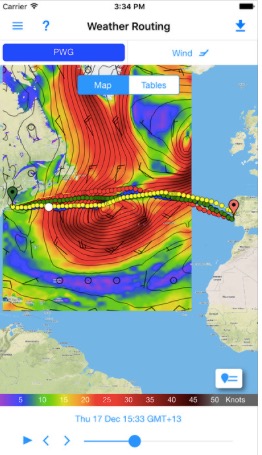
 

Predict Wind

2016-10-27_10-55-32This app does not compete with the above weather apps.  It has a few nice features that address the offshore sailor.  First the app works easily with Iridium Go.  This is one of its key features, so if you have a cell signal this app is less interesting.  Secondly the app does weather routing, which is only useful for longer trips.  If you have both of those needs I can recommend the app.  Its Iridium Go usage is efficient and it has a decent GRIB viewer.  The interface is much friendly than the free service from Sail Docs.  It lacks gusts in the weather planning module, which is a big oversight, In addition, the cost for a subscription is not tiny.


Navigation
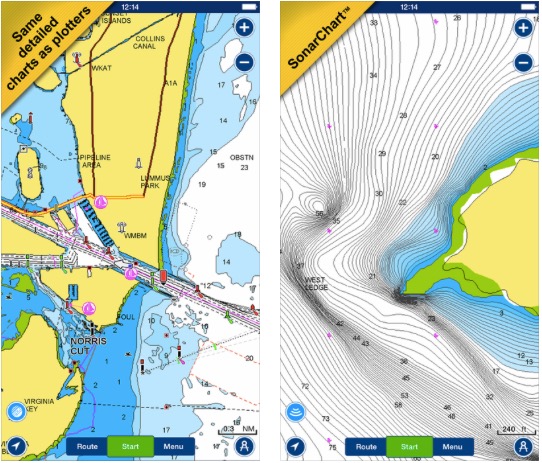
Navionics

2016-10-27_15-43-18I use this app frequently for a variety of reasons.  It is great to have when onshore and another sailor tells you of a great bay or an unmarked sand bar.  The alternative, carrying your chart plotter, is not very easy.  I also do some light planning on the phone.  It has an auto router which I do not use, but it is good for a quick check.  Just tell it your start and finish and the router will honor all the appropriate markers.  It also has tides, moon, sun, simple weather data and a basic logbook.    For 22$ you can buy the entire Pacific islands. Raises the question of how long chart plotter companies can continue to kill us with such high prices.  Navionics also tries to have crowd sourced information but it pales in comparison to Active Captain.  They also have more detailed sonar charts which is pretty useful for those going down the ICW.  Must buy.
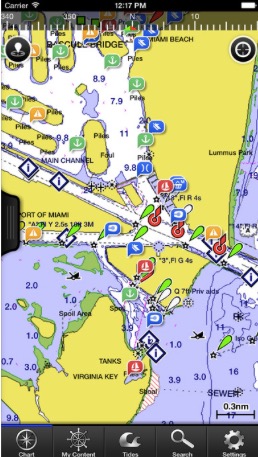
Blue Chart Mobile

2016-10-27_15-46-26

The only reason we bought Blue Chart Mobile is that it includes Active Captain.  It was convenient wile transiting the  ICW to have the anchorage, shoaling and other navigation warnings in my pocket.  Blue Chart has a friendly interface but leaves out key features to protect their chart plotter offerings.  The app does not display boat speed. Are you kidding me?  A sometimes useful feature is the ability to edit the position of user-input spots. For some reason, once a new spot is put on the Navionics chart, it can’t be altered. We have and use both apps but I prefer Navionics.  Buy this app if you value Active Captain data. There are some other Active Captain enabled apps (see the Active Captain website for the most recent list).
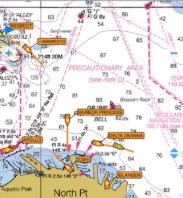
iNavX

2016-10-27_17-03-19Why in the world would I want a third mini chart plotter app?  iNavX offers two things that neither of the big brothers offer.  First, it can display raster charts containing the Explorer Chart guide to the Bahamas.  These guides are by far the best for Bahamian cruising.  This is superior to a hard copy book since it allows for the live location of Two Fish.  Secondly, iNavX can display my entire NMEA network data.  From wind speed to AIS targets.  Nice as another back up.  Recommendation: only buy if cruising the Bahamas.
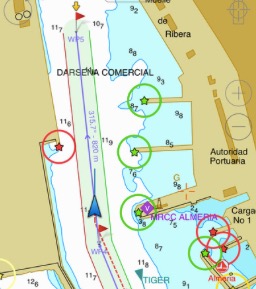
 

Transas iSailor

2016-10-27_17-17-18Very little experience with this app since it costs a bunch to open up all the features. Pay for AIS, NMEA, charts etc.  Uses a type of vector chart common in the programmer’s home country of Russia.  App has a clean, yet not stunning interface.  Looks to have nice apple watch integration but I don’t have an apple watch. Recommendation: Get a more detailed review from a power user.
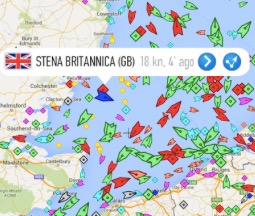
 

Marine Traffic

2016-10-27_17-18-35

Ever wonder where the boat you met a year ago has traveled to?  Want to know more about that huge ship that passed in the channel?  Marine Traffic uses AIS data to track other boats’ histories and additional data.  Add friends to the fleet and the app will tell you when they make a new landfall.  Does not help you navigate but helps you stay in touch.  Must have for amusement.
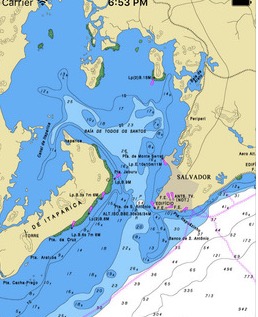
Marine Brazil

2016-10-27_17-22-45

This featureless app offers free raster charts for Brazil.  We carried it as a back-up for our time in Brazil but never used it.  Recommendation:  Its free, why not, if you are going to Brazil.


Tides Planner by Imray  There are several  tide planning apps and tide tables come with navigation apps.  But what is the data source?  My watch proudly announces the tides for our current location and it is often horribly off from reality.  Tides are very local and some apps try to use lat / lon to calculate tides via formulae.  That does not work.

Celestial Navigation
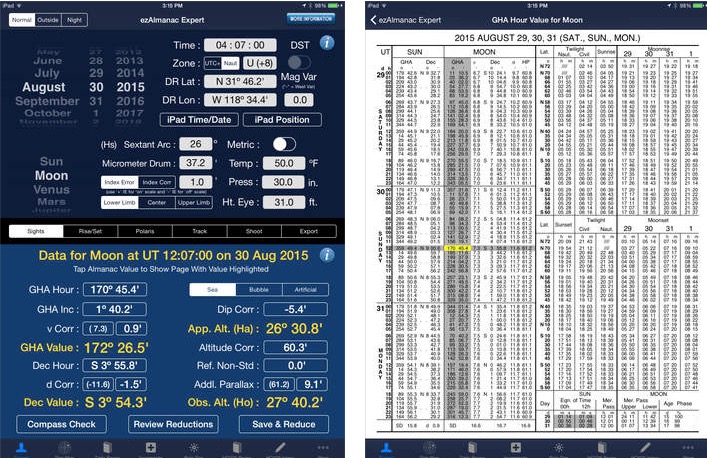
2016-10-28_13-56-50

EZ Sights and EZ Almanac  help make the complex game of celestial navigation less confusing.  The apps offer the user two approaches.  The first approach is to type in the observed angle of the object, and the rest is done for you in the app.  The second approach is to look through the same printed tables that are in the books and complete the calculations as if on paper.  I still struggle with either technique.  I do realize that if my iPad is key to using the sextant, I am not free from power failure vulnerability.   I bought the app to help me become a celestial navigator.  I have failed, but no fault is due to the app.

Logbook

I have tried WaveTrax and the log feature inside Navionics.  The former dedicated logbook app was a huge let down.  It is no longer in the app store for good reason.  Navionics’ log book feature is great for a two hour day sail, but if you run it for days it eventually crashes.  I wish Furuno had a logbook feature.  It seems like an easy app to write.   If any readers of the blog know of a better solution, drop me a line.  Until then, I will use the pen and store my GPX files from the Furuno.

NavPlay is a multi-feature navigation app which has a log book feature but I have been let down twice and am shy on spending fifty bucks for another flop.  I asked Gail if she wants to write our own logbook app.  Start the 7 year wait for the app.

Reference Books
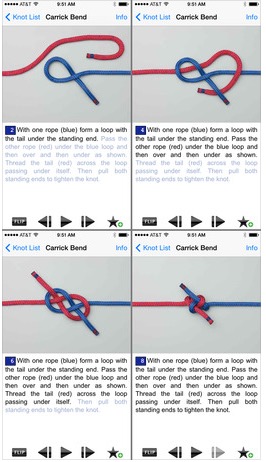
Grog Knots

2016-10-27_11-23-19I forget key knots and can not spell but computers have come to my rescue.  Spell checker for one problem and Grog Knots for the other.  Easy to follow animations make rope klutzes into natural born bowline makers.  Carrying this “book” on the iPhone saves space on the book shelves.
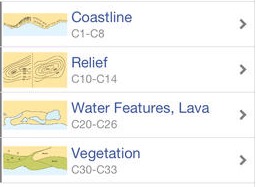


Marine Chart Symbols by Imray

2016-10-27_11-25-38

As a US Coast Guard Vessel, we are required to carry a book that lists all of the chart symbols.  That makes this app redundant, but when bored it is fun to quiz yourself on odd chart symbols.  While on the topic of chart symbols, remember that green “land” is very dangerous.  It will can have a depth of less than one meter except it looks like normal navigable water.  It is easy to get confused when looking at the chart thinking the visible land is the end of the island and accidentally short cut across the shallow green area.   If you see green on the chart, think twice.  Not a required app to buy.

Starwalk

2016-10-27_11-37-12

When watching the phosphorescence illuminate your wake becomes boring, it is time to use Starwalk. Hold the app up to the stars and it will tell you the names of the objects.  You can impress your crew mates by identifying the planets, constellations and even the International Space Station.  Not a required app but what else are you going to do during the night on multi-day passages?
 

Barograph

2016-10-27_11-42-02

We use GRIB files frequently to keep ourselves out of nasty weather and the traditional barometer has taken a back seat.  Recently I have elevated the barometer in my weather tool kit.   Any iPhone 6 or later has a built-in barometer that was added not for weather forecasters, but to help in speeding up GPS fixes. Barograph is the only app I found that graphs the pressure, but it lacks a calibration feature.  I have compared the iPhone to four other sources and it seems within 2 millibars of the other sources.  Must buy if you have no other barometer on board.  My preferred barometer is my Garmin Fenix 3 watch and my least favorite is the fancy Weems and Plath.
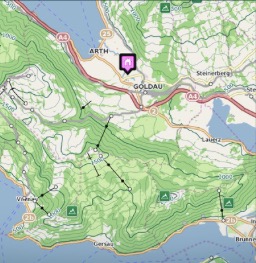
Pocket Earth

2016-10-27_12-29-31Our friends from another Antares, Echo, tipped us off on this great app.  When hiking or exploring new towns, it is nice to have maps but often you have no cell signal or lack a local sim card.  Pocket Earth has decent maps which we used in the Galapagos, Las Perlas Islands and French Polynesia.  Very helpful when lost on a hike and the sun starts to dip. Just remember to download the data for each country while you still have wifi.


Boat Maintenance

SIM Yamaha:  A simple app that helps in the ordering of parts for our reliable outboard.  Helps finding part numbers.  It is free so you might as well use it if you have a Yamaha.

Volvo Penta Dealer Locator:  Saves time when looking for a real Volvo dealer.  We are picky when we ask for professional help on our engines.  Only pros are allowed on board. It doesn’t have all the dealers, but it is a good start.

Boat Owners Mechanical and Electrical Manual by Nigel Calder:  Originally this book was made into an app but now it is for sale in e-book format.  I would prefer the hard copy but if you are low on space, at least travel with the e-book.
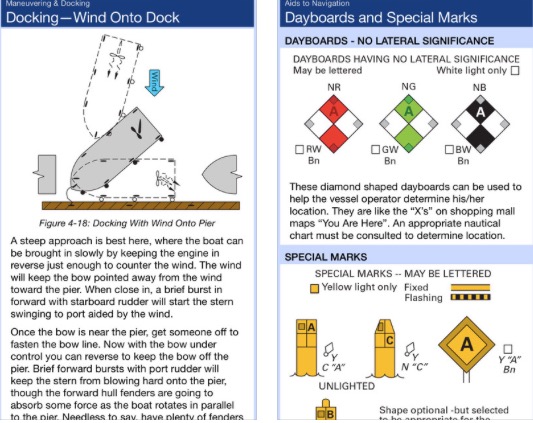
2016-10-28_13-28-44


Boater’s Pocket Reference is another book to app transformation.  It is good but I would hold off if you have a strong boat library on board already.

Travel
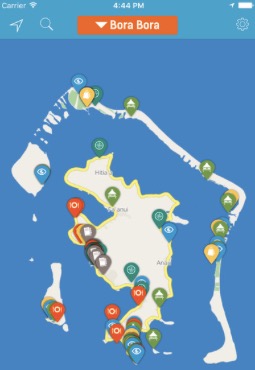
2016-10-28_14-03-27The Islands of Tahiti: Official Guide is a government sponsored ad for tourism.  If you travel to buy a T-shirt and go to Hard Rock this is the app for  you.  Else, stick with Soggy Paw’s compendiums.  They are much better and written by and for cruisers.  They are simple PDF’s but will enhance your Pacific crossing.



2016-10-28_15-08-03

Antoine in the Tuamotos Islands:  Antoine is “the famous singer / sailor in the yellow catamaran Bannana Split”.  I bought this app for comedic value but it fell short.  Again, stick with the compendiums.


Collins English French Dictionary  A French, Spanish and Portuguese dictionary have all been used on Two Fish.  I will never forget the word for garden hose in Spanish or thank you in Portuguese.  Looking foolish in foreign languages is one of the reasons I enjoy travel.

Sail Fiji is another travel app that is less useful than the Fiji compendium by Soggy Paws.  To make maters worse they charge you twice to buy the app for east and west.  Decent charts but not a great app for 60 bucks total.  Save the money and buy kava root and ask the locals where to go next.

Number Crunchers

2016-10-27_15-18-13


Boating Calcs:  Can’t track the formula for hull speed or working load? Want to understand the math behind heading to steer vs course made good?  This app will answer those questions and many more.  The app is better for ending disputes at the bar rather than a critical or practical app.  Not a must have but a fun to have.

Beaufort Wind Scale:Some weather forecasts only give “the wind will freshen to force 5”.  In many of the Commonwealth countries they use this terminology on the local news.  However, as NYers, this is a foreign language and this app is no more than a colorful cue card.  Plenty of other places contain this information, but this one is easy to access.
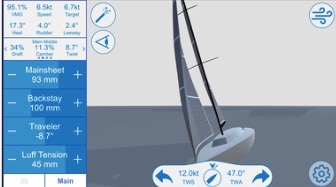
North Sailing Simulator

2016-10-27_15-30-06

You control all the sheets, vang and more on the classic J35 mono hull.  The app scores your set up.  Tweak again and you can get closer to 100%.  Give up and the app will show you the 100% setup.  Then try again with a different wind strength and angle.  The app is kind of useless for catamaran sailors.  Take a pass unless they add a cruising cat.


This is by no means a comprehensive list and wasn’t meant to be a complete research project. But, if you are short on time to search for the ultimate app, I hope this list gives you a good start so you can spend more of your time on the water.


Comments { 4 }

Roller Furler – How to keep it rolling

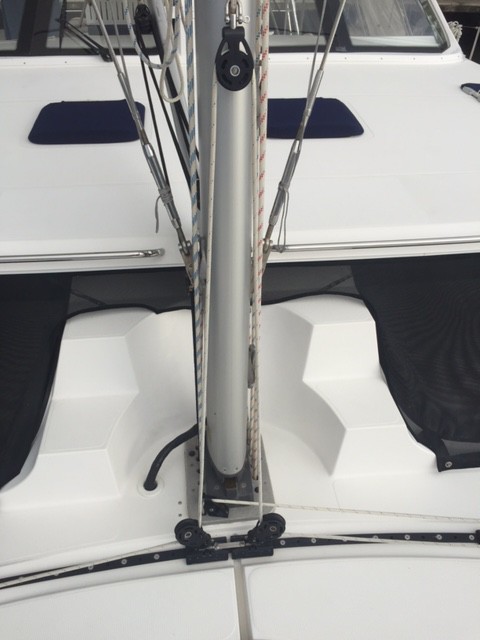
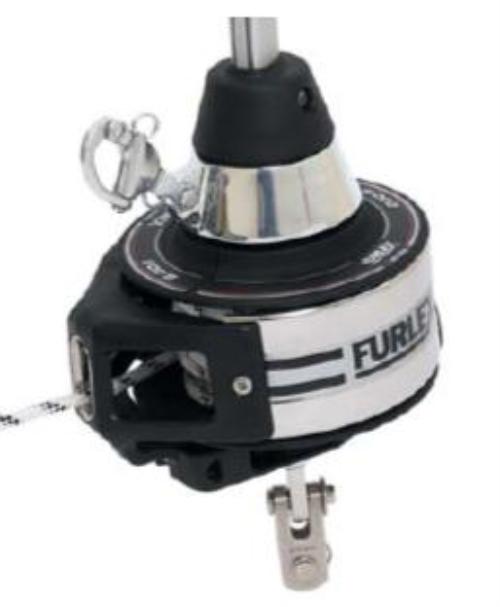
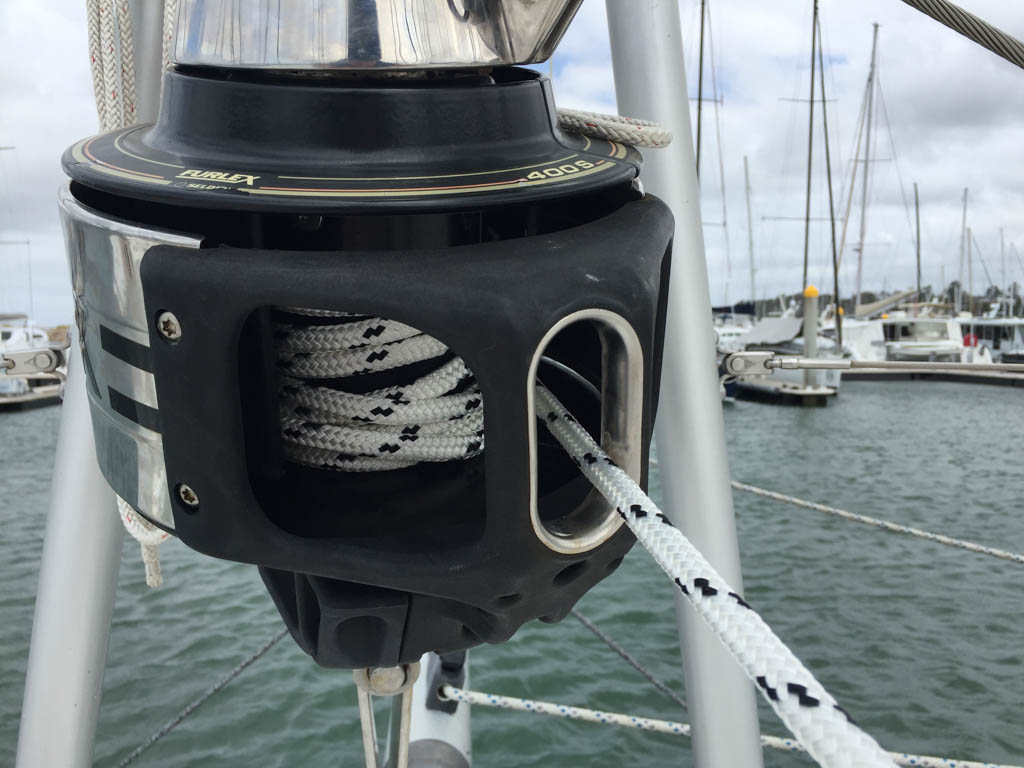
Two Fish has a Furlex brand furler to manage both the genoa and the rarely used jib. Furling headsails allows a single person to manage the sail plan safely from the confines of the cockpit. No clipping in and roaming the decks in the middle of the night. Gail can easily shorten sail when a threatening storm is detected as an orange blob on the radar.

It is the current fashion for boats to hide the furling mechanism below decks, resulting in a modern look. However, I would consider this a liability on a blue water cruiser. I want a bullet-proof, easy to access furler.

furl2-1-of-3

A genoa furler is a bit like a toothbrush, we have used one for years, but, are we using it correctly? Well, here comes a lesson but without novicaine.


  • When furling or reefing, head downwind.   The lower apparent wind reduces loads and is kinder on the furling apparatus. A power winch is strong enough to furl while sailing hard on the wind, but at some point it will break your furler. The bearings will seize when you are entering a windy marina or at some other inconvenient time.


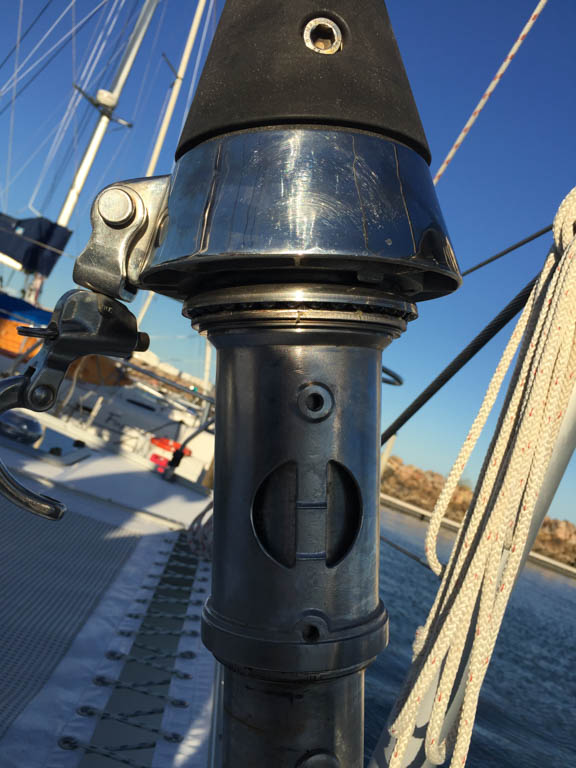
Aluminimum Foil Inside the aluminium furler foil is a traditional headstay. This wire holds up the mast, not the aluminum foil. The foil spins around the hidden wire headstay. The lower drum has to be attached to this foil to allow it to rotate. There are two large bolts at the top of the lower drum that are screwed into the foil. It is worth tightening these bolts to avoid having the drum come free and lose foil rotation. We experienced the wander bolts; not so much fun, so now we carry spares if any bolts go swimming.


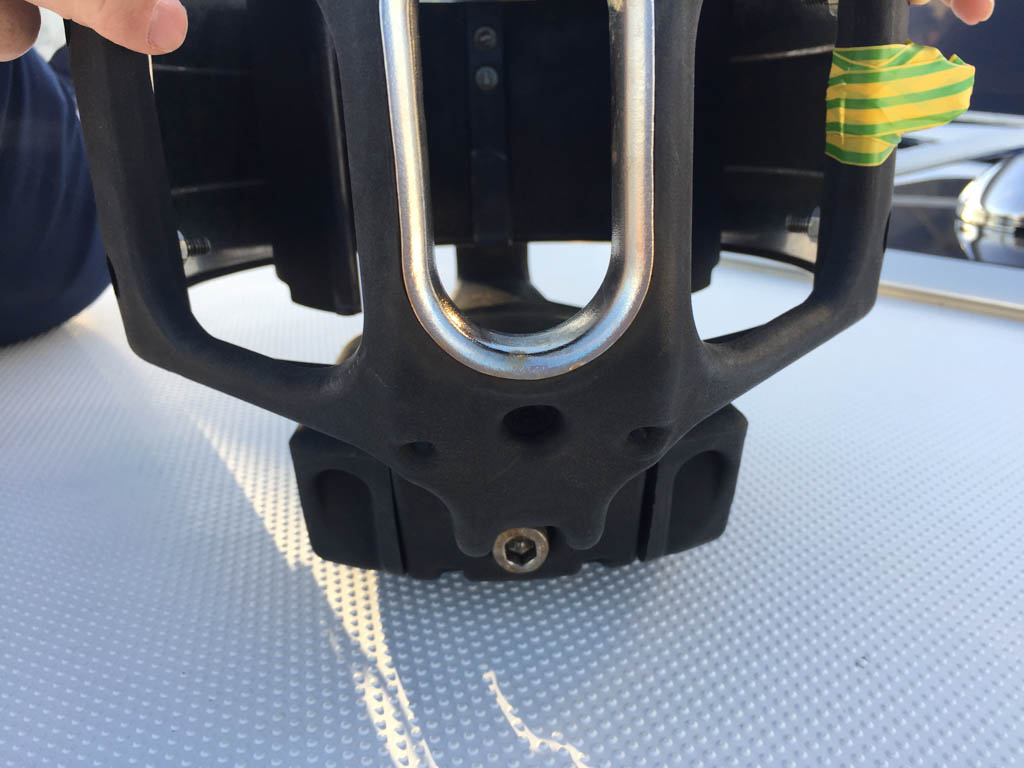
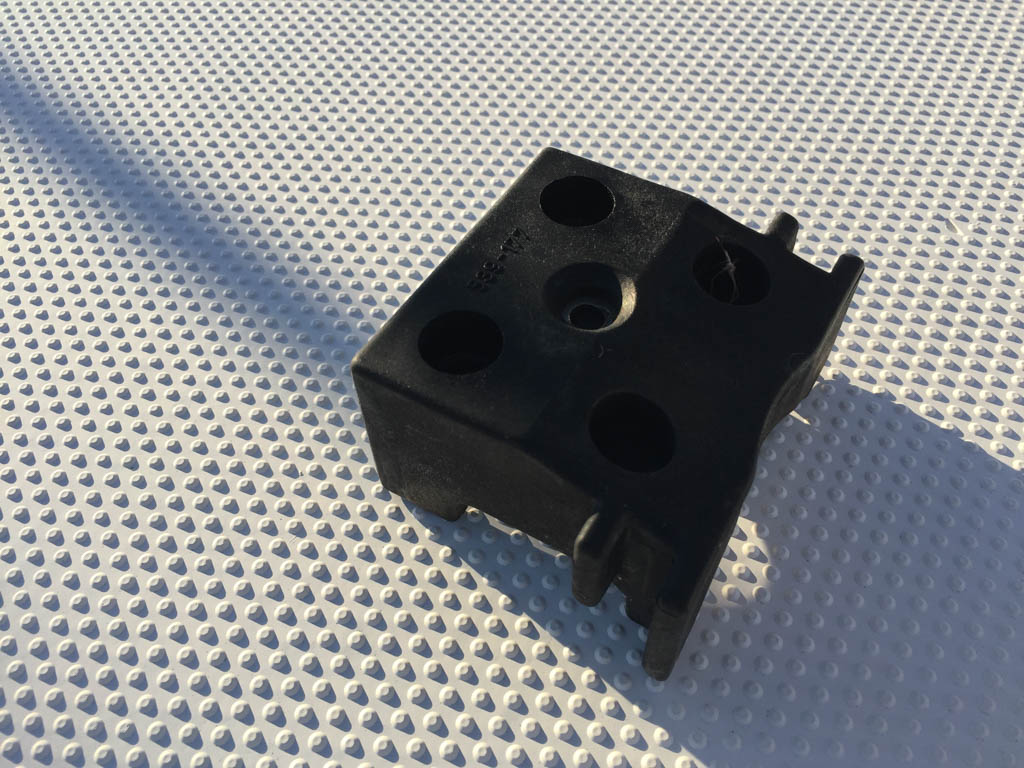
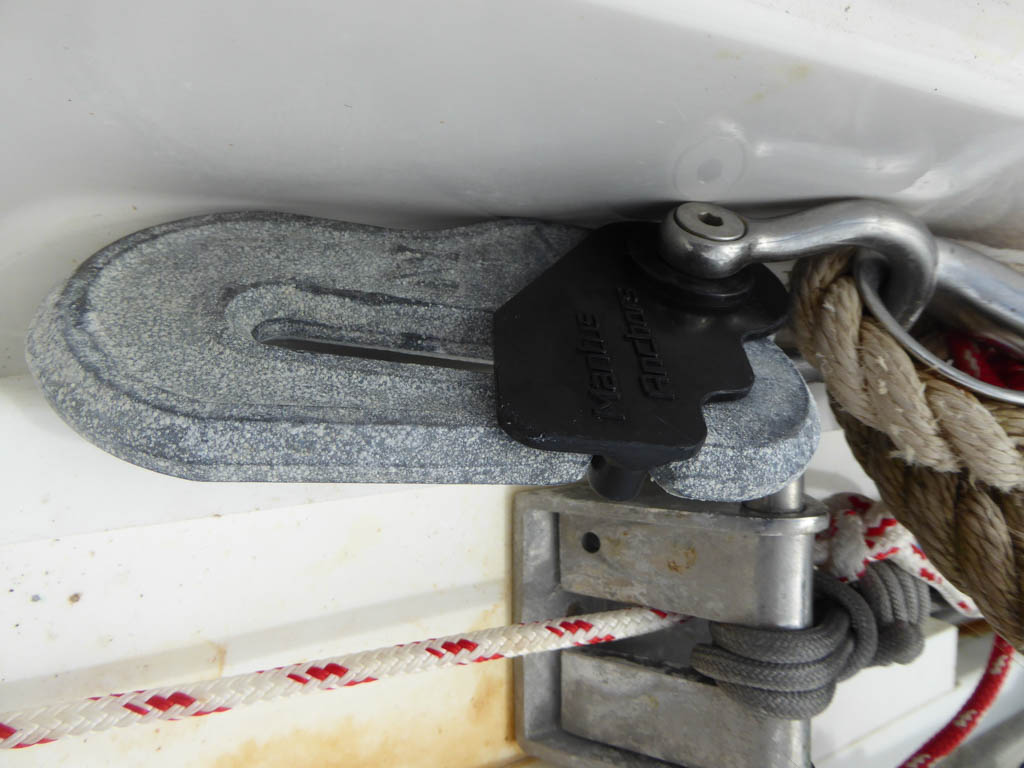
  • Another bolt to check is hidden under the drum. This bolt and plastic plate hold the entire drum in place. If this bolt is loose the furling line will come out but the drum will not spin. This bolt is shy and will only come loose on a dark stormy night so check it while the weather is fair.

furl-5-of-7

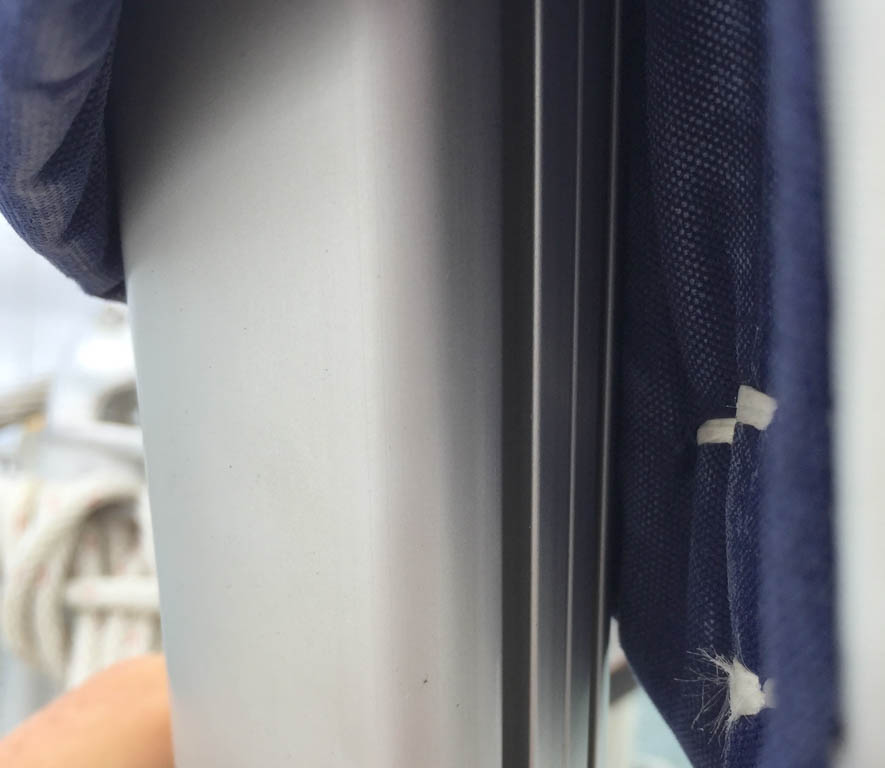
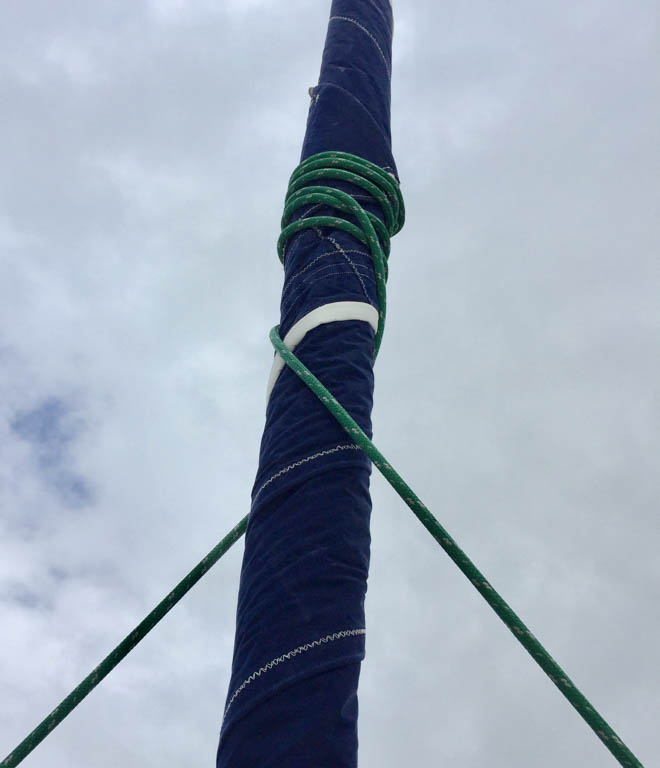
  • A sail can be furled clockwise or counter-clockwise but only one direction will have the UV protection showing.   Try the wrong way and your sail will look like a barber shop poll. The foil has two tracks. The manual suggests using the track opposite the sail’s first contact on the foil. It is not going to materially impact the furling if fed via the wrong track.

Two tracks in foil

  • When the sail is stowed, I like to have five wraps around the drum. Too few wraps and when you stow the sail under load you will run out of furling line.   We have avoided that horror show. Too many wraps and the jib will not fully deploy as the drum gets too full of line. I recently upgraded the furling line to a narrower 10 mm spectra so I may be able to carry more wraps and should have less friction in the furling system.
  • This should be rule #1. When furling and the winch sounds odd, STOP. Really STOP. Go look at sail, drum, furling line, sheet, halyard at the head and anything else. Then go look a second time. Your ears are not wrong; something needs to be fixed.   You can save time by holding down the electric winch button and after a few seconds you will hear something break. That later technique is more expensive, but is popular. Power winches are evil.   A halyard around the forestay coupled with a power winch can destroy the foil and place huge stress on the forestay. Now you seem very interested in knowing the causes of a wrapped halyard.   A loose halyard, poor greasing of the top drum or using a smaller sail without a pennant all can cause halyard wrap.
  • The distance from the halyard exiting the mast to the rotating drum should be less than 15 inches. This allows the halyard to be sloped towards the foil. If a smaller headsail is hoisted, the distance could be several feet and the foil and halyard will be almost parallel. This increases the chance of halyard wrap. To avoid this, attach a pennant to the sail. I prefer placing the pennant at the foot.
  • When stowing the sail, make the wraps neat so wind can not enter but not so tight that the sail is getting crushed.   However, when reefing the wraps should be tight to have a smaller and higher performance luff.

furl-1-of-1

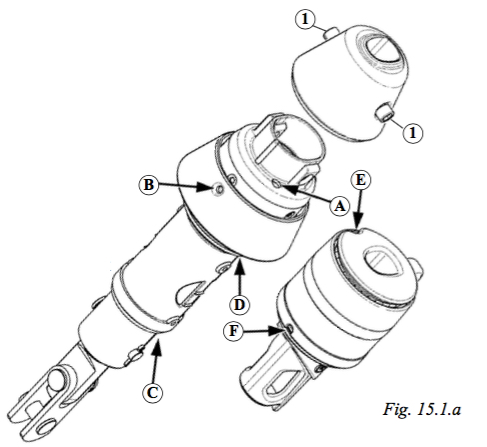
  • The following diagram from the manual shows grease points. To do this properly the lower furler must be taken apart.   Four screws detach the feeder from the drum. One bolt from the bottom plate. Wash with fresh water and use a brush on the four sets of ball bearings. Then use the Furlex provided grease. Reading the manual somewhere in this process may also be a good idea, as some furlers with durlon ball bearings hate grease. According to a few riggers, 90% of furlex failures are related to boats that have not greased either drum in 10 years. The top drum tends to fail first.

furler

  • Wow, who would have thought that there is so much to discuss on a very basic system? Halyard tension is used to reduce the draft on the sail. Only adjust the halyard with the sail fully deployed. (You knew that!) The trap with a catamaran is that there is a limit to the halyard tension. Since a catamaran lacks a back stay it is possible to add too much halyard.
  • To deploy the genoa should not require a herculean effort. Washing the line organizers or ensuring no twist is in the furling line could solve this problem.

A well-maintained furler and a thorough understanding of its mechanisms can reduce the number of unexpected issues and make a dark and stormy night less scary.


Comments { 1 }

Moving Parts

It has been a while since I have written a dry blog about Two Fish’s parts and set-up along with lots of numbers and photos.  I can not post many photos because my bandwidth is limited,  but I still can write long technical sentences to satisfy my mechanical friends.

Anchor Set-Up

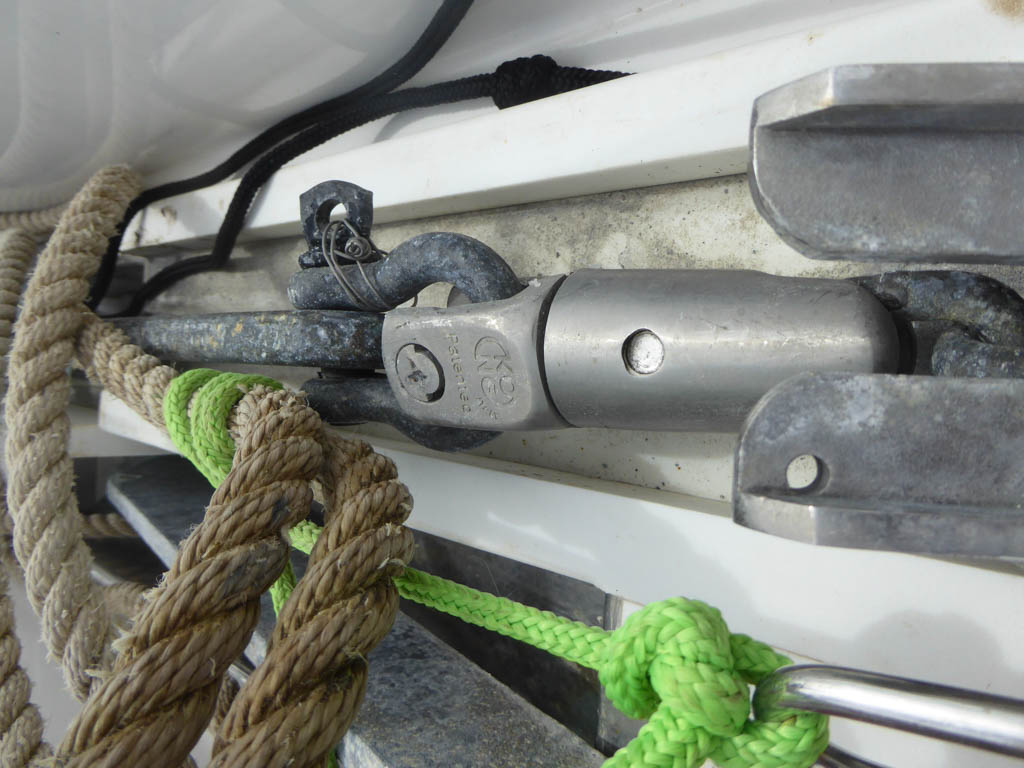
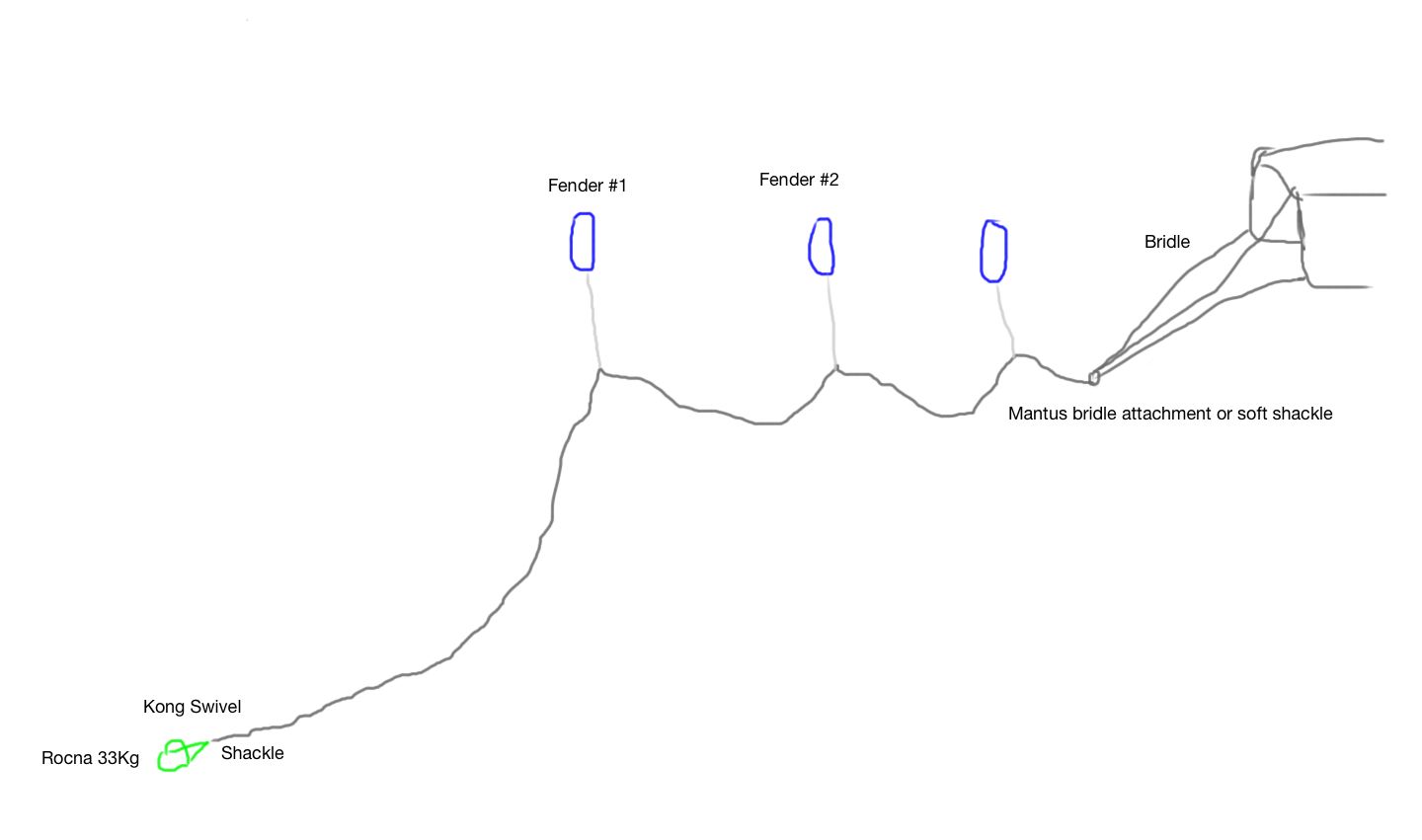
The boat came with an okay, but not perfect rode for our needs.  We upgraded the system for the Pacific with the goal of being able to anchor in 30 meters with 5 to 1 scope.  We have already anchored in 26 meters.  The old set-up was 35 meters of chain and 30 meters of nylon rode.  The new set-up is 70 meters of chain and 80 meters of nylon rode.  The old chain was unrated, unstamped, heavy but not strong.  Our new chain,  G43 5/16th (WLL 3,900 pounds, 8 mm), received the highest rating from Practical Sailor.  By the foot, it is lighter and stronger than the old chain; this keeps weight out of the bow.  Our anchor is a 33 kg Rocna and we worship at the Rocna altar as it has done a good job of resetting in shifty breezes and swift changing tidal currents. Attached to the anchor we have a Kong anchor swivel, another upgrade from the Antares standard.  It allows twist to come out of the chain when weighing anchor but some consider this a weak point.  Our Kong is rated for more load than the chain and is also tested for horizontal load.  We have a large shackle after the swivel to prevent horizontal loads on the swivel that occur when the chain moves to the side of the anchor . The shackle is stamped and rated number one by Practical Sailor magazine (1/2 inch Titan WLL=4,000 pound).  The shackle is moused with Monel wire.  Next is the chain and then the nylon rode.  To accommodate the smaller but stronger chain we had to change the gypsy on our windlass from a 10mm to an 8mm gypsy.  This size gypsy has the added benefit that it can handle 3/8′ nylon rode much better than the larger 10mm gypsy.

We sleep very well at night on this combination and check the gear regularly.

Floating the rode

float anchor

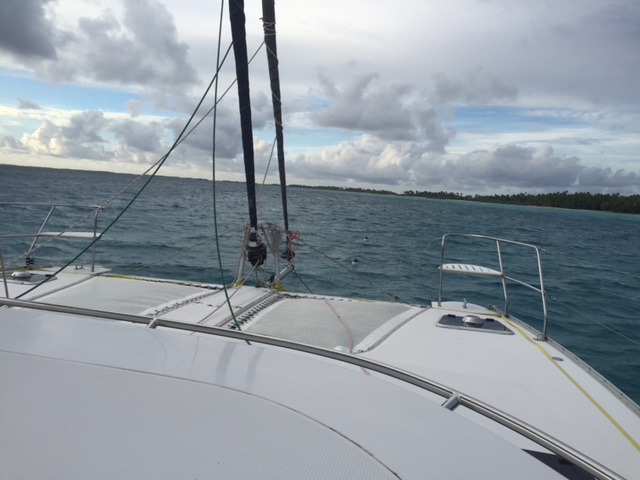
In a  typical Caribbean anchorage there are vast areas of sand.  The cruising guide will warn that a portion of the bay has coral, but that is usually broken shards of coral with a few tiny heads.  In the Tuamotus, the bottom can be 70 or 80 percent coral.  To anchor, you need to hover over a small spot of sand and then drop the anchor with precision.   We add fenders to float the chain to protect the coral and avoid major fouling of our chain.  We put our first fender at about 1.5 to 2 times the depth we are anchoring in.  Thereafter, we add fenders every 10 meters.  We tie the fenders on before launching the chain and retrieve them as they come up with the chain.  A strong line for attaching the fenders will help support the large weight of the chain.  Divers will find it close to impossible to adjust the fenders after deployment.  The system works well, but not perfectly.   I enjoy standing on the foredeck to see whether my chain has hooked a coral head.  If all is okay, the fenders will be floating in a line. However, if a few fenders are submerged, all is not well with the chain.  If this occurs, either with the engines or a swimmer we will try to fix the fouling.  One time we were too slow, and a fender was gashed by the coral.   In light air this rig can get confused.  Look closely and you can see the fenders floating in front of Two Fish in the photo below.

Floating the chain

Pros:  Good for coral.  Less likelihood of wrapping around coral heads.

Cons:  In a big blow, I would rather be in a place with less coral so that the angle of my rode will not be altered by the floating fenders.

Stern Anchors

I will cut to the chase.  I hate stern anchors but concede that they are useful in certain situations. My hatred of stern anchors is driven by three issues 1) they undermine the bow anchor by preventing the boat from pointing head to wind  2)  the rode leading to the stern anchor can bend stern hand rails or, worse, catch the dinghy propeller, and,  3) I struggle with the deployment and retrieval.

Point number one can be addressed by using the stern anchor in places where the breeze is unlikely to be strong or shifty.  Point number two could be fixed by adding two large U bolts to the inside of the sugar scoops at the stern.  This would copy the bow bridle and eliminate any chance of the rode fouling parts of the boat.  My final short coming could be addressed, like most of my fears, by more practice.

Unlike the bow bridle, the stern bridle needs to be easily adjustable.  With the bow bridle, one can not raise or lower a bit of chain without first detaching the bridle.  To change the main rode length we first raise 6 meters of rode, detach the bridle, adjust rode length, reattach the bridle, and then ease out 6 meters of chain.  This would not work for a stern anchor since the strategy is usually to tighten the stern anchor to keep the boat from swaying.  Instead a system has been created by clever boaters to have the rode (small amount of chain but mostly nylon) attach to the starboard stern cleat.  To keep the rode centered in cross winds a second line that is tied to the port stern cleat is attached to the main rode with a carabiner.  Clear as mud?  I noticed American boats are not as well prepared for stern anchoring as European boats.

Grease the Propeller

Dedicated readers will remember the excitement we experienced when we ran low on propellor grease in Connecticut.   Hoping to avoid another loss of control I decided to grease the props early and often.

Here are the steps I take to add grease underwater.

1)  Prepare grease gun, hex wrench, new screws and grease nipple.

2)  Remove existing grease point screws.  Keeping your propellors clean of barnacles with help in this process.  A wire brush might be required to expose the screw.

3)  Carefully screw grease nipple into one side and leave other side open.

4)  Attach grease gun.  Hold connection firmly.  For every 3 handle clicks rotate the propellor blades three times.  This spreads out the grease.  Stop inserting grease when old grease comes out the open hole.

5)  Remove nipple and replace screws with new screws.  Spend the two bucks on new screws and avoid stripping a very annoying screw.  Job done.

I like the challenge of working under water and Gail likes the fact she can not hear me swear.  During this job three sharks swam by and had no interest.  One remora kept attaching to my leg.  Despite many threats, the fish would not leave.

Genset Temps

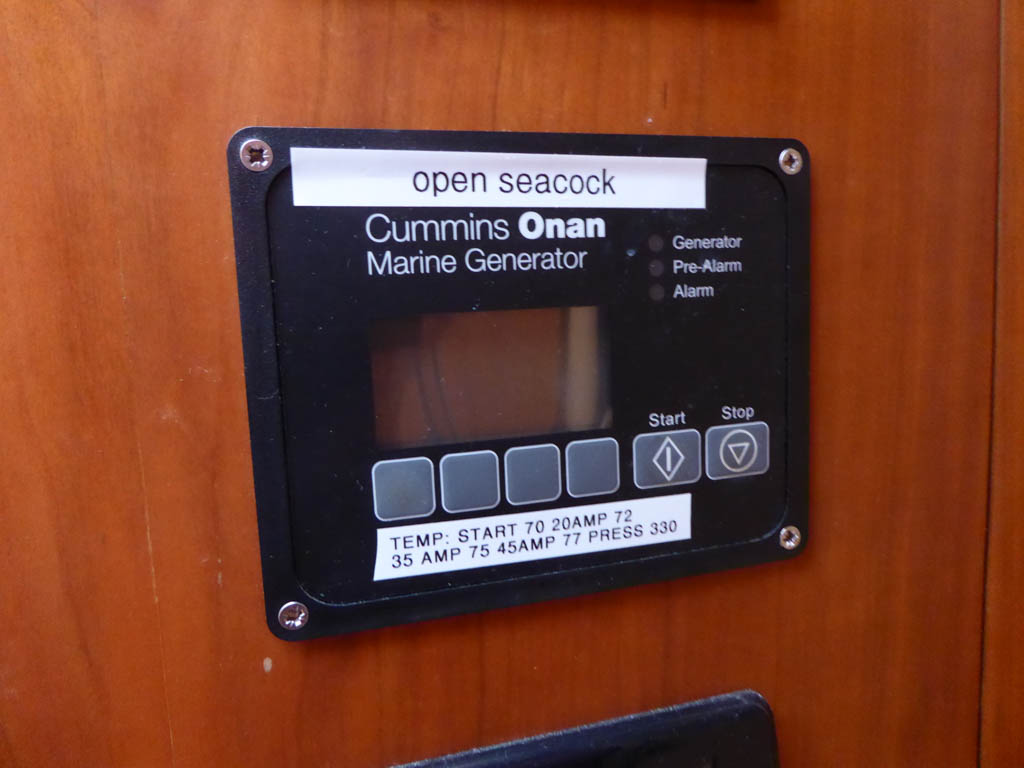
Genset Operation Pad

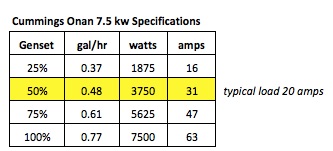
The Onan genset has a reputation for eating impeller blades.  In order to monitor the impeller I track the coolant temparture by Genset load.

No Load (start up):   70 degrees

20 amps:   72 degrees

35 amps:   75 degrees

45 amps:   77 degrees

The temp can vary with sea temp, but hot coolant is a sign that it is time to check the impeller.  This requires a bit of effort but after the first few times the process becomes second hand.  I remove the hoses and check the heat exchanger for the blades while Gail systematically reconstructs the impeller on the salon table.  Good spares for the genset are  (gasket for the heat exchanger, spare water pump and spare water flow sensor).   Friends with the same genset have had all of these fail.   We are replacing the gasket and pump as preventive maintaince next week.

Genset in search of blades

Continuing the topic of the Genset, I recently changed the oil and had another reason to curse the Onan engineers.  The oil cap is located in a very annoying spot and the side panel is very difficult to remove.  What were these guys thinking?  A bit of Two Fish ingenuity and the oil filter was removed.

Self-tacking Jib

IMG_2265

We have been asked whether the self tacking jib is a must-have on a new Antares.  We have sailed with the jib very little but have realised that is a a very powerful tackle.  I mentioned previously that the sheet for the self-tacking jib can be used as a back up anchor windlass.  Two more ideas have come to mind  1)  adjuster for the spinaker tack line, and,  2)  adjuster to fly the tack from a windward hull.   If on the fence, on buying the self-tacker, the flexiblity of having a powerful line on the bow might tip you in favor of buying the rig.

Dive Compressor

Dive compressor

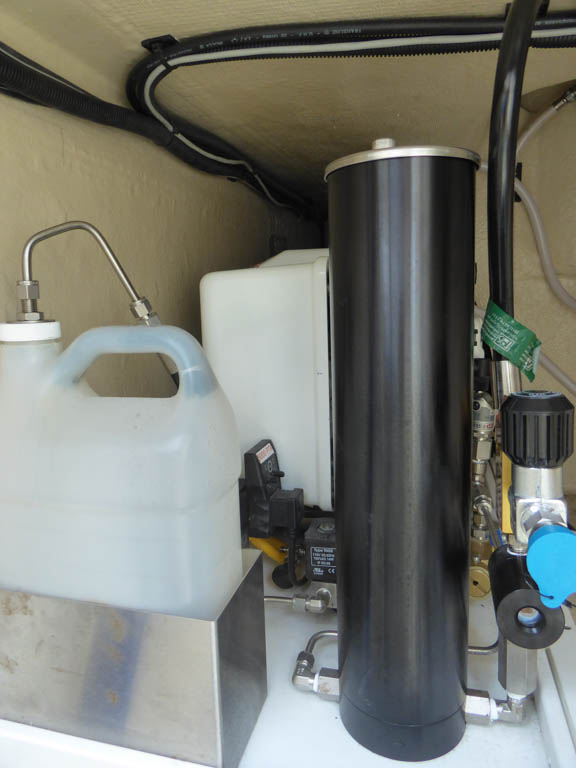
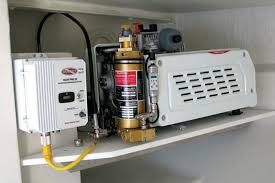
What a joy it is to have a dive compressor.  I dove multiple times a day and refilled with the on board compressor. Only a few atolls have dive shops and they are not always willing to fill tanks.  We sailed thousands of miles to be with the fishes and the dive compressor made it all happen.  The compressor can fill up to 4 tanks at a time and turns off automatically.  The tanks are easy to access since there is space in the rope lockers and the fill is located on deck, making filling easy.

Bilge pump


IMG_2262

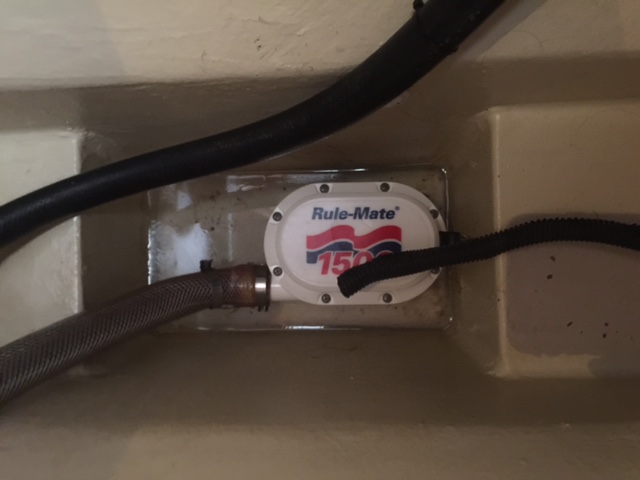
The bilge pump is key safety gear item on any boat.  Whenever we have a hose, I test the pump by washing the bilge and allowing the pump to remove the water.  Recently, the starboard bilge would only work in manual mode, even after a thorough cleaning.  Before replacing the pump, we rewired the electricty for the sensor but still the pump was not working correctly.   A quick shout to Gail and a new pump appeared.  We cut the wires at the blunt splice and spliced in the new pump.  I am new to splicing but here are a few take aways.  Have a great splicing tool and a sharp wire cutter.  Have a variety of blunt connectors.  It is common that the gauge on the two sides might not match.  Finally, buy the deluxe blunt connectors that have the heat shrink preinstalled.  This will make the connection much stronger and keep it dry.  Splices done by soldering seem to be much weaker.  The best connection is by a bus bar, but this would not have been appropriate for this application.
Starter Batteries

IMG_2264

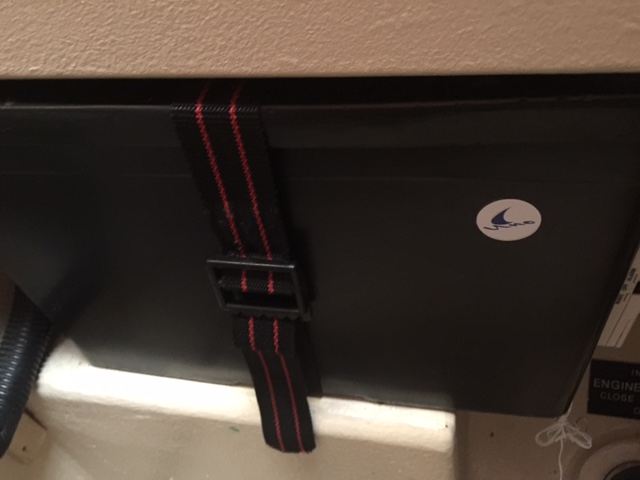
Our boat has a very clever but sometimes complex (for me) battery switch system.  Instead of the old switch where you can select house or starter or both, it does the work automatically.   I find automatically safe but only if you understand how it works.  Imagine that the starter battery is an island.  Between the island and the house system is a combiner which joins the starter battery to the system when it will receive a beneficial charge (solar, engine alternator or genset); it will disengage the battery when there is a load.  This protects the battery, but hides its condition.  If you start the engine on a sunny day the solar power will show that the batteries are in great shape.  The only proper way to gauge the battery’s status is to isolate the battery for a few hours and then test the voltage or, better yet go to an auto store to have the battery bench tested.  The Tuamotus did not have auto parts stores so I tried the former and my starter batteries indicated that they needed to be replaced.  I decided to pre-order some batteries in Tahiti and during my visit to the Tuamotus, I used the genset to start the engines.  Very easy trick when necessary.  Start the genset on its separate starter battery.  Ensure battery combiners are engaged and genset is producing 12 volts.  Check engine starter batteries for a voltage in excess of 13 volts.  Start engines.  Turn off genset.   If one engine is already running, then no genset is required as the alternator on the running engine will start the other engine.

The ten minute job of installing the new batteries took much longer since the positive terminal did not fit the post, the battery was too high and the strap got stuck.   After a few hours the job was done and now the engines start up instantly.  Good to replace stuff early.

Comments { 4 }

Dreaming of a Dry Bilge

A bone dry bilge is my dream and here is what I have learned:

1). Bilge pump cycles on and off.
Few things are less comforting during a night passage than having the bilge pump turn on and off. Up come the floor boards with no conclusive evidence of imminent sinking. The only real cure is to make the water collection pit bigger. Here is my logic. The pump fails to send the last bit of water overboard. This last bit is the amount from the pump to the loop of the loop. Let’s say that is a liter. The liter then returns to the tiny bilge box and becomes a centimeter of water. This volume of water confuses the trigger and restarts the pumping process. Add a bit of a rolly boat and you have an endless loop. Now imagine a much bigger box and the liter of water is only a film. I am not ready to start cutting but this would be a great solution. Newer boats have larger boxes. Lucky ducks.

2. Transmission oil cooler (Volvo feature)

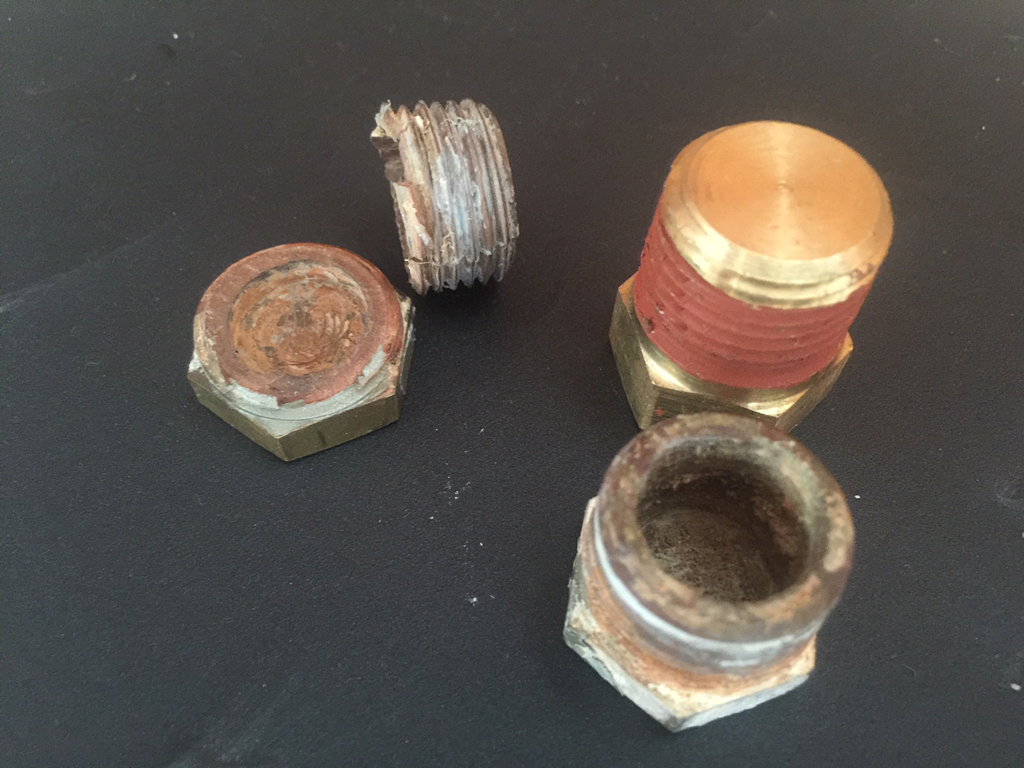
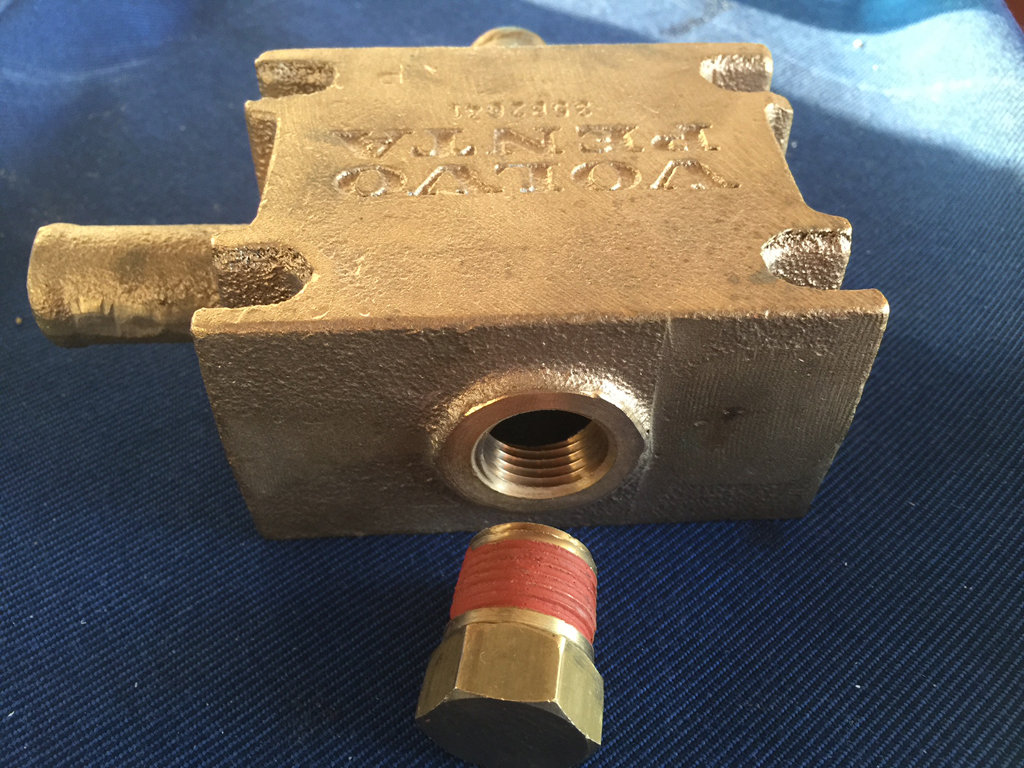
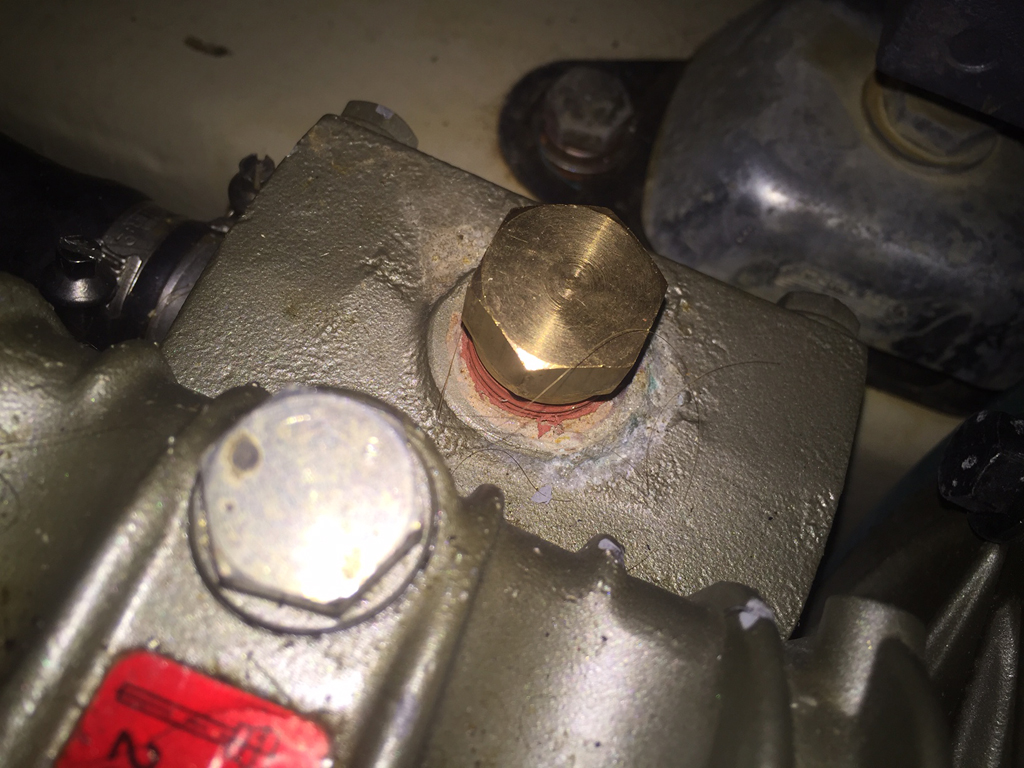
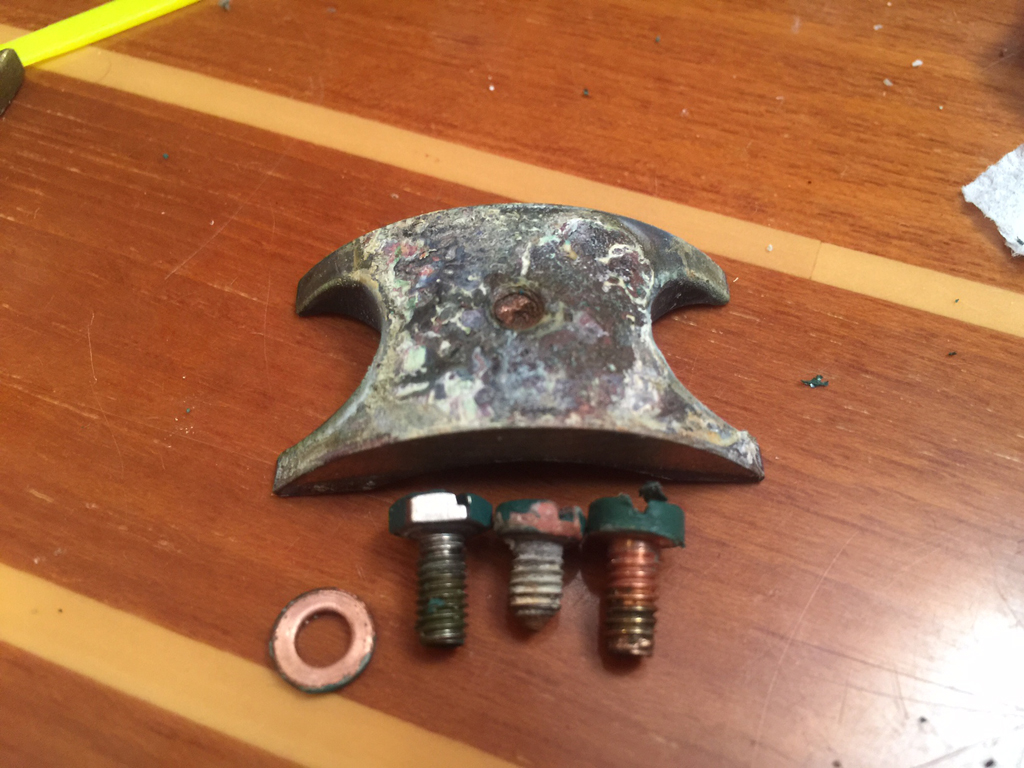
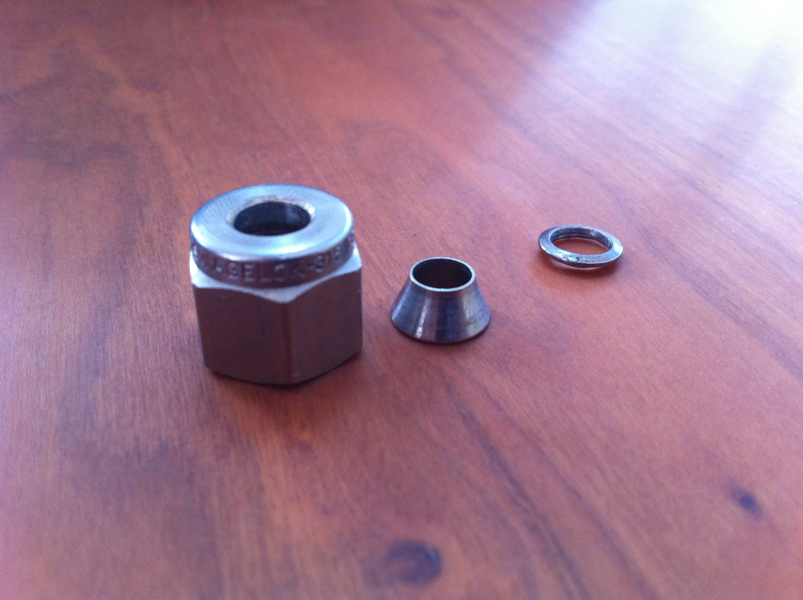
The first photo is of a broken plug, a spent plug and a new plug.  After two happy years, my plugs were dead. Too many marinas? The Volvo engines do not have zincs. So parts can get gobbled. My plugs on both engines were leaking slowly;  this could have resulted in  a dramatic fail, as it would open a fairly large hole in the raw water loop.

I am considering installing a plug that has a screw-in zinc. I found one in St Lucia, but want to email Volvo first.
While on the topic of oil coolers. Mine were both cast poorly and I will swap them out at some point. The output hole is blocked partially from original production. Volvo you are lazy.

3. Hot heater overflow water valves.

Pressure relief Valve routing

Pressure relief valve routing

After giving up on the Quick Water Heater support desk, I followed the advice of the

water routed back to tank

water routed back to tank

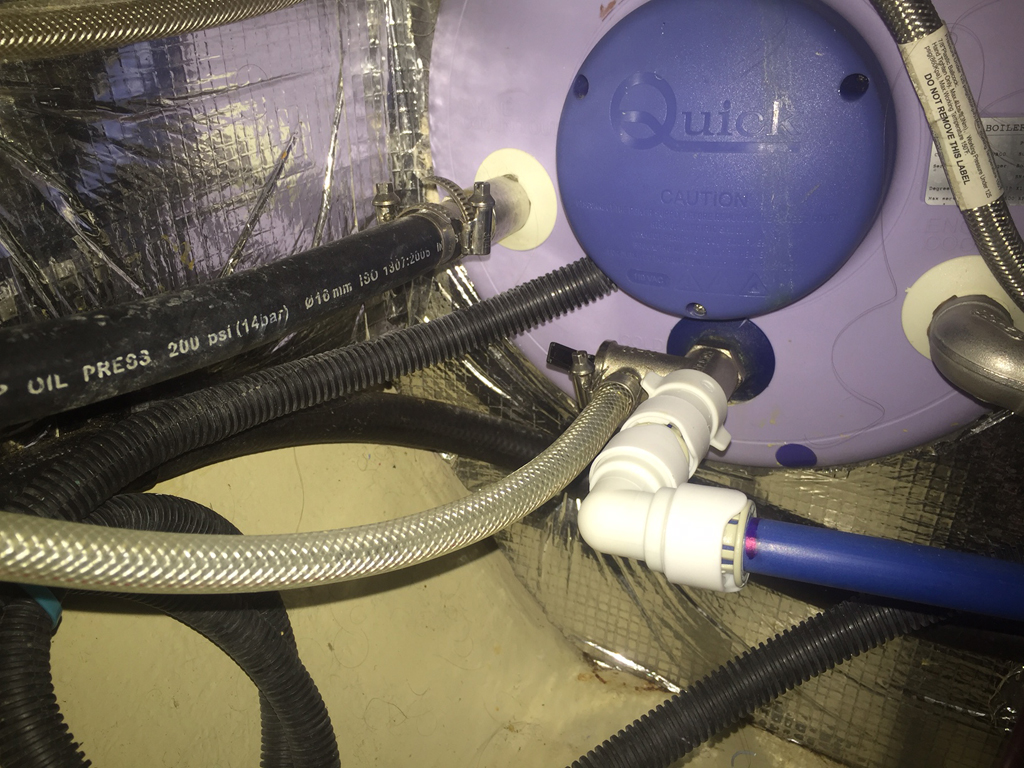
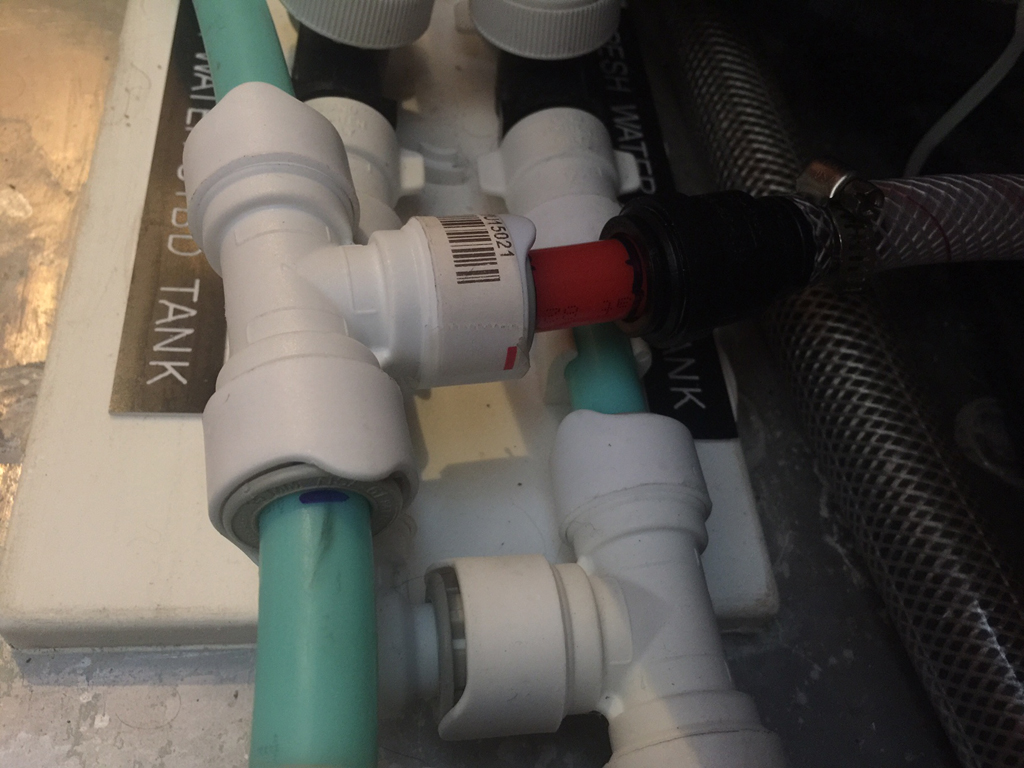
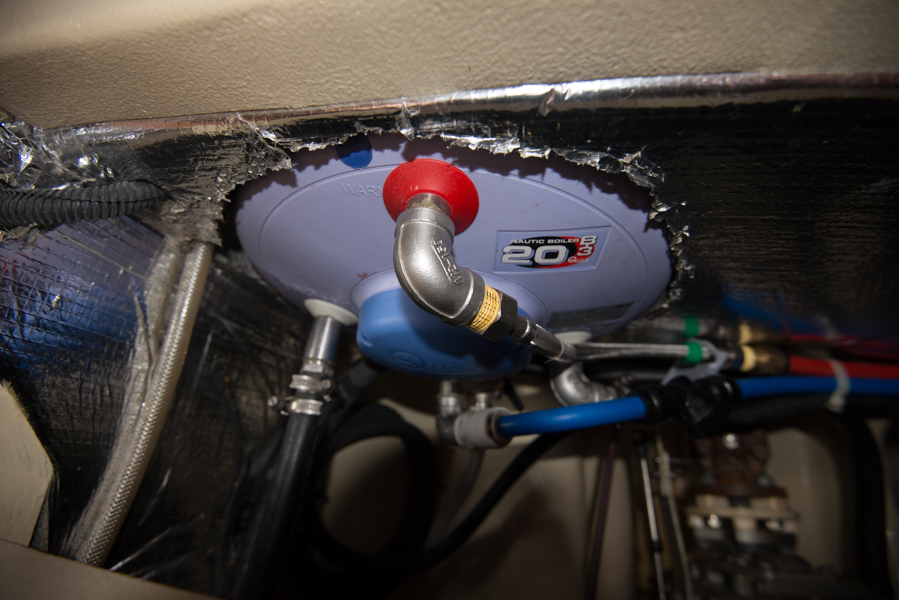
forum (thanks Paul and Jeff). My pressure relief valves are now putting water back into the tank. I am very happy about this as we were losing quite a lot of fresh water to the bilge. I still need to track down weather our hot water heaters have zincs. The photos show the install. 1/4 inch hose most of the way and then a barb to convert to 15mm NPT and then joined at the water maker tank inlet hose. Not too tough, but it makes me wonder why I have hot water heaters. If you need them, you are too far north. Okay, clean dishes are nice. Most of my bilge water was from the hot water heater but I was still on patrol.

4. Cam screw on raw water pump.
Dissimilar metals are hell. I found a small leak from the raw water pump. It was not from the face plate or the hose, but from a screw on the

water pump cam

water pump cam

raw water pump

raw water pump

side of the pump that holds the cam. This screw had been eaten by stray electrons in only 9 months. Turns out my new pumps that were all covered in sexy green Volvo paint hid the fact that Volvo did

not use a brass screw. It was eaten and started to leak. The screw broke off in the cam so I used the perfectly good cam from my old pump. Brass screw spares are on order.   By the way Volvo will no longer sell the cam separately. I assume it was hurting pump sales?
You can see I have the speed seals as impeller covers. Still like them. As a safety measure, we cut off an inch of the hose attached to the feeder side of the pump to have a cleaner fit.

5. Clean the shaft

Shaft Seal

Shaft Seal

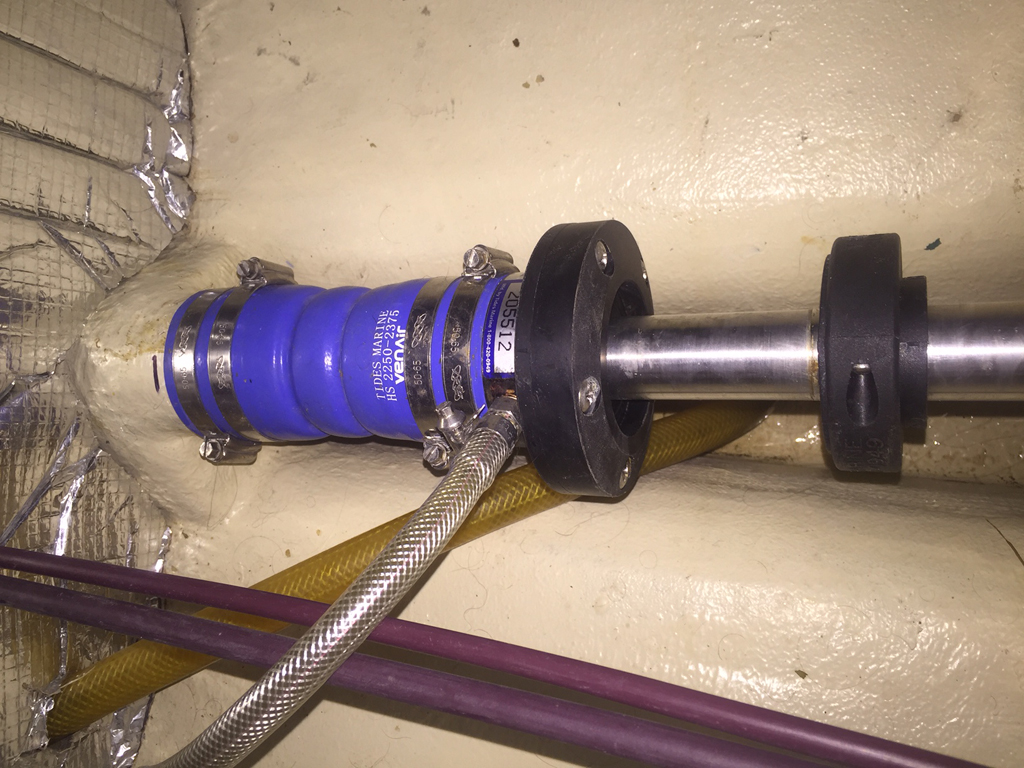
Underneath the elephant nose (aka Tides Marine Shaft Seal) is a home to hearty sea creatures. With the bilge pump on, we removed the black ring and pushed back the baffle revealing some barnacles. Wet sanded them off and new shaft ready for another 1000 hours of dry bilges. Also moved the entire unit forward a centimeter to have the lip seal touch at a new point of the shaft. Our shaft alignment is good, so the seals are in good shape. The second black ring is our back-up seal that allows for changing at sea with shaft removal.


6. Leaky head solenoid.
The solenoid has a small anti siphon loop that was leaking. Swapped it out for new and no more drips.

7. Years ago we had a leaky sump from the shower, but this has been fixed.

As Two Fish is a catamaran, we got to do most of the jobs twice.

As for my other bilge dripper, the air conditioning condensation, we will be on anchor more from now on, so this should not be an issue.

And so completes the tale of my dry bilge experiences to date. One can only hope it works.


Comments { 0 }

Fuel Management

Our last two major cruises were motoring on the ICW (InterCoastal Waterway) and sailing along the Caribbean chain.  On the ICW, diesel is easier to find than a NYC Bagel.   During our 6 months sailing south in the West Indies we used the engines for fewer than 40 hours.  In both cases, fuel plans were not needed.

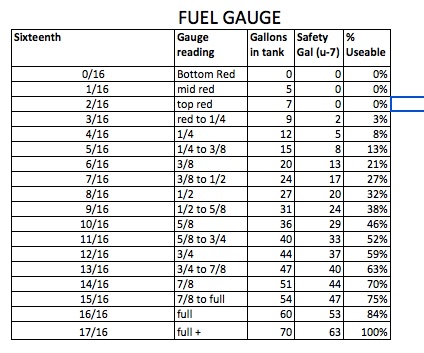
Our next adventures will involve long distances (3,000 miles from the Galapagos  to the Marquesas), no or unreliable quality diesel (Tuamotos) and possibly light air (Bay of Panama).   As is my usual habit when solving problems, I created a spreadsheet to investigate further.

Fuel gauges vary in their accuracy.  I have heard that air pressure gauges and electrical sound gauges are very accurate.  We have traditional WEMA float gauges, which offer a suggestion of the amount of fuel in the tank rather than a definitive statement.   Also, we never push it close to empty to ensure that the engine does not suck in bottom-of-the tank gunk.   I should have more faith in my multiple fuel filters.

fuel gauge

Conservatively, (7 gallons in reserve) we have 63 gallons of diesel capacity in each tank.   The builder claims 75 gallons; that may be correct if you draw out the last ounce of diesel.

At anchor, Two Fish’s batteries require very little charging since the solar panels cover the lights and other anchor based consumption.   We tend to run the genset every 3 days for about 1.5 hours.   However, during passage our consumption skyrockets.   The solar produces 20 -30 amps for the sunny parts of the day, but the boat relentlessly consumes 21 amps every hour, whether the sun is up or down.  8 amps for the fridge and freezer, 7 amps for the navigation screen, 4 amps for the beefy autopilot and radar; other assorted bits fill in the balance.

Onan consumption

Two Fish and other Antares boats will run their genset for 2.5 hours a day when on a 100% multiday sailing passage.   To reduce the hours, I purchased a Watt & Sea hydro generator.   It looks like a rudder from a sailing dinghy with a propeller attached.   So far, the results have been okay. It is too early for a final verdict.   The boat does not seem to travel any slower with the hydro on, so it is kind of free energy.   The marketing materials are rather optimistic.   The hydro can be fitted with 3 different size propellers.   We fitted the largest size. It produces in the real world what the marketing gurus say is the medium size propeller’s amps.  At six knots (a speed we exceed most of the time) the hydro can produce between 5 and 10 amps.   This is a game changer as it replaces 1.5 to 3 hours of genset time.   We might only need the genset for the watermaker!   The hydro will produce almost no energy at 4 knots and at 12 knots it cuts out.

Genset Usage

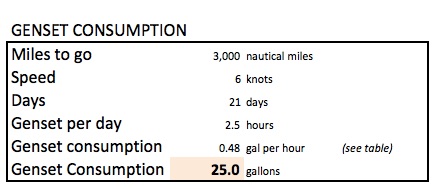
This is the plan for our 3,000 mile leg, assuming no hydro amps.   Without any type of rationing, assuming a 21 day passage, we would consume 25 gallons, or 20% of our fuel by running the 2.5 hour top-up.   All hail hydro.

Volvo Consumption

When the wind becomes light the engine typically fills in for the loss in speed  but on a long passage you have to ration your fuel.

Fuel Capacity

What is the magic number of jerry cans to carry?   8 cans can fit nicely in the cockpit locker.  I like to keep the weight out of the bow and stern and this has proven a convenient location when they need to be accessed.   If 8 cans is not enough then tying extra cans under the cockpit table.  They are not too annoying for folks sitting at the table and can be secured well with a few lines.   It is a large boat and there are plenty of places to hide cans.  I once put 17 cans on Two Fish and she does not sail well with that much weight.  The waves are more uncomfortable and the performance is ruined.   However, 8 cans and I did not notice any change.

Motoring Range

Our usual one engine, 2200 rpm motoring speed burns .8 gallon/hour has a range of 775.5 nautical miles.   That is  conservative since we give no credit for the hydro generator, no bonus for motor sailing, and reduce speed by 20 percent for bad waves and wind.   More realistically, over 1,000 miles is possible.  In an emergency that number could double if you sacrificed speed and ran the engines at lower rpms.

I need to end this post before I become a motor boat head. Our new screecher headsail should power us up better than the engines. Next post should be about sail trim?

Comments { 4 }

Just Three Bolts


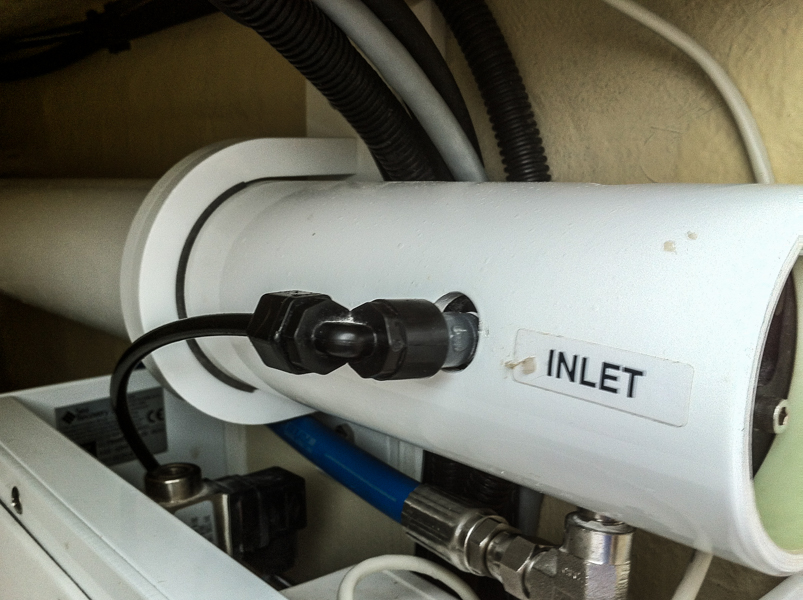
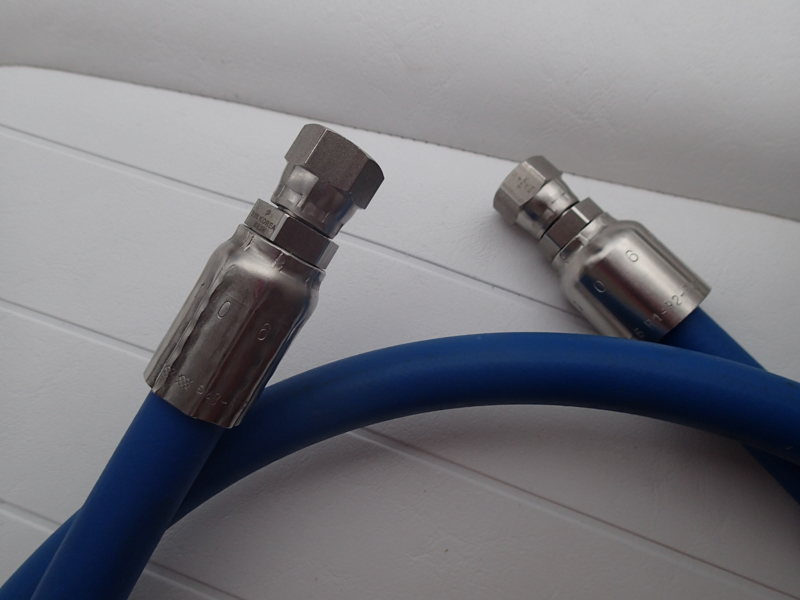
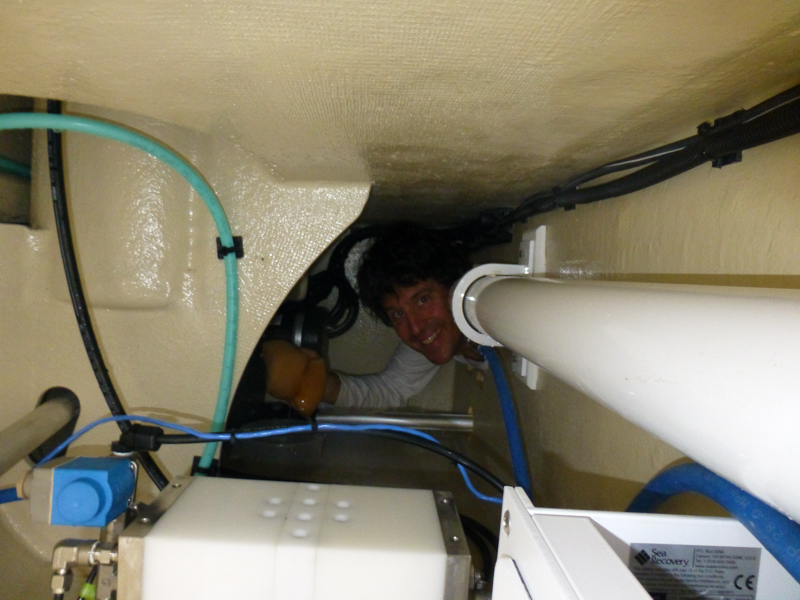
“Just remove the three bolts on the cap and drop in the new membrane” said the Sea Recovery representative last month at the boat shot when asked about the process for replacing the membrane. With no written instructions, because they do not exist, we decided to charge ahead with installing our new membrane. 10 minutes into the job we were flummoxed because the end cap would not come off. We took photos and surfed the web for a solution, which is our usual response to any boat problem. I hope I never have to google “what to do when a axe murderer boards your boat”. Stumped by the stuck end cap we called Beard Marine, seller of our membrane, and they talked me through the next steps. Take a random screw in your collection and screw it into the membrane cap. Then, pull hard on the screw with plyers and swear many times. The second part I added, but it seems to help a bunch. Oops, the cap won’t slide any farther because I need to remove the high pressure inlet and the pressure sensor. This maneuver requires adept manipulation of your wrench and more swearing. Victory was declared as the cap slid out and the membrane followed. Half-way done or half-way to hell. The membrane is about 3 feet long and the locker does not have enough space for the membrane removal. I rerouted some wires for more space but it was still not enough. I then removed the bracket holding the membrane and with Gail’s help the membrane was freed. Many high fives and confirmations that we are luminaries of the boating industry.
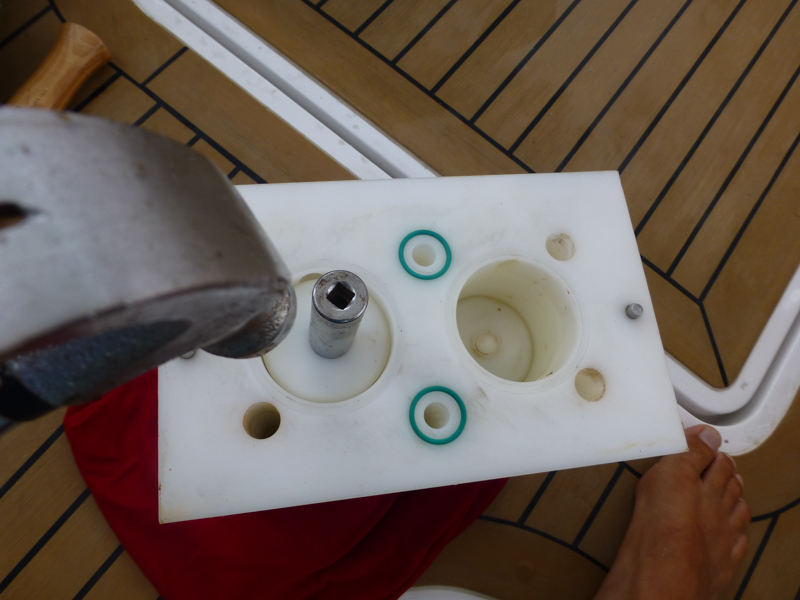
Our hubris was heard by the boat gods and failure came quickly. We had forgotten the orientation of the membrane but a quick call to the folks at Beard Marine again got us back on track. This was phone call number two; I hoped they were not counting. To aid the insertion of the membrane we removed the rack that holds the emergency tiller and snuck the membrane into position. More self congratulation and immediate punishment. The cap would not slide all the way back in. Hammer. Hammer Harder. Hammer harder. Swear. Have a time out.
I then realized that my hammering has misaligned the bracket holding the membrane. Despair lasts for a short time as fixing this was only a 15 minute road bump.
I did not want to hammer too much harder since the membrane is a pricey boat part. So I decided, with Gail’s approval, that removing the output side’s end cap would allow inspection of any hazard preventing the reseating of the membrane. The output cap is located in a mandatory advanced boat yoga location. I gave up on the double pretzel but Gail removed the output hose and moved the end cap back.
Will this ever end? I should have never started this project. But just as quick as hell came it left. I changed hammers to a rubber mallet and the end cap cooperated. I still have fears until I test the work as the input and output hoses are not screwed in but fit into the end caps with o-rings. I think a third called to Beard Marine is warranted before the big test during the sail up Island.

Comments { 5 }

Vendor Review

Two Fish has needed a few fixes and we have performed many upgrades over the past two years.   Here is how we rank the subsystems’ providers after-sales support.  This is not a representative poll so we would like to hear from others on their experiences with marine manufacturers.

Harken (winches, blocks, main sail cars)

Harken

Harken

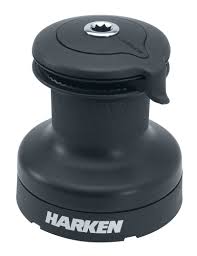
We had a bent stripper and damaged jaws in the early days of Two Fish.  The company was very helpful via email on diagnosing the problem and getting the parts ordered.  Their inability to  ship to Brazil, not uncommon for companies, is the only thing that holds them back from a perfect score.  In Florida we upgraded the main sail cars and Harken was very helpful in recommending the correct combination of parts.

Score 9/10

Selden (rigging)

Selden

Selden


Selden pro-actively replaced our original Reef Lines, including arranging for a rigger in Trinidad to come aboard. They also pro-actively adjusted the angle of our furler. The president of Selden USA has been super-responsive in answering our questions on worn out parts and rig questions.

Score 9/10


Quick  (water heaters, capstan)

Quick Windlass

Quick Windlass

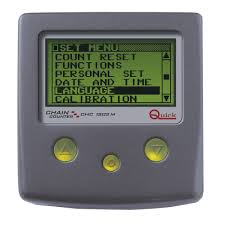
We have worked with Quick on problems with our chain counter (installation issue).  Quick USA are quick to respond with very thoughtful answers.  They got us a spare sensor and magnets as we debugged a problem which turned out not to be Quick’s fault.

Our second interaction with them was to buy new hot water heater release valves.  The current valves leak a small amount of water as tank pressure increases.  The replacements were easy to order.

Finally we got plenty of quick replies helping us change our gypsy, actually wildcat, to accommodate the new G43 chain.  We decided to install 80 meters of 5/16′ (8mm) G43 chain which requires us to change the wildcat.

Perfect service but not perfect pressure valves prevents a 10 out of 10.

Score 9/10

KVH

KVH

KVH

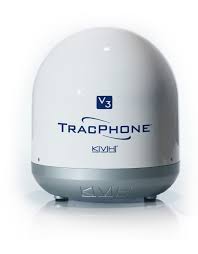
The KVH is our source for internet while at sea.   This technology could be very complicated but between Gail’s huge brain and KVH’s great customer service, the unit has been easy.  On delivery of the boat the unit was not activated properly so we had to call KVH.  They emailed us the solution but we did not act on it as we were busy with other things.  Two days later they emailed us asking if we had problems since they had not seen us on the network.  Wow, that is follow up.  Since then we have worked with them on missed software upgrades because the unit was off while transiting the US East Coast.  Again, they were efficient.   KVH can remotely control the satellite unit when in need of service so you never need to find a local dealer.

Score 10/10

Sea Recovery

Sea Recovery

Sea Recovery

We were shocked at how bad the experience with this company was.  They do not have a dealer network in Brazil or maybe anywhere.  When a dealer did board, they spent half the time complaining how they hated the company and the other half asking me how the unit worked.  The dealer even emailed us 6 months later asking for help having his bill paid by Sea Recovery.  They were not open about a known problem with the water maker that would have saved us hours of headaches.  In their defense, the main office in the US did work hard at times trying to help, but still not enough.    This low score could have been lower.  Since our fix, the unit has run like a dream.

Score 3/10

Furuno

Furuno

Furuno

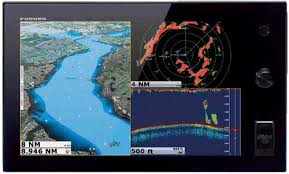
The best way to get service from Furuno seems to be via their forum where Johnny Electron will usually give timely responses. (Johnny was helpful with questions about velocity made good and velocity made course)  Furuno is always at the boat shows with some helpful people who answered our early questions.  (How to turn off the fish finder or fix a stuck button on the autopilot).

Furuno, however, fell down in the early days of the TZ Touch units.  They had a major glitch in the map distribution web site which was producing corrupt files.   The plotter would crash or freeze once a day.  We felt Furuno was denying this issue which affected 100% of the Antares.  Finally, Furuno realized the source of the problem, but did not publicize it properly.  Unit working 100% now but still a bit irritated with their piecemeal service.

Score 5/10

Fusion Stereo

Fusion

Fusion

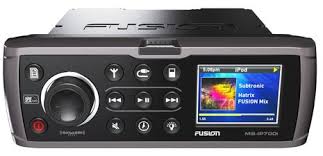
After owning the boat for a year, we got around to investigating why the stereo had a strange orange bar appearing occasionally on the screen.  A quick email to Fusion, and they informed us that they would fix the unit.  I told them I was a full time cruiser and could not afford the time for the turn around.  We brokered a deal where they would send a new unit and charge the credit card until the old unit was returned.  The process was good but could have been smoother.

Score 8/10

Vesper AIS

Vesper

Vesper

We have never fixed something with a kitchen pot but that was the advice Vesper gave us to block the AIS’s antenna for a proper software update.  The advice worked like a charm.  The company is in NZ so plan on working on the unit at night to reduce the turnaround time.   Friendly staff, but when will the anchor alarm upgrade be released?

Score 9/10


Onan

Onan

Onan

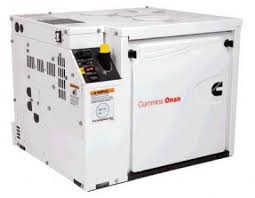
Companies can deliver service from headquarters or from a dealer network.  Electronics are easier to do centralized while bulky stuff like engines tend to be better served by a network.  A strategy of neither will fail for sure.  Emails to Onan central will get a response of please seek advice from a dealer.  But Onan dealers are hard to find, and the dealers do not seem to have experience with the product.  Our Onan has been running well so that is very good news but the service is skimpy at best.

Score 4/10

Volvo

Volvo

Volvo

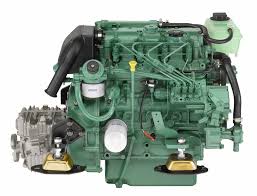
Volvo also follow Onan in a dealer network strategy but they actually have plenty of very well trained dealers. It is worthwhile to get the shop manual for the Volvo engines to better understand their construction.  Volvo parts and service centers are not that hard to find with a bit of planning.   I would score them higher if the Volvo headquarters helped, but their dealers are strong.

Score 7/10

Spinlock

Spinlock

Spinlock

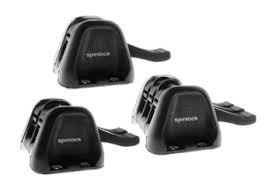
They sold us our auto inflation vests and our line clutches.   The vest side of the business has offered much help on replacement cartridges and other questions.  But the clutch side of the business was not helpful in our questions about the always open feature.

Score 6/10


Victron

Victron

Victron

We have had a few chances to talk with Victron about the solar charger, the inverter charger and the possible installation of a transformer for cruising in Australia.  They quickly replaced our broken solar charger and did not require us to mail the broken unit back to Victron.  The service was speedy and done via email, my favorite.  I wish I had sorted that problem out much earlier.  They also have some tech support folks that can really go the extra mile and advise us on plans to make the boat 220 volt prepared.   They do not have a dedicated support network, but the electricians who we have come aboard start by reading the manual.

Score 8/10

Winslow

Winslow

Winslow

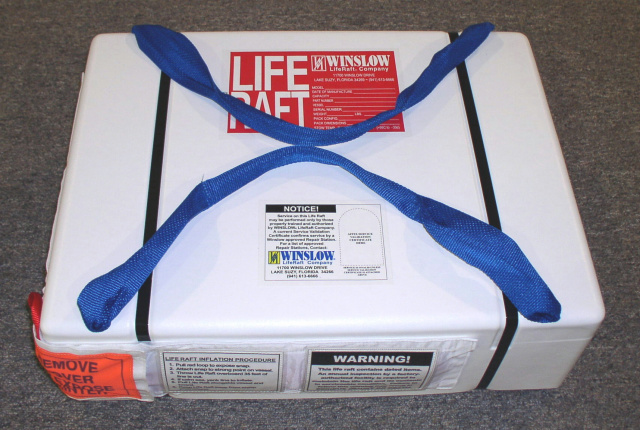
Our salesman was responsive and helpful when the check was being written. Since then, we discovered that Winslow only services liferafts in the US. Perhaps he could have alerted us to this when we told him we were sailing from South America? What liferaft company doesn’t have a rep in the Caribbean. When I emailed him, he would not respond and when I called the company they were less than helpful. Since liferafts should be tested every few years, make sure you know your manufacturer’s service areas before you buy.

Score 0/10

Brownies

Brownies

Brownies

The diver compressor folks are located in Fort Lauderdale.  They have done a modified version of a common German dive compressor.  It is fairly technical stuff so I would not ask many folks to work on the system.  Our initial unit had a faulty 3 phase motor.   Brownies came to the boat multiple times and finally solved the problem.  The machine has been reliable since then but Brownies stuffed me with part of the fix-it bill.  Great service, but a hefty hit to the wallet lowered the score.

Score 6/10

Antares

Antares

Antares

The only help network that is 24 hours.  The presidents of the company will reach out with almost any type of help they can offer.    The topics are not limited to their product but also seamanship, must see places to visit and food advice.  Many boat builders after sales service is limited to “their” part.  Send you off to fight with the electronics firm on your own.  Antares stands behind the whole boat long after the warranty is over.

Score 10/10


Comments { 2 }

Bilge Pump

Rule Bilge Pump Break Down from Two Fish on Vimeo.


The more I learn about boats, the more I realize the marine industry is an industry of fear.  Preparation is prudent but frequently I find myself planning for extremely low probability scenarios.   Having a decent flood plan is not a bad idea.

How would Two Fish flood?

1)   Most likely candidate would be a failed hose or hose clamp.  We check for loose and rusty clamps frequently and  replace as necessary.  Hoses that contain hot engine fluids should be replaced before they deform.

2)  Much less likely would be if a thru hull fails.  Near each thru hull are a variety of wood and synthetic cones to fill any leaky point.  The speed at which water enters is not fast and the bilge pump can actually keep up with a failed thru hull.

3)  A failure of a fitting in a remote part of the boat such as under the port head or under the master bed.  Both of these areas did not have limber holes at construction.  We added these to allow a leak to flow back into the bilge.  The limber holes are fairly small so will allow small amounts of water to pass but will continue to keep some separation of space for the bulkhead.

4)  Hull failure due to impact would not be fun.  Our manual bilge pump and electric might not be enough.  I would try to use the engine’s raw water pump as well.  I think this scenario is unlikely.

The reason I took out the bilge pump is that it was mis-firing.  It frequently would cycle on and off as the sensor was getting confused even after cleaning it.  We bought the new model which has a sensor instead of a manual float.  But I have learned that the new technology also needs frequent cleaning.

The bilge on the Antares is not 100% dry.  The air conditioning condensation and hot water heater overflow deposit measurable water in the bilge after a few days.  Old salt water pumps for the Volvos can also leak into the bilge.  The Volvo pumps were replaced while in St. Martin.  Another source of water in the bilge occurred only once in huge seas. Water came into the bilge via the pump exit despite the loop.  If we encounter nasty seas again, I might close the seacock and turn off the pump.  The bilge manual states clearly that there should not be a check valve to prevent water coming into the boat.


Comments { 2 }

Going to Weather

Thoughts on sailing hard on the wind


Sailing hard on the wind from Two Fish on Vimeo.

Monohull sailors will often preachingly ask us “how we sail to windward.”  On our last sail of the season, the answer would be “just fine”.  While beating up the south coast we passed a monohull that had no sails up, motoring into the wind and seas.  We were tacking back and forth but eventually caught up to the motoring mono.  How does she sail to windward?

The reality of cruising is that all cruisers spend hours reading GRIB weather files and spend days hiding in harbors to avoid sailing to weather.  We are no exception to this rule and will use our engines to make a tide or to enter a harbor before sunset.

A few ideas for sailing upwind:

1) Set up your sails for power or speed according to the wind speed and sea state.  In the video, we are in power mode as the seas were on our nose; we wanted power to accelerate after hitting a wave.   We positioned the jib fairlead one slot forward and the main halyard a bit looser.   The draft on both sails was near 50%  (measure from clew to tack).  We had the main and genoa twisting at about 35% between the clew and the head.

2) Your instruments can help you determine how much to point for distance, or foot for speed.  Our chartplotter draws a line coming from the boat showing our course made good. As I pointed the boat lower, the leeway was reduced and our course made good pointed higher.  Wow, now that is backwards but it worked.  Point lower and achieve higher!


Hydrogenerator by Watt&Sea

In 2016 we will sail about 12,500 nautical miles, comprised mostly of 4 to 21 day legs. I have discussed in past posts that this type of sailing requires that we run the generator every day.   This is typical on cruising boats that run fridge/freezer/RADAR/Auto pilot/chartplotter and more but I was hoping for less generator time and dependency. We decided to experiment with some new technology and buy a hydrogenerator that produces electricity when the boat is moving.  The hydrogenerator has an underwater propeler that is spun by the movement of the boat through the water.  This creates three phase power that is sent to a charge controller.  The charge controller then sends the proper 14 volt power to the batteries if they need a charge.   In the video you can see the hydrogen moving back and forth like a rudder.  Besides dropping the Hydro-gen in the water there are no other tasks for the crew of Two Fish.
The hydro-gen can use one of three propellers with different diameters (small, medium and large).  The larger propeller allows power to be generated at slow speeds; the cost is that at higher speeds the propeller ceases to produce power because of cavitation. Our unit came with the medium propeller, but its production matched the marketing material for the small propeller.  Artistic license?  Poor water flow because of our positioning? Either way the dealer has decided to install the large propeller. We will test this when we come back to the boat in the fall.


Comments { 0 }

The Antares 44i Water System

Our greatest luxury and key comfort on Two Fish is fresh water. It is wonderful to be able to shower after ocean swims or before a long watch, to wash away salt from the deck, and, of course, to drink, make ice and clean dishes. Air conditioning, a fancy stereo, comfortable furniture and Internet are not nearly as important to me as an unlimited supply of fresh water. We have met remarkable cruisers that survive on only an eye dropper of water a day. To each is own.

Uses of water
I have not done a scientific analysis but here is my estimate of our water usage.

Washing Machine: 7 gallons per load
Fresh water flush of watermaker (once per week): 5 gallons
Wash down deck: 5 gallons
Navy shower: 2 gallons
Washing dishes: 1.5 gallons per person per day
Head usage: 1 gallon per person per day
Drinking water: 0.5 gallon per person per day

On a passage with four non-cruisers our consumption surged to almost 1 tank a day (55 gallons). This still holds its place as our most wasteful record. Our most frugal streak was with a similarly sized crew of cruisers – a tank lasted 1.5 weeks. When Gail and I are at anchor, a tank can last almost a week.

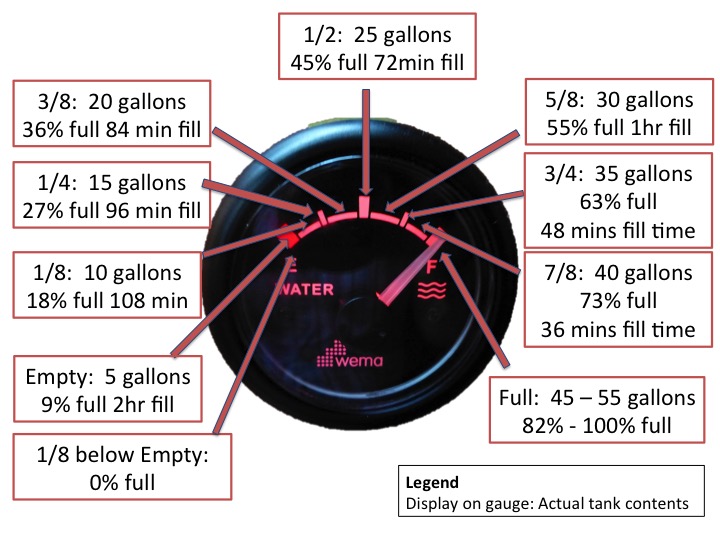
Fresh water gauge

Fresh water gauge

We have two 55 gallon tanks; when Two Fish was being built, we swapped fuel and water tanks to allow for more fuel to be carried on board.

Sources of water
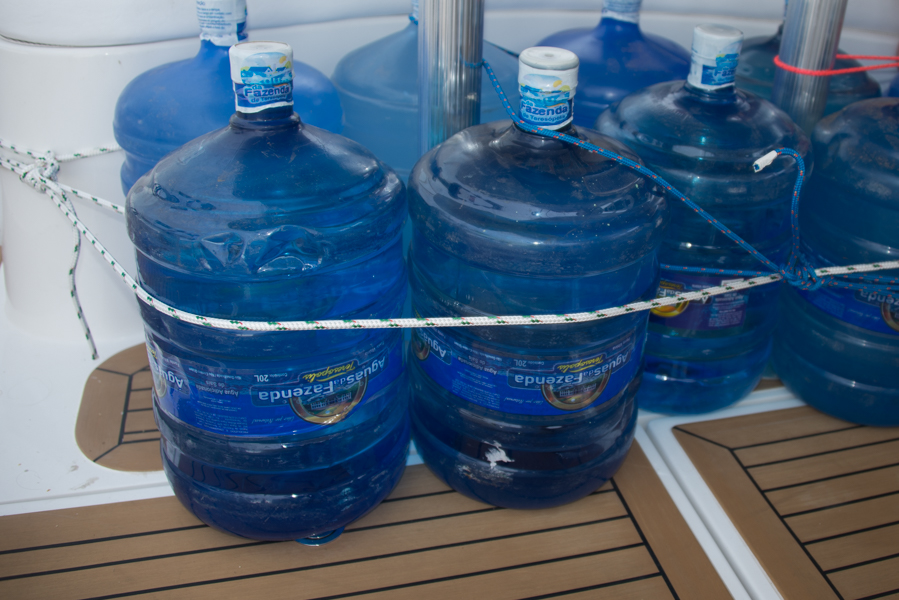
Our tanks are predominantly filled by the watermaker, but we can also collect rain water or use the hose at a marina.

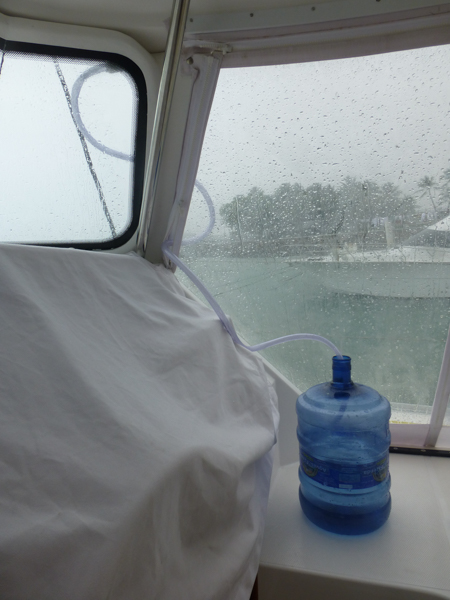
Rain Capture

Rain water capture

Rain water capture


Our boat has a huge hardtop with gulleys for water capture; these funnel to two stainless tubes. The tubes can be plumbed to lead to collapsible water jugs. Some owners insert an inline filter to catch sand. While at anchor, we use the rain water to wash scuba gear, wash vegetables bought from home gardens and wash the salt off the deck from bumpy passages. Typically, it takes an hour of rain to  fill a 5 gallon jug. However, the Two Fish record (yes we keep records on all sorts of things) is 5 minutes and 12 seconds during a strong cloudburst in Brazil.


Dock Hose at a Marina

Fresh Water Fill

Fresh Water Fill


Dock water is plentiful but has a few drawbacks. Chemicals in dock water can pit the aluminum water tanks. We always ask twice if the water is drinkable (potable) when staying in a new place. Much of Brazil had water that locals suggested we avoid. My possibly unfounded fear in some countries is that the city water supply can get contaminated during a power outage at the treatment plant. In addition, older marinas may have old rusty pipes leading to the docks. Recently, we have been avoiding the hose and only using watermaker water to fill the tanks. When we do use marina water, we run it through an inline filter first.

Watermaker

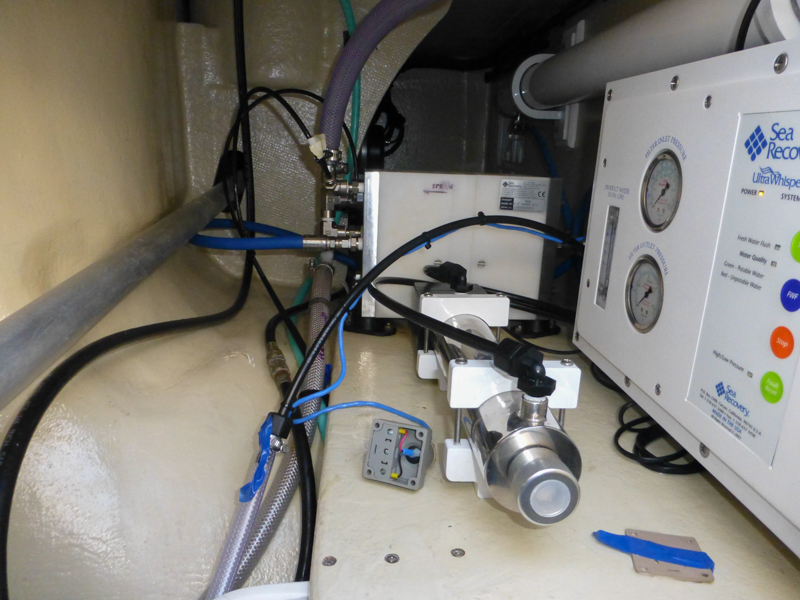
Our water maker is a Sea Recovery Ultra Whisper Modular 600, which produces 25 gallons per hour (95 liters). Converting sea water to fresh water can be accomplished via evaporation or by brute force. Most installed watermakers use brute force.

How to operate the watermaker

First, the unit needs power and water. Ours uses 110 volt power for the lift pump that draws the water from the ocean and 12 volt power for the control unit. On an Antares, the seacock must be open and the input/output valves set for water making NOT pickling. Get the input/output valves wrong and you will flood the boat. Fortunately, unless you are leaving your boat for a long time, these can be set correctly and left alone.

The control panel has a green “start” button to start the unit making water. This causes the lift pump to draw water and send it through the system. The system primes for about 40 seconds. Then, the ETD (energy transfer device) pump begins to squeak. Another 40 seconds and the water quality lamp will change from red to green. The manual advises that you may have to wait 30 minutes for the lamp to change color. This has never been the case for me. There is a red “stop” button to stop the unit. There are two other buttons, fresh water flush and fault clear. I stop the unit when the water tank gauge just reads full as I am not sure what would happen if I overfilled the water tanks via the watermaker hoses. If I press the red button only once, then in 90 minutes the unit will wash itself with fresh water. Many new owners think their fresh water flush (FWF) is not working because they do not wait 90 minutes. If you are patient, in 90 minutes you will begin to hear the pulsing of the 12 volt Fresh Water Flush pump and you will see water exiting via the brine port in the stern. We always give the watermaker a good clean after each usage. If you get excessively enthusiastic and press the stop button multiple times then the water maker will not execute the fresh water flush. Since the fresh water flush pump is a 12 volt motor, you do not need to have the genset on for the final step. Also, if the 12V power is left on, every week the watermaker will flush itself, a great way to have the membrane last without effort. The fresh water flush pump has a charcoal filter to protect the membrane from chlorine if city tap water is used for flushing. The fresh water flush uses about 5 gallons from the starboard tank, so make sure this tank has water. The fresh water flush pump makes a pulsing sound while running. If the pump seems more off than on then you need to replace the fresh water flush’s anti-chlorine filter.


Behind the scenes at the watermaker

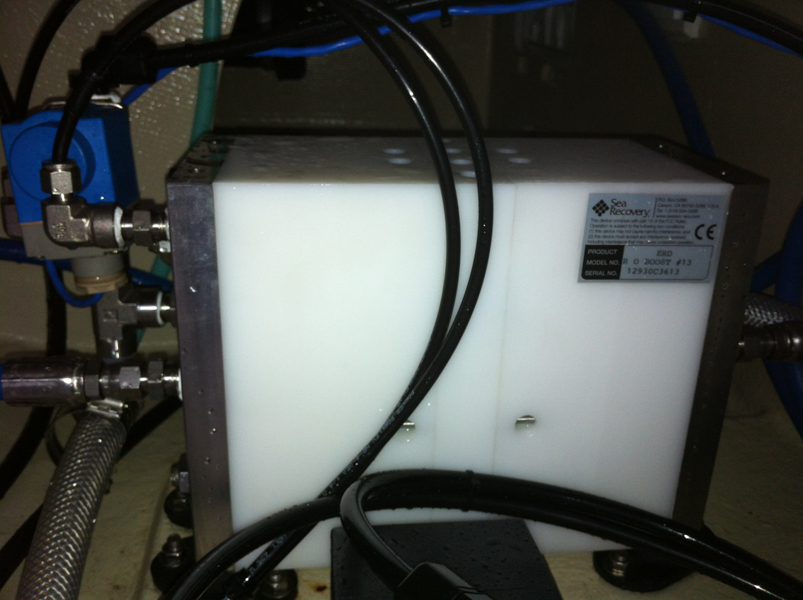
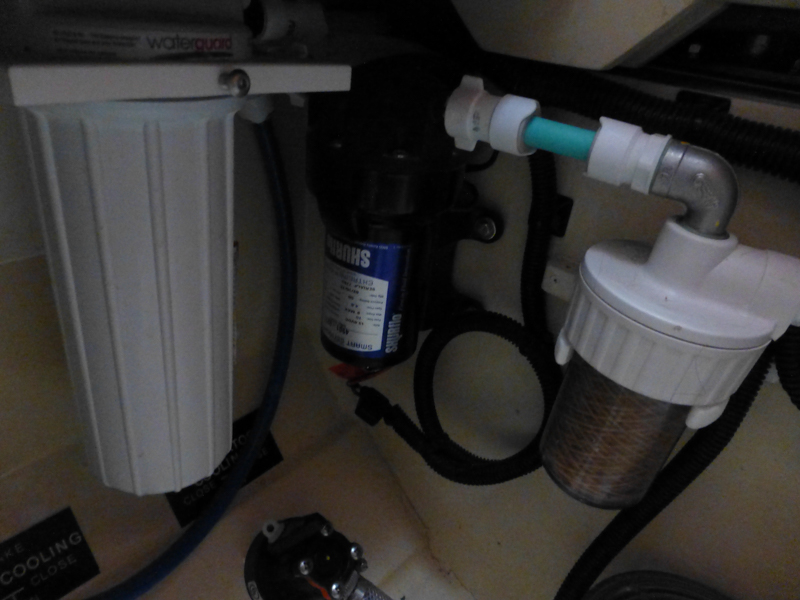
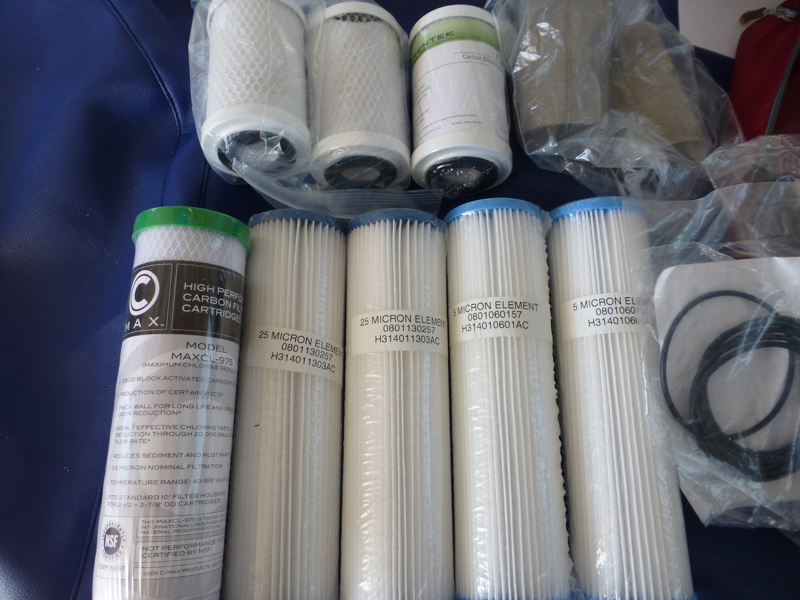
Raw sea water enters the boat via a thru hull and then passes through a strainer on its way to the water maker. The Antares thru hulls are in very smart locations. The Genset, water maker and engines will hardly ever be starved of water as the thru hulls are close to amidships. The cost of this comfort is a secondary raw cooling water pump for the Genset. The extra pump is worth it, to be able to make water in the ocean and not to have to wait until the boat is in a calm harbor, something that is necessary on some mass production cats. After the strainer, a football size lift pump, powered by 110 volts, pulls the water into the boat. Powering this pump requires the generator to be on. The strainer and lift pump are installed below the water line for automatic priming. The sea water now exits the master cabin and enters the rear locker where it passes through two filters to remove particles greater than 25 microns and then 5 microns. Initially, while the system is priming, the sea water takes a short cut and does not reach the membrane. 100% of the sea water exits the boat via the brine waste output located on the starboard stern. After one minute of priming, the control panel instructs the Danfoss valve to open. Danfoss valves are electronically controlled valves that open and close based on the watermaker’s control unit’s instructions. The now open valve allows the salt water to begin its conversion to fresh water. The water also passes through a UV lamp that kills microbes.

ETD

ETD

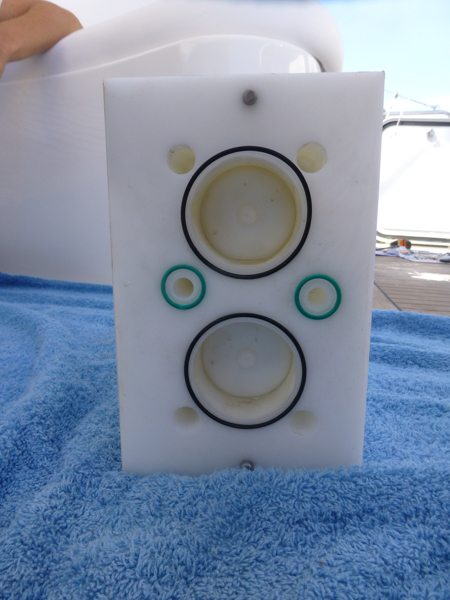
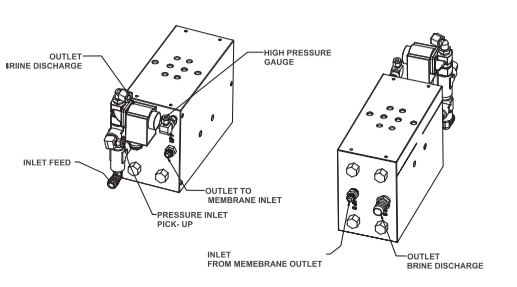
The sea water then enters the ETD, also known as a Clark pump, which pressurizes the water before entry into the membrane. The ETD uses the waste brine’s pressure to move the pistons, thus reducing the electrical load requirement of the unit. The ETD may be too complex a solution; other brands use a second pump. However, an ETD has fewer moving parts than a second pump.

The next stop for the now filtered sea water is the membrane, which is 1 meter long and has layers of material whose perforations are too small to allow the passage of salt crystals. The water that passes through to the center of the membrane is clear and good for drinking. Only 12% of the raw sea water is made into “product water” while the other 88% is sent over board as “brine”. These are two good terms to know when you start reading water maker manuals. The membrane should produce product water that has 99% of salt and other contaminants removed.

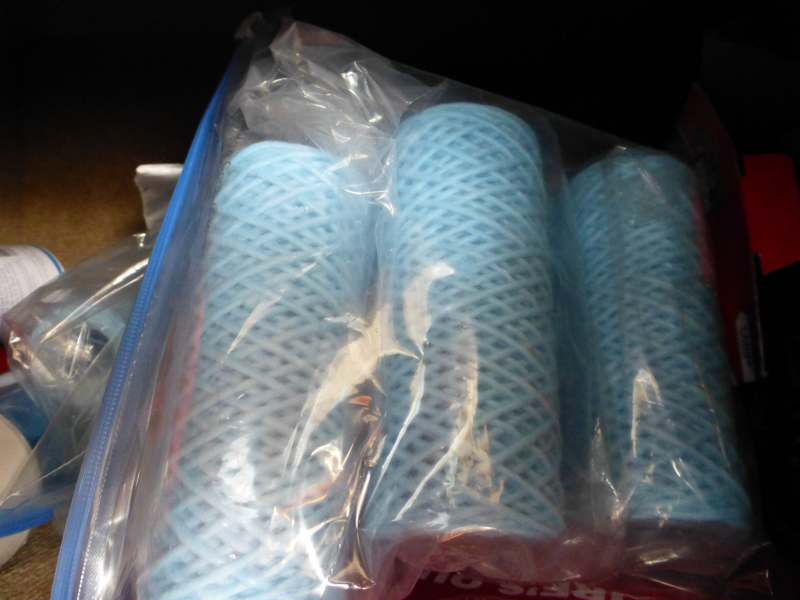
I do not make water in harbors or lagoons. We mostly make water while at sea to give the membrane the cleanest possible water and to extend the life of the filters. If you do make water in a place with lots of silt, then the filters will be exhausted early. But do not fret, as dirty filters are easy to change. However, oil can kill the expensive membrane, so one should avoid making water near the wreck of a super tanker.

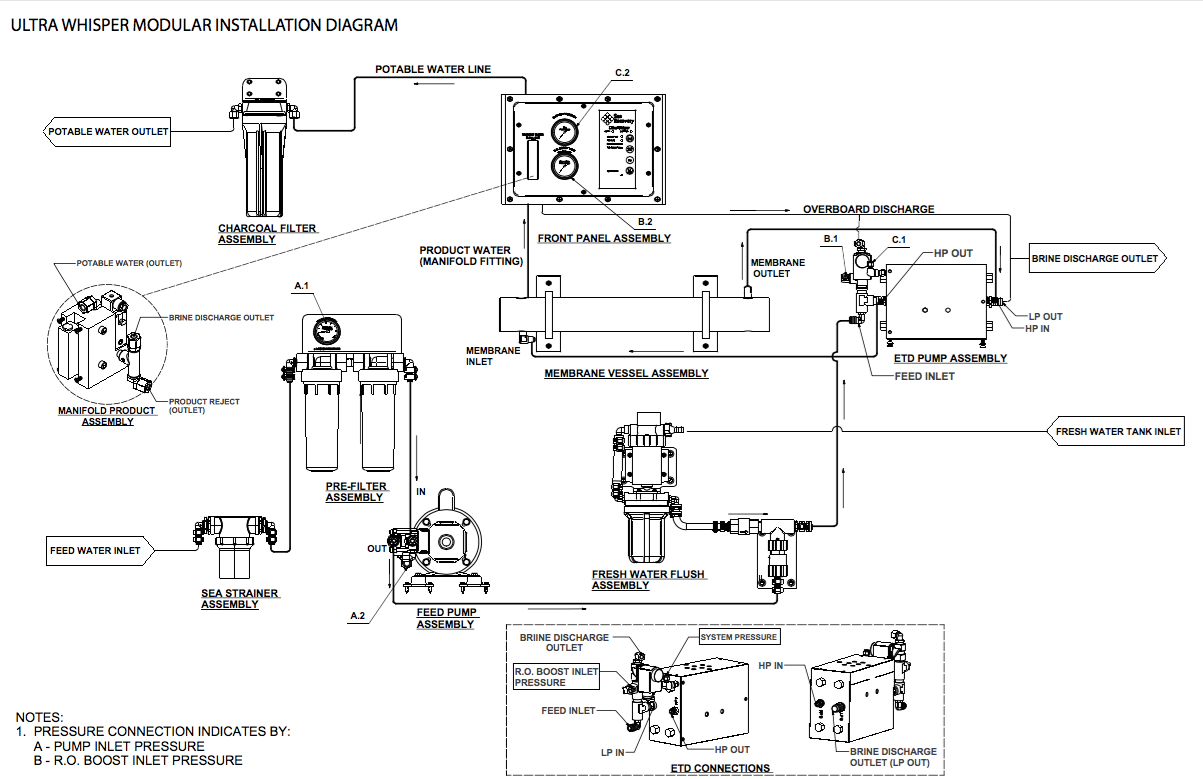
Installation Diagram

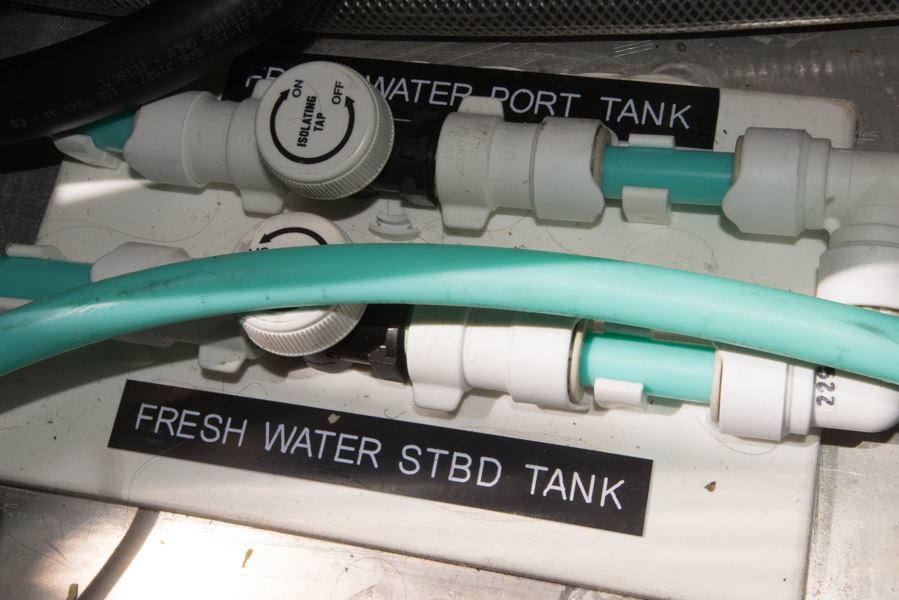
The control unit does a few things behind the scenes. First, it ensures the pump pressure matches the needs of the system. Brackish water will perform differently than salty water. Second, the water maker tests the product for being drinkable. When the salinity tester deems that the water is clean, it opens another valve and allows the product water to enter the tank. There are isolating valves installed by Antares that route the product water to port, starboard or both tanks. Never have it routed to neither. I wish the system had a port to fill buckets. Someday I might add that, but in the interim I just unplug the quick connect hose.
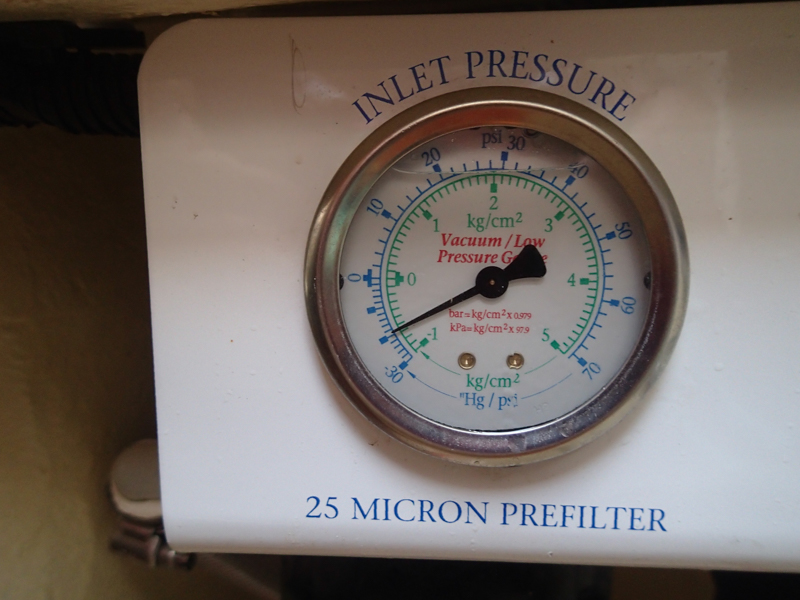
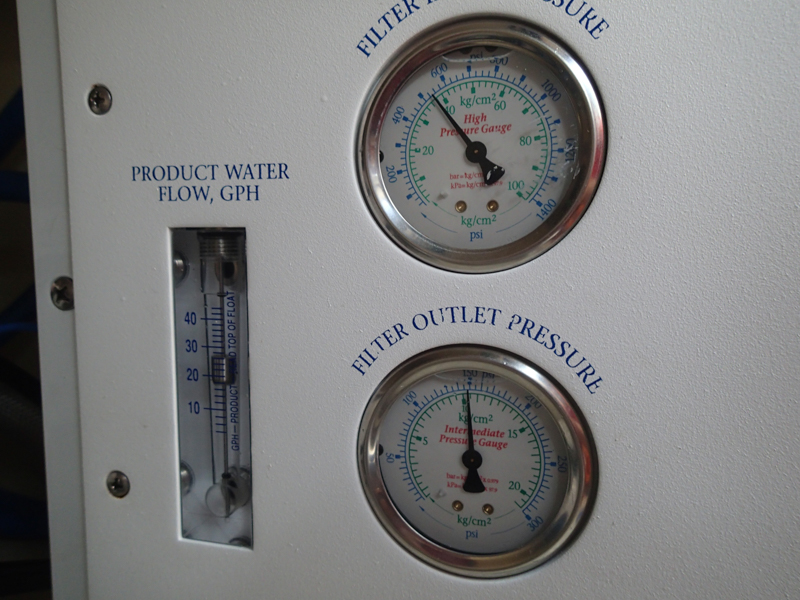
After starting the unit it is worth checking the gauges for proper performance. For the Ultra Whisper 600, the product water output, which is read from the top of the silver float, should always read 25 gallons per hour when producing product. The main unit also displays the pressure on the low pressure and high pressure sides.   The pressure reading will increase with colder or more saline water. These readings are taken just before and after the ETD. A proper reading for the low pressure side is 150 psi and 650 psi for the high pressure side. They will vary, depending on salinity and water temp. Finally, there is a gauge by the filters that should warn you of dirty filters. Some of the gauges suffer from chronic inaccuracy and need oiling or need to be reset. I write my gauge readings down frequently to see if something has changed. I have placed a label next to the gauges with the average expected reading.
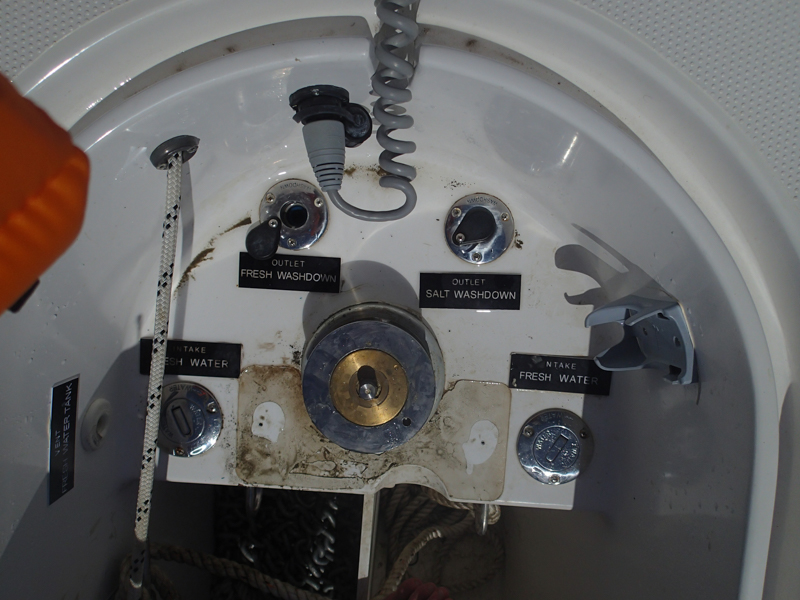
Deck Fill

Deck Fill

The watermaker uses fewer than 10 amps @ 110 volts, so there is plenty of room while the genset is running to wash clothes, heat water, charge laptops and charge house batteries.

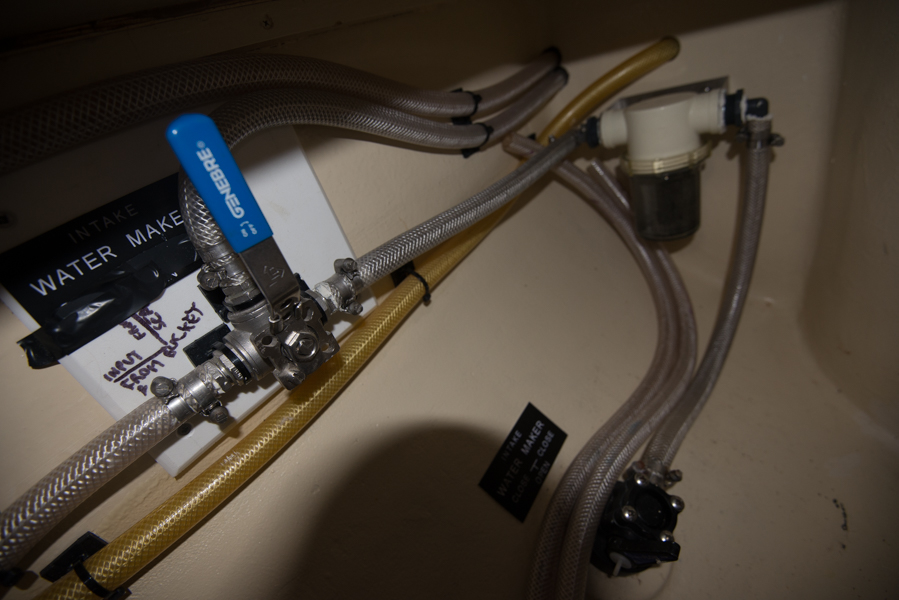
If you plan on leaving the boat for a month or two at a dock, the automatic fresh water flush will keep the membrane clean. Just make sure you have enough water in the starboard tank for the time you are gone. If you plan on hauling out for a season, the membrane requires pickling. The Antares watermaker is set up well for pickling; you can replace the sea water input with pickling agent from a bucket. Adjacent to the watermaker thru hull, there is a source selection valve that routes seawater to the water maker. Obviously, when water is being made the source must be the sea. If you wish to pickle the watermaker, the source must be set to hose. There is a hose in this locker that you can use to suck pickling agent out of a bucket. Bucket not included. This valve is operated in tandem with a second valve in the water maker locker that determines where the brine goes. It goes over board when producing water or back to the bucket when pickling. This is a very dangerous valve as accidentally routing brine into the boat could fill the locker with water very quickly. I always make sure, when running the watermaker, that the brine is going overboard. I have yet to pickle my watermaker; to do this, one needs a pressure release valve which I will install soon.  I may spend the big bucks to buy a new membrane for our Pacific passage.  Probably way too early, but I do appreciate tasty water.

History

It has been over a year since we have had issues with the watermaker so it is a bit unfair to go back and complain now. Sea Recovery originally sold us a watermaker with a faulty ETD (energy transfer device) and a broken Danfoss valve. This led to a horror show of no water maker for our first 5,000 miles, in an area with limited fresh water. The ETD is a block of plastic with two pistons. Our ETD had poorly milled pistons and locked up when we used it. However, the lift pump would keep pumping water and the resulting water pressure would cause hoses to come off their barbs. I quickly had humor failure. The crew were great and never complained even though they had to ration water. We then took apart the ETD, a multi-hour process, and hammered the pistons back to the correct positions. The water maker then would work once, but not twice before blowing off another hose. We also had a few bad Danfoss valves. When the Danfoss valve was broken, I did a work around with a manual ball valve. Instead of electronically opening after a minute of priming I would manually open the valve. Bit of an ugly solution, but it worked okay until the pistons froze again. After running out of expletives, we gave up and waited for Sea Recovery to send us a new ETD. Like many marine companies, they claimed to have a global network but it is closer to global acquaintances, some of whom were not talking to them anymore. In short, we wasted lots of time in strange ports but now we know a bit more about the operation of a water maker. We also learned that fixing it yourself, now matter how clueless you are, is the fastest solution. The water maker has worked for over a year, since the repairs.
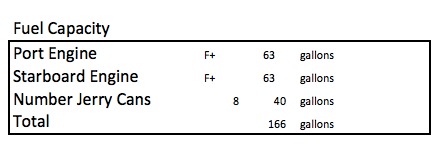
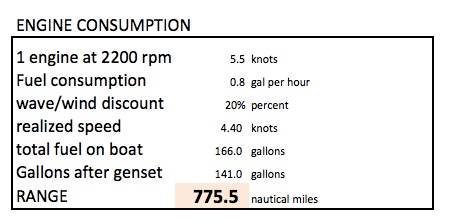
Conspiracy Theory

Cleaning water maker locker

Cleaning water maker locker

I tend to believe in free markets but in order for them to work consumers need to enforce the invisible hand. Plenty of watermaker buyers are clueless like me. I did not know the difference between a membrane and a pump, so I fell for marketing hype. Reverse osmosis water makers are old technology that is commoditized but the manufacturers wish to distinguish their products. They add features and great marketing slogans to lure the unknowing consumer. Then they make the spare parts slightly different shapes and sizes from off the shelf filters. This allows the watermaker manufacturer and dealer to lock the buyer in as a long term revenue stream. Sounds like my computer printer. Maybe my blog will educate a few future water maker buyers and the invisible hand will cause manufacturers to change their behavior?
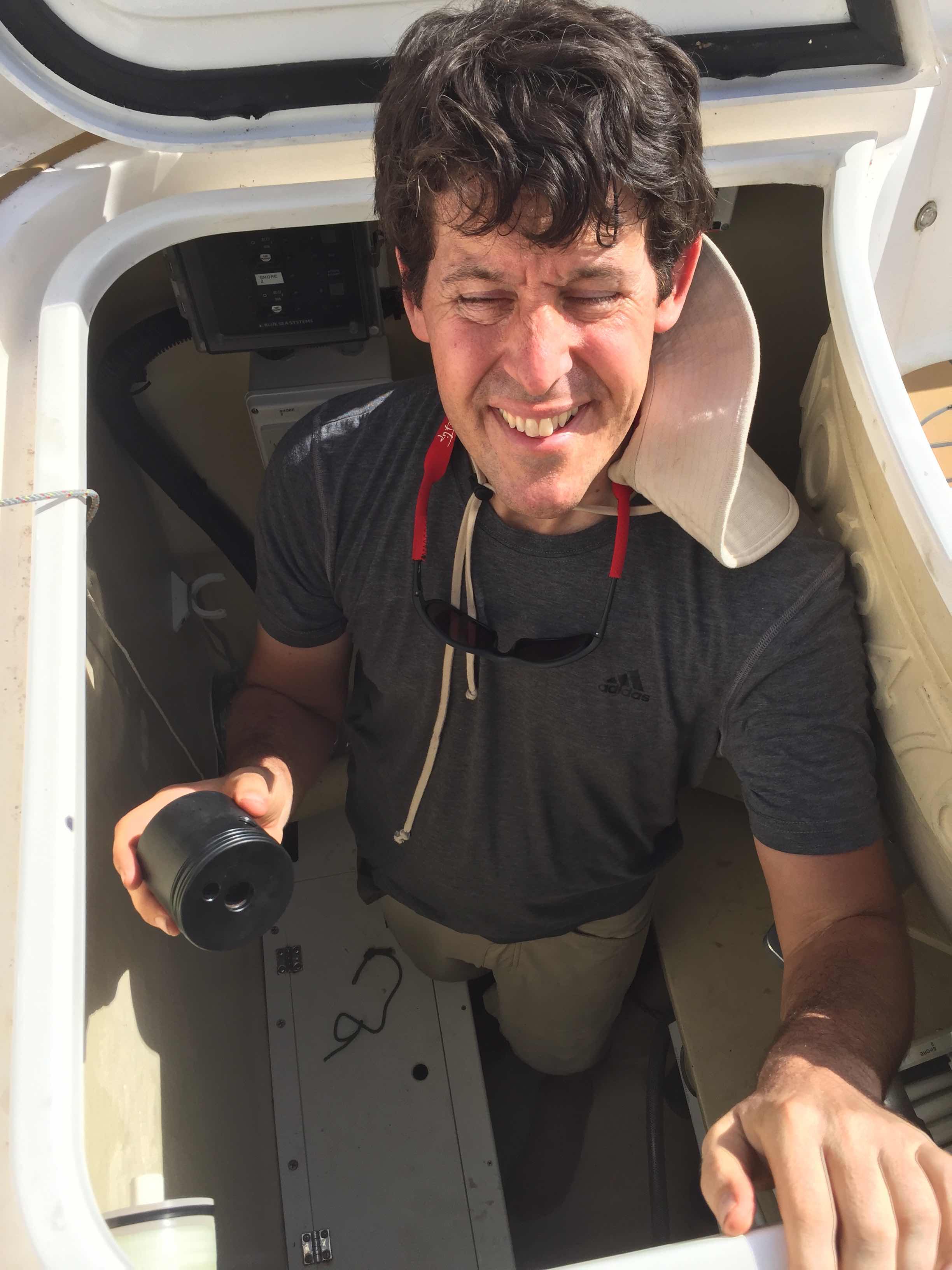
Dream Installation

Watermakers often fail on boats. I do not think there is another brand that would outperform Sea Recovery. I would consider buying a “standard parts solution”. The Sea Recovery is very convenient with one button operation, automatic priming, automatic pressure control, automatic salinity sensor and flushing. But a “standard parts” solution would have fewer parts to break and replacement non-proprietary parts would be easier to find. I found this manufacturer on the web as an example. (http://www.cruiserowaterandpower.com/40_GPH_Water_Maker_2.html). With this model, one would have more switches and valves to operate; that might be annoying on a frequent use basis. I do not have experience with their products, but would research if we did this again.

My dream installation would be to have a second 12 volt watermaker. When on motoring passages, I could slowly top up the tanks without running the Genset and while on pure sailing passage I would fill the tanks while charging the batteries with the Genset. This set-up would offer a back-up, which would be comforting. For our Pacific crossing, I have decided to buy a portable 12 volt system that I will store in the sail locker in case old faithful decides to take a break at the beginning of our 3,000 mile leg. Two weeks ago, one of teams in the the Volvo ocean race had their watermaker stop working. For three weeks, the team will be manually pumping for eight hours a day from Brazil to Newport, Rhode Island. My arm hurts thinking about it.
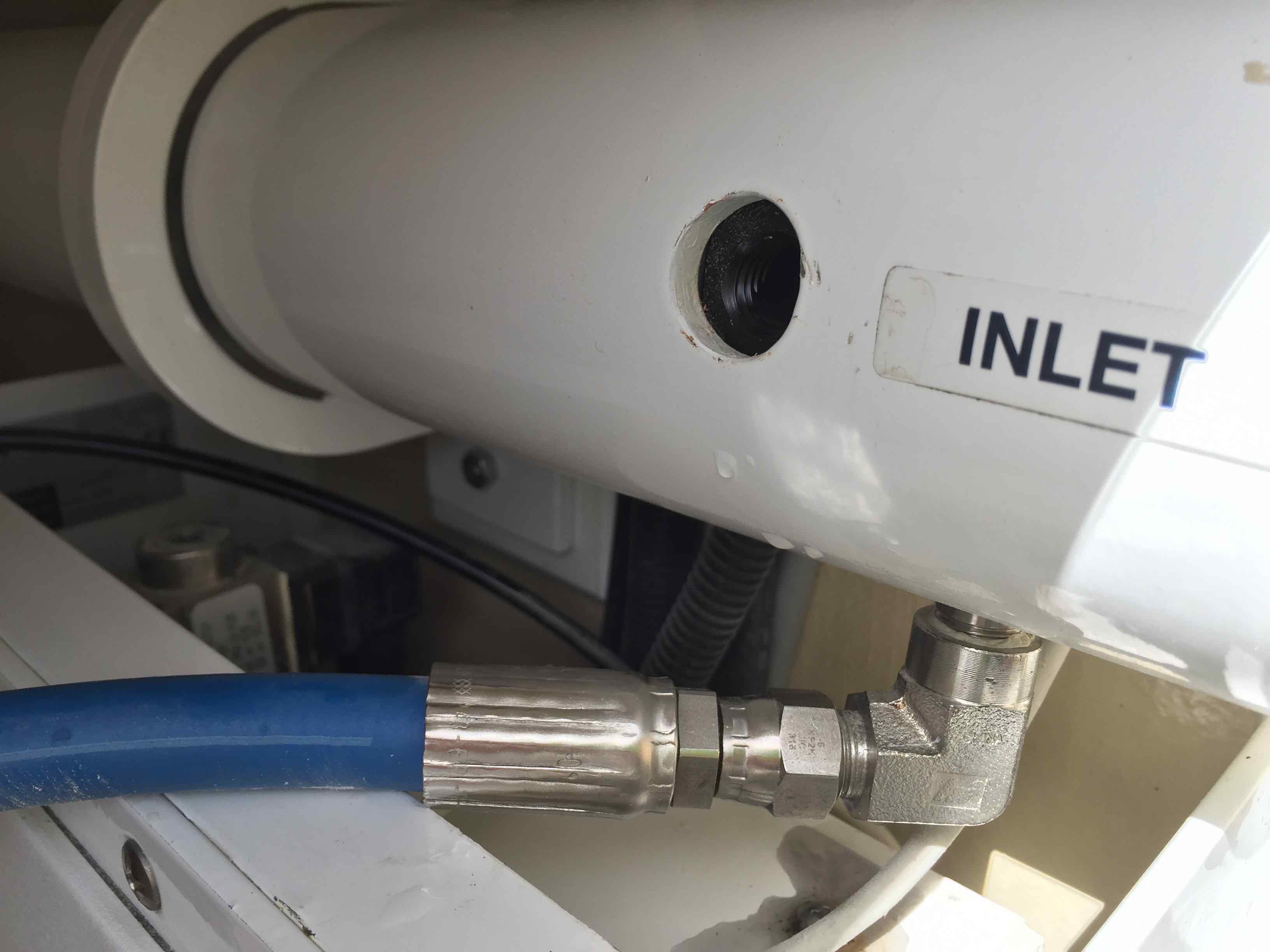
While I am talking about my dream installation, I would like an hour meter to monitor the usage. This would not be useful in determining the time to change the filters since water quality can be a huge variable in filter life. The manual says change the filters when the unit stops working. I have not pushed it that far and change my filters too early. A remote starter panel might be nice but also adds another point of failure. I did add a taster port that allows for testing the product water. If the watermaker has not been used for more than two weeks, I reject the initial product water longer than the unit requires. I also have a handheld detector that measures parts per million of the product water. I use it, but I am not sure of its accuracy.
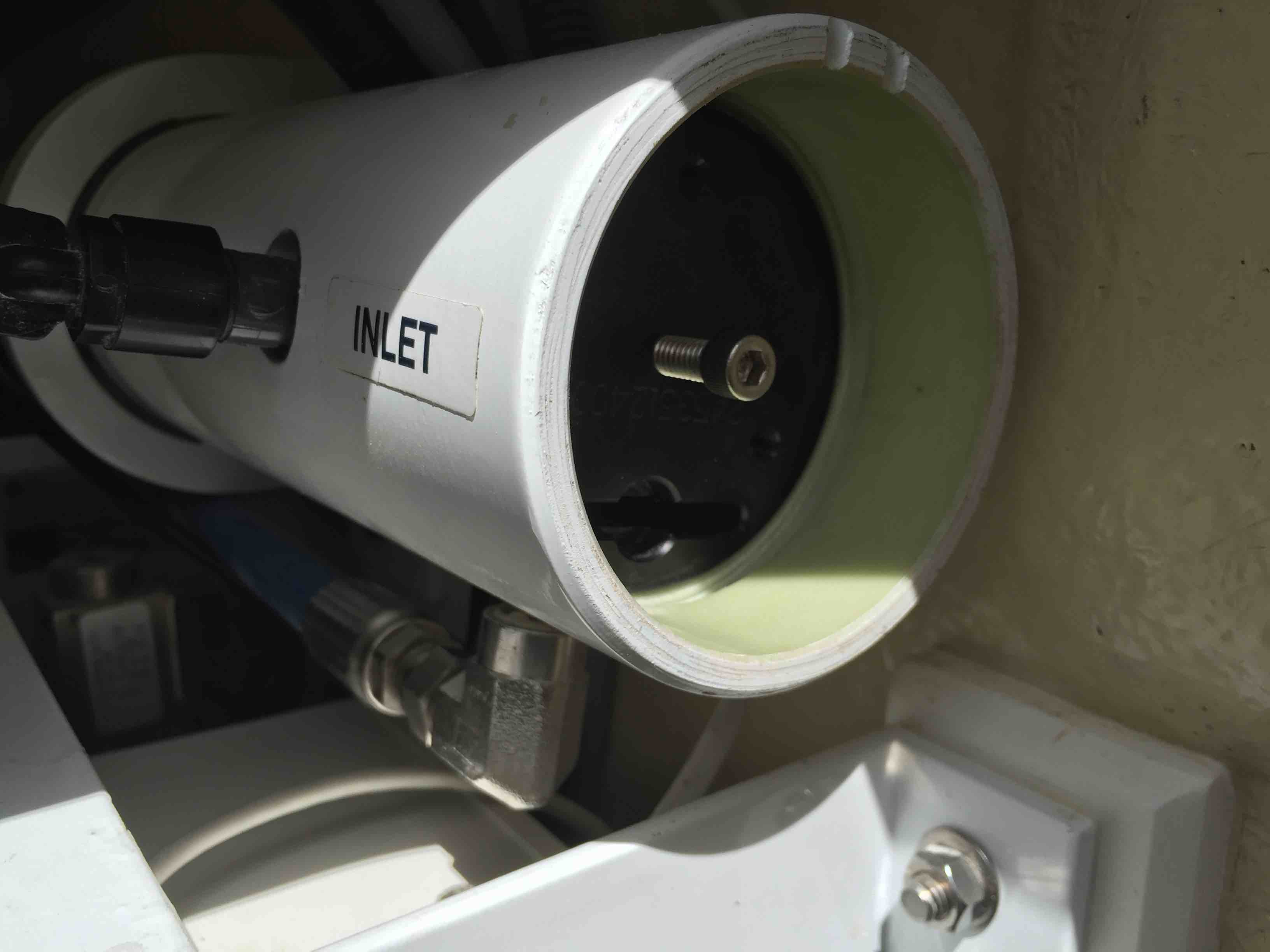
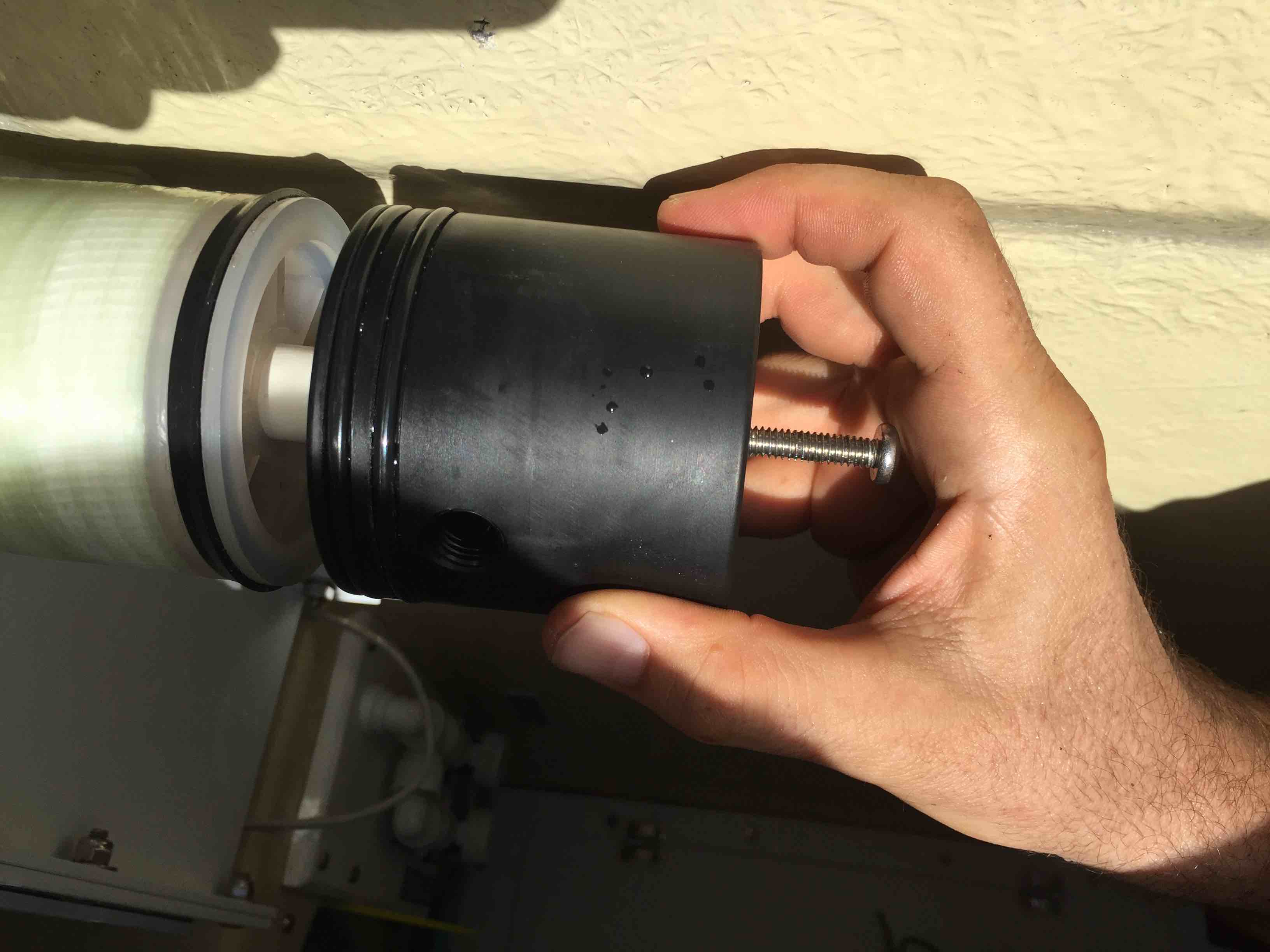
Another feature is to be able “plug into” a hose when in a Marina.  The hose pressure replaces the need for a water pump and you do not have to fill your tanks.  We do not have this feature, but before installing I would research how to avoid sinking the boat if the hose leaked.

I do enjoy the modular version on Two Fish as it makes service much easier. The compact version stuffs all the bits into a crowded space.

Starboard Hot water heater

Starboard Hot water heater

Golden Rules of Water Makers

1. No air in the system.
o Make sure the system has a good prime. Ensure good water flow at start up. If poor water flow, check for hose kinks or leaks on low pressure side.
2. Enough pressure from boost pump.
o Sea Recovery pump is matched to the unit’s need. Some home-made systems have lift pumps that are too weak or too strong.
o Ensure thru hull is not clogged and that it is underwater.
3. Clean filters
o Most common problem is clogged filters. We use only Sea Recovery filters to ensure the chairman’s child can go to private school.
4. Well-attached hoses
o There is significant pressure in the entire system. Check hose clamps and attachments to barbs. Ensure hose diameters match the barb.
o High pressure hoses will either be crimped or have a swagelok. Good to have a few swagelok spares. Ferrule ends can NOT be reused. Buy a few spares.

From Tank to Tap

Two selector taps exist under the floor boards on top of the starboard water tank to route the tank water from either the port or starboard tank to the boat’s water system. We only draw from one tank at a time; if a tap were to be left on, it would only empty one tank. We rotate the active tank from time to time so that the water is fresh.
After the tank selector, the water passes through a string filter. Sand, mostly oxidized aluminum from the tanks, will collect here. The water then flows to a variable speed water pump. When the pump senses the pressure in the water system has dropped, it starts pulling water from the water tank. If the pressure drops more, the pump increases its speed of pumping. When the tap is closed the pump eventually re-pressurizes the water system and the pump turns off. If a pipe were to come loose, the pump would keep pumping for eternity or until the motor burned out. In this case, the bilge would fill with fresh water until the bilge pump sent the water overboard. We often turn our fresh water pump off when leaving the boat overnight. We also track down the causes of unexpected water pump noises as they are clues to leaks in the system. The pump is fairly noisy, which sailors claim is good since you can hear when a tap is left open. I would prefer it if it were silent. They do not make these variable pumps anymore so we have a second pump as a spare. Our boat does not have an accumulator (pressurized fresh water reservoir).

String filter, water pump and charcoal post tanks

String filter, water pump and charcoal post tanks

After the pump, there is a charcoal filter to ensure tasty water. We change these filters every three months. If the water system has reduced pressure, then it is time to change the two filters. Fill a jug with some extra water. Turn off the water pump and open a tap to release pressure. Then fill the filter vessels with the extra water to assist in priming the water system. Without this help, the pump will struggle to reprime the system. The construction is very clever since spilled water lands in the bilge.

The fresh water from this point is pressurized and drinkable. There are several junctions as fresh water must feed 3 sinks, 3 showers, 2 heads, 1 deck wash down, 1 ice maker, 1 washing machine and 2 water heaters. The paths double as some devices require hot and cold water. The system is easy to maintain as all the connections are quick-connect plastic hoses. A leak can be fixed in no time, as long as you have spare tubing and a hose cutter.

Plumbing with isolator valves

Plumbing with isolator valves

The pipes are color coded (blue=cold, red=hot and teal=watermaker product). We also carry spare pipe connections and isolator valves. If you are trying to find a slow leak, the isolator valves allow you to shut off a portion of the system. The Quick brand water heaters are notorious for leaking from their overflow valves. We try to keep our bilge dry so that we can notice a leak in the water system or some other system. Other spots that might leak into the bilge are: Volvo raw water pump, shower sump, through hull (less likely), air conditioning, fridge/freezer condensation run-off, and shaft seal.

Conclusion

Jerry cans can be found on the decks of many cruising boats.  Red for gas, Yellow for diesel and Blue for water. Some cruisers store a dozen empty water bottles that get filled when there is a clean water source.  We are lucky and unlucky to not have to rely on dockside water.  The water maker increases the comfort aboard immensely, but makes you dependent on a fragile machine.  The right choice is personal, but, if you commit to technology, the Antares installation is very comfortable and well thought out.


Comments { 9 }