Archive | Boat Systems and Gadgets RSS feed for this section

Two Fish gets customized

Waiting for a semi-custom boat to be built offers plenty of time to consider what features to choose.  The Antares comes with just about everything so it is difficult, BUT not impossible to create add-ons.  However, the additions you decide on during the build can only be based on inputs from previous owners and brief trips aboard, rather than your own lifestyle.  After a year aboard, we have  firmer views on what we want from the boat.  WARNING. Before you ask Antares to add features to your new boat please follow two rules:  1)  Do not tell them it was my idea, and,  2)  This boat has a long wait-list so the factory is focused on keeping up with their production and you may have to customize it after splashing.  Waiting will help you figure out your own preferences.

I like an organized boat.  So some of our upgrades have been about making things more organized for a cleaner look aboard and in the lockers.  I think the bilges should be as clean as the cabin.

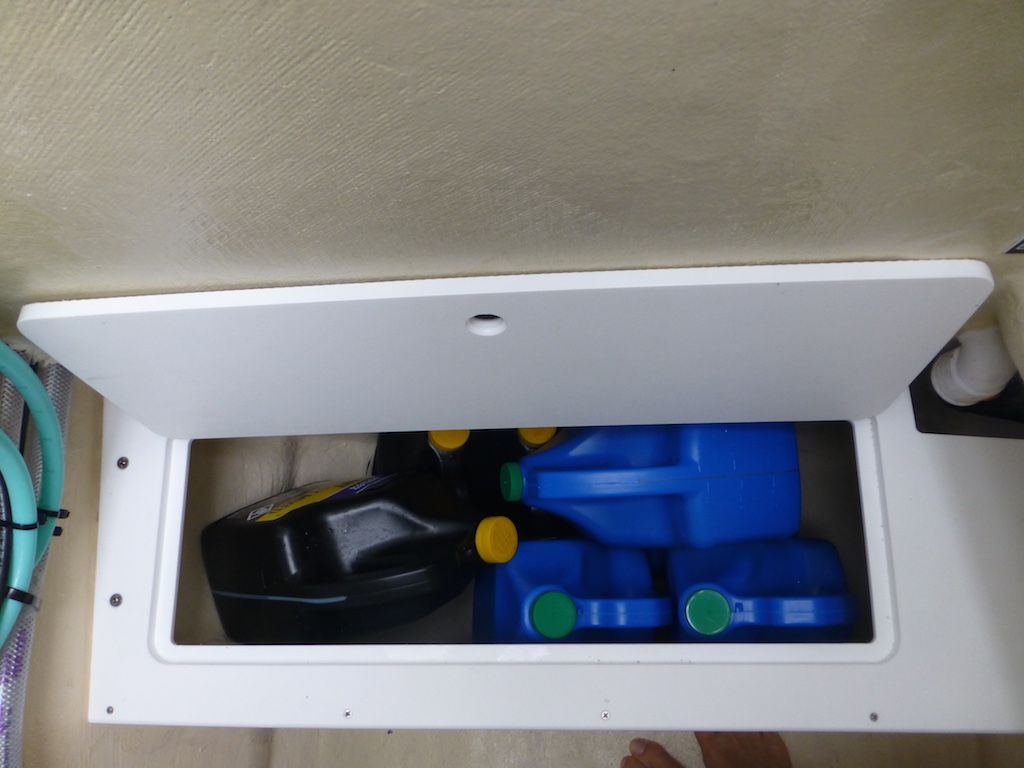
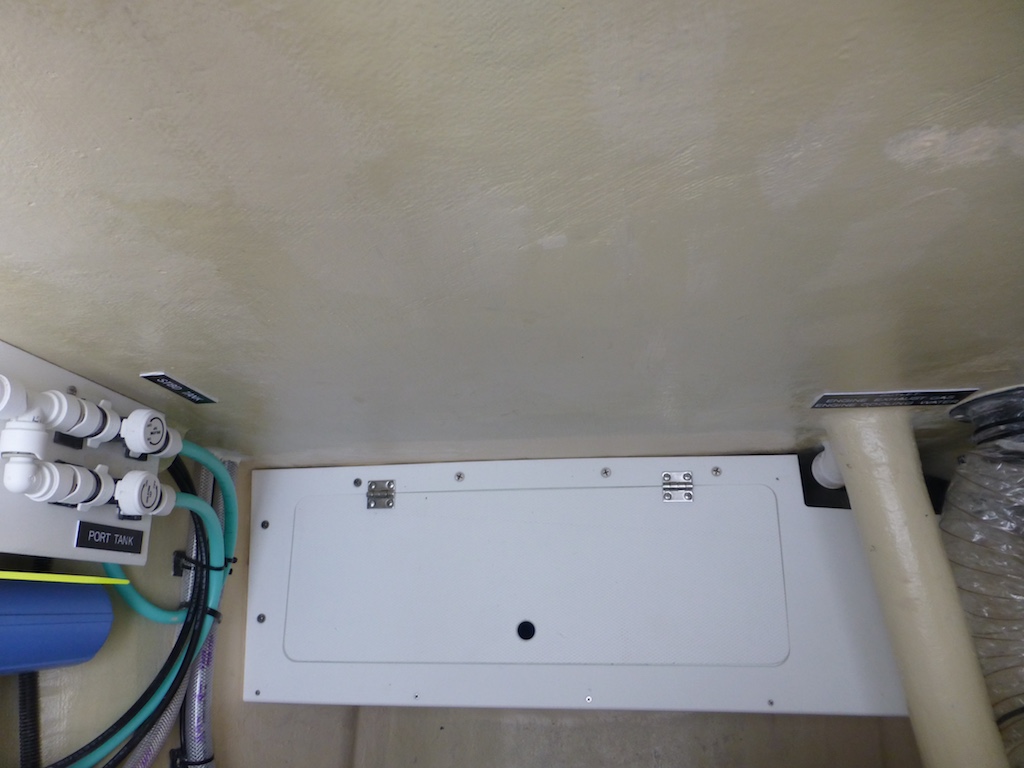
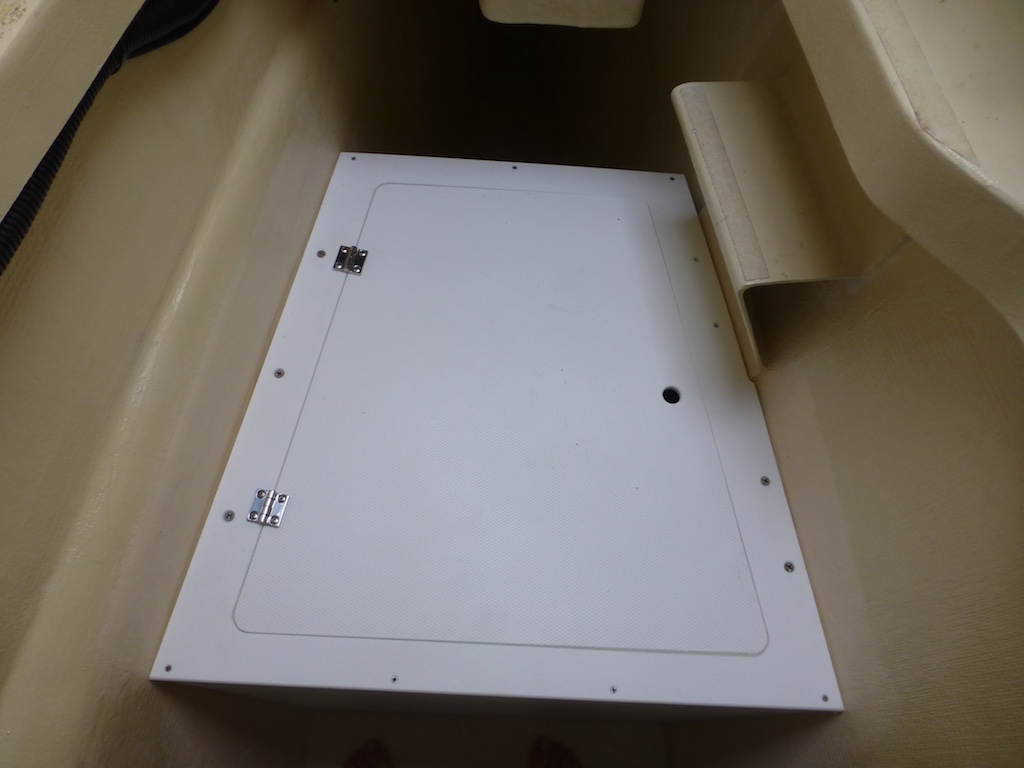
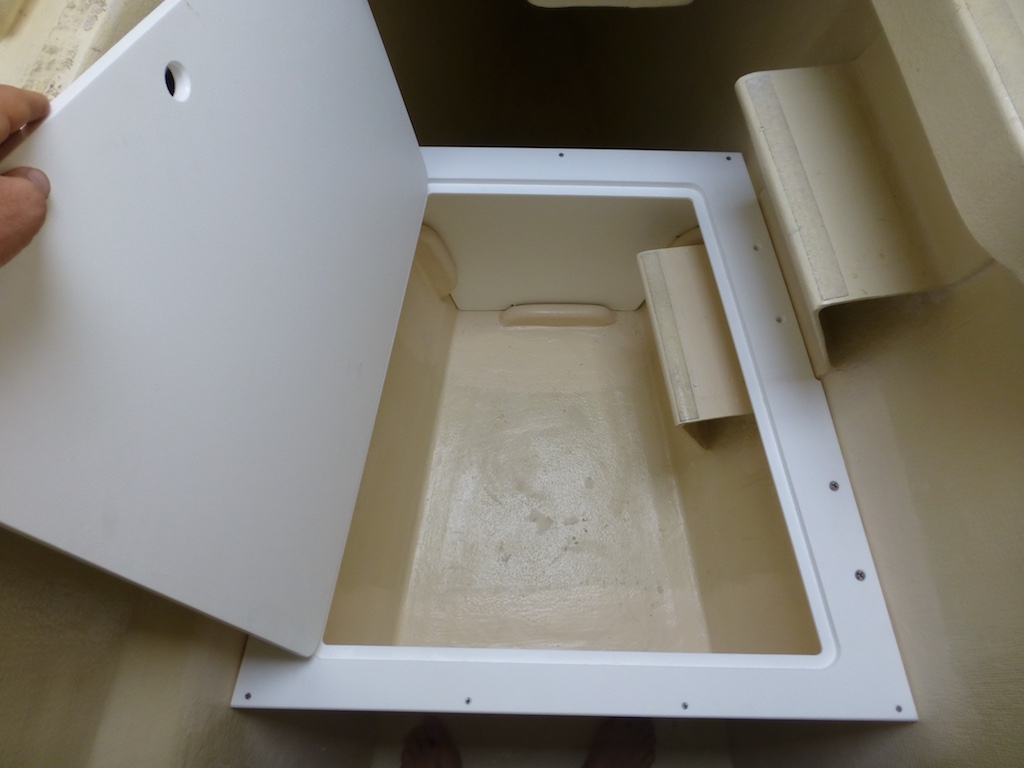
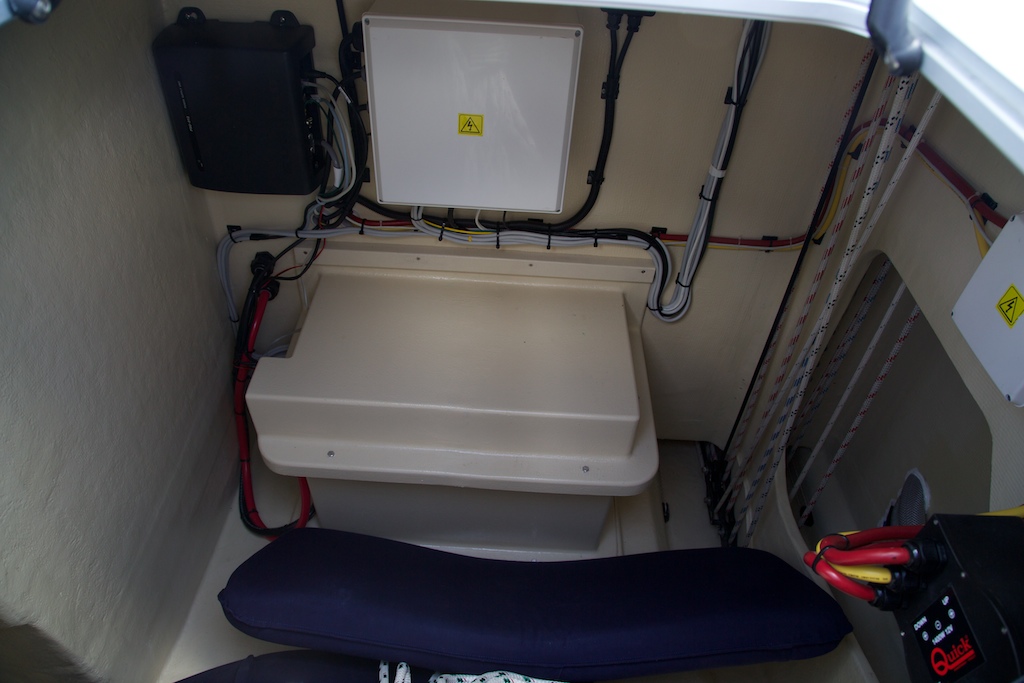
Permanent Storage boxes in the Genset locker and the Watermaker Locker

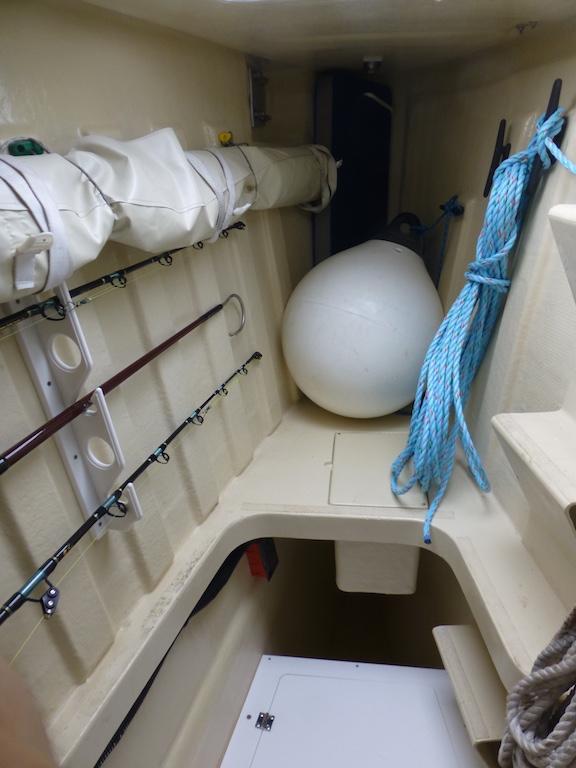
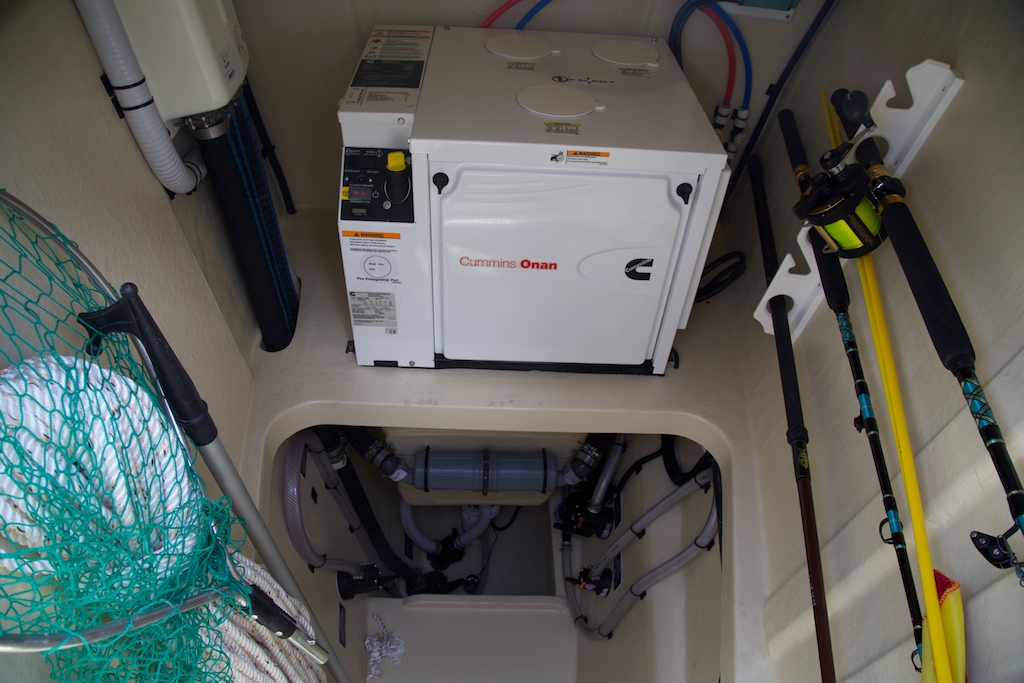
It is early days with this new creation but I love it.  Now engine oil, coolant, and other fluids have a home aboard Two Fish. The Genset locker box is so huge it can hold a large tub.  We store our baja filter, fuel siphon and other oily bits in this space.  The box also creates a space in front of the box for holding our oil extractor.  No, we are not starting a small fracking operation, this tool is for oil changes.  No longer do I have to tie down the oil cans.  Also entering and exiting the lockers is much easier now as the boxes make a great place to put your feet.  Finally, the boxes can be removed if necessary for some unusual service.  Maybe Antares will make them standard in a future boat?   Remember rule #1, do not mention my name if you ask for it.

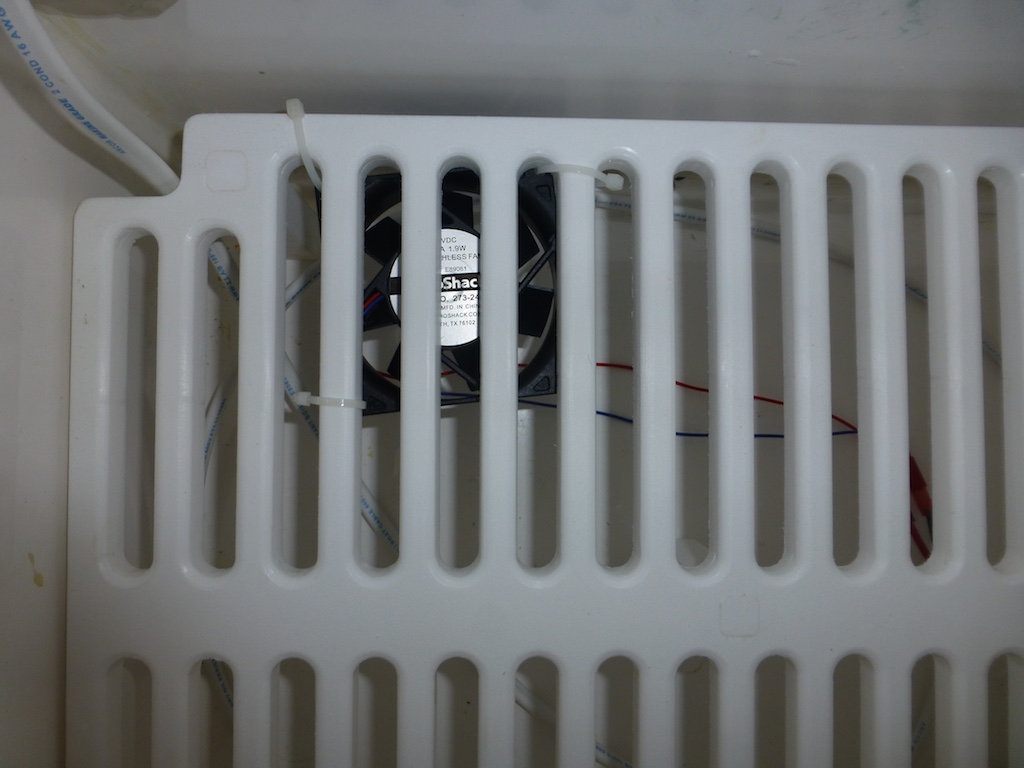
Fridge and Freezer Fans

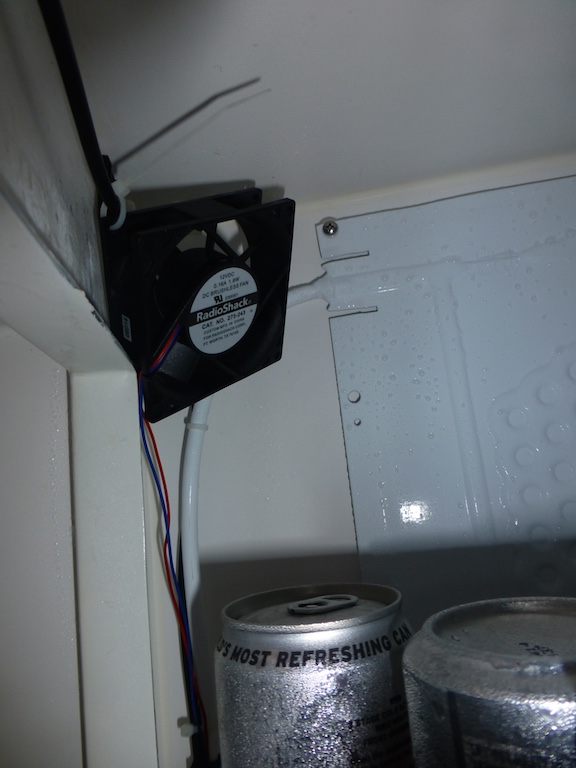
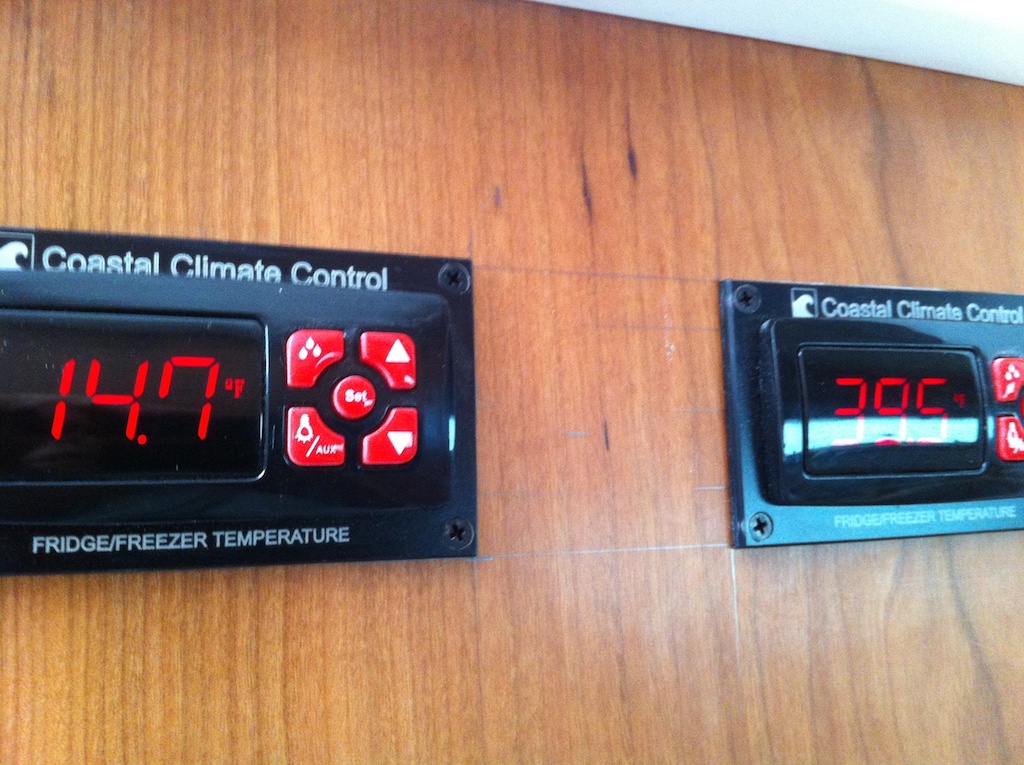
Marine fridges and freezers are not as powerful as our 110 Volt models onshore.  The symptoms that we have seen are excessive condensation, frost and troubles achieving and maintaining a very low temperature.   We have improved the fridge seals, ensured the proper compressor coolant pressure and have now added fans.  We hope to have the best in marine refrigeration.  The fans should address the issue of uneven temperatures.  Initial testing is good but serious testing will start when we arrive in warmer weather.  In Charleston, we could have kept our stores cold by leaving the door open.  We also upgraded the thermostats to a digital model.

Bilges

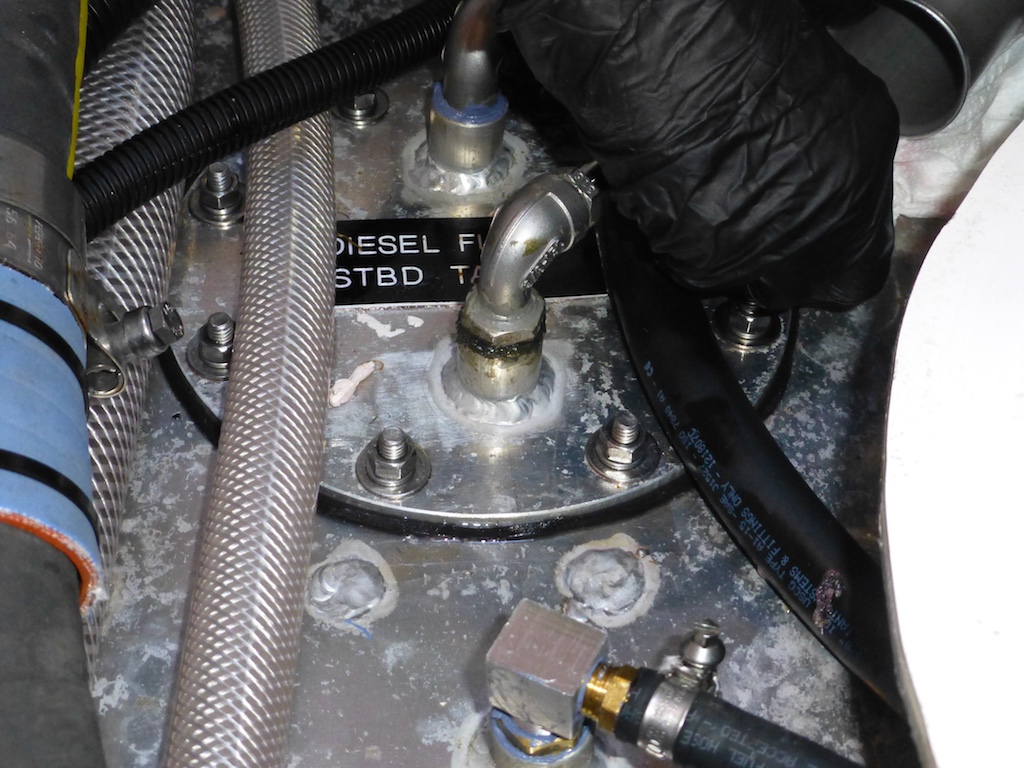
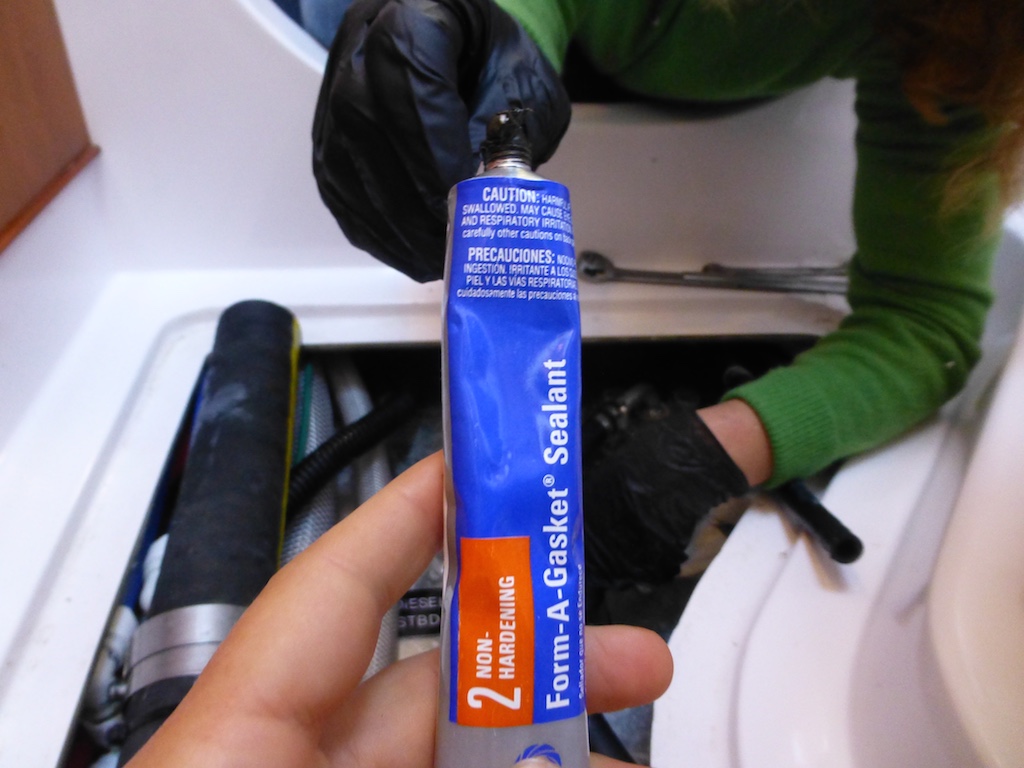
We had some initial problems with fuel not staying in the fuel tank.  There is nothing worse than the smell of diesel, but we eventually sorted out the problem.  First, we replaced the gasket in our fuel tank inspection port.  The previous material was failing under the assault of diesel with additives.  The new material is pricey, but Viton seems to keep the diesel in place and does not degrade.   Second, we tested the tank for micro leaks when filling the tank to full.   A few bolts were leaking so we re-seated them with a sealant known for is diesel resistant power.  We now have a tanks that keep the diesel trapped.
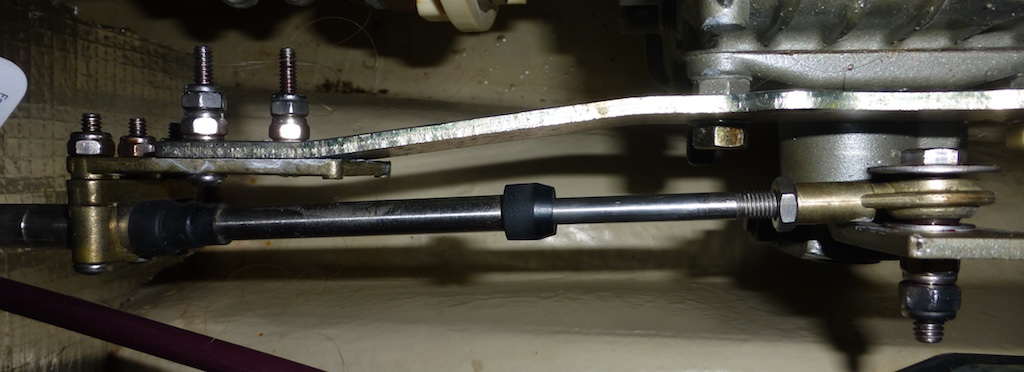
Bullet proof gear shifter

Bullet proof gear shifter

Our next bilge upgrade was preventive.  Antares Guru, James, told us about power catamarans that had the shifter connection come off. Murphy’s Law requires this failure to occur next to the fuel dock. Imagine that you are locked in gear headed at pricey boat.  For the cost of a few nuts, this seemed to be a worthwhile upgrade.  James installed longer bolts, extra nylock nuts and some Loctite to defer a visit from Murphy.

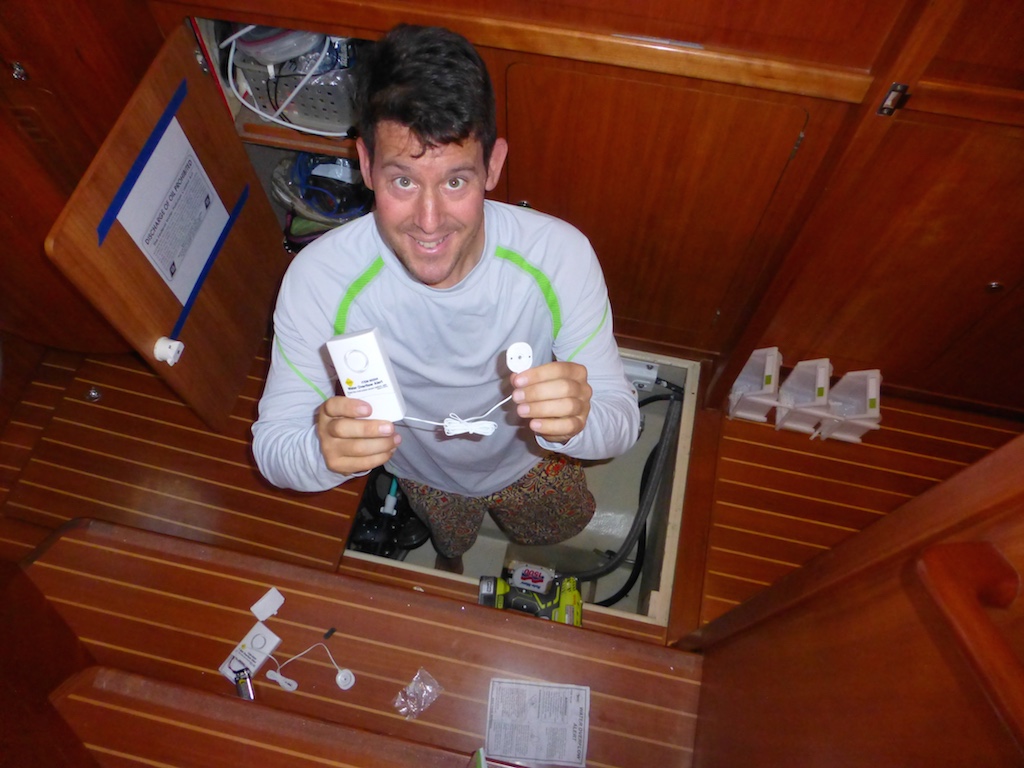
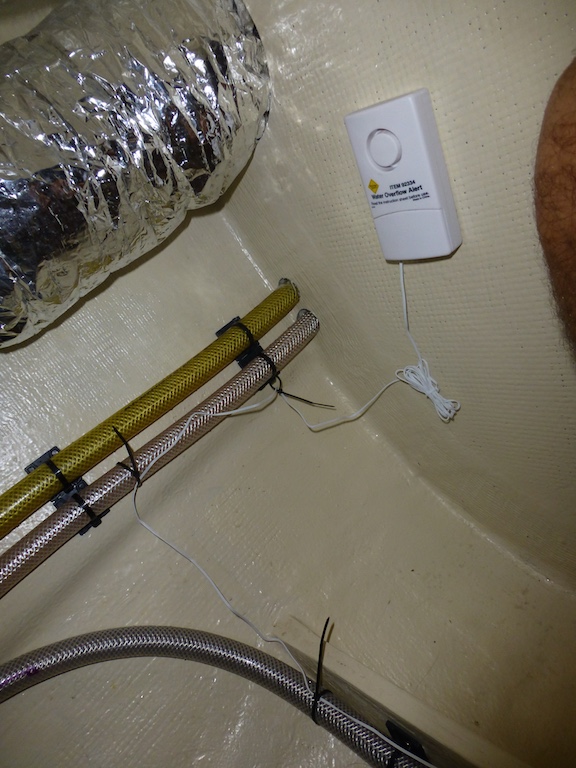
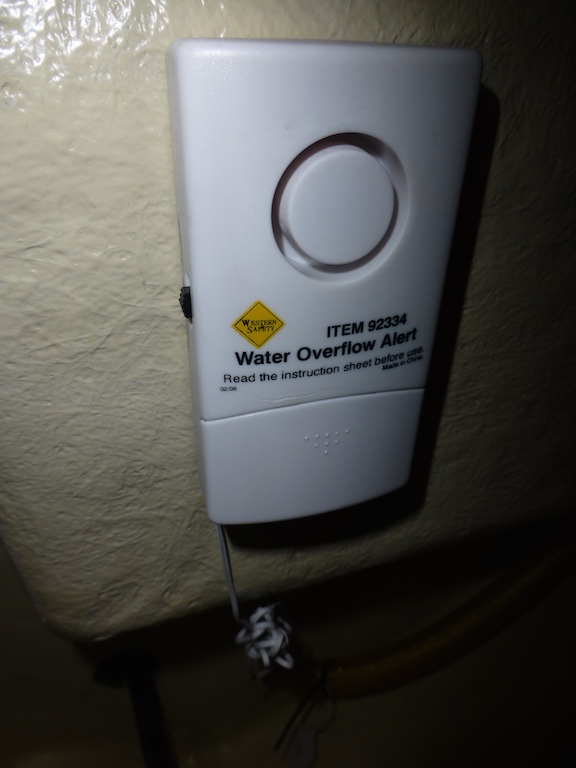
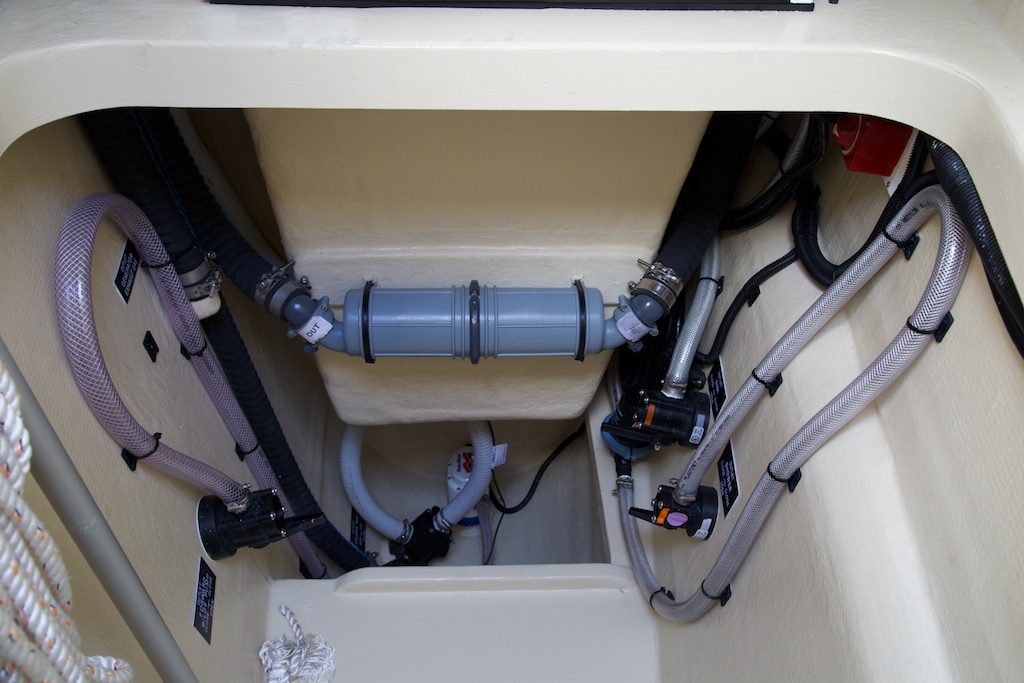
When we first got the boat, the watermaker had a fatal flaw and created a small pool of water in the bilge.  This led to fears about the boat flooding in strange compartments without my knowing.   We bought a bunch of inexpensive water alarms that run on 12 volt batteries and placed them near possible flood spots.  We also added limber holes under the master and guest bed so those areas could empty into the main bilges.

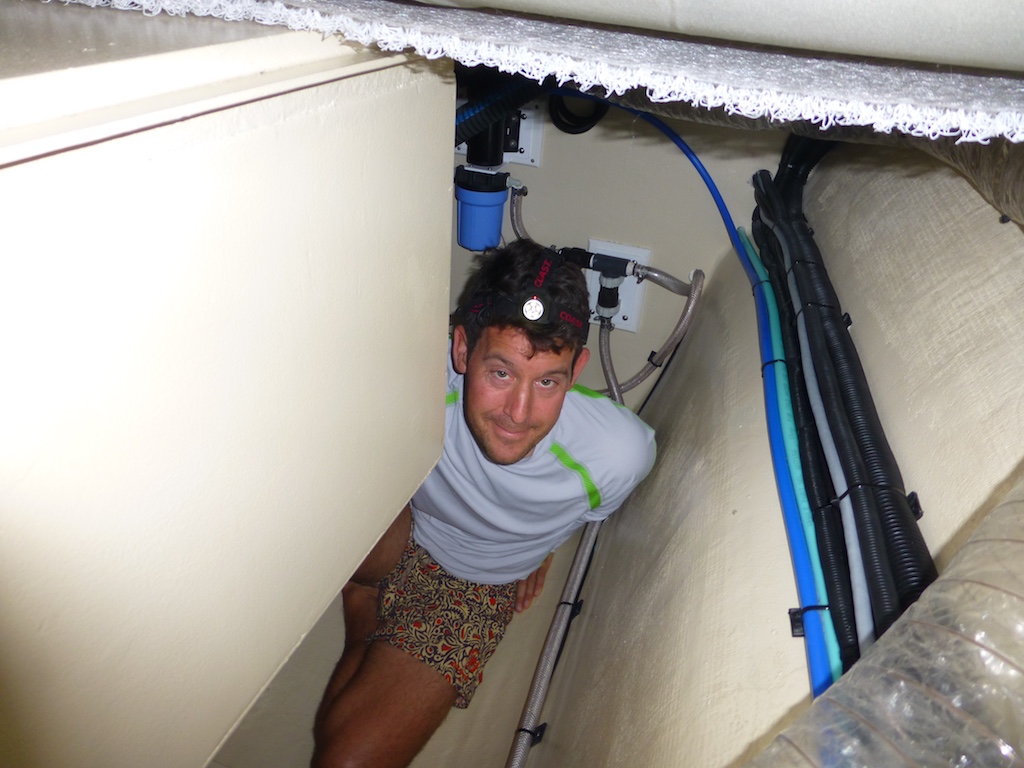
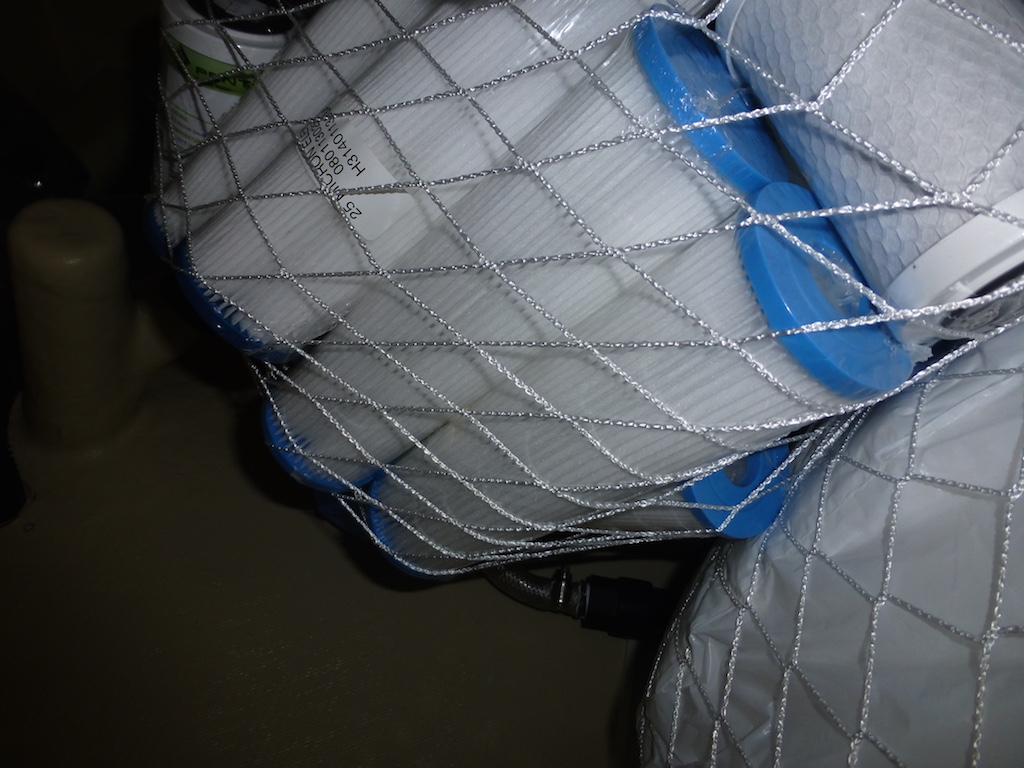
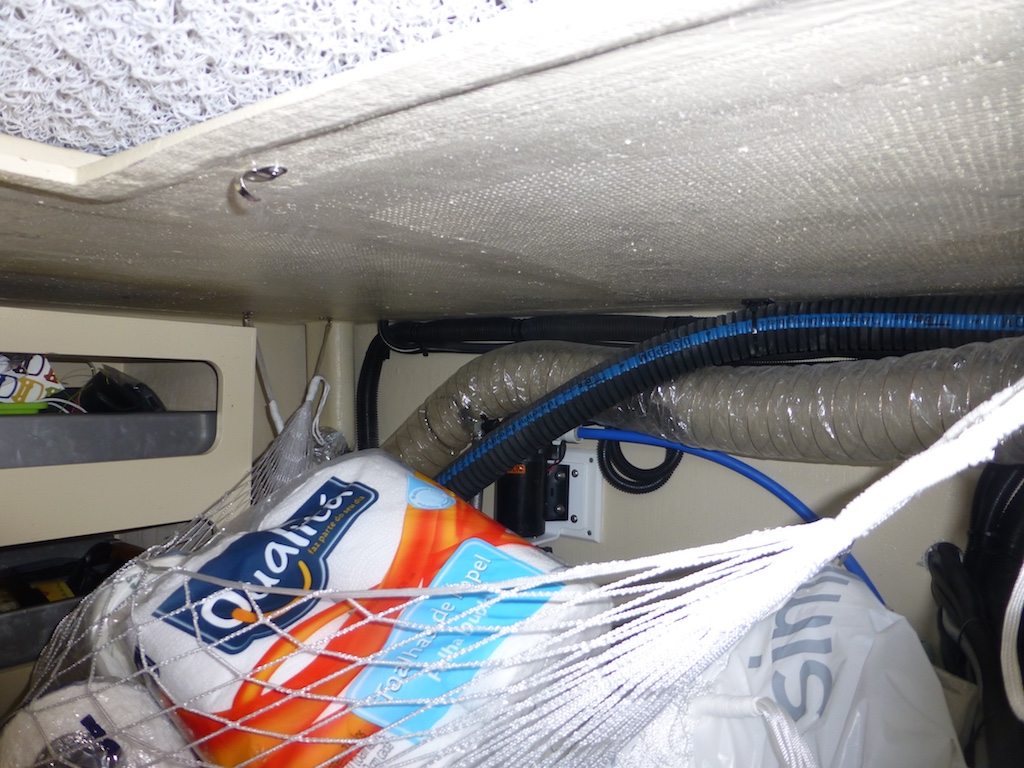
I have avoided storing anything under the master bed because the area contains the lift pump for the watermaker.  A year has passed since our initial issues, so I decided to store some rarely used items there.  Accessing this area is almost as easy as swimming to shore mid-passage.  Our huge collection of watermaker filters was a perfect candidate for remote under bed stowage.   I installed 3 gear hammocks that keep the filters, oil blankets and paper towels out of the bilge.

Clock and Barometer
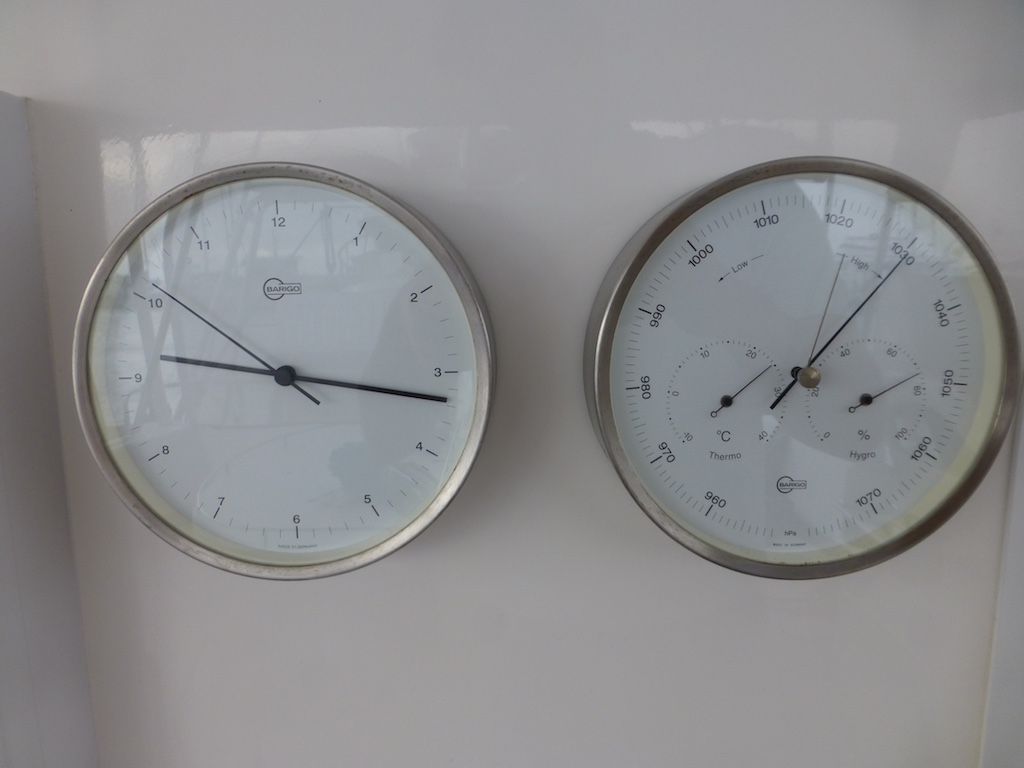
Barigo Clock and Weather

Barigo Clock and Weather


These units were chosen for their looks and not their accuracy as marine instruments.  They need to be polished to avoid rusting.   The weather device has humidity, temperature and the all-important  barometer.  We keep track of GRIB files with a high regularity and the barometer is not currently a huge focus.

website for the clock maker


USB for 12 volt

BlueSea USB

BlueSea USB


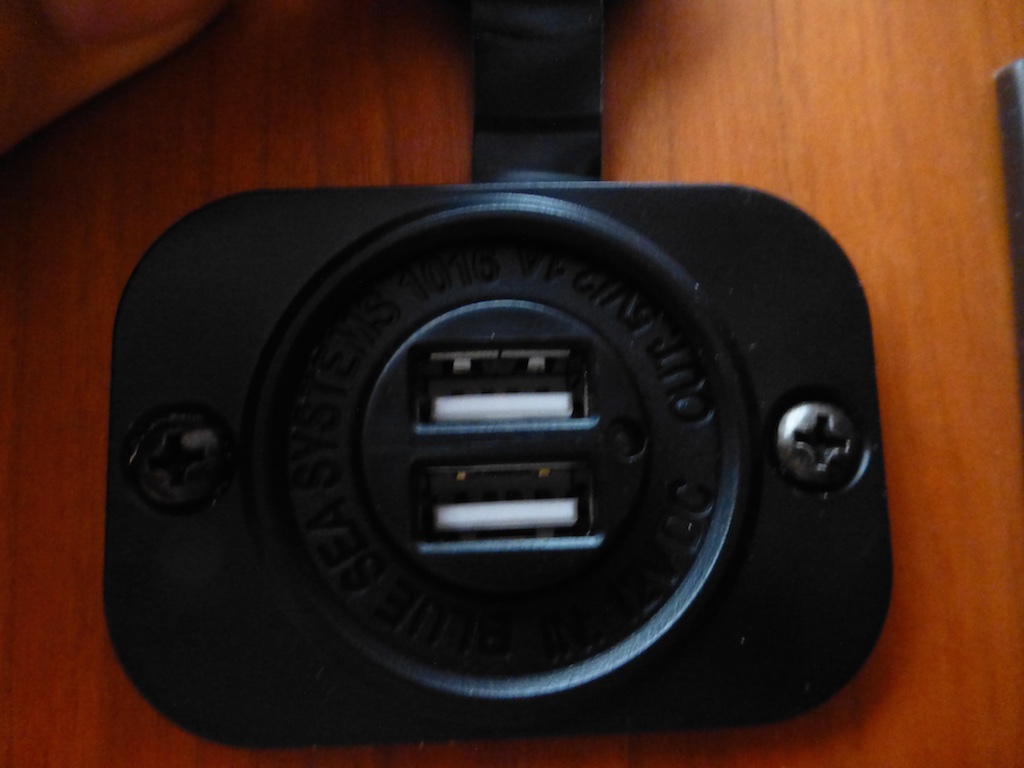
With our iPhone anchor alarms, iPad podcasts and other amp-consuming applications, we have a constant need for charging our Cupertino friends.  We had plenty of cigarette lighter style outlets, but the adapters always got warm; this deeply concerned me and curtailed their use.  Now we have replaced these fire hazards with a USB outlet from BlueSea.  They work great and should be standard on all boats.  Check out this post on the charging or take my word for it.


Canvas Customization

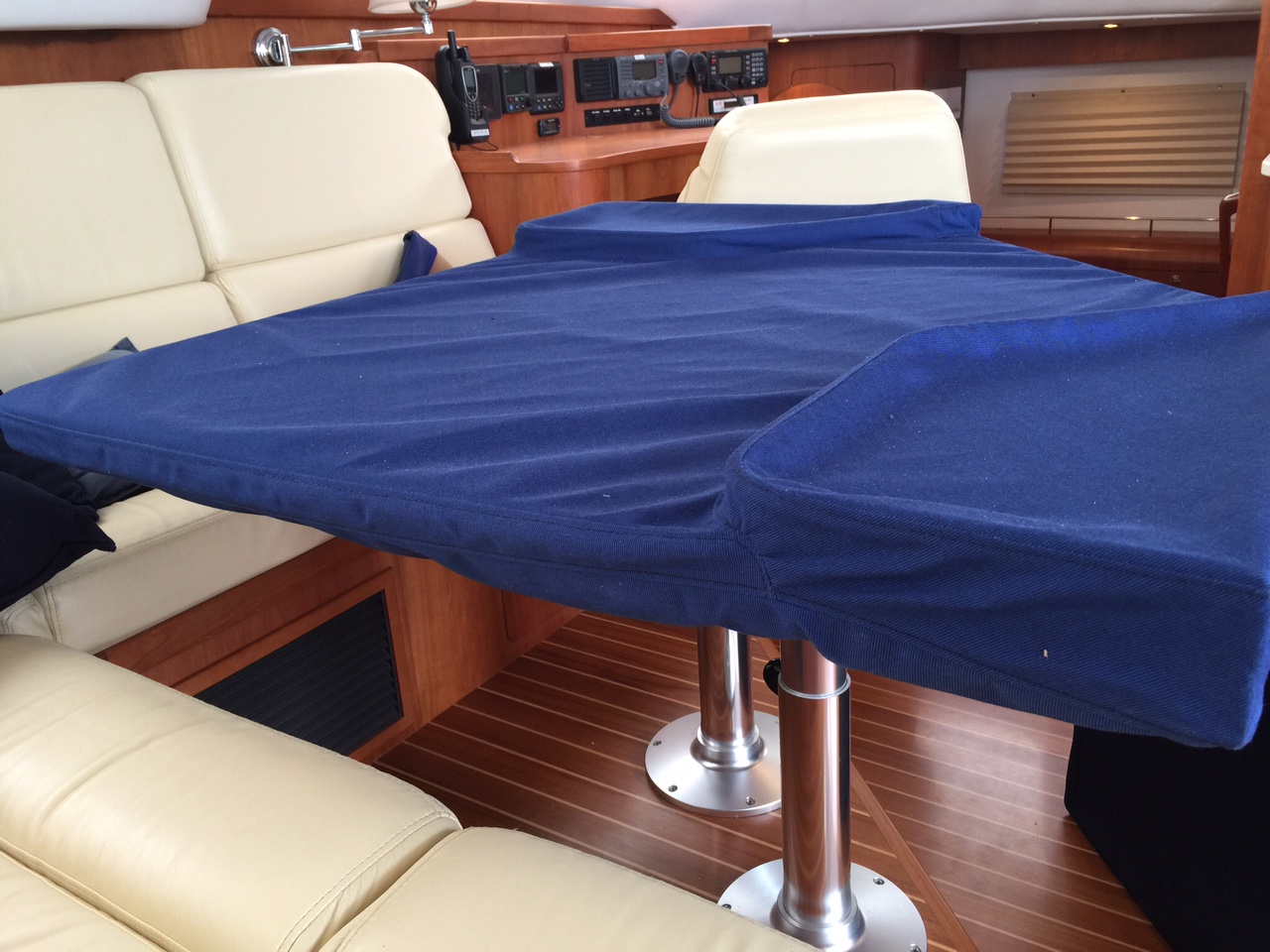
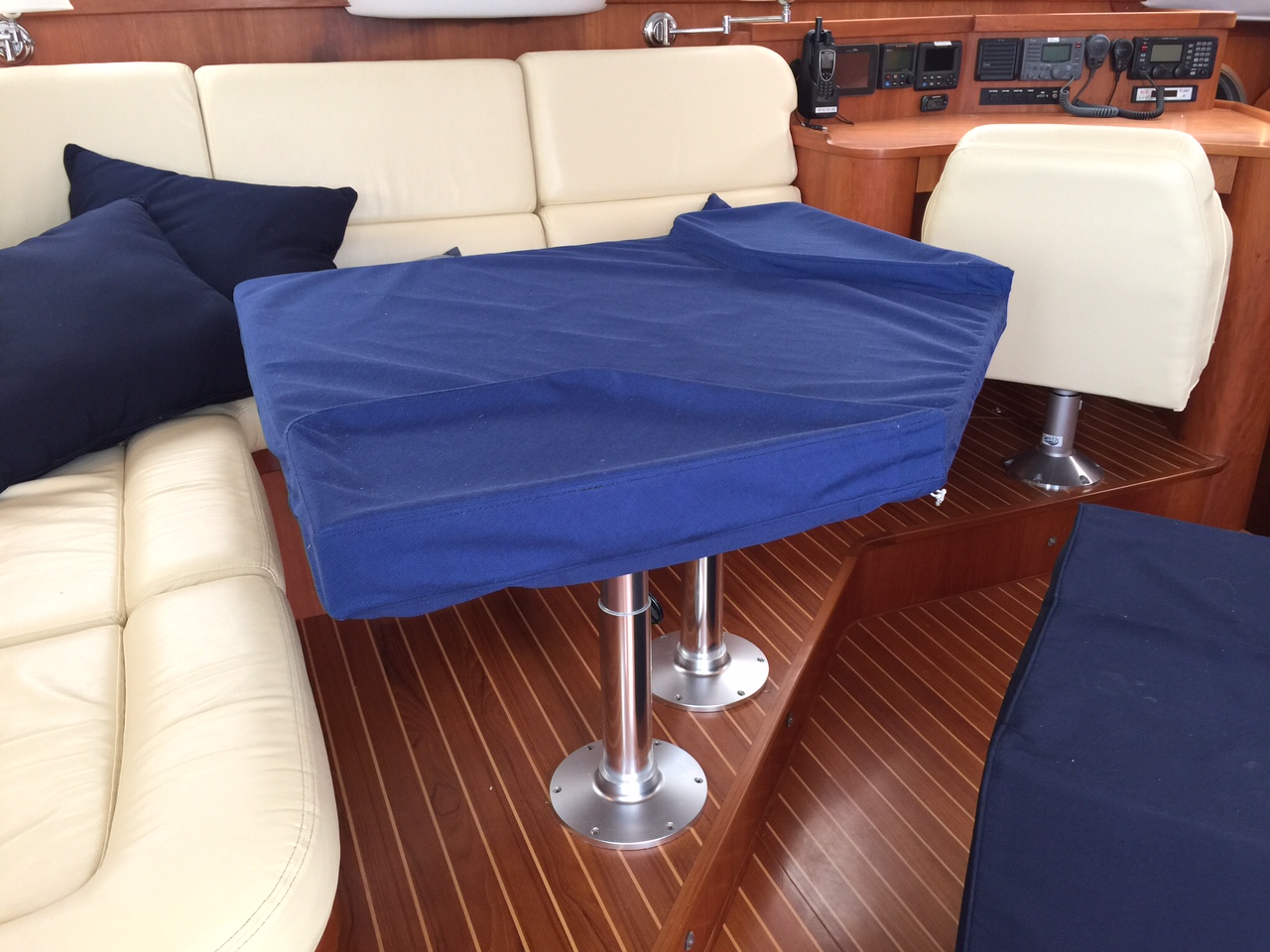
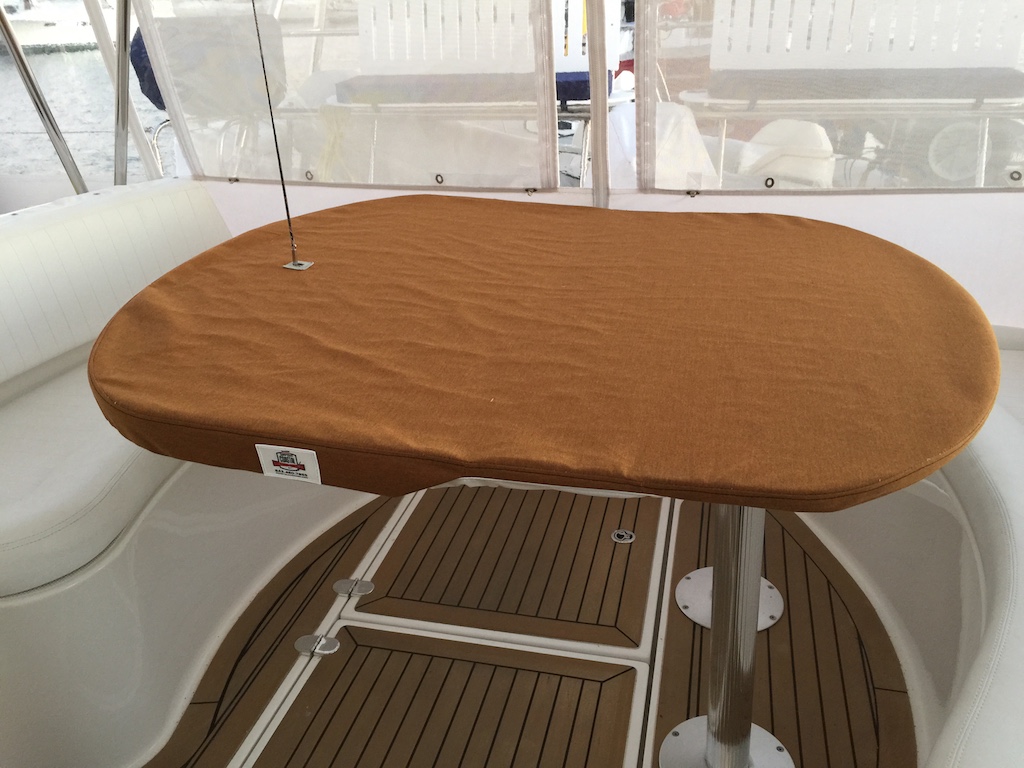
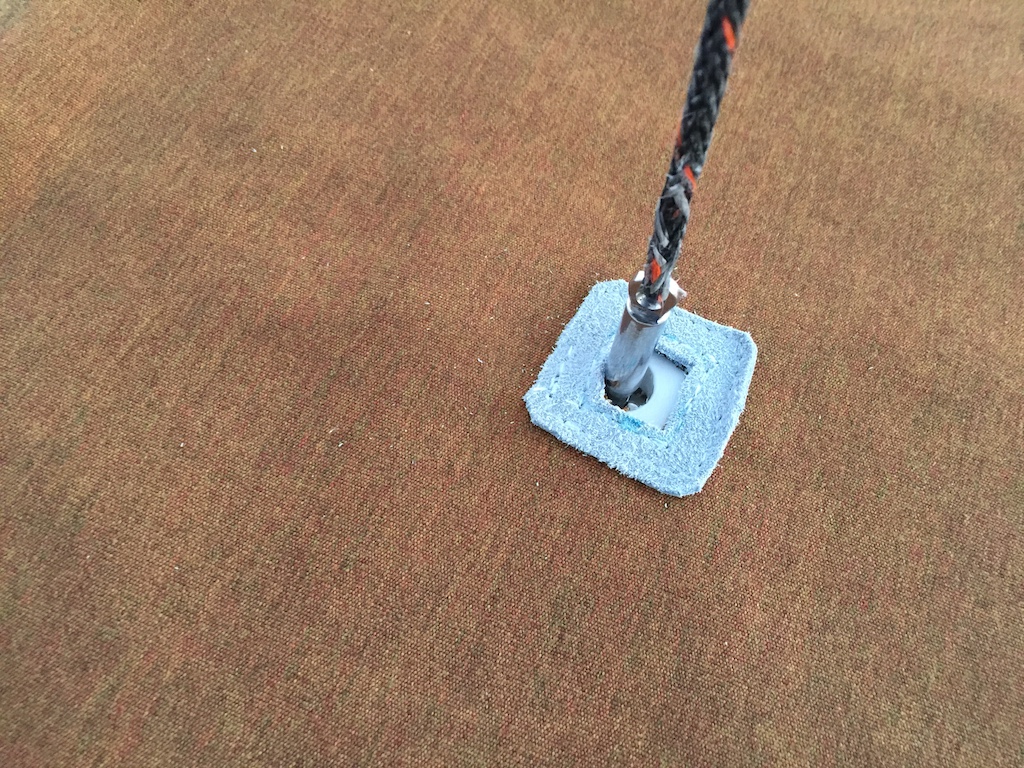
“Hello sir. I would like to buy two table cloths.  The first is for a table that is sort of oval with a line holding it up at one end.  The other one is more complex, has wings and is a pentagon.” said Gail.

“Please leave the store” said the store employee.

That is what would happen at a department store if you asked for the two tablecloths we had custom-built in Charleston.  The canvas shop was efficient and made a quality product.  It is a joy to have a proper table cloth for outdoor dining and the indoor cloth protects the table during passages.

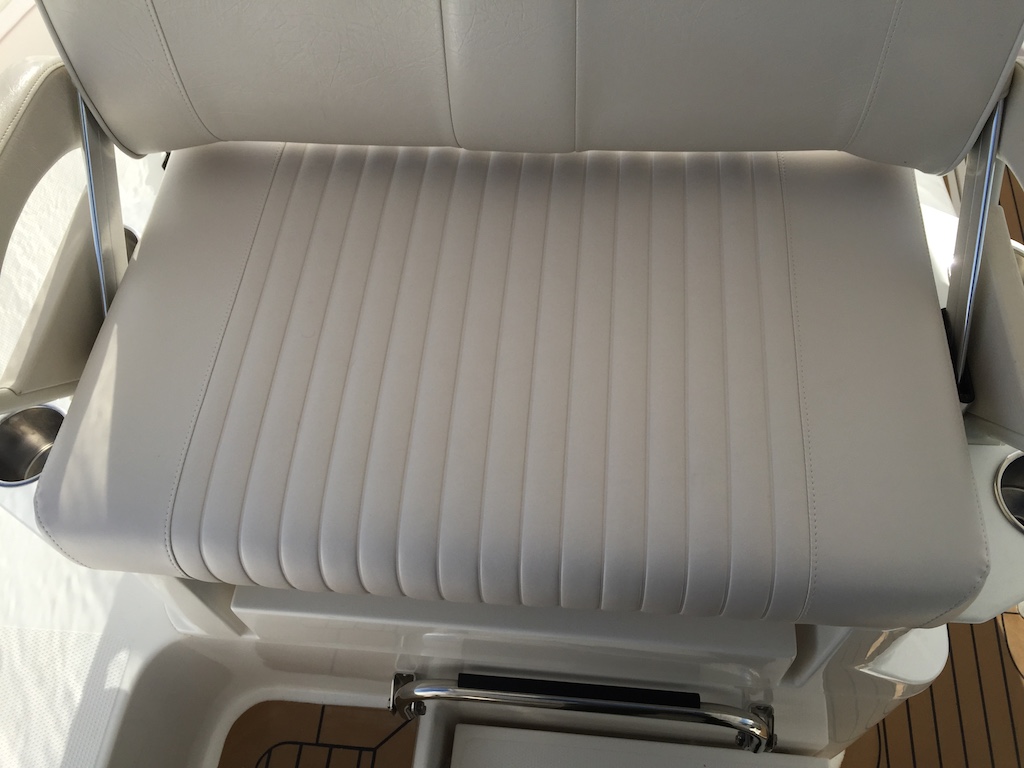
We never loved the quasibucket style design of our helm seat.  It had padding that pitches you forward at an odd angle and a ridge in the middle.  Also, a key seam failed on Two Fish and some early boats.   I think the seats are now made with a better material so the failure is less likely.   The manufacturer sent us a replacement seat but we chose to construct a new design.  This design is flat and matches the pattern of the cockpit cushions.   So far it has been very good for both of us, especially as we like to sit in the lotus position while on watch.

Preventer system

This creation is over-engineered.  Or may be over Jason-ed as the engineering might not pass muster at an MIT inspection.   The system has the goal of being an easy to operate preventer. (For non-sailors, it is preventing the boom from violently swinging over to the other side if the wind shifts.)

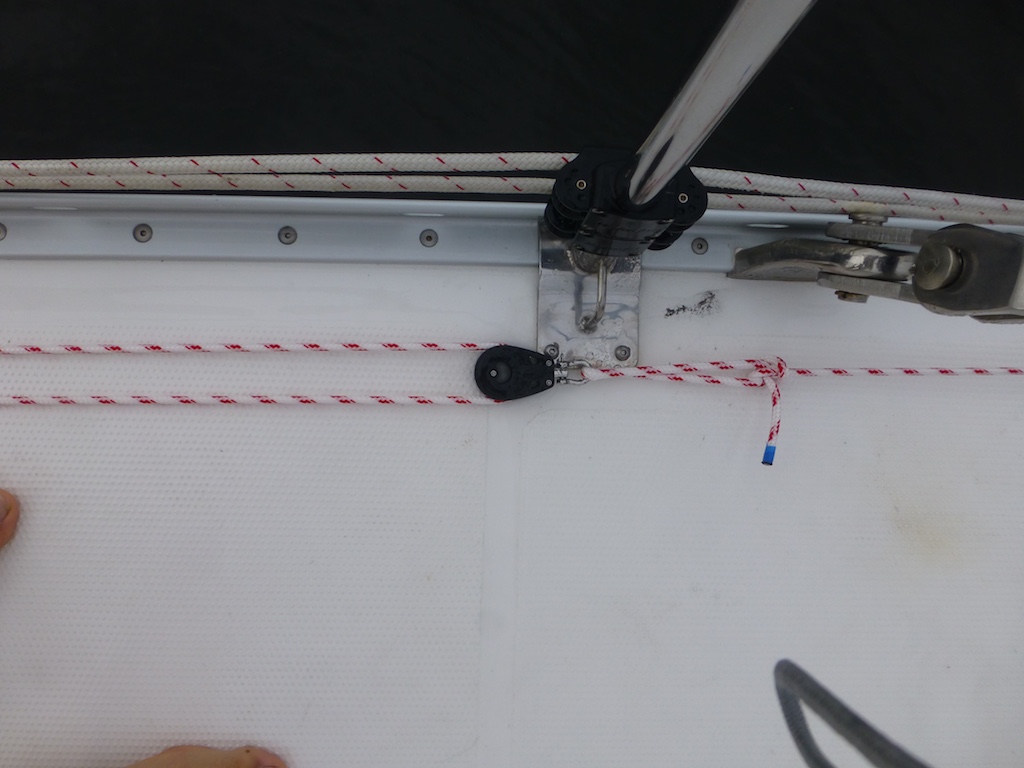
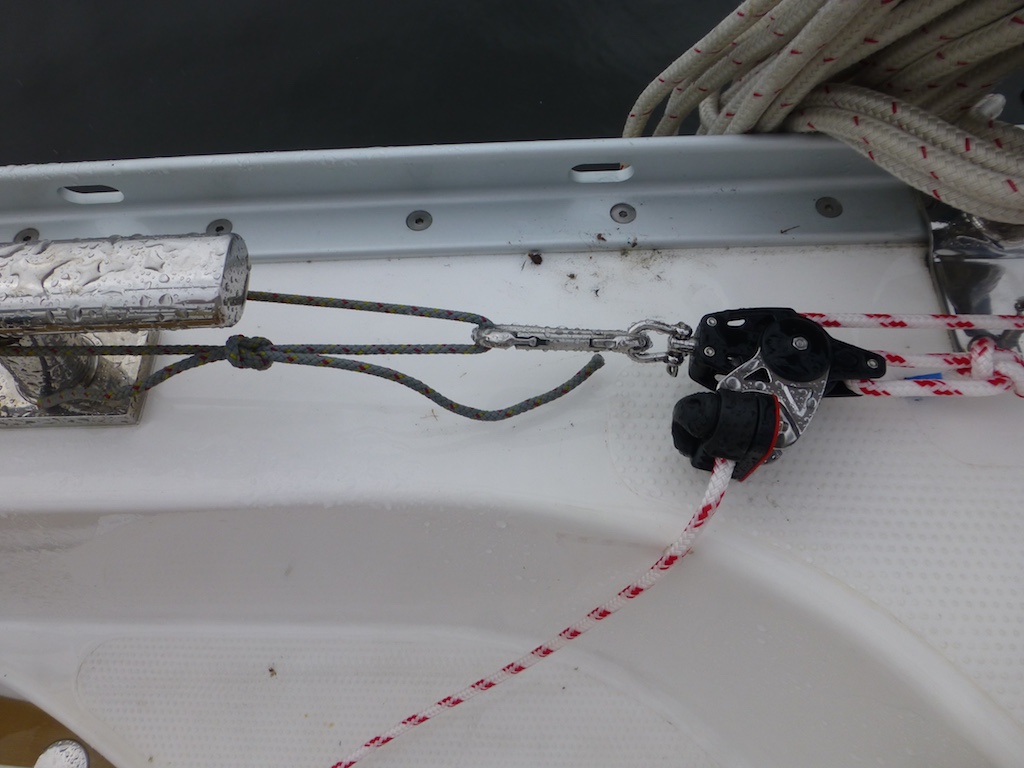
1)   When not in use, only a loop remains attached to the end of the boom.  This makes for a cleaner cockpit.

2)  When it comes time to use the preventer, it is easy to attach.  A simple clip system from the preventer attaches to the end of boom loop.

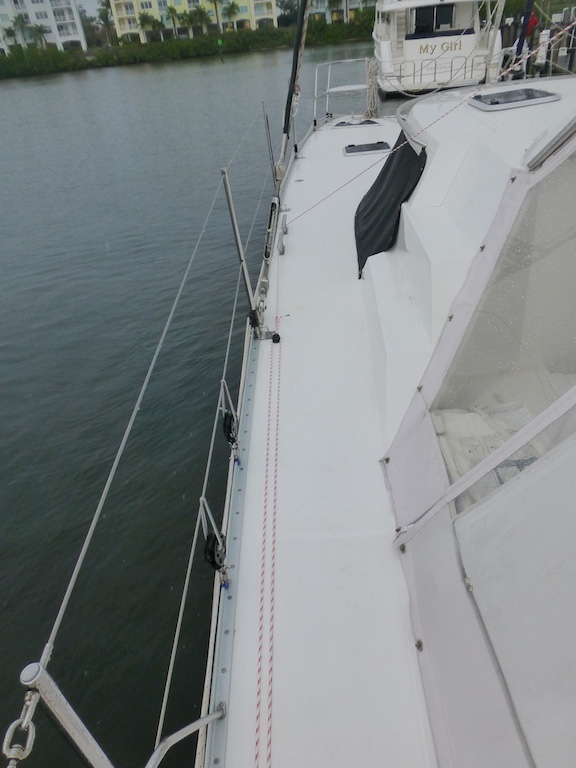
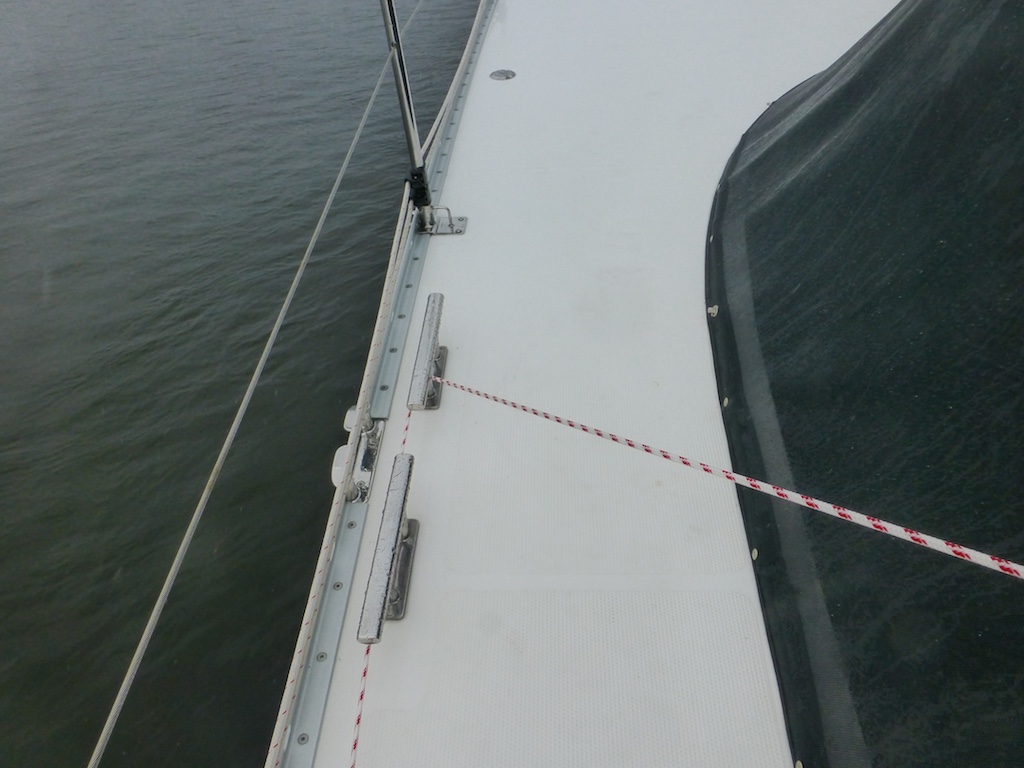
3)  The preventer line uses the mid-ship cleat to turn the line aft.

4)  Finally, the system has purchase and is controlled with a repurposed dinghy mainsheet block.

The traveler on the Antares is basically a preventer since the mainsheet is kept short.  Remember to cleat BOTH sides of the traveler at all times.  The preventer is another layer of protection from  accidental jibes and also can be used to shape the main sail.   A less obvious usage is to reduce mainsheet slap.  The Antares mainsheet passes under the salon and in lumpy seas and light air the mainsheet will slap the bottom of the salon.  Nothings gets me on deck faster than hearing the sheet slapping the underside of the salon.   My best technique to eliminate this noise is to ease the vang and tighten the preventer.   The new system is easier to tension than the old one (a simple line to the cleat).

Other Rigging changes

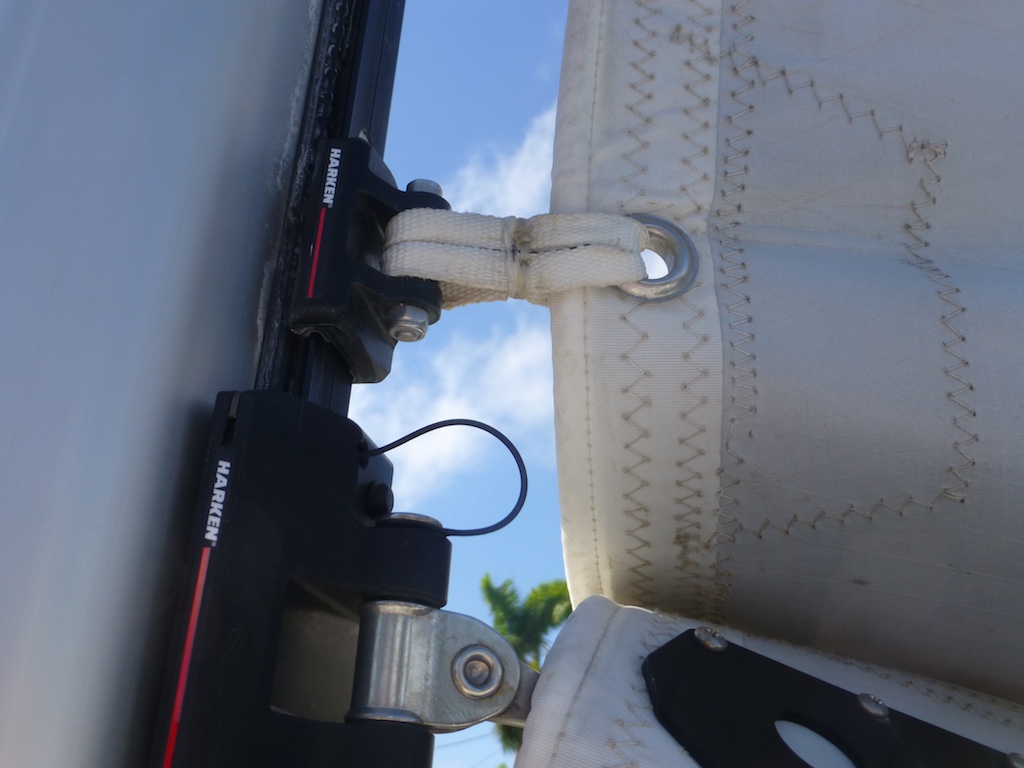
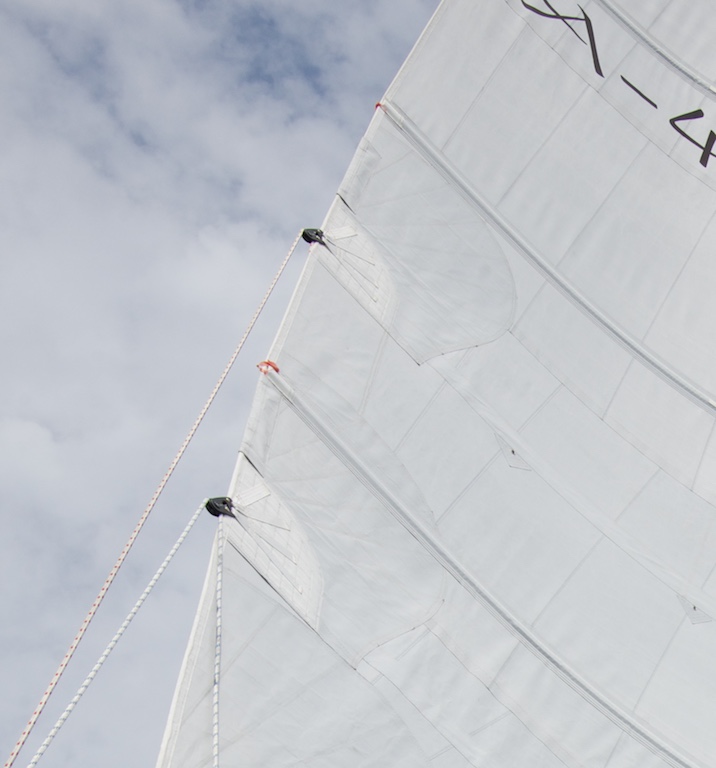
We disagreed with the design of the mainsail cars on the Antares. Before you take my word as gospel, there are many boats that have sailed 10,000 miles without incident with the factory set-up.  The factory set-up uses small harken cars so that when the sail is dropped the head is not too far off the deck.  This is a laudable feature but does not give the most robust Harken solution.  We installed batten cars at every batten and reef cars at every reef point.  The intermediate cars standard on the boat are friction sliders and they were replaced with ball bearing cars.  This may be overkill, but it allows for smoother drops and a more robust attachment of the main to the track.  We re-cut our sail cover and added a few mast steps to adjust for the higher mainsail stack.  Gail can still put on and remove the sail cover.  She can also frap the main halyard with a little help from the boat hook.

Organizing the Genset locker

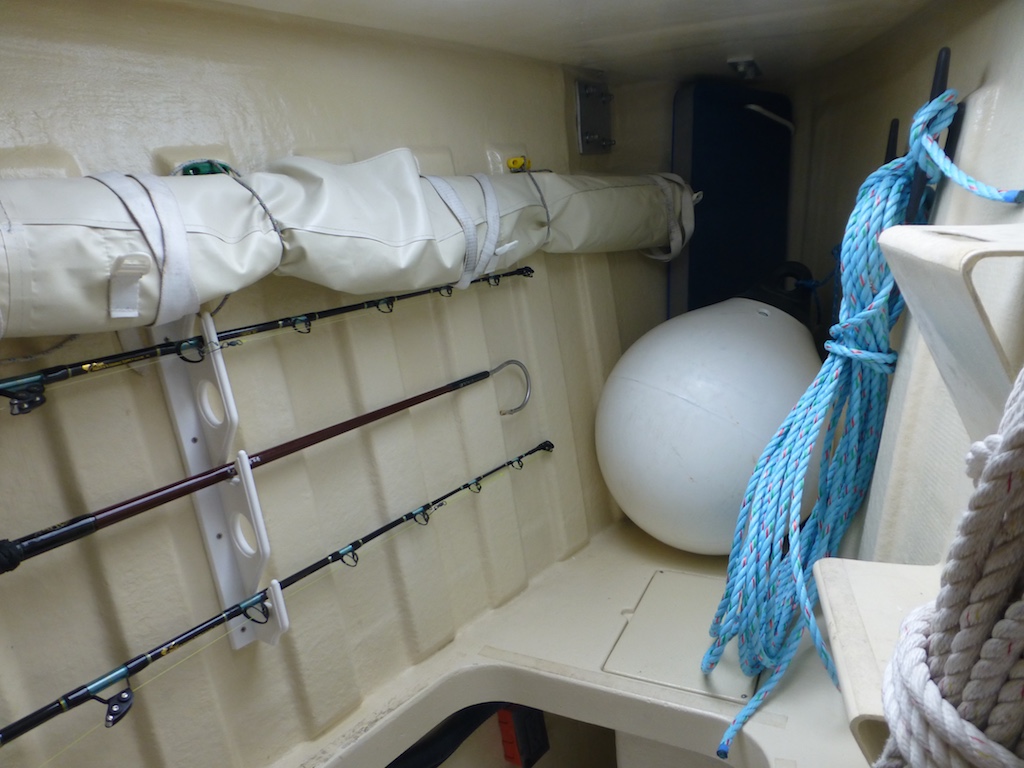
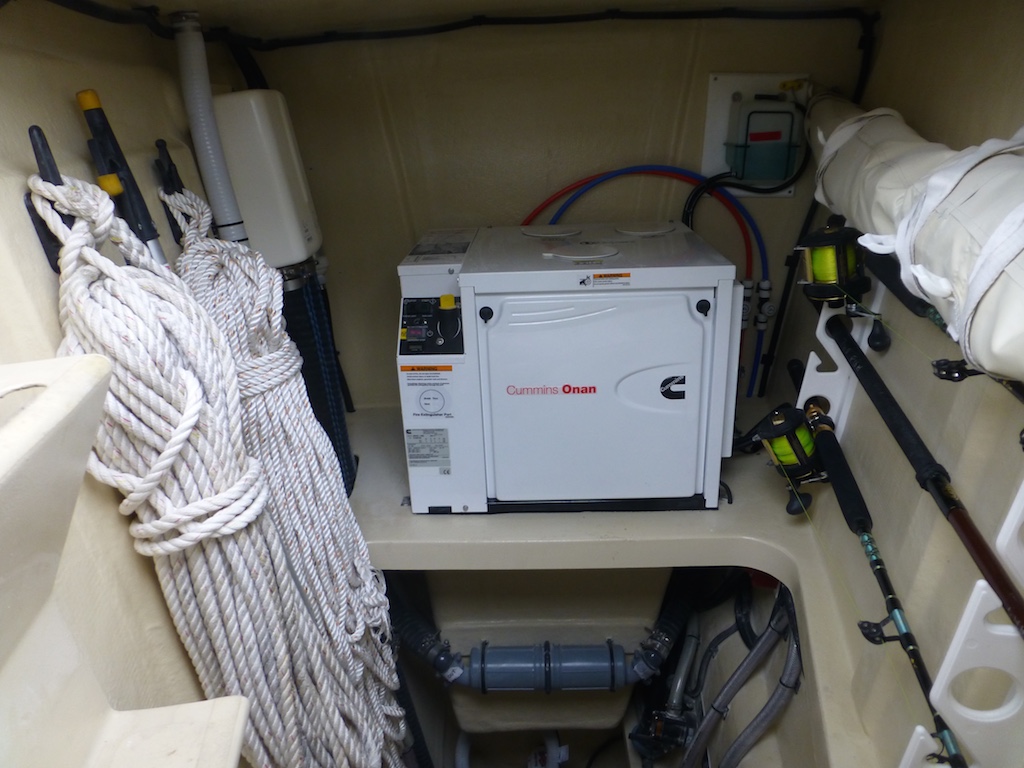
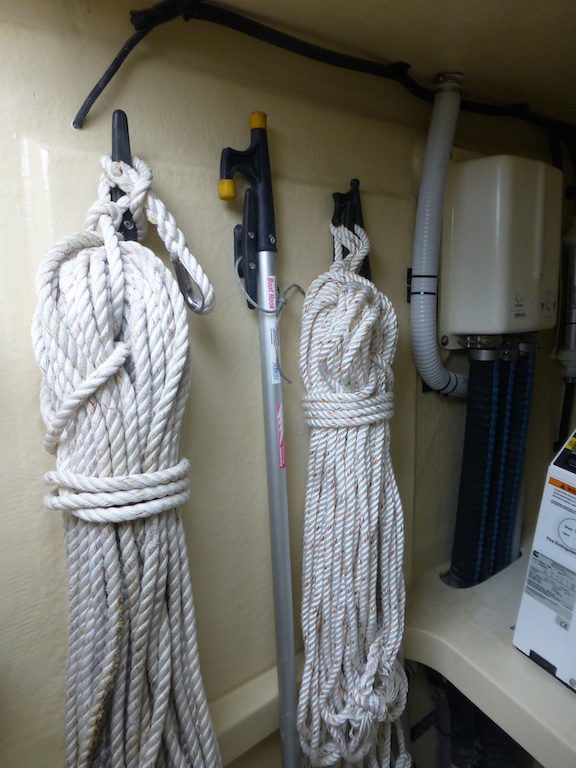
The Genset locker holds long lines which are useful in narrow rivers and tight anchorages.  They are also useful when warping or leaving a Med moor.  One line is 300 feet, the other 150 feet and the final is 70 feet of propellor avoiding polypropylene used for grabbing mooring balls from the stern steps.   The fishing polls are out of the way and there is a custom place for the aft sunshade.  Most owners store their sunshade on the dinghy arch.  The genset locker is so organized and clean, I am thinking of inviting guests over for drinks in the locker.
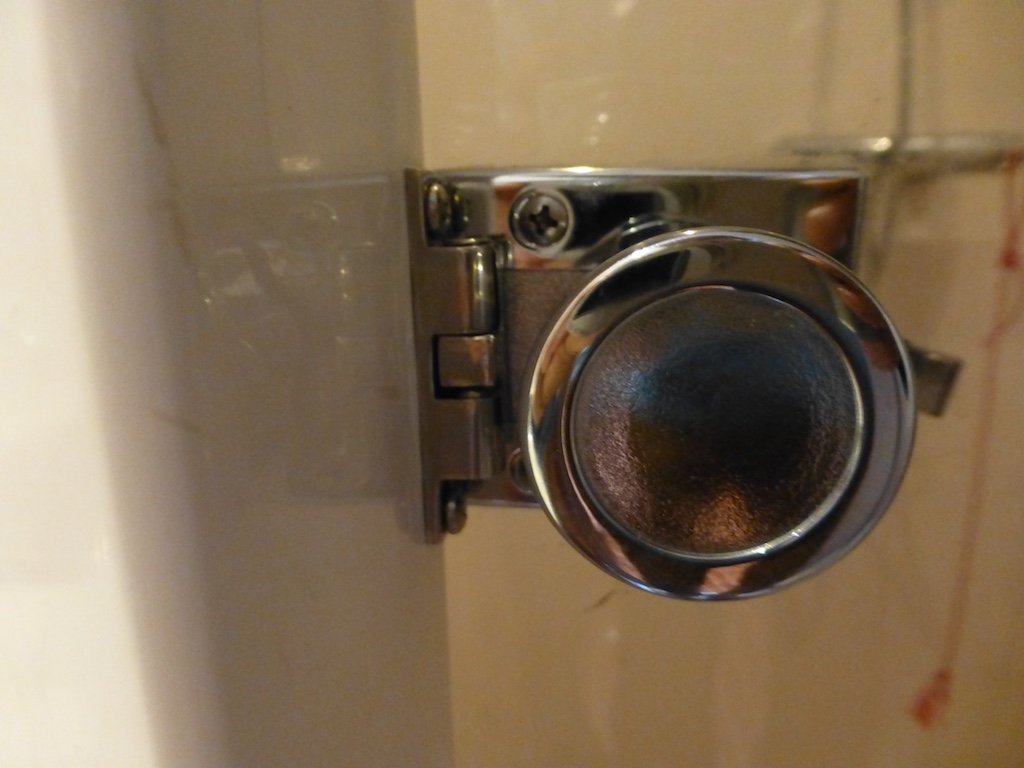
 

Slam Latch left of knob

Slam Latch left of knob

Shower door lock

In big seas, the master shower door can fly open.  Many owners sail blue water with an extra line tied from the door handle to the sink.   Effective, but hobo style.  Two Fish added a slam latch to the existing latch.   The latch can be adjusted via a screw to create the correct pressure to keep the door closed in a big sea.  Better yet when the factory makes  a new door they need to hang it such that the mechanism goes deeper into the catch.


VHF position

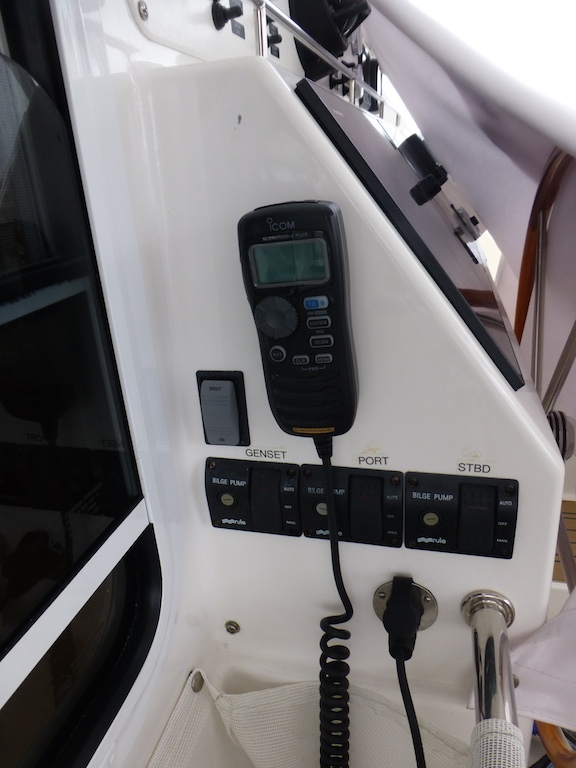
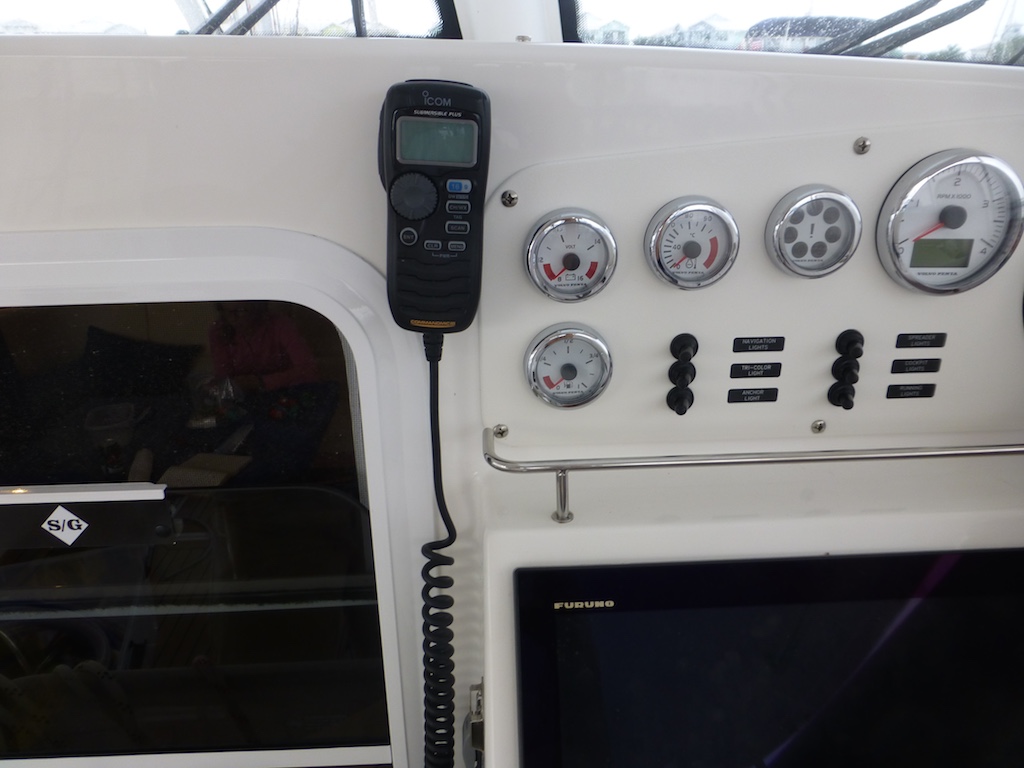
Many boats install their VHF above the bilge pumps.  One person can then be at the helm, and the other can operate the VHF.   However, the flaw with this installation is that the VHF speaker is facing to port and is hard to hear while helming.   The solution is to add another dock for the VHF higher up so it can be heard by all and reached by all.  When the trip is over the VHF returns to its old dock where the canvas cover protects it from exposure.  Small change but big benefit when transiting the ICW where there are frequent communications.

Entertainment cabinet

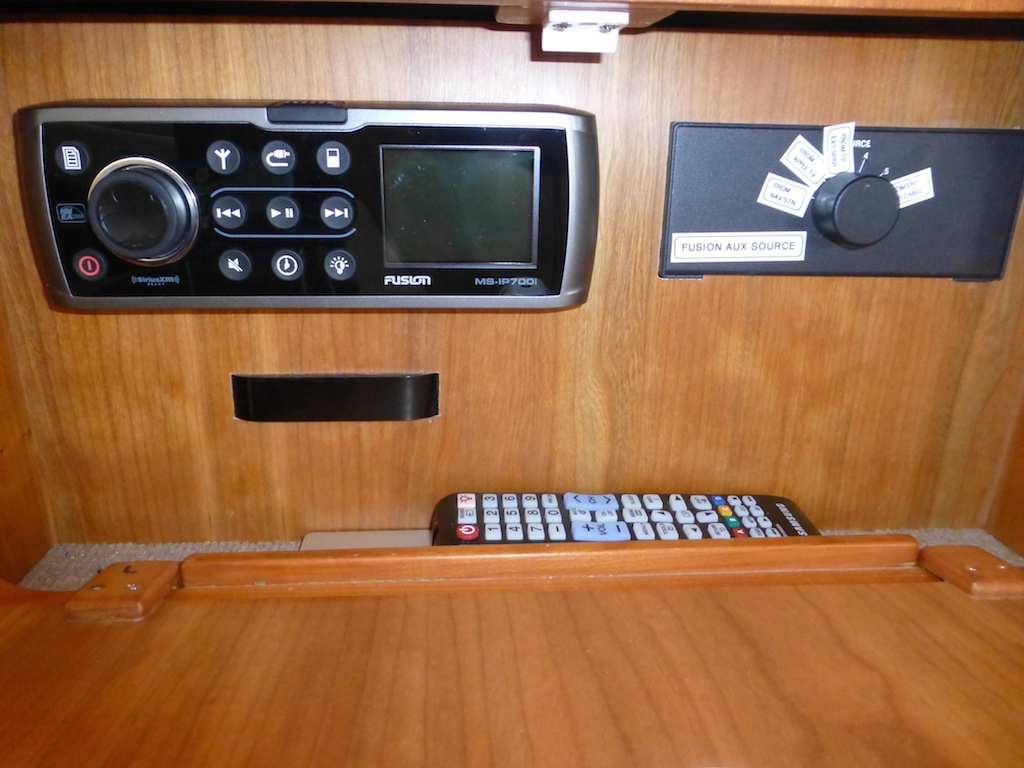
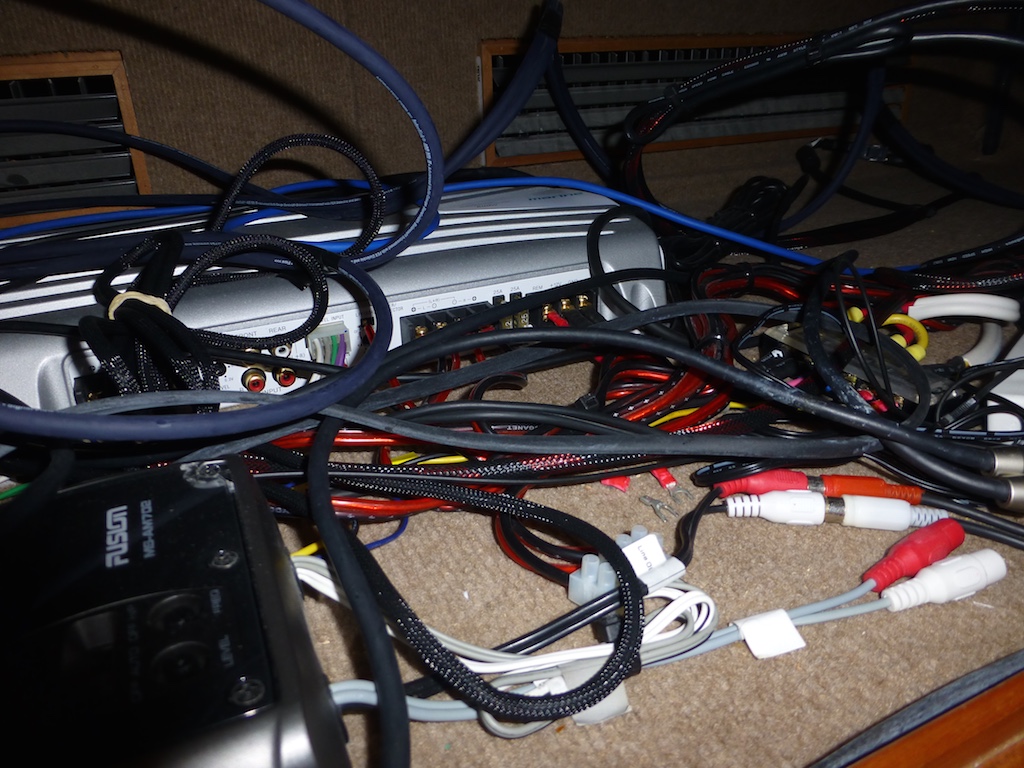
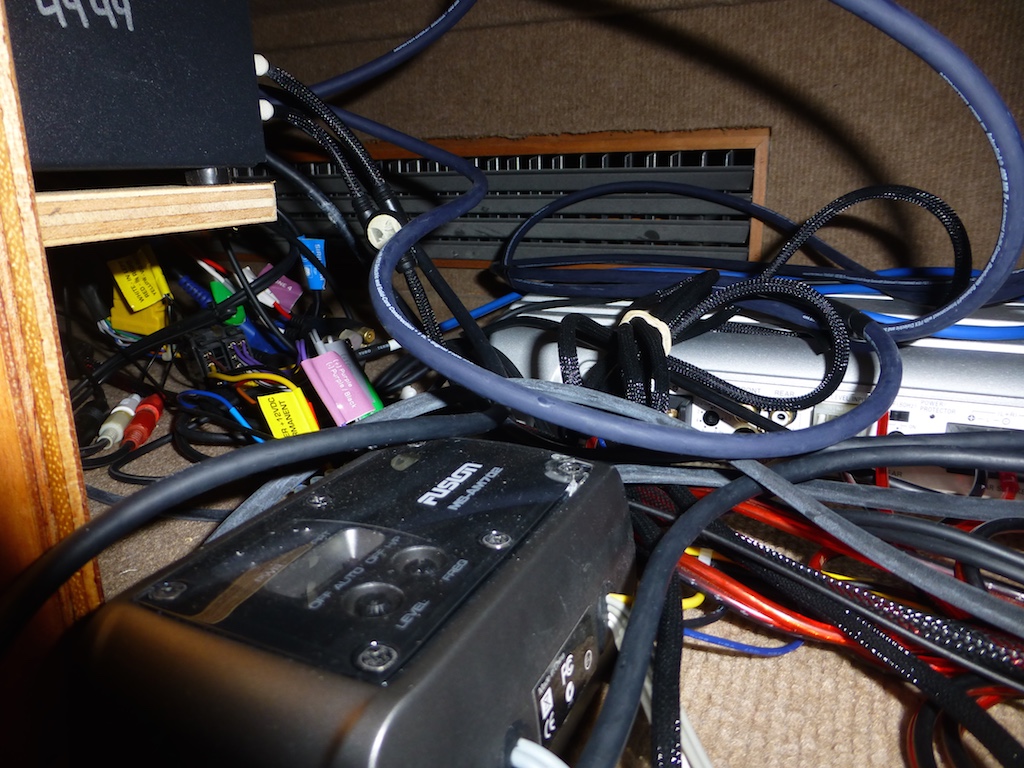
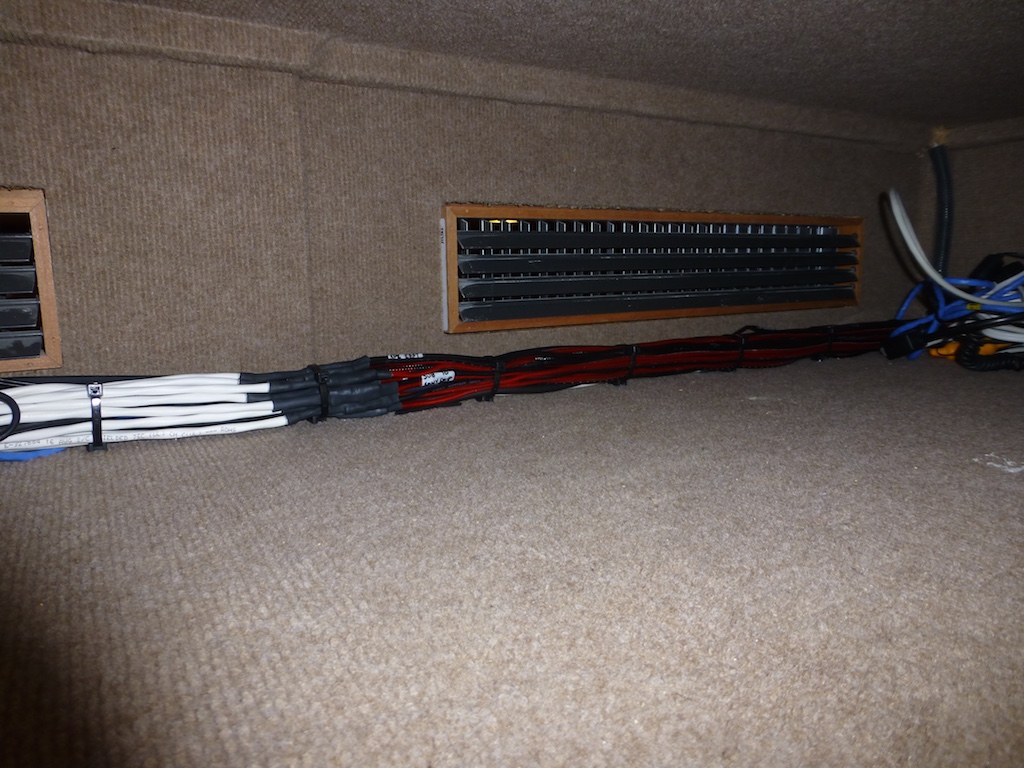
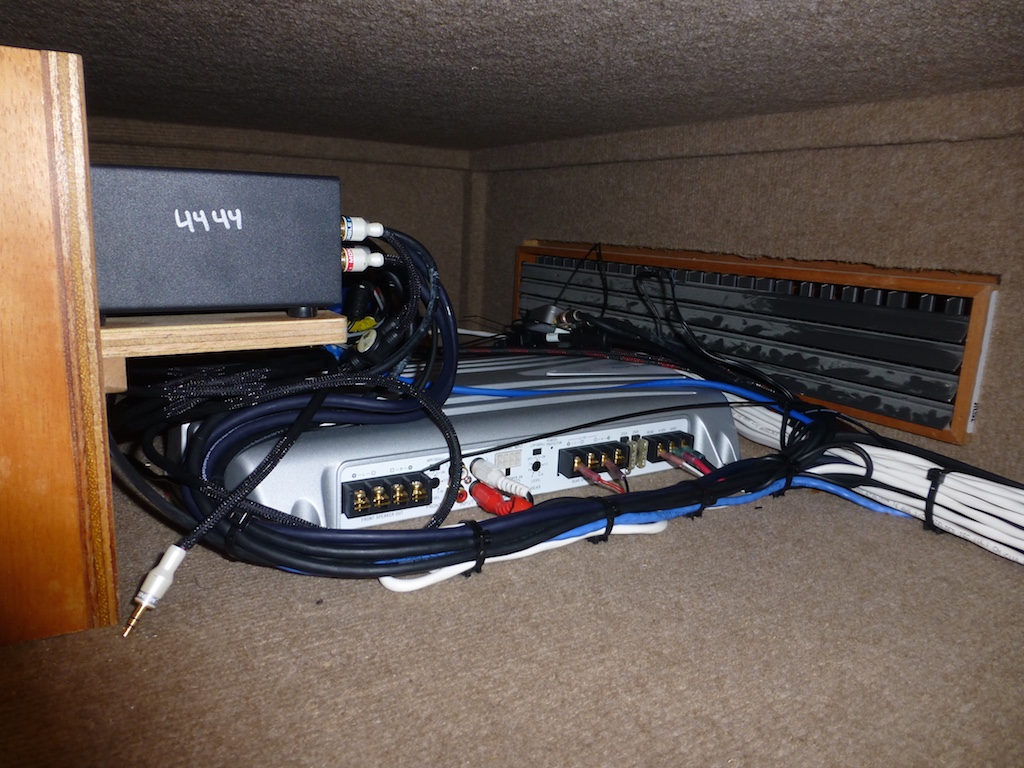
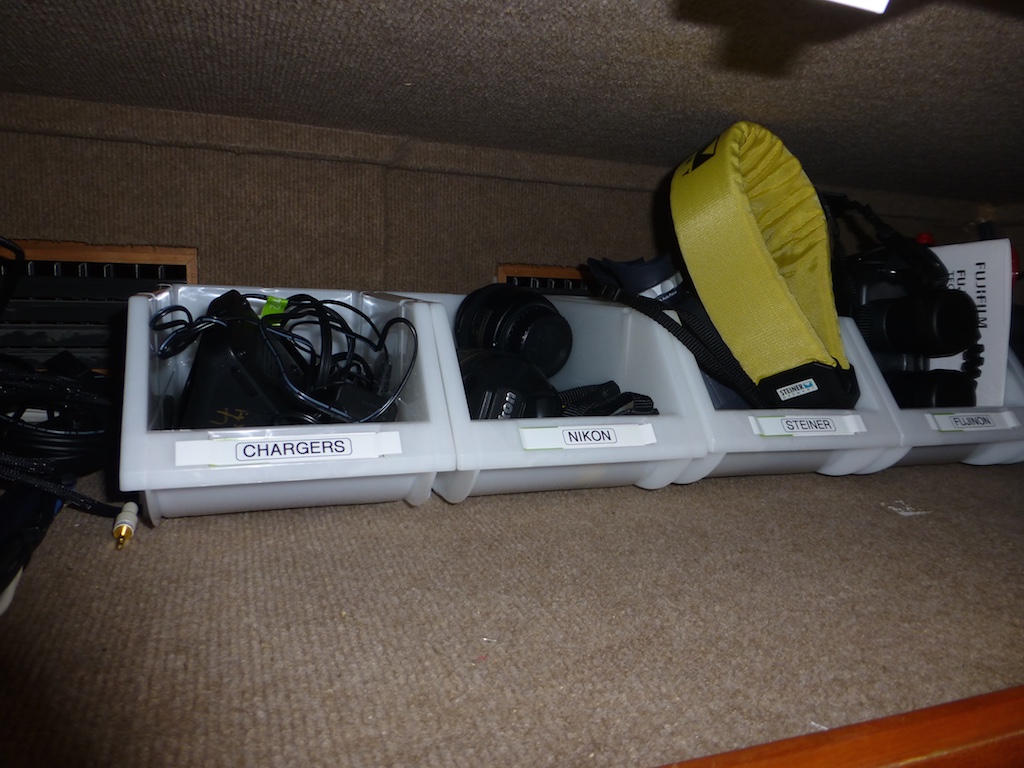
Under the salon TV, there is a huge space but the boat builders used this area to run  wires.  For a year, this has driven me nuts. That created the energy needed to change the set-up.  We cleaned up all the wires and moved hardware behind the Fusion stereo.  With a large space ready for organization and a quick trip to The Container Store,  vital stuff now has a safe place.   Binoculars with compass, stabilization binoculars, air horn, rangefinder, camera, VHF chargers and more, all have homes.  This change is a huge lifestyle improvement.

Since day one, the Fusion stereo has had a wired remote at the helm. I find it nice to be able to quickly stop the music to hear the VHF or law enforcement.  Recently, we connected the Fusion to our 12 volt router and “bingo”, now iStuff can control the stereo with album art. Not necessary but very nice.


Screecher
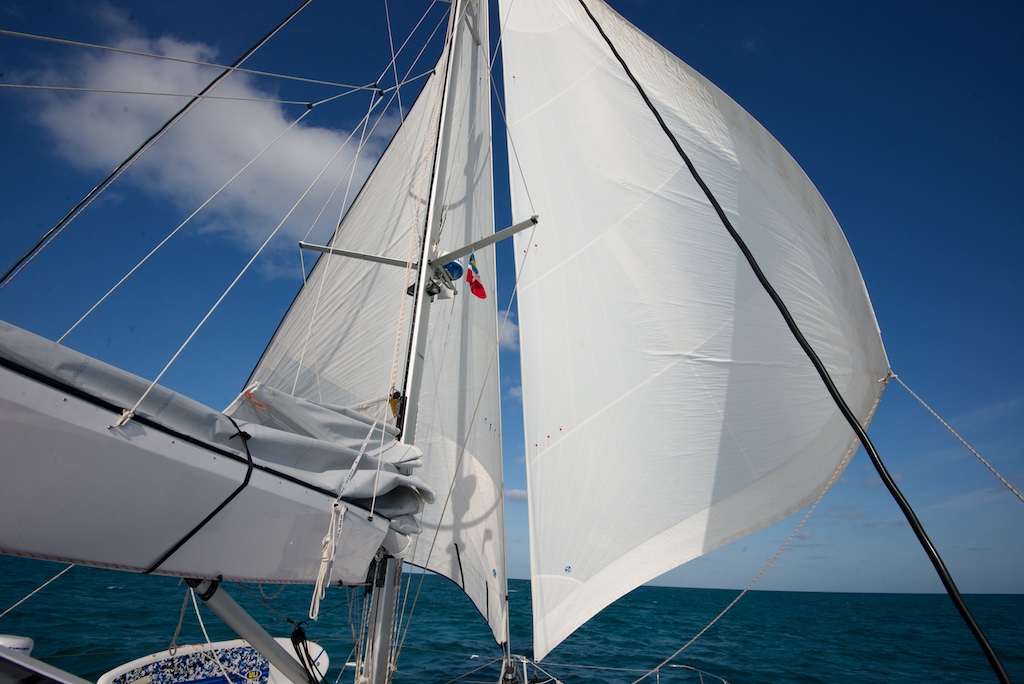
Screecher

Screecher

This is a must.   Traveling dead down wind with Genoa and Screecher is a joy. Power reaching with Main and Screecher is fast and fun.   100% happy I got this sail and the bowsprit installed.  At some point I will change the reefing line to a continuous line and snatch block for winch reefing like sister ship Calypso has already done.   However, I have hand-furled the sail in over 20 knots with no issues.

Self tacking Jib
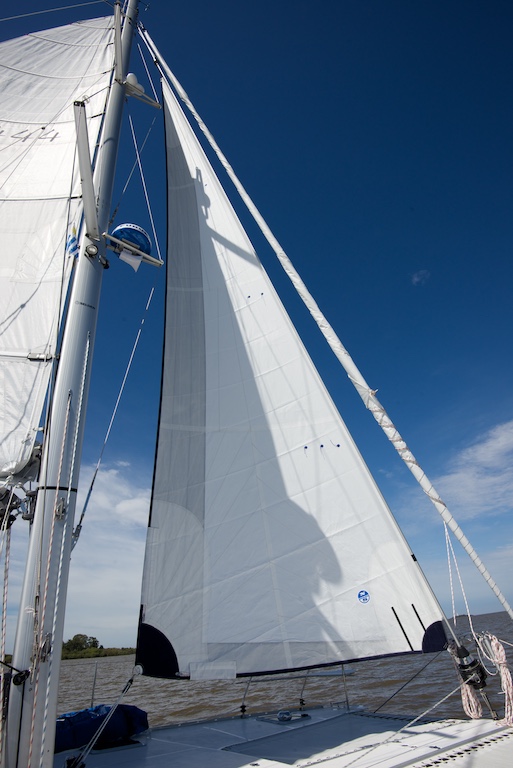
Self-tacking Jib

Self-tacking Jib


We have not used this, except for testing.   If we sailed a lot in cold weather, or, short handed, the sail might get more use.  The furled Genoa works ok in very strong breezes (40knot) when off the wind and does not require the crew to go forward to drop and bend on a new sail.  However, having the Jib offers back up if a head sail winch were damaged.  I would consider skipping this option and having a cleaner foredeck, one fewer line in the chaseway, and a few more bucks in the wallet.


Underwater Lights

Before I get new owners too excited about adding features to their boats, I would warn that a simple boat is easier to learn and may have fewer initial problems.  You can add many systems later as you learn your preferences.

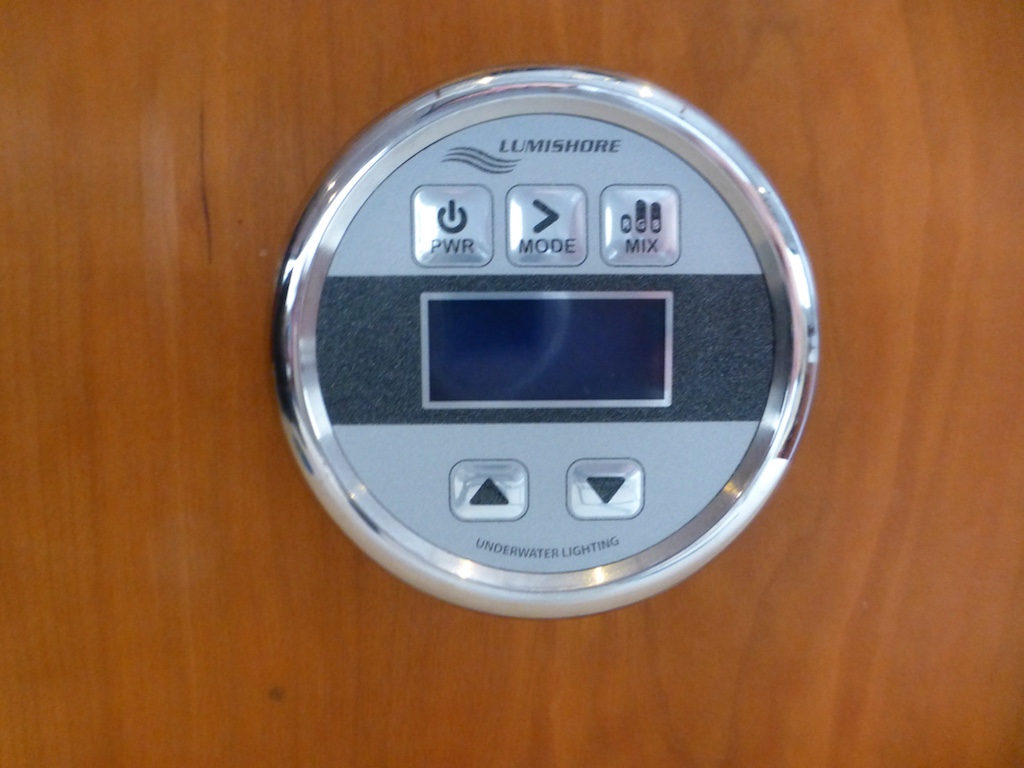
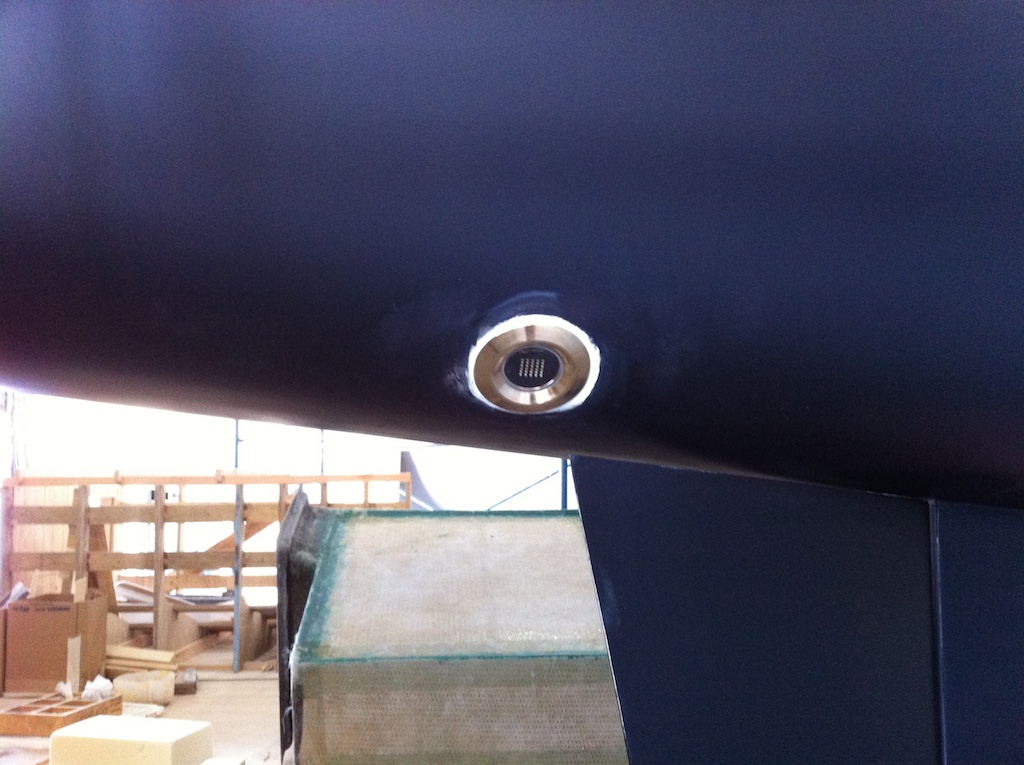
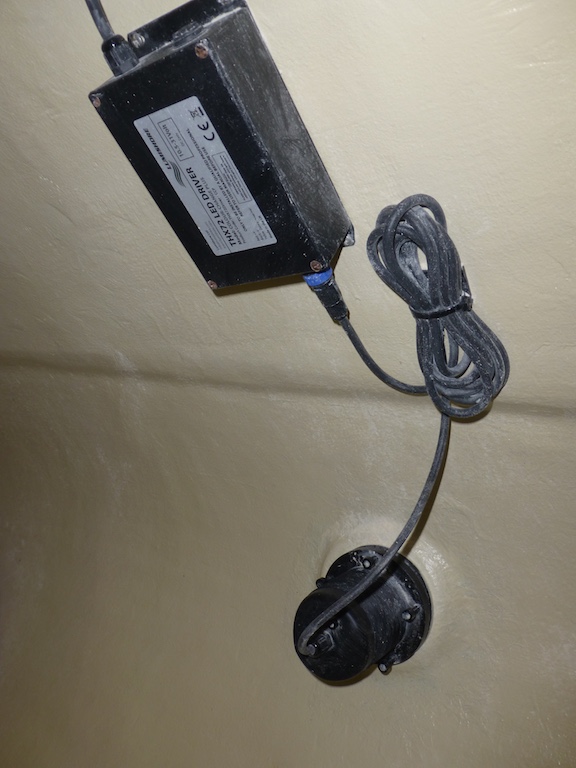
We bought these lights under the advice of Live Wide.  The factory did a great job installing the units.  Lumishore lights are bright and make any color under the rainbow.   We turn them on when we are expecting guests.   We do not mimic sport fishers and leave them on during the evening when in the Marina.   We do enjoy their ability to attract fish at night, but would rather sharks stayed away.

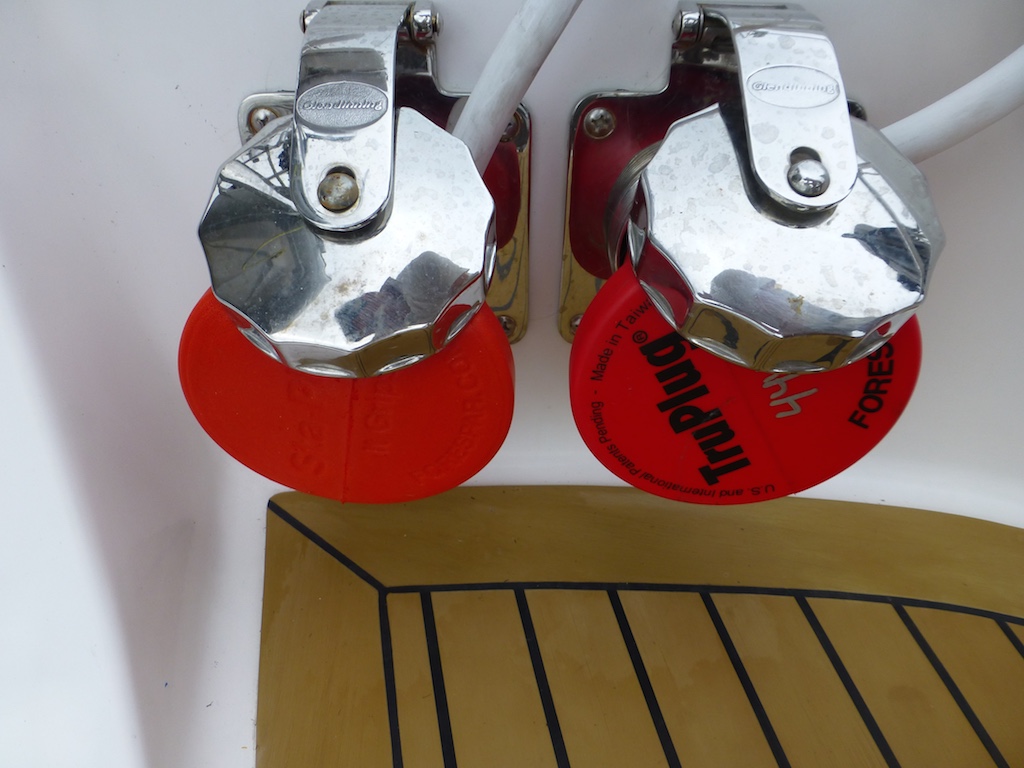
Glendinning power cord reels

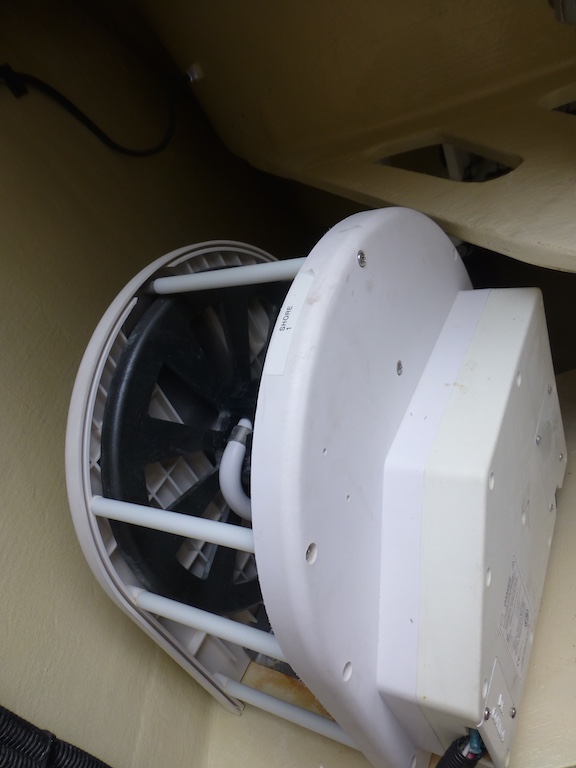
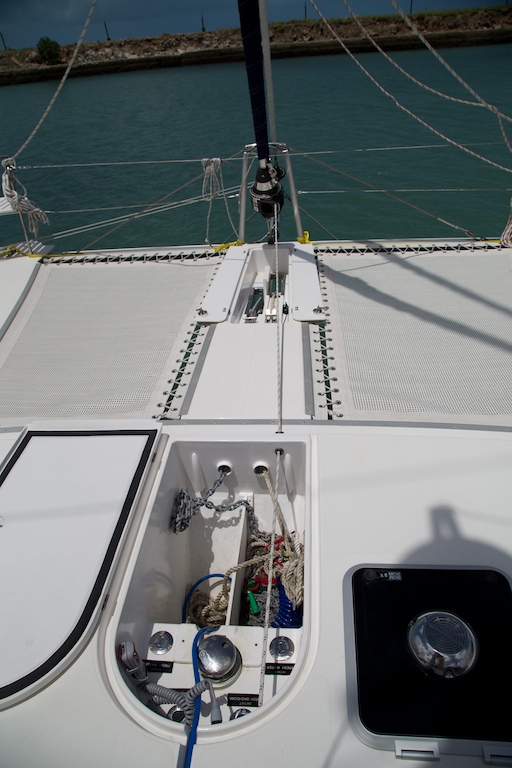
I do not think this option is offered anymore, and I think we are the only boat with this feature.  It has worked flawlessy.   The job of stowing cords is made shorter as the electric reels spin the cords away.  But the biggest benefit is the reels are in a place where you would never store something.  This frees up space in the valuable cockpit locker where traditional cord owners store their power cords.  Also having the power at the stern rather than mid ships often leads to a cleaner hook-up to the power post.  As you can see in the photo we put plugs into the cord exits when in use.   If there is large chop, water will not enter the boat (very very rare).
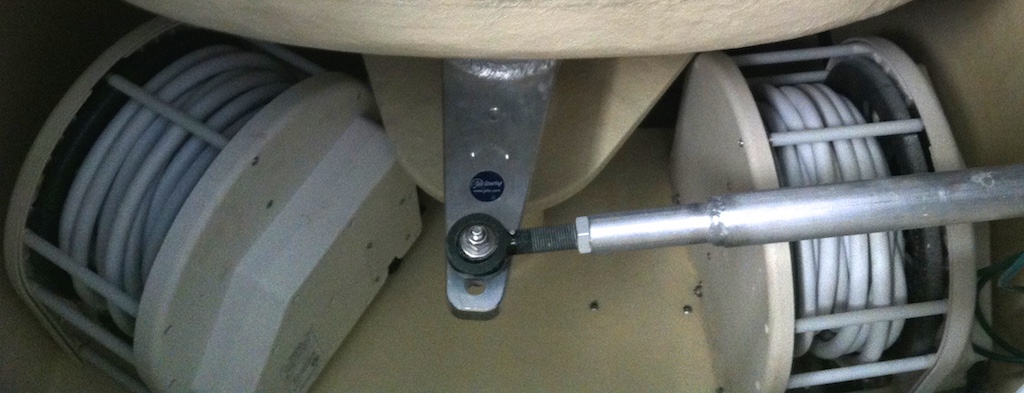
Cords stowed

Cords stowed

Single Side Band Radio (SSB)
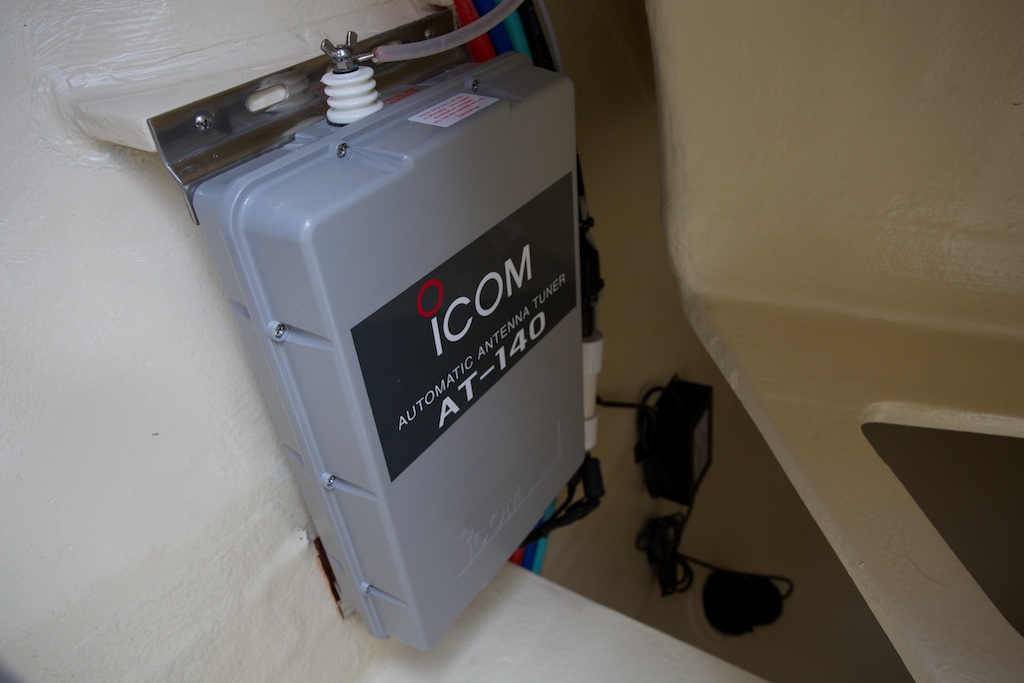
SSB

SSB

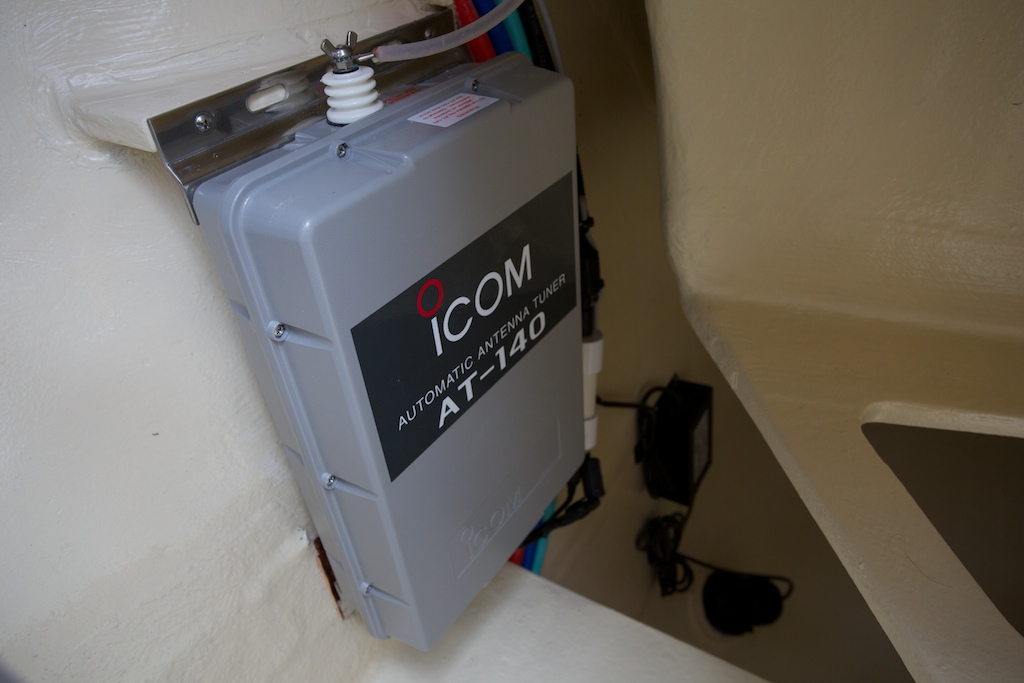
We do not use it much.  A little over a year since moving aboard, is sometimes too early to know your eventual go to items.   For example, we did not use our heat for 9 months, but we would have frozen to death, or at least never gotten up in the morning, on the ICW as an early winter caught the southbound sailors.  Likewise, the SSB might come in handy in other parts of the world.  Part of our low usage is because we have not mastered using it as a modem.  We hope to make some friends in the BVI that will give us tips on controlling it with the MacAir.  We know it works well since we have used the radio for long distance communication.


Roller main versus slab reef main

This topic could consume a blog post.  One of the joys of cruising for me is working the sail plan.  Putting a reef in the Main at night when the breeze is climbing is a skill.  Not a tricky skill, but one learned with practice.  If you find no sense of accomplishment in that process, then install the Roller Main.   The Roller could allow for a more balanced helm in a big blow as you can hoist a tiny Main and tiny head sail.  The slab reef can not get smaller than 2 reefs and so one must go Jib alone.  In theory, this will create a less balanced helm.  However, in strong winds we have not found the helm poorly balanced with our slab reef Main.  I know one owner who installed a third reef on his Main.  Interesting, but I did not follow his lead because it would force me to leave the cockpit and it would create too many control lines.   Having blocks installed on the leech of the main is a must for easy reefing.  The Slab Reef Main has a huge amount of extra sail area in the roach.  After one reef is installed in the Slab Reef Main, it is the same size as the full Roller Main.  This extra sail area can be nice on a light air day or going upwind.  It is also very difficult to tension the leech on the Roller Main which limits performance in certain conditions.

I support the purchase of the Slab Reef Main 100%, while Gail partially supports the Roller.  She is concerned about the Roller not working one day but is jealous about the Roller Main being push button in and out.
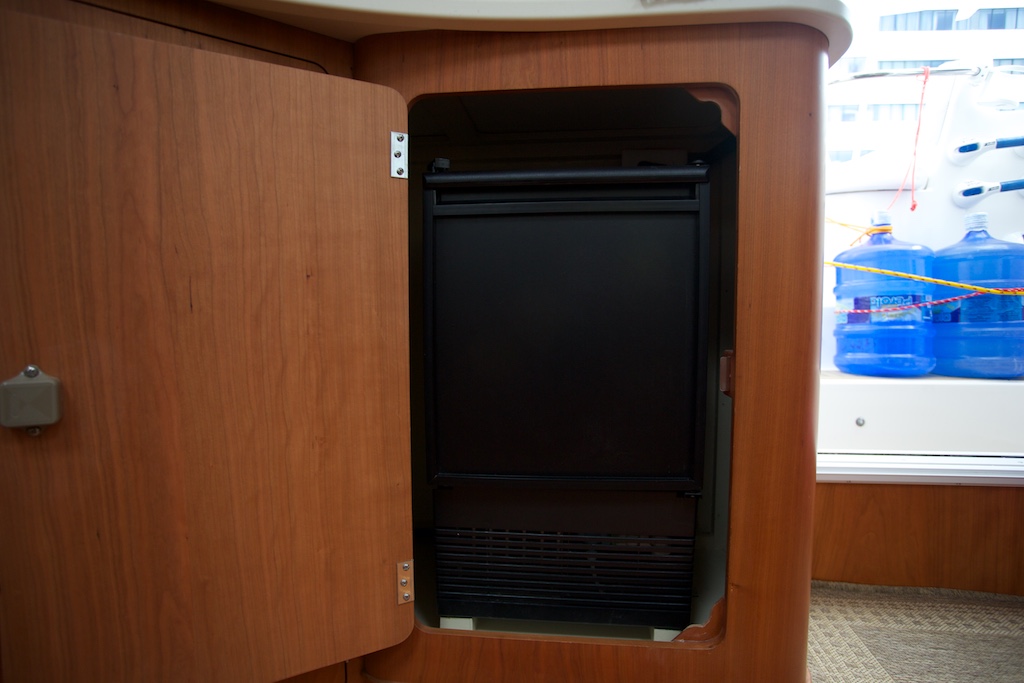
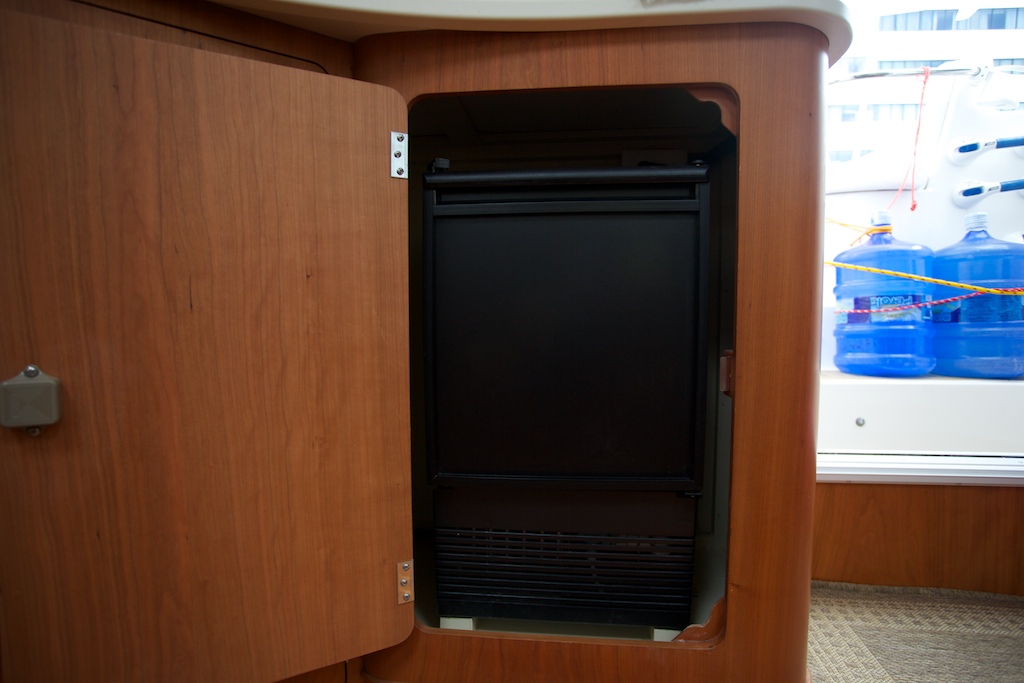
Ice maker

Ice maker


Ice maker

We do not use our air conditioning often, but really enjoy an ice-cold drink.   We have hung the ice maker power supply off the inverter so solar power can make ice.  Our bit to stop global warming.  The factory-installed model works very well but others prefer their plug-in models from Amazon.  The plug-in is easy to replace but is slower and requires water to be added by hand.  Oh, the rough life of a cruiser.  Gentlemen do not cruise without an ice maker?


Printer Shelf

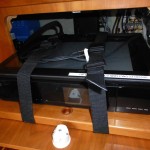
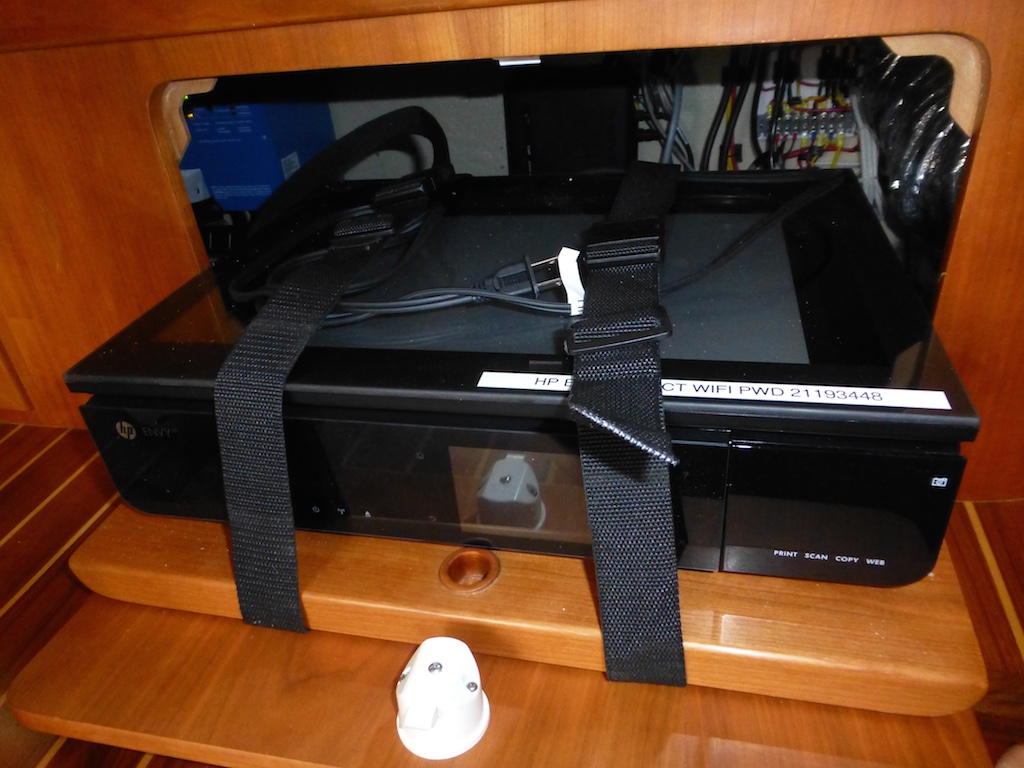
Two Fish is not just a sailboat but also our home.  No home office can survive without a printer/scanner to fill out entry forms, file taxes and other pedestrian paper work.  Many cruisers place the 110 volt printer in a locker.  Gail was not excited about diving into a locker every time she needed to print.   Instead, Two Fish has a printer located behind a custom wood door in the settee.   The carefully sized printer slides out effortlessly, making that quick print job painless and curse-free unless Jason left the printer without paper.   We have straps to keep the printer in place during passages, but this may be excess.

Woodwork

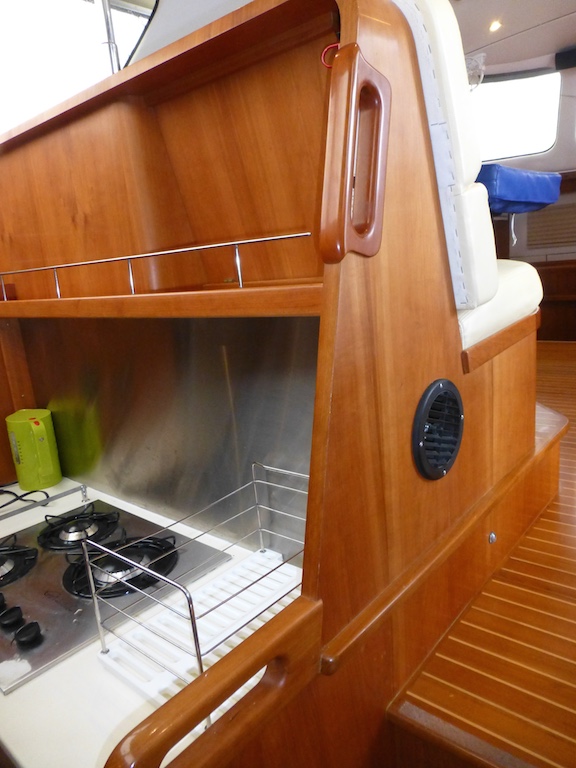
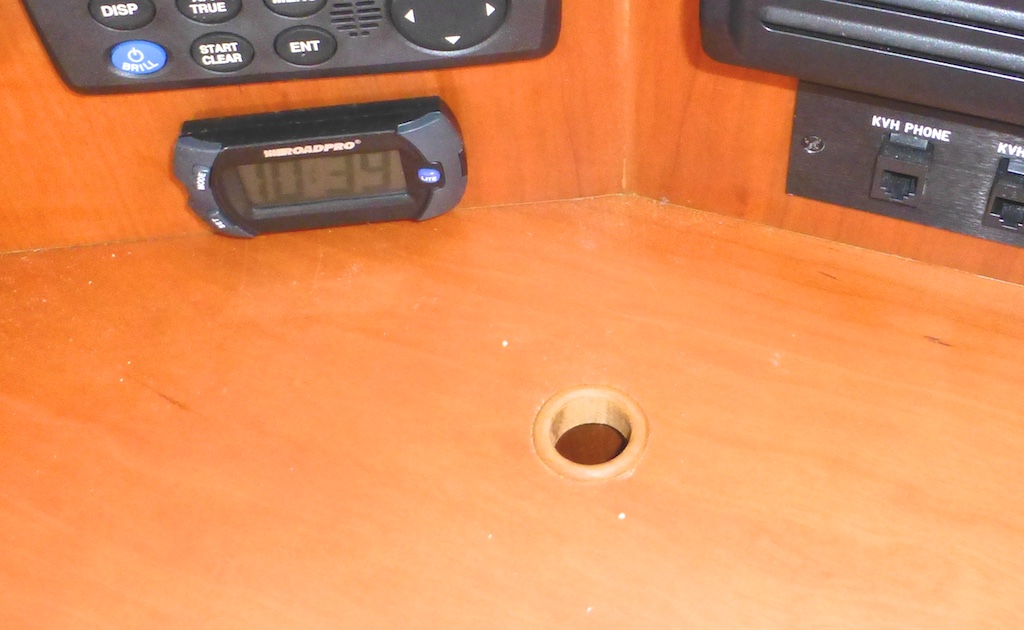
The factory is great on woodwork details.  We added shelves to the bottom of our closets.  We also added a grommet in the Nav Station so that power cords pass nicely to the laptop.  We copied Live Wide and added a handle for safe passage from the galley to the salon.  I will add more shelves in the master hull cabinets, but they will not be as beautiful as the Argentine cherry.

Chain counter

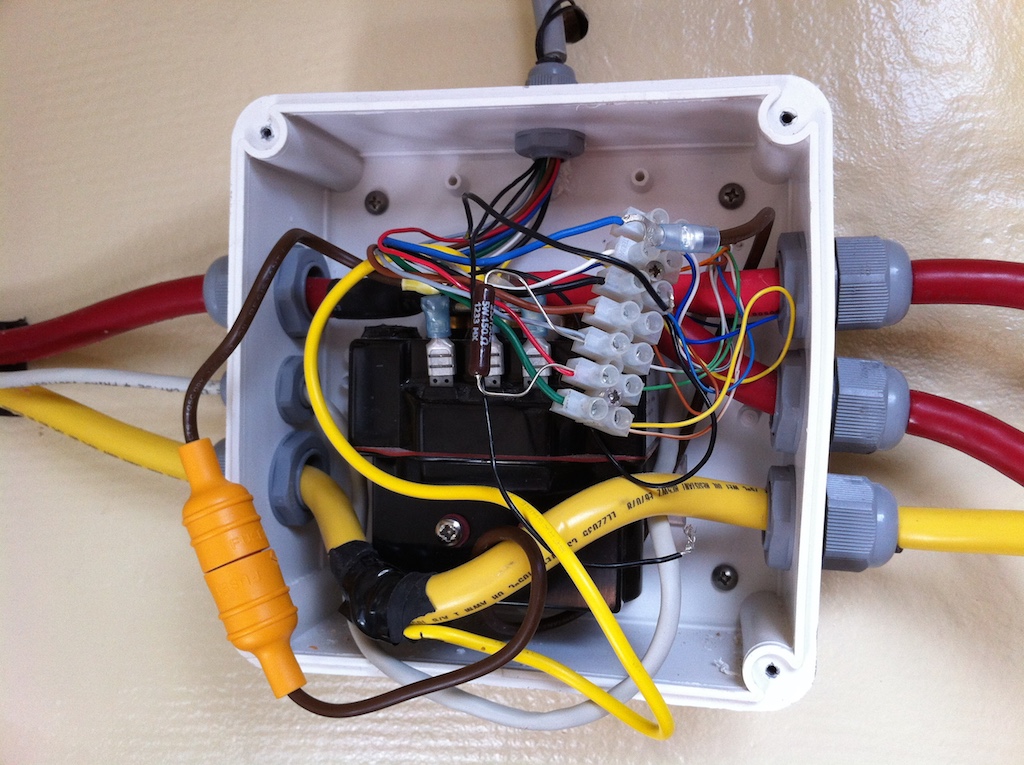
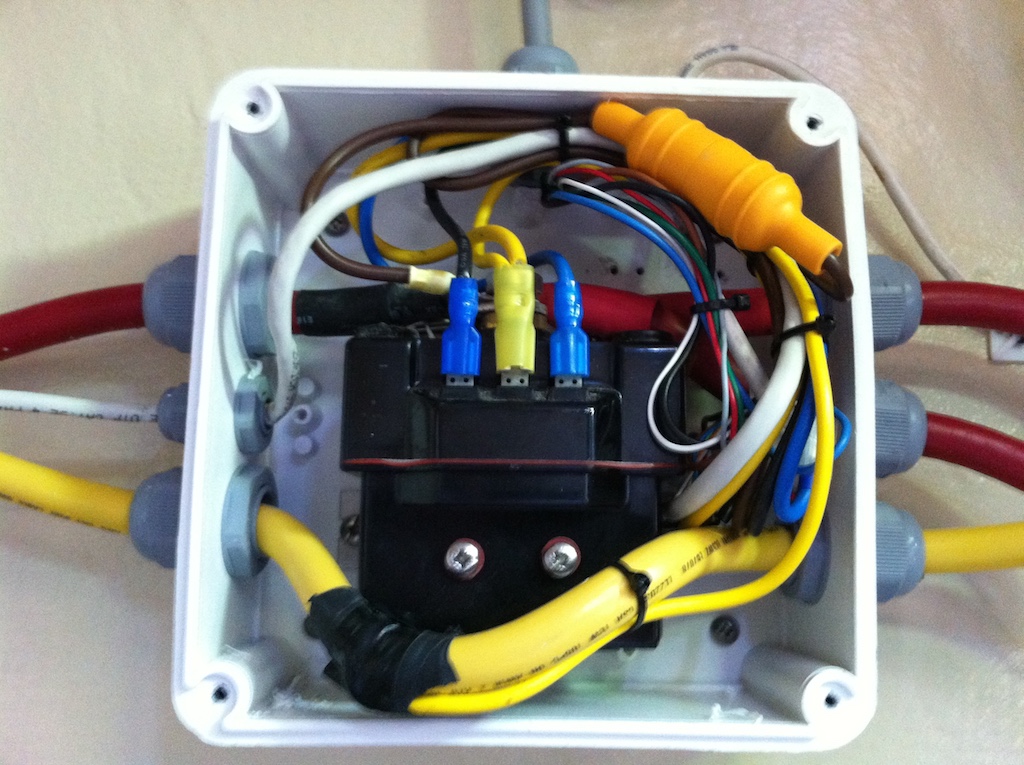
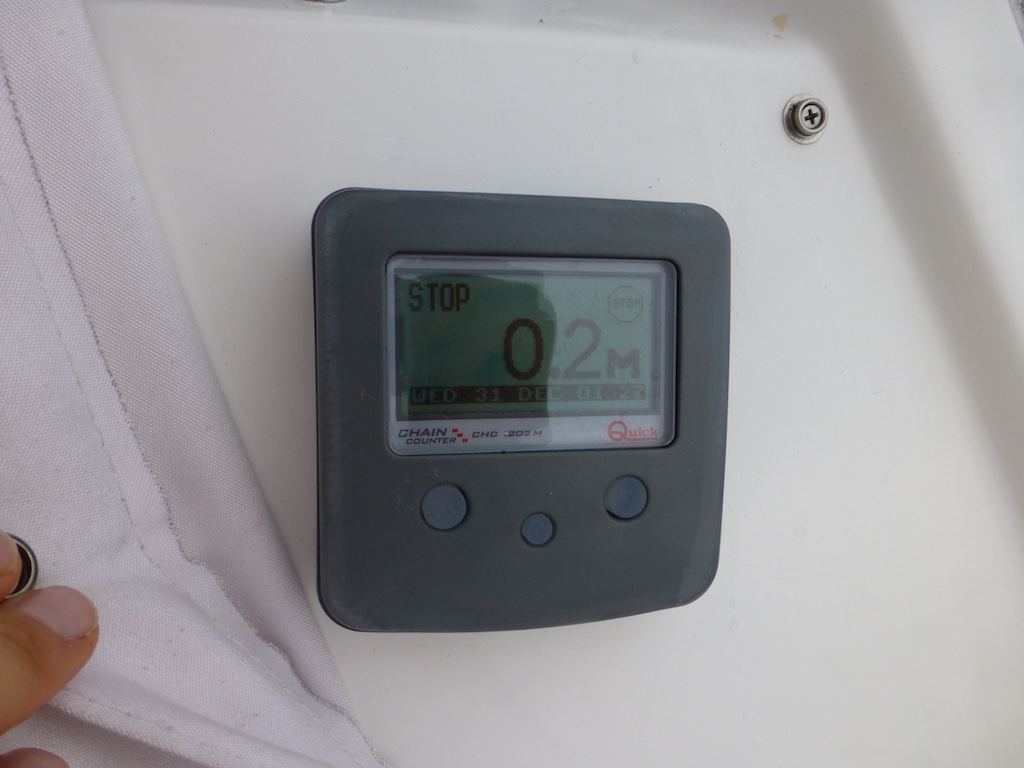
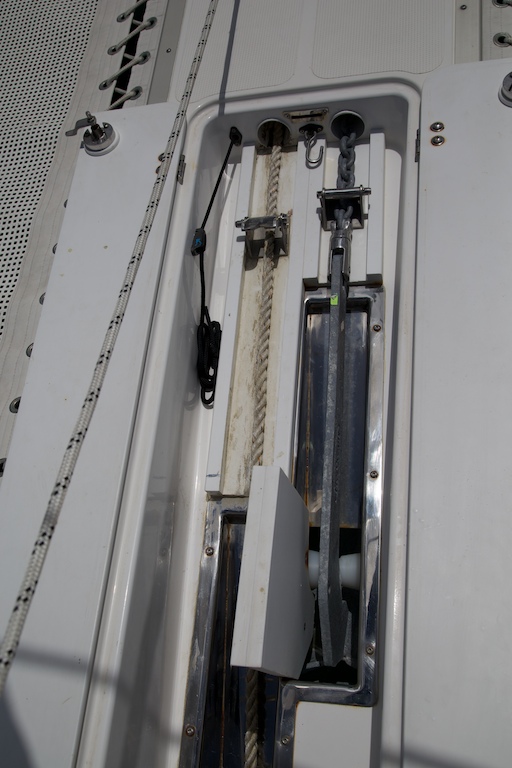
We were the first boat to ask for a chain counter and a remote at the helm.  This was new technology for Antares and we had some initial glitches.  But after we cleaned up the wiring, in the junction box the gremlins fled and it has been a joy.  Most folks have a coloring scheme on their anchor chain to tell how much chain has been released.   I found this system difficult because the zip ties fell off and I could never remember our color code system.  With this system, both anchor person and helmperson can see how much chain is down.  Often the diligent person weighing anchor (Gail) is working terribly hard on cleaning the anchor as it is being raised and may on occasion forget to tell the helmsman (Jason) that the boat is adrift.  With the remote located at the helm, this problem goes away.  In rare occasions this remote is useful for Med-Mooring or single handed anchoring.

Solar power
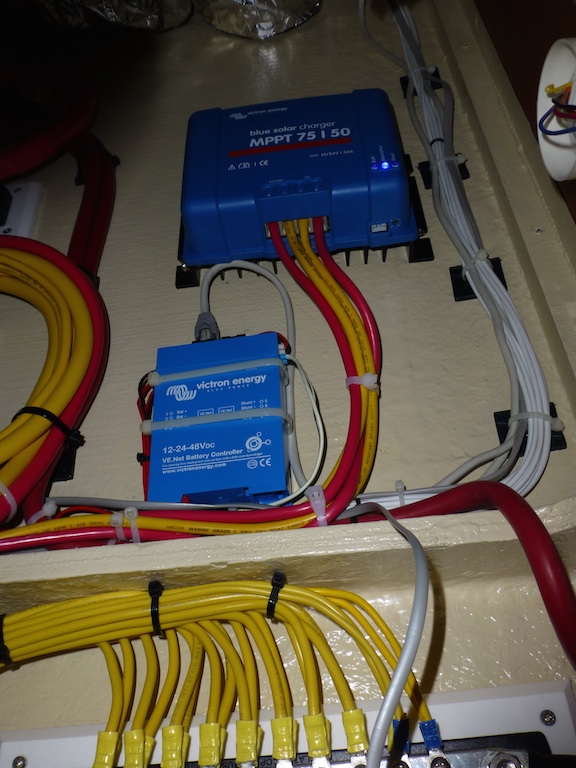
New solar controller

New solar controller


Nothing beats solar power on a boat.  Silent and great at top-up charges.   Our boat was ordered with the two extra large panels on the dinghy arch.  I may add more some day as solar requires no effort.  We recently replaced our defective solar controller.  The symptom was the need to be rebooted by removing the fuse with some regularity.  Victron sent a new unit ASAP so it might be a known glitch.  The new unit is a small upgrade to our unit  (more amps and includes their new communication protocol).  So far I am just happy not to be yanking the fuse all the time.
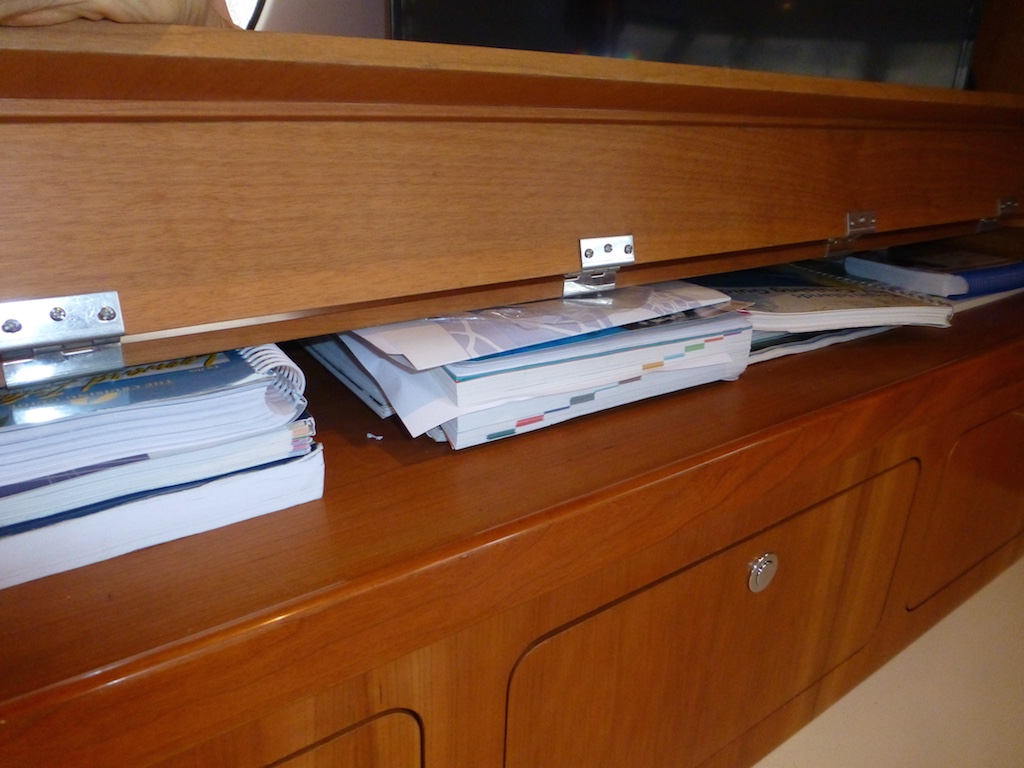


Chart storage

Chart storage


Chart storage

We always have paper charts on board (Gail rule) so this is a must to keep the cabin organized.  I will skip the debate about their need in the modern world.  Gail likes them, so they are aboard.  We also tend to buy every cruising guide we can find.  Bluewater Books is a great store for buying guides.  However, sometimes I avoid reading the guides so I can be surprised by what is onshore.  I do always read their navigational tips so as not to be surprised by a rock.   Remember the old sailing adage, surprised by a beach bar is a good thing – surprised by a rock is a bad thing.   Told you sailing is not a complex activity.

Nav station input strip
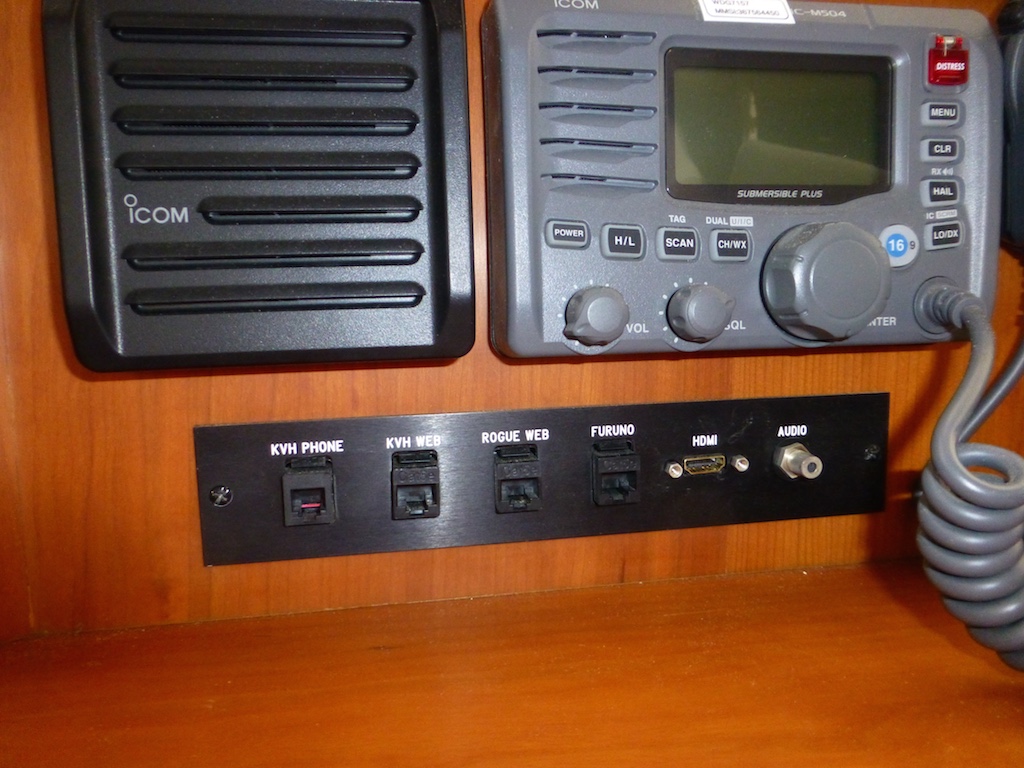
Plug central

Plug central

This was Gail’s discovery and has worked well.  Older boats just had wires coming out of the hutch.  Ugly and leads to broken wires.  This strip cleans up the mess.  Which inputs do we use?  KVH web frequently in passage for our internet.  In order to not use data by accident we do not serve up the expensive satellite internet wirelessly.  HDMI is used when we watches movies from the laptop on the big TV.   KVH phone is only a back-up since the Iridium is a quicker phone solution. Rogue Web is only used if there are debugging issues with our wifi extender.  Furuno allows MaxSea navigational software to get the data from the network.  I keep forgetting what settings are required to make this work and Gail has to keep fixing it for me.   Audio allows any audio source to go into the Fusion stereo.


Fish Finder
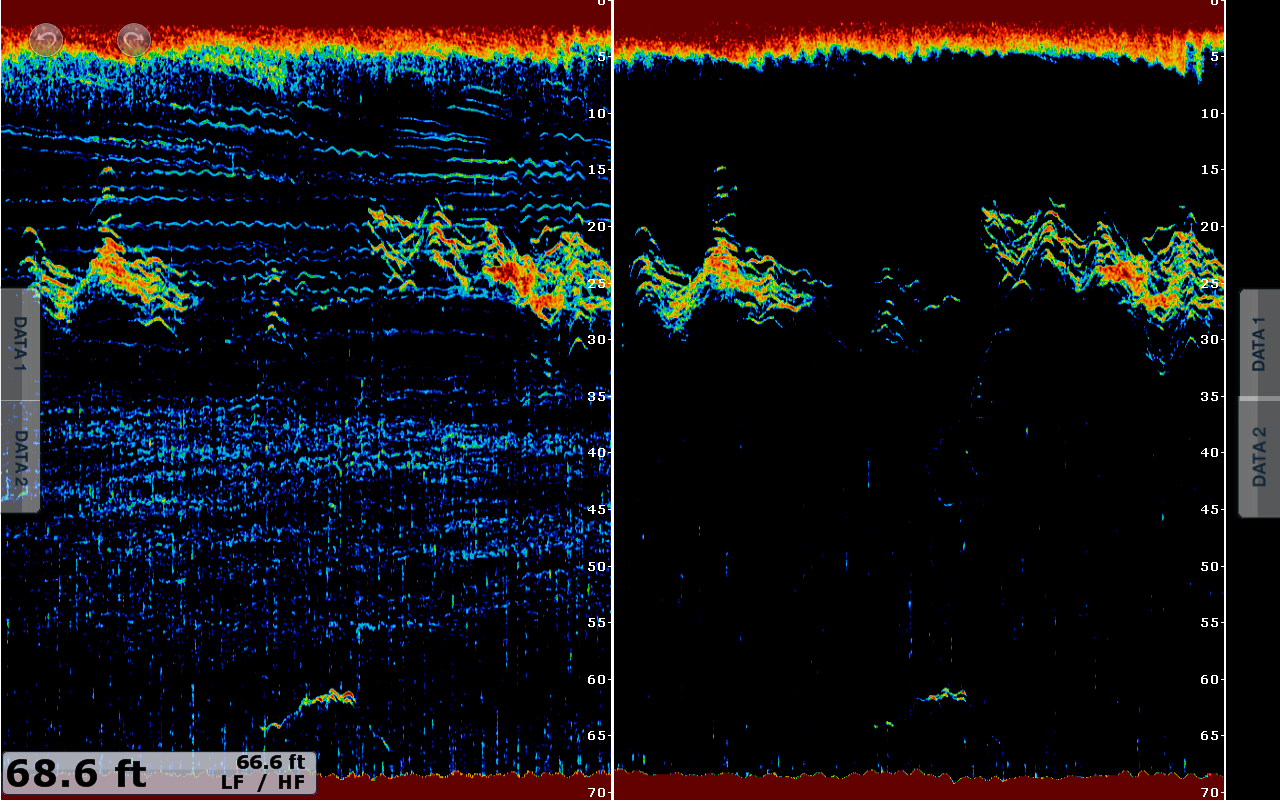
Fish Finder display

Fish Finder display


This one missed the mark.   A simple depth sounder is enough.  Our fish finder consumes power and only offers a  graph of what you have passed over.  The fish finder helps in understanding the contour of the bottom when anchoring.   I turn it on when anchoring, gunk-holing or passing through a tight passage.  I am too hopeless a fisherman to use it to increase our catch.  One advantage of the fish finder is  that it is a back up for the depth sounder and my starboard hull is wired for a transducer upgrade in the future if my mood changes.


Port forward cabin selection

We have the storage option instead of a small pipe berth or an office.   An office seems excessive since when we need to work we use the nav station or the salon table.  Computer work inside a hull could be stifling.  The pipe berth has merits but we prefer convenient access to our tools on nice shelves.  Boat work is never a picnic so you do not want to be lifting cushions every time you need a different tool.  The second shower option was not available when they built our boat.   I can see the advantage but guests typically shower outdoors when the weather is warm enough.  The sail locker has been convenient for storing the chute, canvas covers, and extra cleaning supplies.

Factory sold Canvas covers

The helm cover is a must.  Protects the expensive navigational equipment in no time.   The dinghy cover has limited usage since we are full time live-aboards.   If we left the boat for an extended period of time, this would be used.  Winch covers were a bit too small and need to be replaced.  Helm seat cover is not used as the enclosure is often up, thereby protecting the helm.  We enjoy the convenience and protection of the canvas rear winch cover.
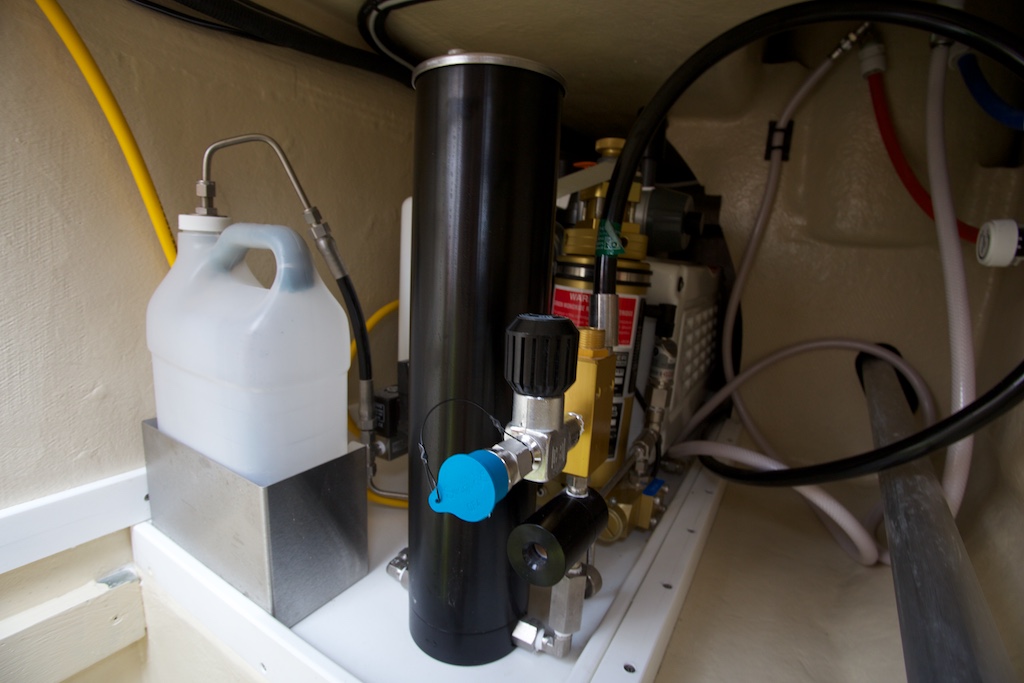
Dive compressor

Dive compressor


Dive compressor

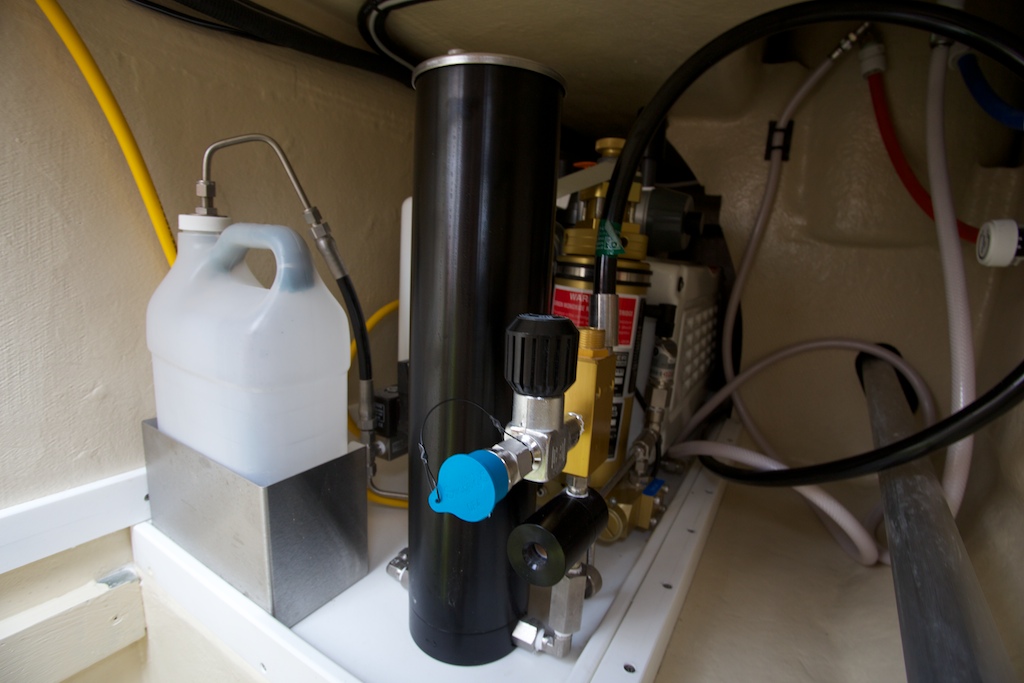
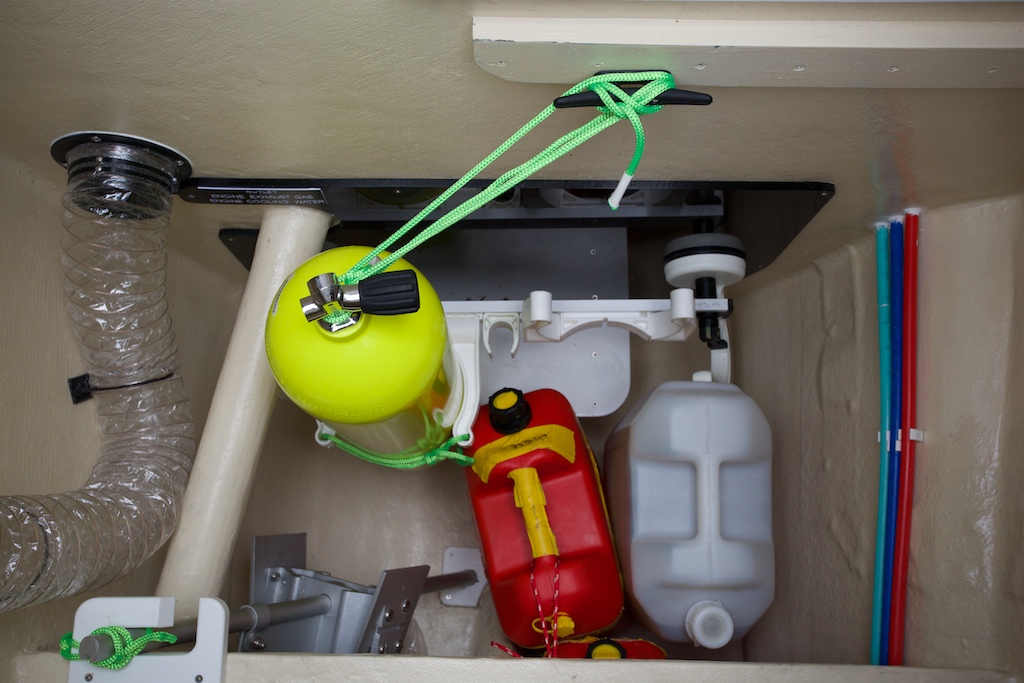
So far it has been underused, but we expect that to change as the next 6 months as we will be in perfect waters for diving.  I will report more on this feature later.  It was installed in a very clever location so you end up losing almost no space.  However, there are dive shops that can fill your tanks.   2 x 62 liter tanks fit nicely in our stern line lockers and a rack in the locker can hold 2 x 80 liter tanks.  The compressor takes less than 30 mins per tank and can fill up to 4 tanks at a time.   We have a 110 volt fan to keep the compressor cool during fills and a nice cover to protect the compressor from accidental splashes.


KVH V3

This is an expensive option at start up but costs only $50 a month to keep running.  In the right parts of the world, it is fast and is a very convenient way to access the internet for weather, email or web surfing.   The KVH has come through for us in dealing with mundane finances and last year’s retirement.

Nav Station Set-up
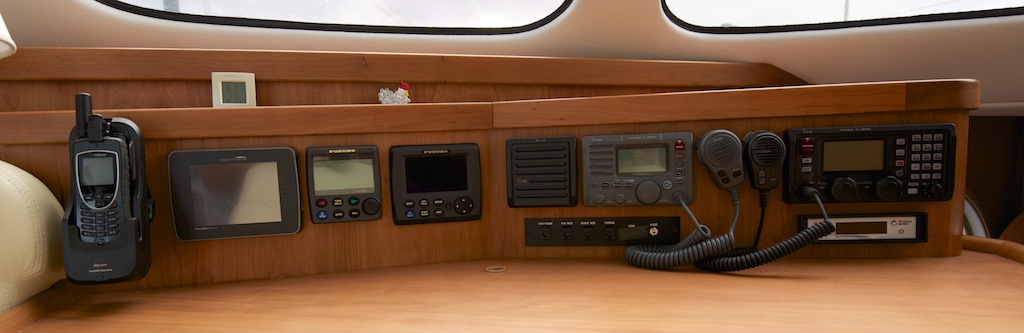
instruments

Iridium Extreme phone

The Iridium’s primary purpose is to go into our ditch bag in case of emergency.  It works just like a cell phone so any crew member can operate the phone in case of emergency.   For our upcoming trip I have the 6 different Coast Guard numbers pre-programmed.  I wonder if I should also include Domino’s pizza?  Do they deliver mid-ocean?   The Iridium can also download data but we use it for  GRIBs and text emails only, as the speed is only 4kbs.  Your home network work is probably 40,000 kbs.  We have an antenna for the Iridium on the dinghy arch.

Vesper Vision AIS

The Vesper has been a great AIS.  It seamlessly sends the AIS data to our Furuno system.  The feature we were happily surprised by was the ability of the unit to broadcast data from the NMEA network.  If that mumbo jumbo makes no sense to you, what it is saying is that wind speed, depth and other data are sent out wirelessly anytime the unit is turned on.  A few bucks at the app store and you can buy slick applications that will show this data.  Now in the middle of the night if you want to know the wind speed you can check it with out getting out of bed.  My current project is to get iRegatta to calculate VMC.  (That is another post!)

Furuno RD33 data display

This data repeater is a workhorse for Two Fish.  Location makes log book updates easy.  Also, while at anchor the windspeed alarm is a nice safety feature.  The compass is a convenient way to detect wind shifts.

Flexiteek
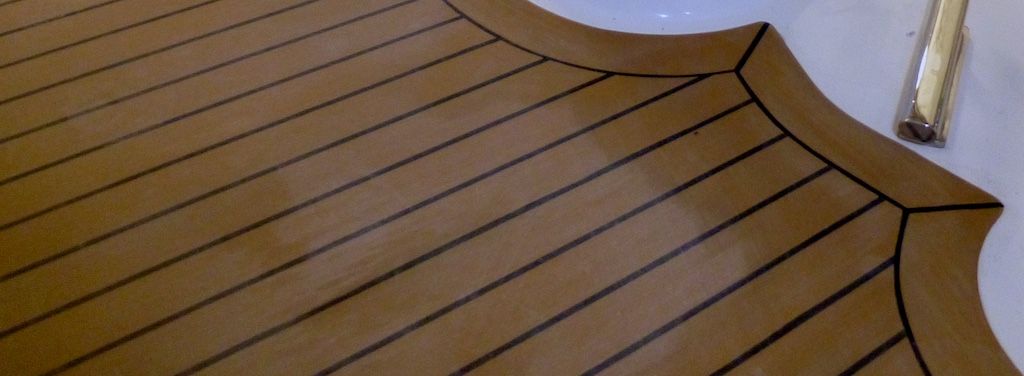
Flexiteek

Flexiteek

I would get the fake teak again.  It hides dirt, reduces glare from the deck, and adds charm to the boat (subjective).   The short coming is that it can get very hot, so we wear flip flops.   Footwear is never a bad thing for a boat.  Your feet thank you by the end of the day.   Stains can be sanded out and as it ages it looks more real.   The black caulking lines need some maintenance over time.

Bigger Water Maker

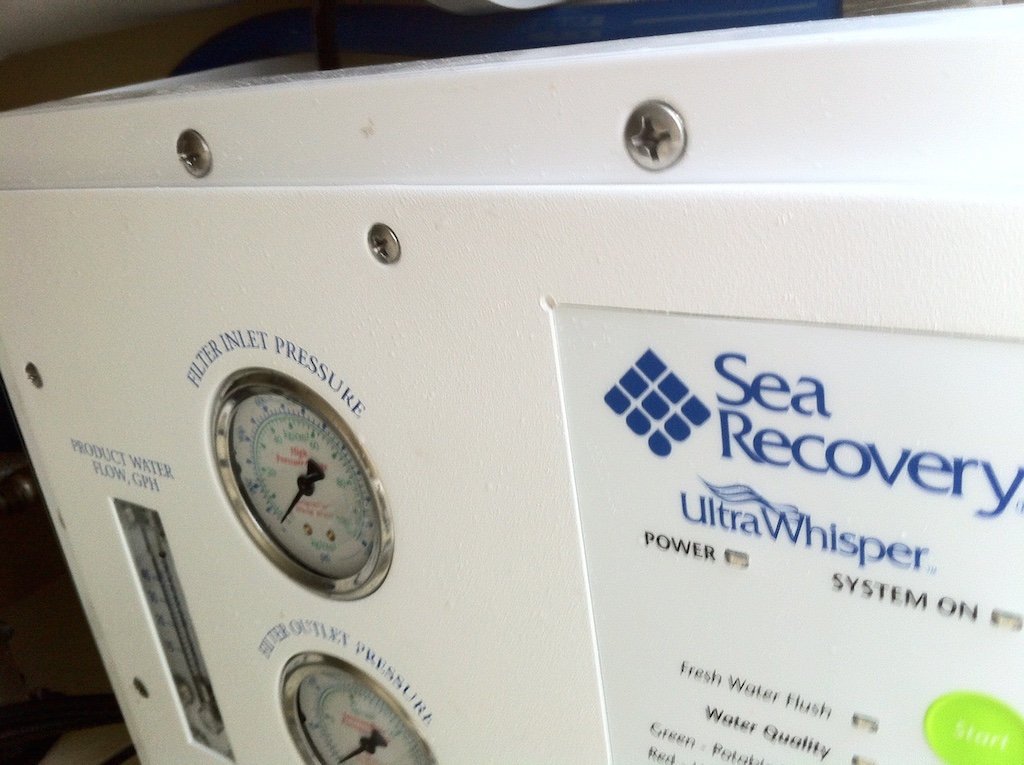
I have passed through the valley of broken watermakers and emerged a stronger man.  Let me tell you the long story. I am assuming that since you made it this far into the post, you must be a glutton for punishment.  We foolishly left the factory with an untested watermaker. When we turned it on the hoses blew off.  For those not into watermakers, this is not a good sign.  We had three issues.

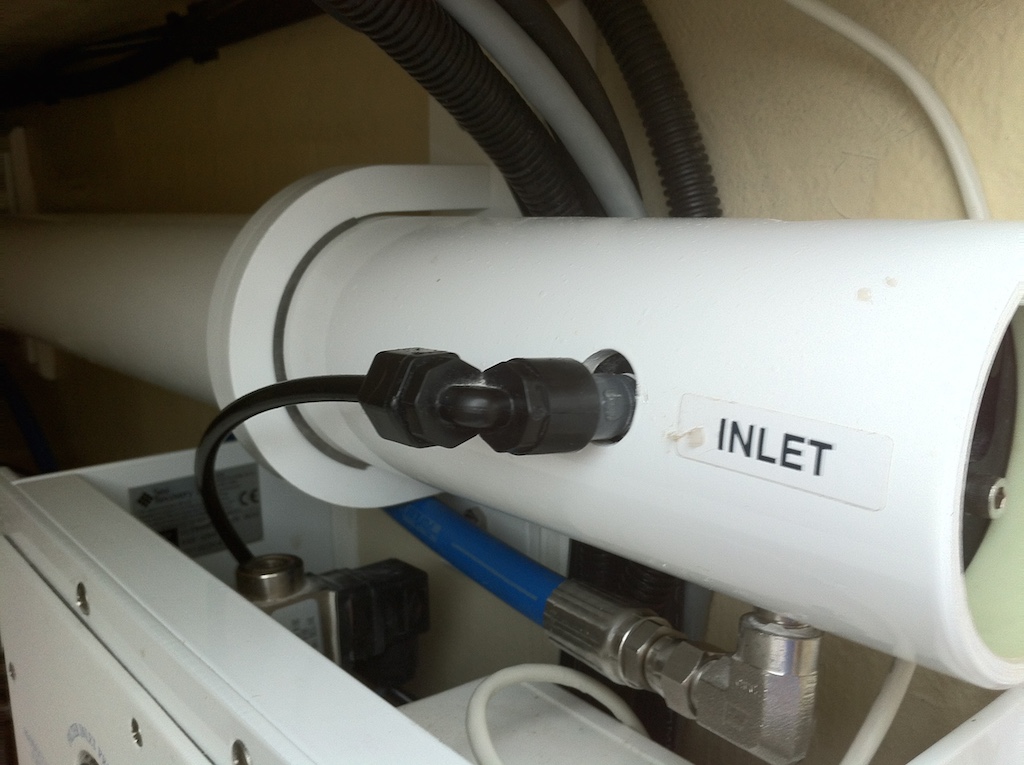
1)  Our watermaker has a lift pump and an energy recovery unit.   The latter takes place of the high pressure pump.  It is called an ETD.  The ETD, now a swear word on Two Fish, was milled incorrectly.   The two pistons inside the ETD would get stuck and become a blockade for the incoming water.   As the pressure built, the weakest link would fail and a hose would go flying.  We did develop the ability to remove the ETD and unlock the pistons.  This would take about 6 hours and only give you one usage of the device.   After a comedy of errors, we finally connected with a new ETD sent by the factory and replaced the unit in Trinidad.   It turns out the watermaker manufacturer had done a recall on this part but never got around to telling Two Fish or the factory.   Since replacement, the unit has been flawless.

2)  Our water maker has a electronic valve that opens after the 1 minute priming period has passed.  Our first 2 Danfoss valves were duds.   We have had perfect performance from our third valve but we also carry a spare.   I bet the early valves may have been damaged by the misbehaving ETD.

3)  Original installation had a few poor hose connections.  Pikin was a hero in Brazil;  after four attempts, he found a guy who could crimp a high pressure hose that was forgotten in the install process.

After all my complaining what do I think of the watermaker.   It is now set and forget.  It makes water just fine and the speed is appreciated.  During passages I will run the Genset for 2 hours to charge the batteries and can make 50 gallon of water at the same time.  I apologize to the crew who were aboard during the drought.  They were such great sports.

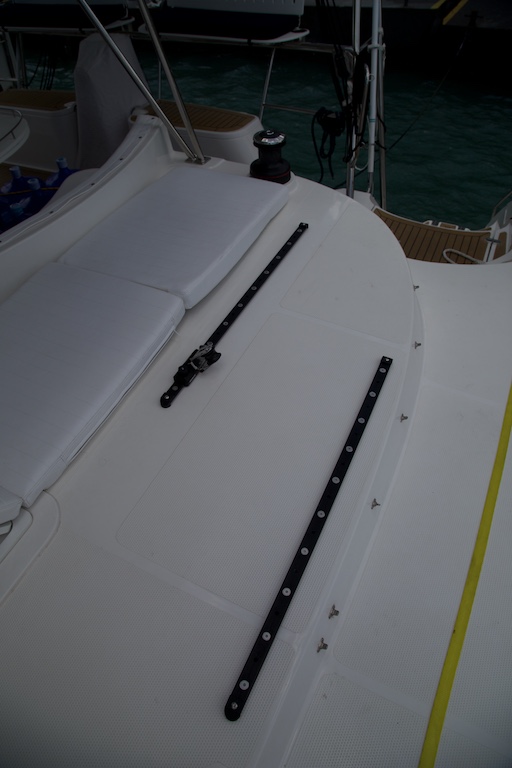
Chaise lounge / Dual Genoa tracks

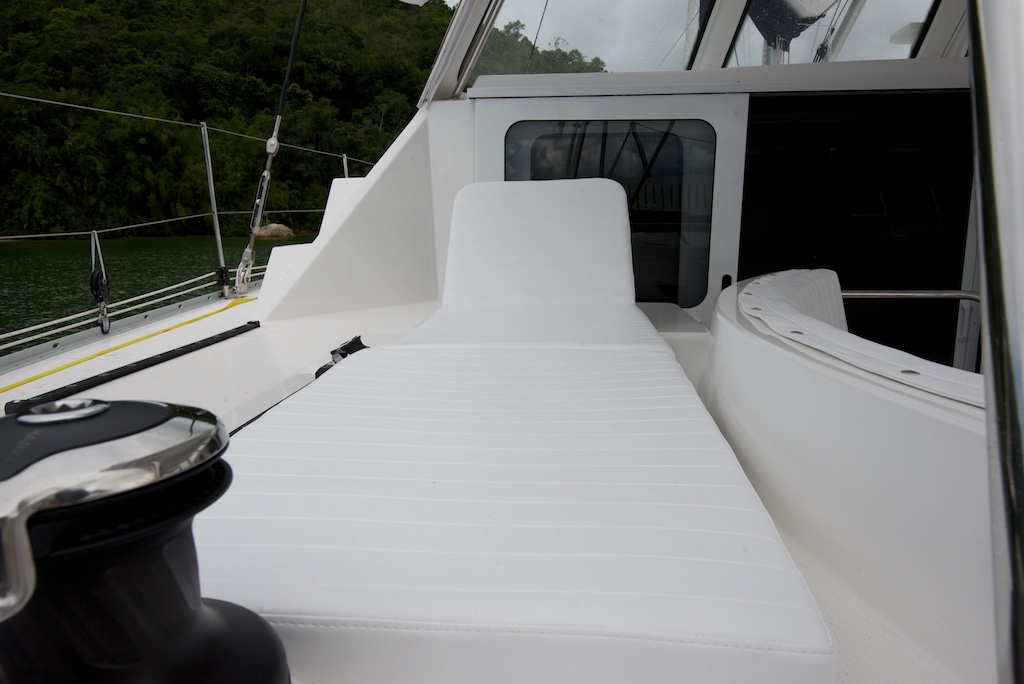
I thought I would be on the chaise all day long and I am surprised I use it less that expected. Every time I use it for a reading perch I appreciate how cool a spot Antares has created.  The cost for this is not having the extra helm seat, which I find a bit out of place anyway. So it is a double winner.  Gail created her own co-pilot seat by buying a huge matching Sunbrella cube which we use both outdoors and indoors for extra seating.  Another double winner for the price of one.  By having the chaise we also got a very nice storage box on deck.
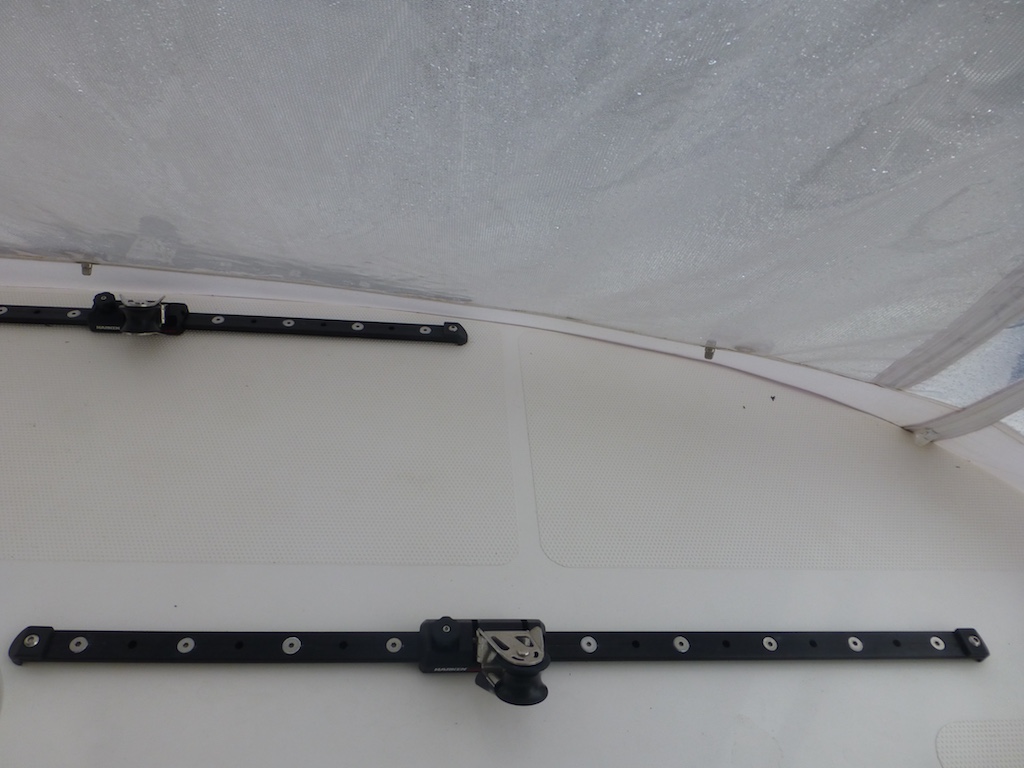
Dual genoa track

Dual genoa track

We had two genoa tracks installed on Two Fish to get better sail trim and accommodate more of the enclosure.   I would not consider this a must have item.  It is a nice to have for back up and fun for sail trim but not a must.  We are cruising after all!


Final small stuff

I can not believe you have made it this far into the post.  Congrats on the epic job of reading through mud.  Our final customization has been adding hooks to the master head.  You can not have enough when you go swimming 3 times a day.  We also added an anti-siphon loop to the genset bilge pump. This may be a small risk but a reverse siphon could occur on the bilge output for the genset as it is close to the water line.  We added a vented loop to stay extra safe.  In the South Atlantic we did notice water was entering via the bilge pump system.   We followed Golden Glow’s lead and installed new cool toilet seats.  They should be standard.  Easy to clean and no slamming.  We also added fiddles above the microwave and above the cooktop.

Future projects

Most important project is not to do any projects for a while and enjoy swimming, diving and exploring ashore.  But I have some thoughts:

1) Copy Field Trip and hang the watermaker power off the inverter.

2) Copy Live Wide and add an AC vent to cool dive compressor

3) Add shelves to cabinets

4) Add adjustable genoa cars.  Add bow block to fly chute from windward bow.

Remember do not ask Anatares for all these features or no one else will get a boat before 2030.  Enjoy your boat, your favorite upgrades will most likely be different than mine.


Comments { 6 }

Haul Out

Astute readers will remember Two Fish’s dramatic propulsion problem: while motoring she could only travel in reverse.  In an old Car Talk episode, a caller had a car that only could turn right.   The caller gleefully announced that she just would use four left hand turns to go right.   Gail was quick to announce that Two Fish would not be traveling the Atlantic Ocean in reverse.

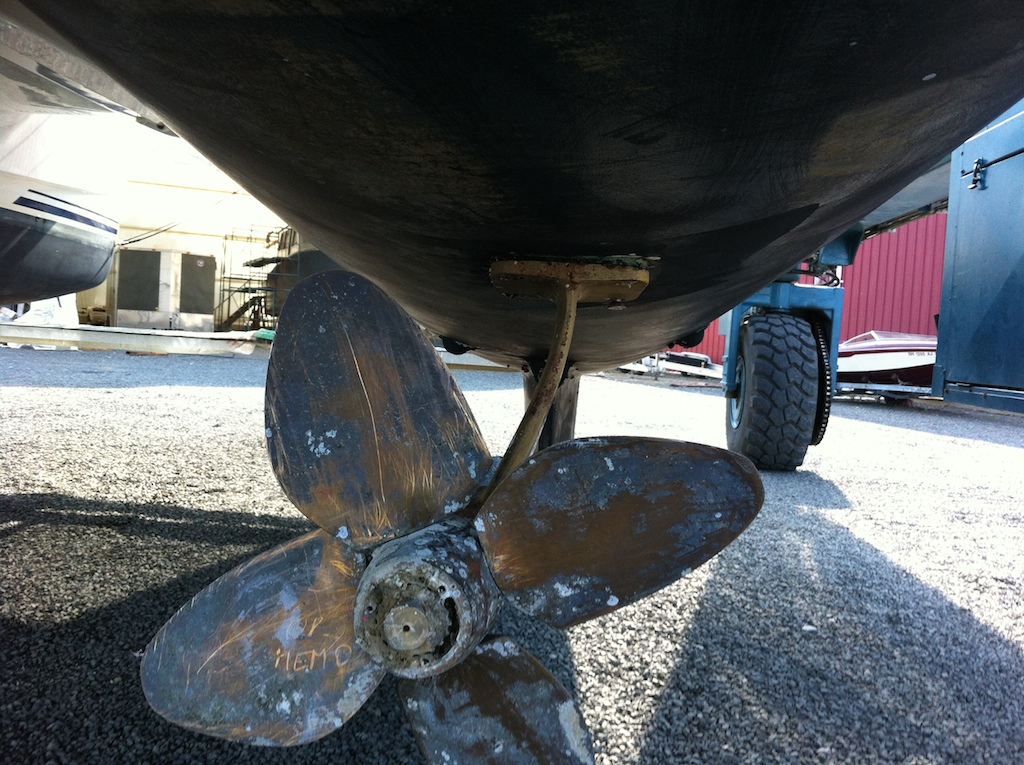
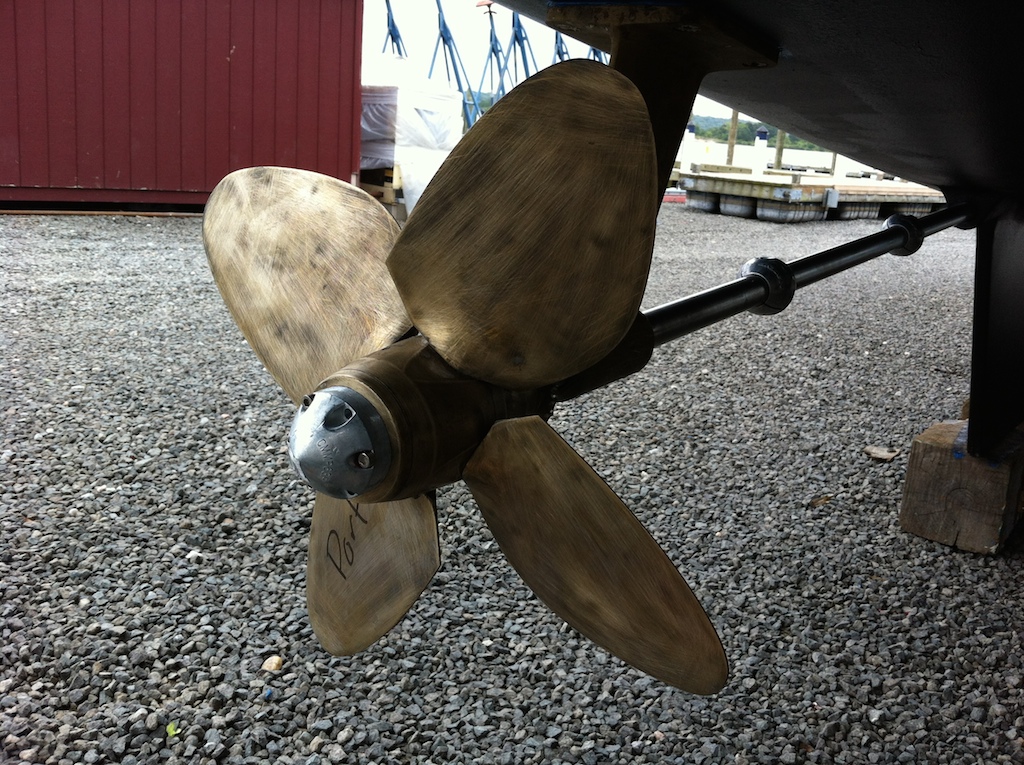
After anchoring, we tried to diagnose the problem.  We tested whether the engines were shifting.  While moving the shifter at the helm, we could see the lever near the transmission moving correctly  (little arm moving aft is forward gear). Next we made sure that the shafts were rotating – again a passing grade  (forward gear is when the shaft rotates clockwise when the observer is looking forward).  So it seemed logical that the Max Props were not operating correctly.

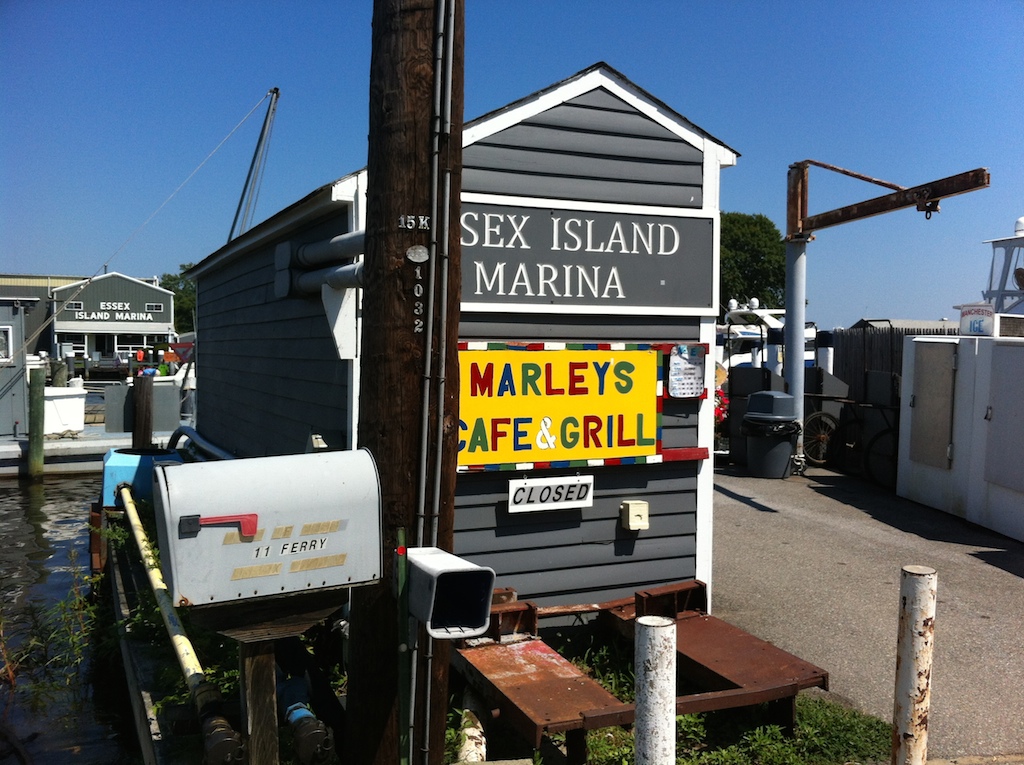
The poor visibility in the  muddy waters of the Connecticut River prevented my diving the boat to examine the props and forced us to haul her out of the water. Once again, I was surprised by Gail’s organizational skills.  Two minutes after we decided to haul out Gail said, “Jason,  a half mile up river is Essex Boat Works and they are one of the few places with a travel lift wide enough for Two Fish.   I will book a haul out for the morning.”  How did she know that?

Sea Tow helps when we lost forward gear

Sea Tow helps when we lost forward gear


The next morning, Sea Tow (AAA for boats) came to help us into a narrow chute leading to the travel hoist.  Even with working engines, narrow chutes raise my heart rate faster than a treadmill.  What will it be like without engines? Our luck continued as Sea Tow arrived just at slack tide in light winds.  Sea Tow did a side tie and acted as my motor.   I was steering Two Fish and asking for more or less power from the Sea Tow captain.  This was a great time to learn this type of maneuvering.  Since the Sea Tow vessel was low to the water, the captain’s view was obscured by Two Fish’s high decks.   Near the mouth of the chute I asked Sea Tow to cast off.  We then coasted in with the help of half of the boat yard staff.   It was easy because of the kind tide and weather.   Our luck would not continue.


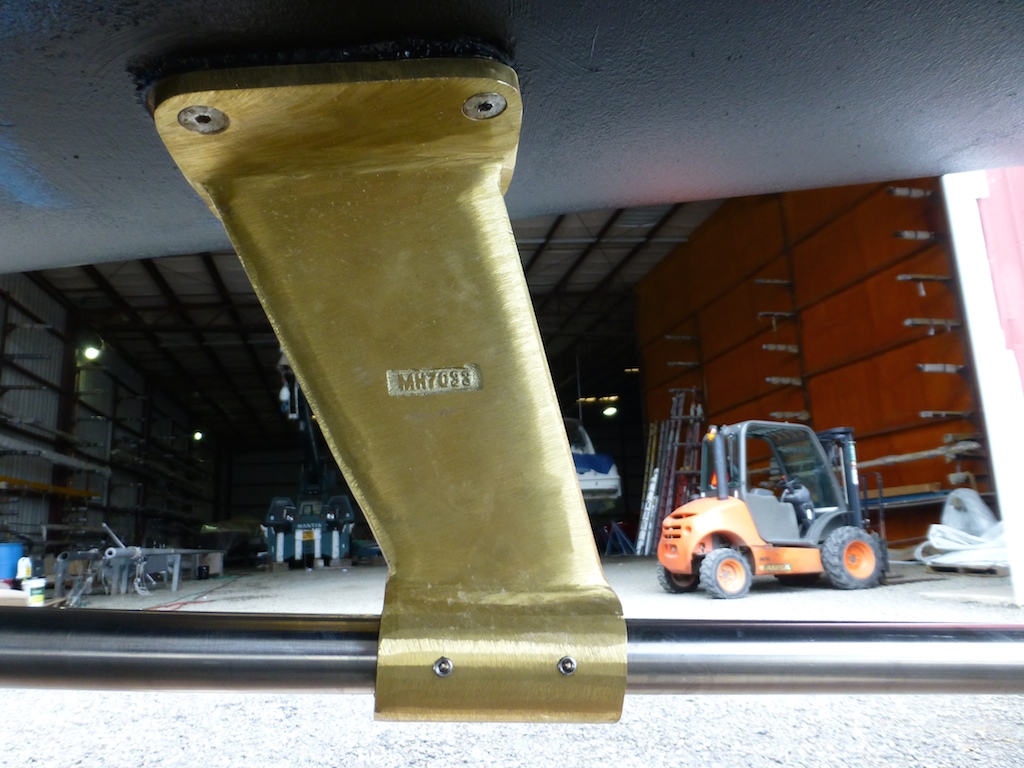
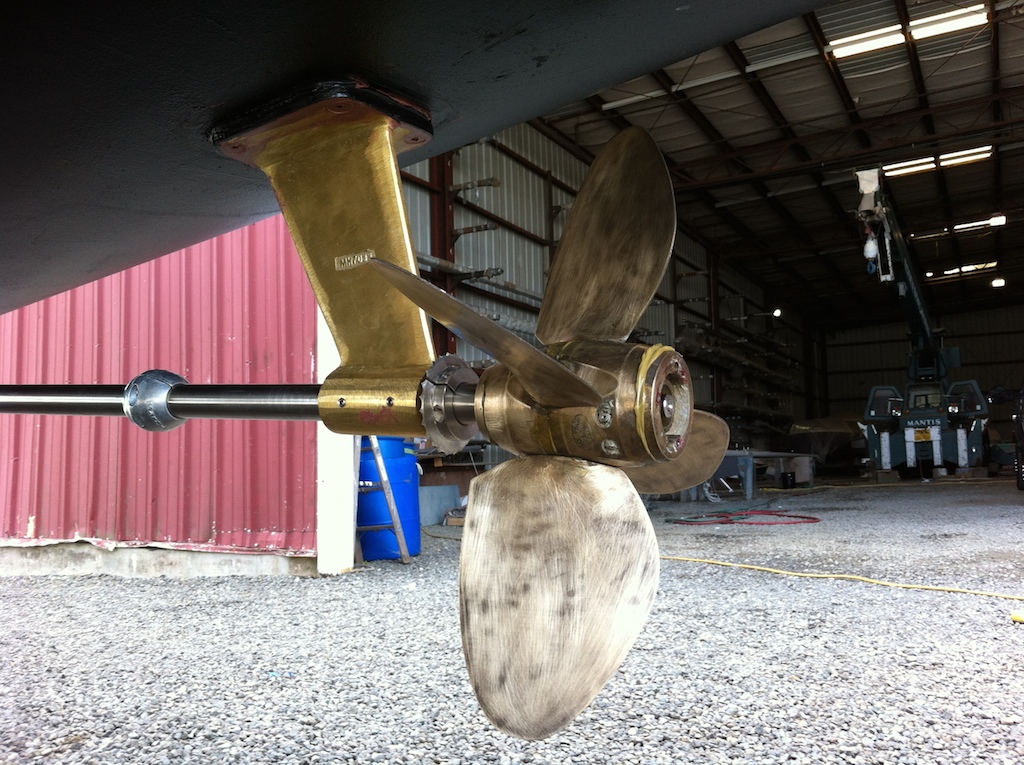
Brass strut should be straight

Brass strut should be straight


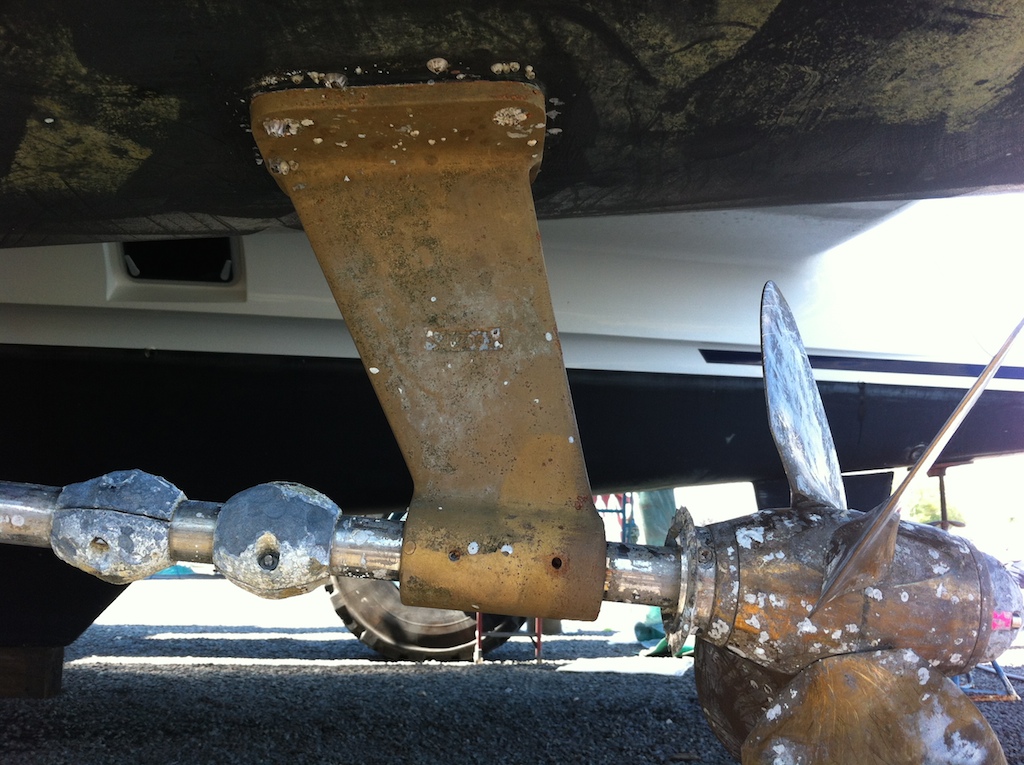
When we returned to the boat yard, we were greeted by some bad news.  The haul-out strap had hooked the propellor and bent the strut.  (Brief intro to engines:   The engine turns the transmission that then turns the shaft.   The shaft then exits the hull and is supported underwater by a strut.)  It was a shame since I had given the haul out operator the builders’ haul-out drawings. The drawings were more hurt than help since it turns out that Two Fish’s construction differs by about 1 foot. Those extra 12 inches of shaft length made all the difference.   New boats are now coming with “straps here” stickers under the toe rail.   Two Fish will also apply stickers.

The guys at the yard felt really bad. I said mistakes happen and no point in carrying a long face.   Our friend Beth ordered us a new strut, but it would take two weeks to be forged. I quickly realized our poor luck was actually opening up some new chances for fun.  But first a bit of work.


Haul Out from Two Fish on Vimeo.

Propellor Puzzle

When the boat has an issue, I go through a few stages of grief.  First, annoyance, as I have no clue what to do next.  When the dust settles, my brain starts to turn on as it is fun to work with Gail on solving the puzzle.   I start unscrewing stuff and Gail starts reading.   She ruminates on the topic while I attack the broken object. If the problem requires outside help, Gail will find the yard and I tend to work with the technician. We have learned volumes from workers.   Since we are such bad students, we have to be in school year round.  Ugh, summer school for Two Fish.

Propellor in working order

Propellor in working order

The propellor fix was going to be stressful since we would not be able to test the fix until the boat was back in the water.   The boat’s splash was delayed 2 weeks by the strut, so we would have to be patient.  I will not keep readers in suspense for 2 weeks.  The cause of the the loss of forward gear was the Max Props.  The blades are designed to rotate while sailing to create less drag.    To accomplish this feat of engineering there are gears inside the propellor.   According to the manual, the gears need to be greased every two years. However, after 10 months our grease had mostly washed out.  Lesson learned, I will now add grease anytime I have access to clear waters. When adding grease it is important prevent an air bubble forming inside the gears.   After greasing the propellors but while still out of the water, we noticed that our starboard propellor would not easily feather.   The Max Prop technicians advocated bedding blows – a fancy way of saying hit the blades through their full range of motion and the air bubbles will burp out.  It worked, and it was now time to test the boat.

We splashed in poor conditions for traversing that nasty chute.  The current was strong and the well-intentioned docks guys lost control of the lines quickly.  I should have warped the boat forward, but instead had the opportunity to perform a good test of the propellors.   If they failed, we would be serving piling sandwich for lunch.   The boat was squirrelly and I had a few shallow breaths, but we escaped without the sandwich.  The propellors came through when I needed them.  I would need their power a few more times later in the month.   A representative from the yard was aboard for this short test sail and witnessed the exciting departure.   In a stoic New England way he told me “good departure”.

Bottom Paint

We took advantage of being out of the water by doing some other necessary work on Two Fish. Bottom paints are supposed to stop organic growth on the hull. The best bottom paints are very toxic for the sea and are not legal in the United States. Other bottom paints are complex to apply and require good weather and the boat to be splashed within 48 hours of being painted.   We decided to go the low tech route.   We applied an ablative paint that is designed to rub off.   I have a few swim suits that have bottom paint styling from rubbing into the hull.  We applied 2 coats of Interlux Micron Extra with Biolux, rated by Practical Sailor magazine (consumer reports of the sea) as good but not excellent.   Our first coat was blue and the second coat black so I will be able to tell when the outer coat has rubbed off.

Cleaning Her Underbits

The shafts, propellor and through-hull covers all need to be cleaned of super-barnacles.   This species has evolved on Two Fish while travelling along two continents from cold salt water to warm brackish waters.   A grinder is required to remove the super-barnacle.   I was happy to see the hull was in  great condition, despite my reduced diving since entering Maine’s chilly waters.  We chose not to apply Speed Prop to protect the propellors from growth.   We use the boat frequently and we plan on hauling out again soon.

Thru Hull Replacement

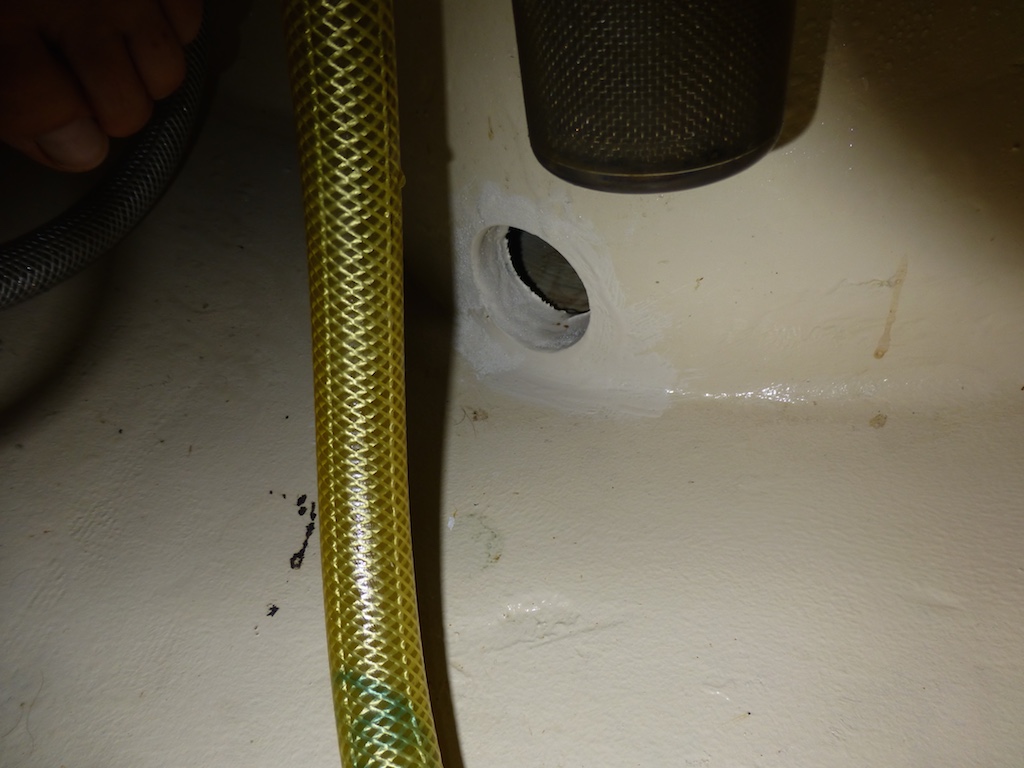
Ever since day one, a thru hull for the port head has leaked the tiniest amount.   At first we blamed our friend Darren, but we later realized his conviction was as well thought out as the Salem witch trials.  The leak was from the sea into the boat not from the head.  Our thru hulls come in 3 pieces so pieces one and two can be serviced without haul out.   Unluckily, Two Fish had a hairline crack in part three that allowed sea water to enter; this could only be fixed while out of the water.   When we first discovered the problem, we decided to use underwater sealant to arrest this leak.  It did an admirable job, but it is nice to have fixed the leak properly.  Gail surprised the yard with her vast supply of spares.  Yard guy: “It will take a week for that through hull to be delivered”.  Gail: “No problem, I have one”  Yard guy with a lowered jaw: “Really?”

Underwater Checks

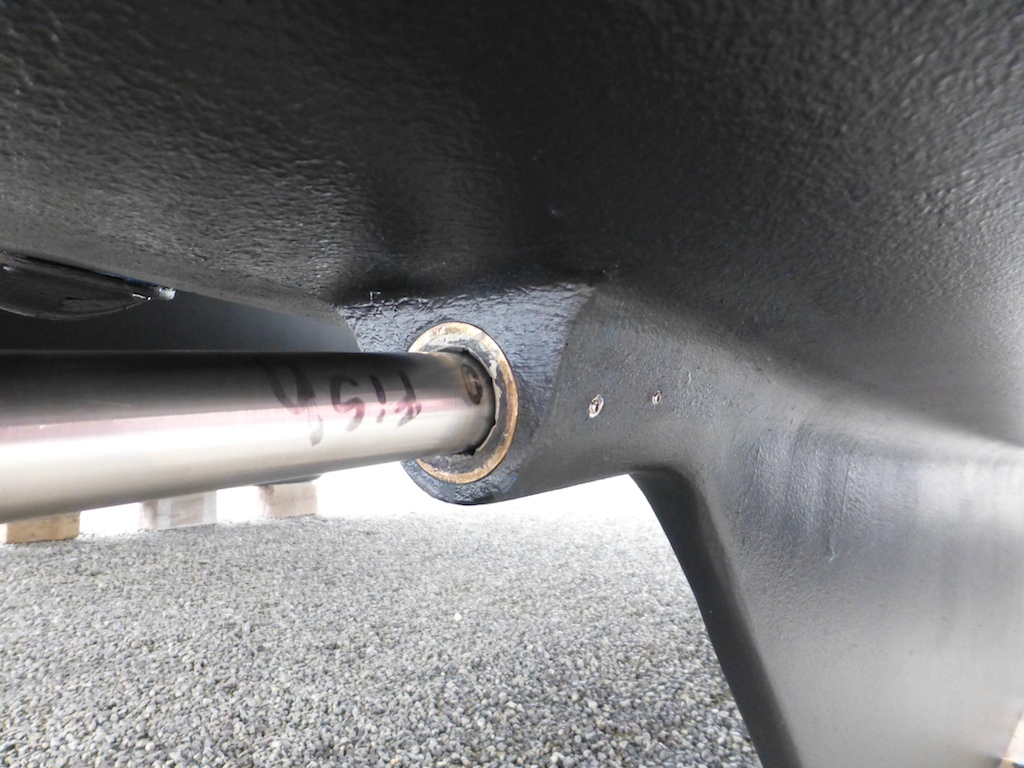
I checked the rudders and also sent a photo to the builder to make sure they still looked problem-free.  No issues to worry about -they are in great shape.   Replaced 6 zincs.  The cutlass bearing inside the strut was in good condition but the set screw was not in properly.   We fixed that as well.

Shaft seals

Shaft seal with replacement collar

Shaft seal with replacement collar


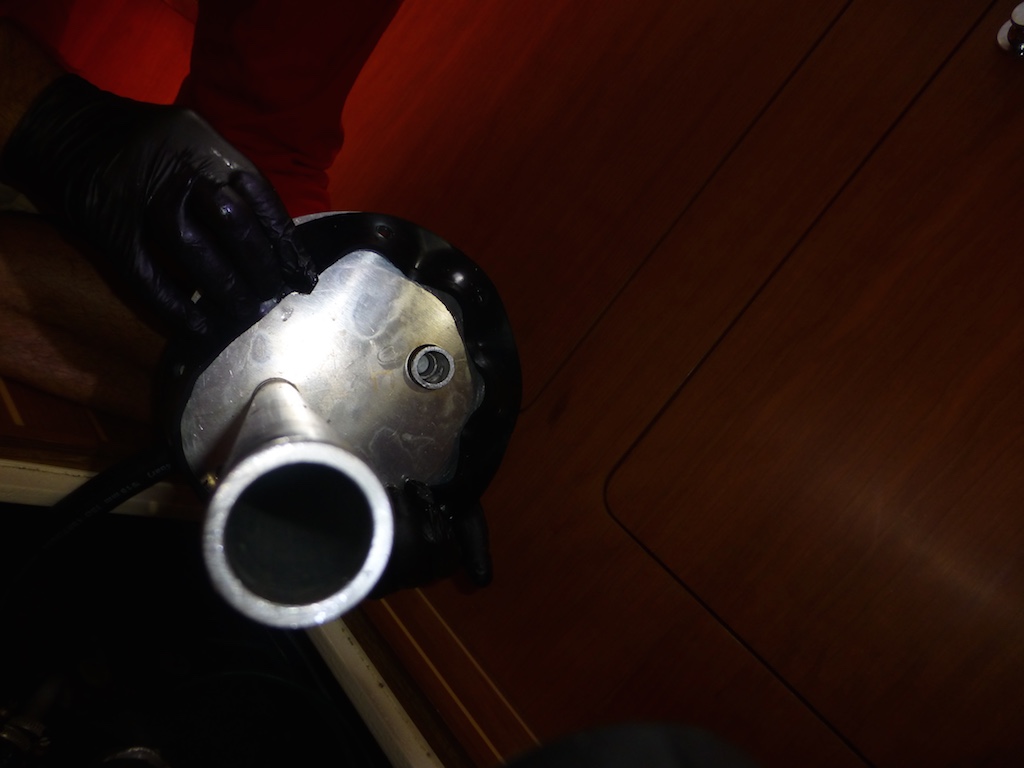
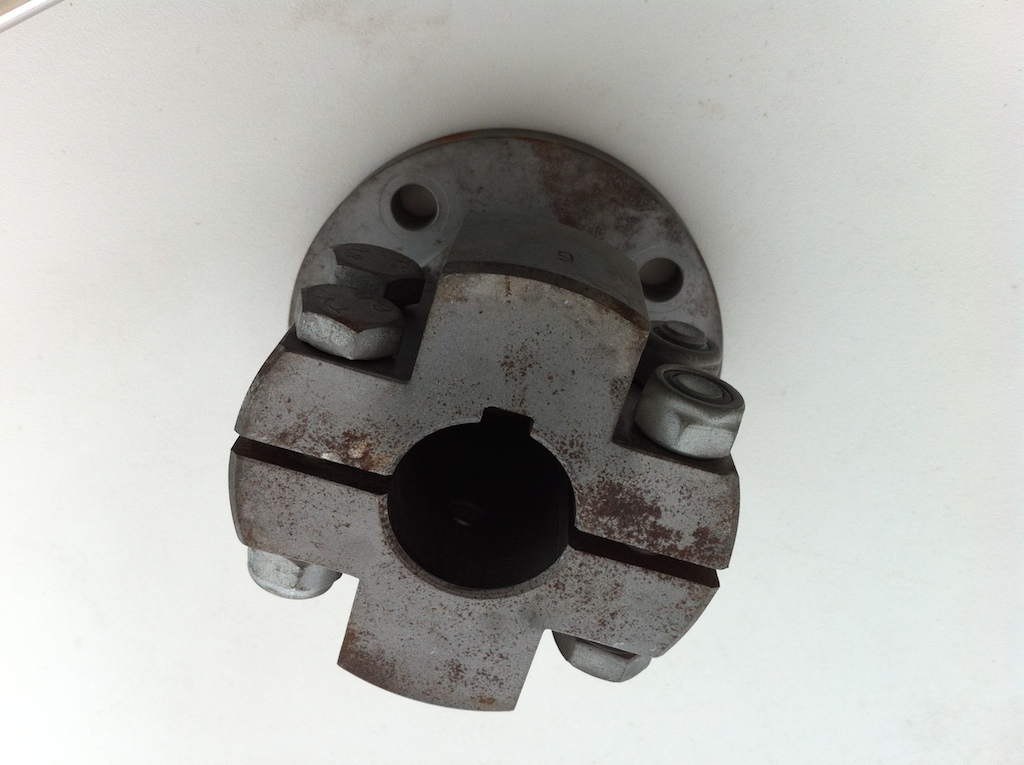
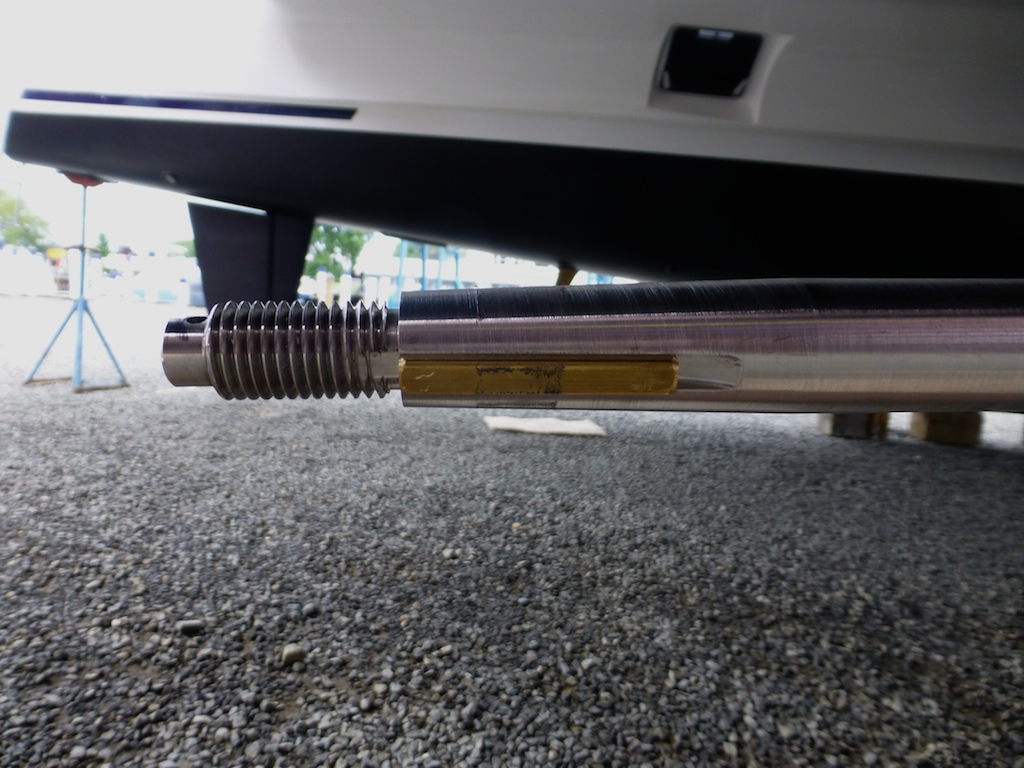
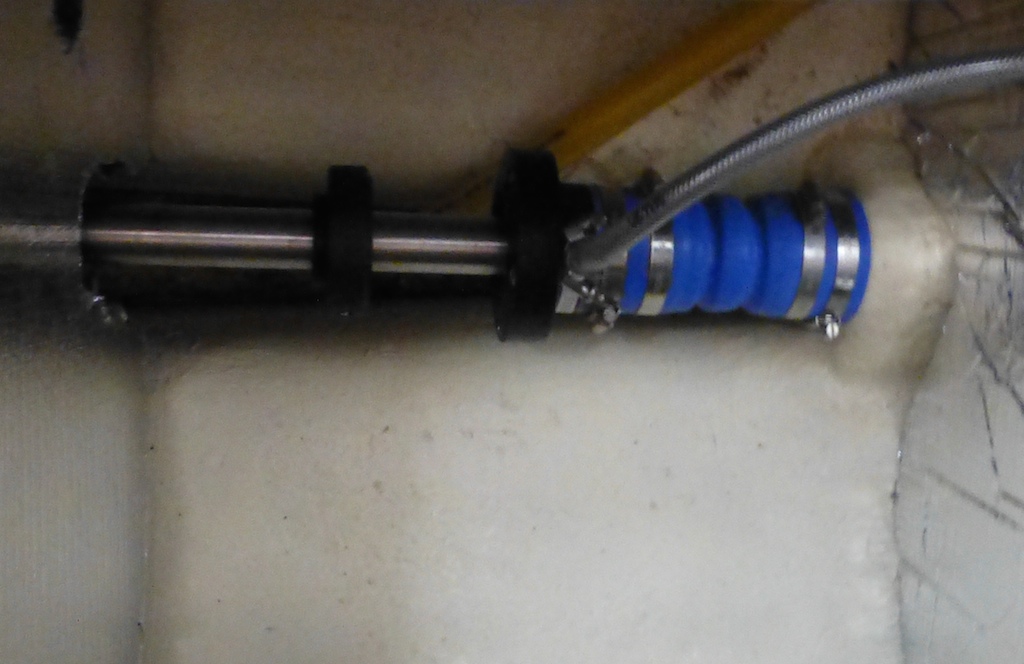
Our shaft seals were in good condition but we replaced them 2 years early so that we could install a version that allows for easier emergency replacement.   My recommendation for new boats is to ask for this upgrade on day one.  Without that second black ring one would need to detach the shaft from the coupling and march it backwards.  Not easy in a seaway.   By the way, the coupling bolts should be checked with regularity.   One friend had his seize up and another had them unscrew themselves.


Fuel polishing

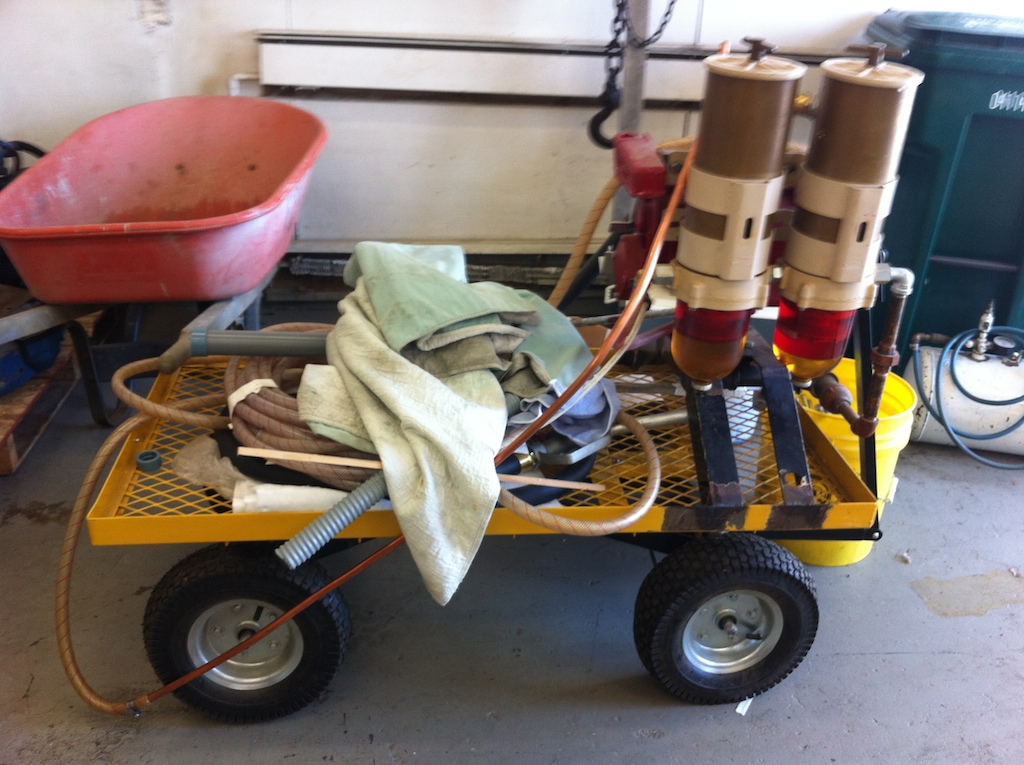
We had a tiny bit of algae in our fuel filter and I decided to get ahead of this problem.   We poured BioBor HF, highly rated by Practical Sailor, into the diesel tank.  The yard then used their fuel polishing machine to remove the algae.   Seems to have worked well.  Might have been overkill, but better than clogged fuels lines when crossing an inlet.   Despite our pleas, we were not allowed to race the polishing machine isn the town’s soapbox derby.

Yard's mobile fuel polisher

Yard’s mobile fuel polisher

Cosmetics

We also cleaned the topsides and stainless, but the process of cleaning a boat is never over.   Today I was still cleaning the teak (fake) with a ton of passion.

 Free time


Comments { 4 }

Tour of One Fish

Due to popular demand, I have given a tour of One Fish our Apex dinghy. She needed several after-market changes to get her up to standard.

1) Replaced useless oars with compact, telescoping, paddles

2) Added rear-facing U bolts for stronger tie-downs during passages and more secure towing.

3) Bought new fuel tank and installed in bow locker.  Required leading fuel line forward.

4) Installed limber holes in helm seat to allow for better flow of water to aft plug.

5) Installed fuel separator.

6)  Added dinghy wheels, Danard Marine, to the stern.

7)  Equipped dinghy with handheld GPS, running lights via suction cups, anchor, rode, security cable, jerry can, bilge pump, boarding ladder  and dinghy anchor.

One Fish, Apex dinghy powered by Yamaha from Two Fish on Vimeo.

Comments { 2 }

Spinnaker Tips – Hoist and Douse with Ease

This video contains my tips for how to make chute raising and dousing drama-free. My top tip involves using a Tylaska snap shackle to tame your spinnaker on windy days.  I bought the T12 Snap Shackle (4 inches long with 6,000lb MWL -T12 SM Bail) and rigged a line around the release mechanism.   Fire up the popcorn for this video, as I have been accused of being a bit long-winded.   If you are a pro without the time to watch the video then consider using a quick-release shackle on the tack.   Release it before snuffing and the spinnaker will almost snuff itself.

Tylaska Snap Shackle

Tylaska Snap Shackle -T12

Setting and dousing the spinnaker on Two Fish from Two Fish on Vimeo.

Comments { 0 }

Keeping Cool

For mammals, summertime is about finding shade and keeping cool.   For marine engines, keeping cool is a year-round obsession.  Two Fish’s engines started running hotter than usual and, during the process of investigating this, we have learned a bunch about engine cooling.  (I used a silver Sharpee to draw arrows on my coolant hoses to remind me of direction and contents.)    Fortunately, the engine never heated above the safe operating range so there was no damage.   Two Fish has easy to see gauges which protected our valuable engines.  In some sailboats, the  vital gauges are located at the helmsperson’s ankle.

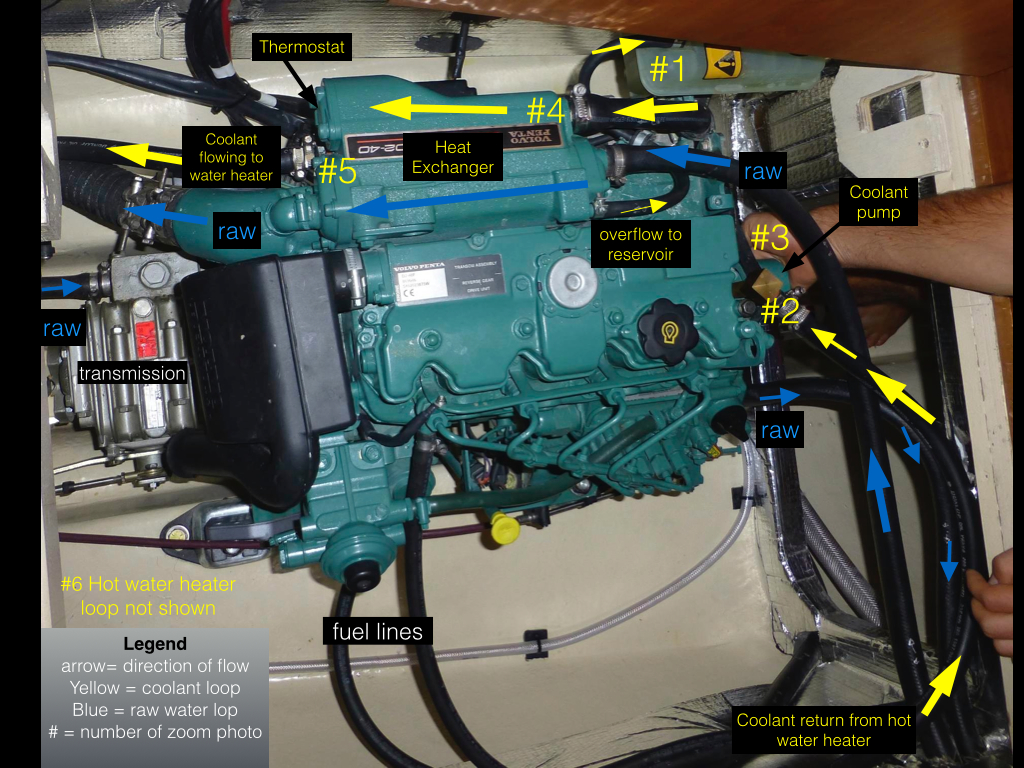
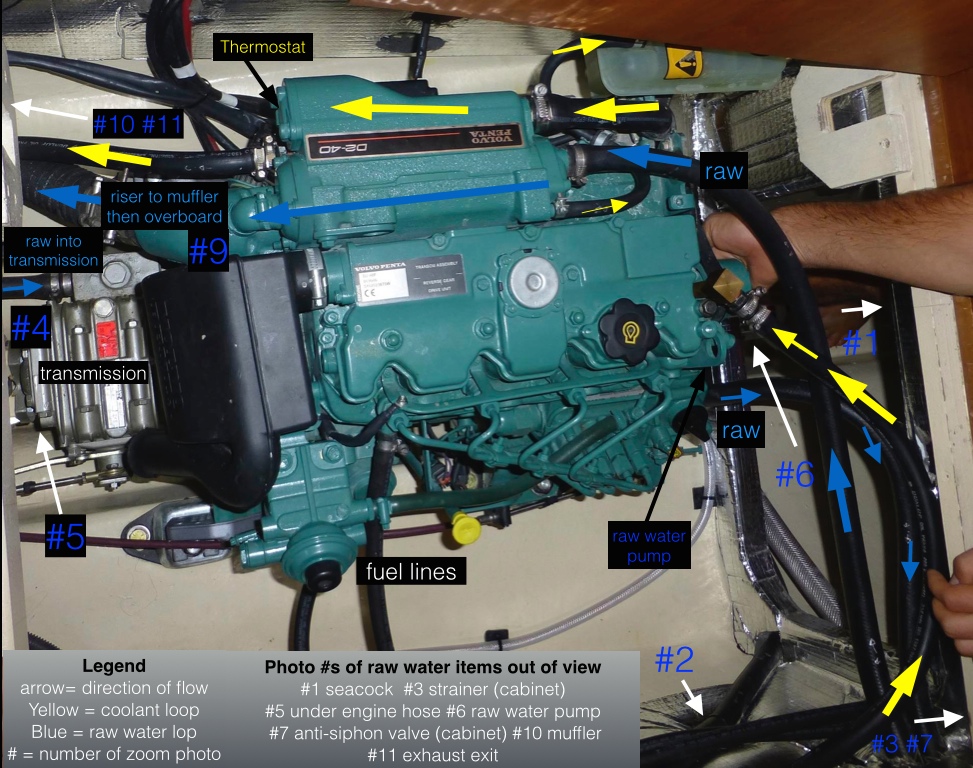
The below photo is an overview of the cooling flows.  Think of it as the imaginary kingdom in a fantasy novel.  It makes little sense at first, but it will help you to refer back to it while reading this post.  The star players are Volvo D2-40 Engines, Quick hot water heaters, Vetus strainers and Vetus anti-siphon loops.

Overview - coolant loop

Overview – coolant loop

Coolant, derived from the latin word coolium (fluid that cools chariot wheels), keeps our engines from overheating.   Coolant technology has advanced since the Roman Era and is now used  in most engines.  Coolant is mostly water with some toxic stuff that raises the boiling point and lowers the freezing point.  The miracle chemicals also protect the engine from rusting.   These Volvo engines demand a particular Volvo coolant (VCS yellow) and nothing else is allowed inside the engines.  Now we will track a drop of coolant’s path  through the circular loop.
#1a Reservoir for coolant

#1a Reservoir for coolant

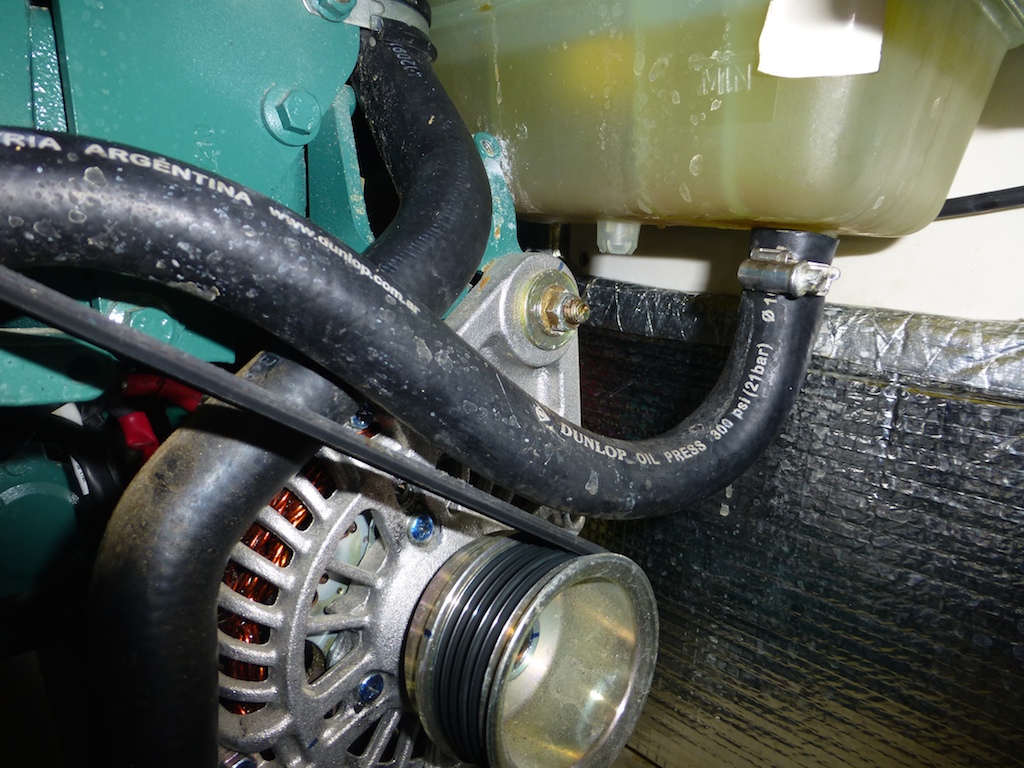
#1  The coolant is poured into the reservoir bottle, which has to be the higher than any part of the engine and the hot water heater.    When refilling coolant, you can lift up the bottle so that the filling point is higher.   This will ensure that there are no nasty air pockets in  your cooling system.  Air is poor at transferring heat and can disable the cooling system, so great care must be taken to remove it from the cooling loop.   Another air pocket defeating trick is to slowly unscrew the cap of the reservoir after the engine heats up.  If you feel suction being released, you had an air pocket.  Please be careful when doing this to avoid burning yourself with coolant.  Burnt by coolant sounds oxymoronic?  Volvo claims that the D2-40 engines are self-purging and thus the engine does not have a radiator style cap for burping the engine.
#1b Coolant path to pump

#1b Coolant path to pump

#1b  At the bottom of the bottle, there is a a hose that leads to the top of the coolant pump.   I have placed white electrical tape on the side of the bottle marking the most recent coolant level.   After changing coolant, there can been major drops as air is purged from the coolant loop.   Once the coolant has stabilized, the bottle should stay fairly constant.  A large change in coolant level could be a sign of an overheat that was not detected.   You can never spend enough time in your bilge looking for things that are not right.  Gail is great at this and uses old photos to confirm her suspicions.  Take lots of photos of your boat so you can find part numbers and what things looked like 3 months ago before you unscrewed everything.  The digital camera is in our top 10 best tools list.   Mirrors and flashlights can not compete.
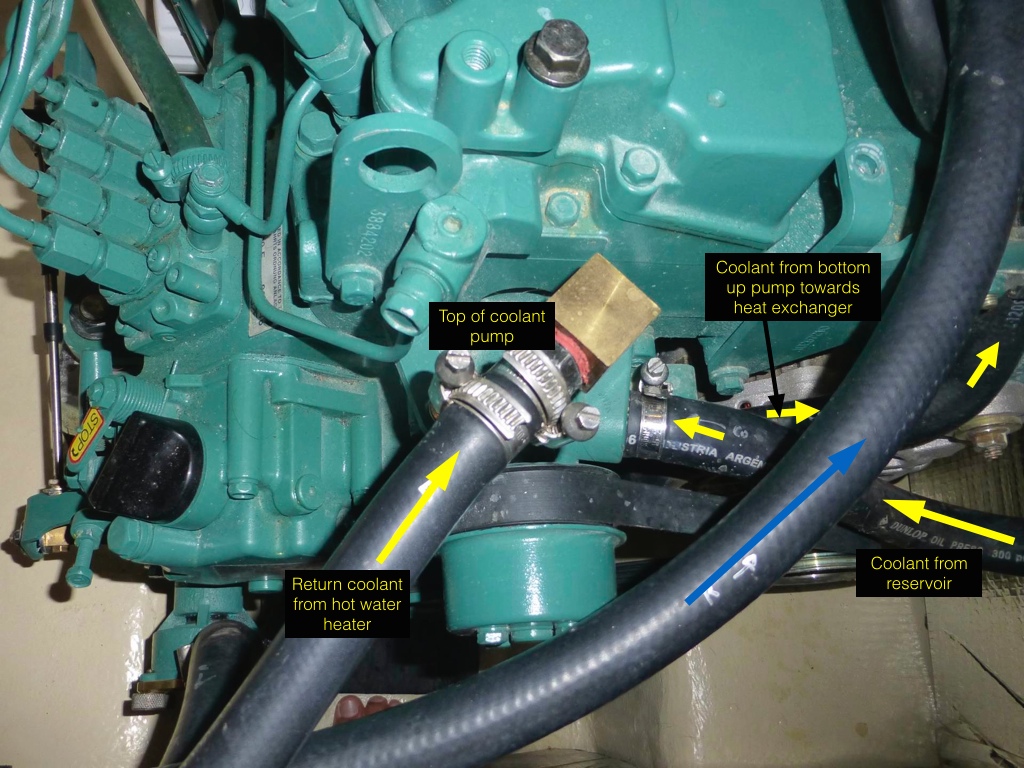
#2 Top of coolant pump (input)

#2 Top of coolant pump (input)

 #2 The coolant pump is driven by the main belt that also drives the alternator.  The pump sucks coolant from two hoses that feed into it from above.   The first hose is from the reservoir and the second hose is coolant that has completed the full lap of the engine.  Because this boat uses the hot coolant to warm hot water for showers and dish cleaning the plumbing might look different than other boats.  Without a water heater, coolant would return directly to the pump from the heat exchanger.


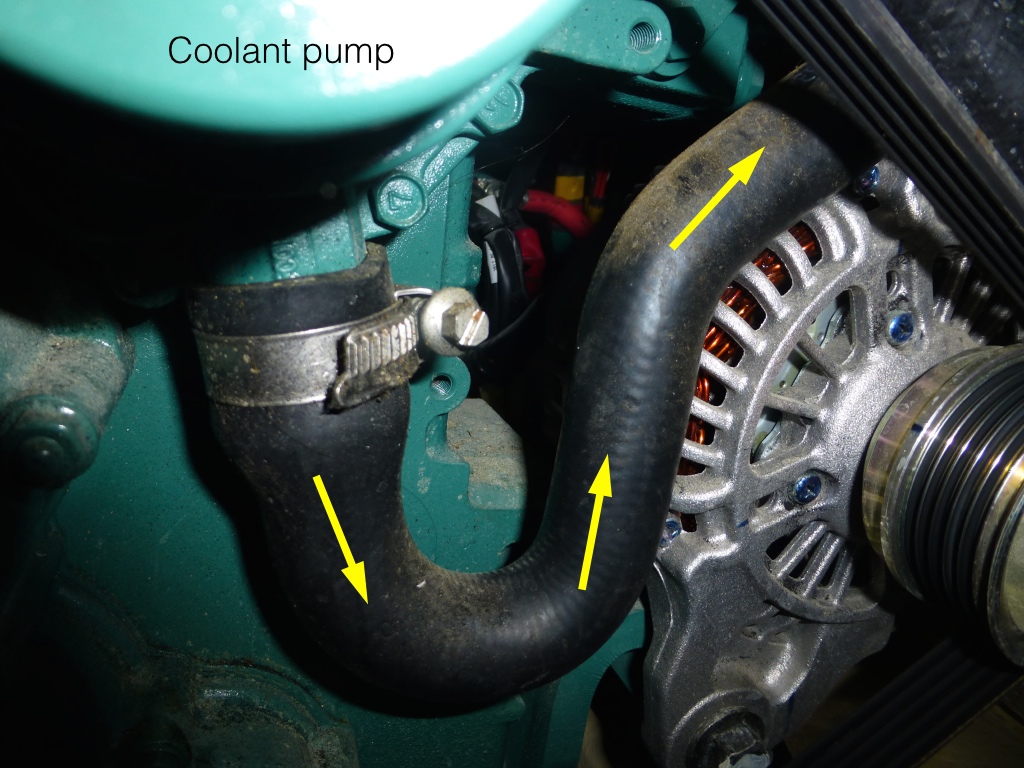
#3 Bottom coolant pump (output)

#3 Bottom coolant pump (output)


#3  The coolant pump sucks the coolant from above and sends it through a hose that snakes over the alternator and heads up and to the other side to reach the heat exchanger.   In theory it should be coolest now as it prepares to enter the engine and absorb heat.  I have not serviced this pump yet.


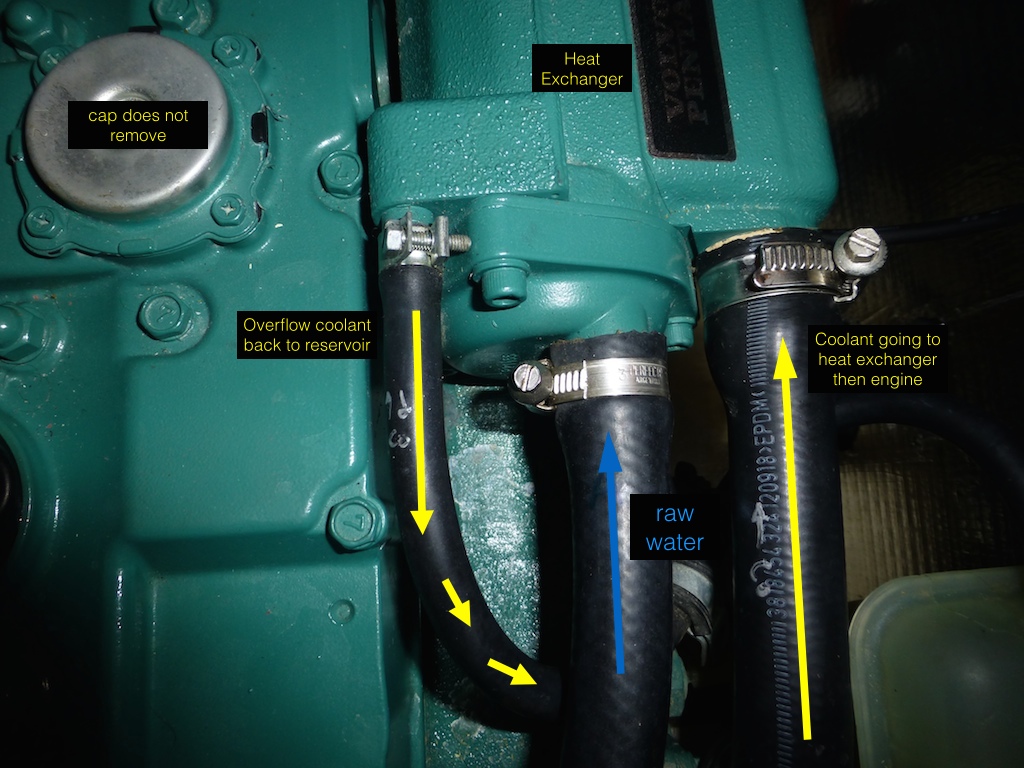
Coolant enters heat exchanger

#4 Coolant enters heat exchanger


#4   The coolant enters the heat exchanger on the outboard (right) side and the cooler raw (sea) water enters on the inboard (left) side.  The coolant then enters passages in through out the engine.  The now warmer coolant reaches the thermostat.   If it is hot enough to melt the wax in the thermostat then it gains entry to the heat exchanger.   The heat exchanger should raise the temperature of the sea water and lower the temperature of the coolant.  The metal passageways are designed to have large surface areas and the adjacent passage of raw water cools the heat exchanger.   The raw water and coolant never mix and like forbidden lovers are kept apart by metal walls. The raw water now having done its cooling job will be dispatched overboard.   The coolant will be ready for another circuit through the loop.  The small diameter hose is for coolant overflow.   If the system overheats, this would send excess coolant back to the reservoir.
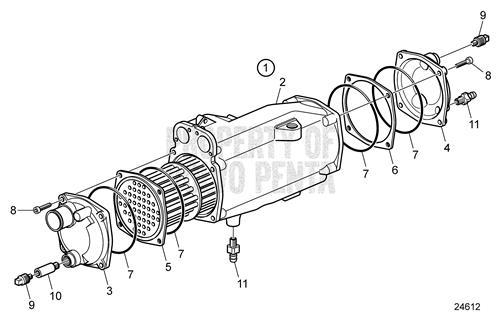
Volvo Heat exchanger

Volvo Heat exchanger


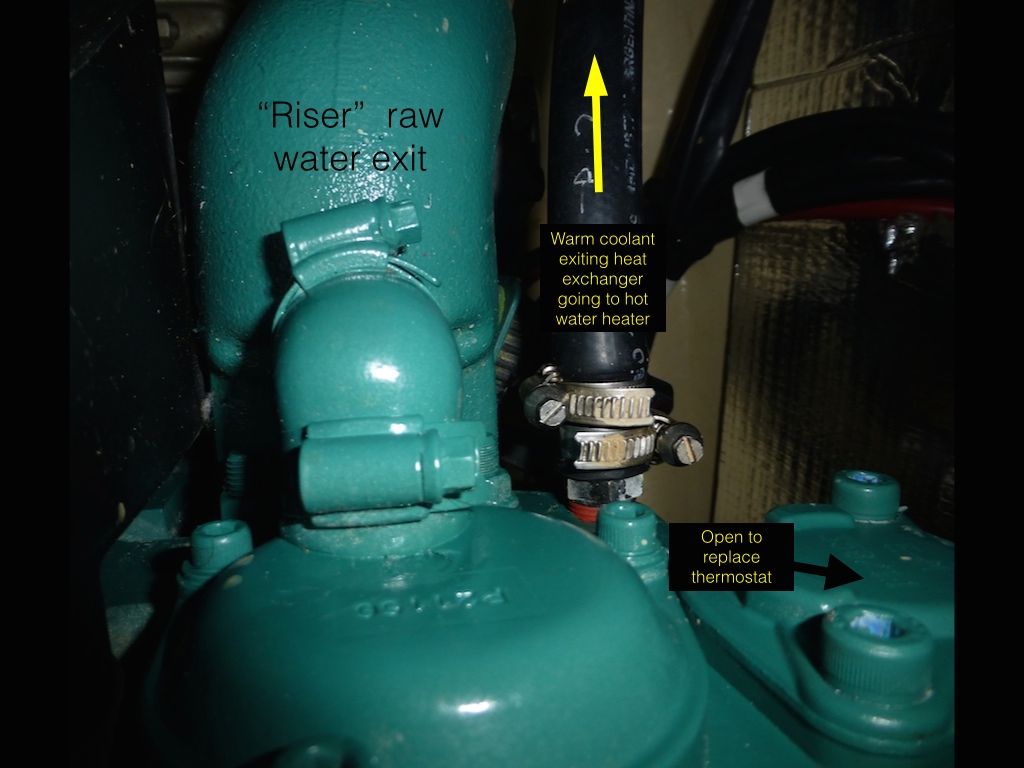
This diagram shows a heat exchanger’s interior and the complex surfaces that encourage heat transfer from the coolant to the raw water.  At the end of the exchanger is a thermostat.   If the coolant is hot enough the thermostat will allow the coolant to enter pathways within the engine.   I am still searching for a  drawing of  the coolant path for the Volvo D2-40 engine block.  I replaced both of my thermostats while tracking down my heating problem.   The thermostat opens at 90 degrees Celsius (194F), which is near the typical operating temperature.  When the temperature rises to 102 (215), the thermostat is fully open.

Coolant leaves engine

#5 Coolant leaves engine


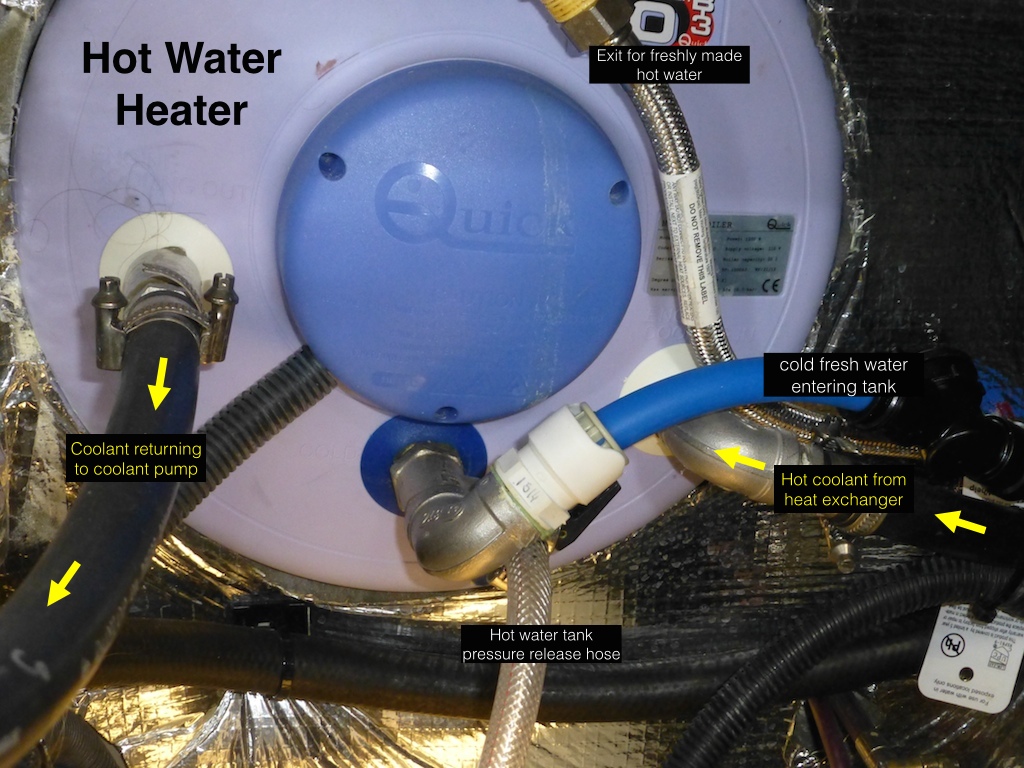
#5  Hot coolant leaves the engine and heads towards the hot water heater.  The coolant then passes throughout the hot water heater, even if the water in the hot water tank is fully warmed.  If the water in the tank is cool, the hot water heater pathway will transfer heat from the coolant to the water.


#6 In and out of hot water heater

#6 Inflow and outflow – hot water heater


#6 On the right side of the photo, the hot coolant comes into the tank.  After a brief travel through a helix shaped passage, it exits the tank on the left side.   Hot showers can now commence!   If you are not motoring, the hot water tank can be warmed using 110 volt power.  Showers do not taste like coolant, since the coolant never mixes with the drinking water in the hot water tank.    The coolant now takes the long trip back to the coolant pump and our loop is complete.


THE RAW (SEA) WATER LOOP

Raw water loop overview

Raw water loop overview

#1 Raw water enters boat at seacock

#1 Raw water enters boat at seacock


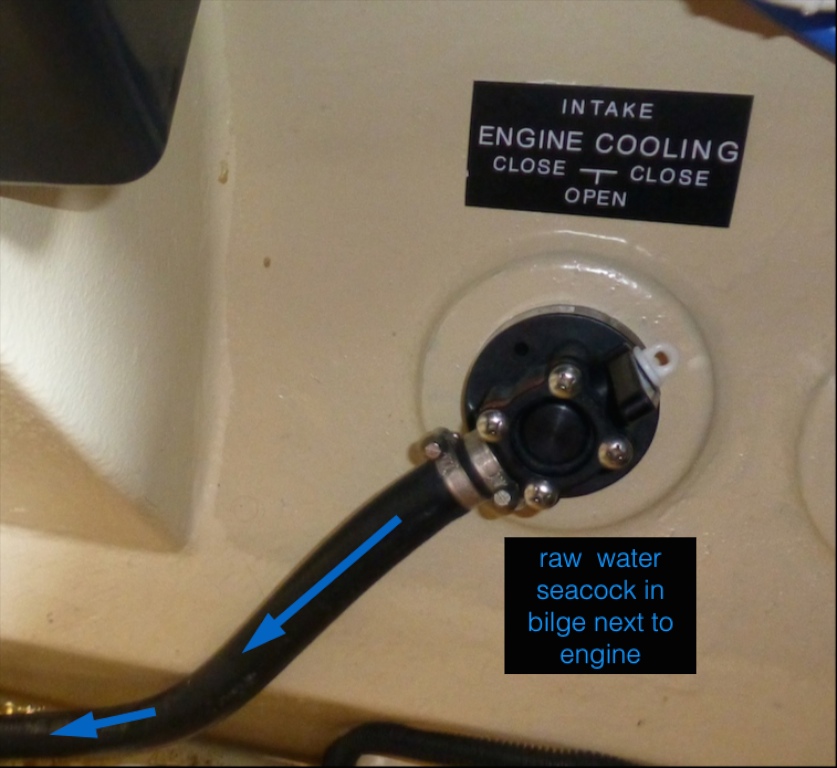
#1  The seacock brings seawater into the raw water circuit.  If you are ever servicing the raw water circuit, you will need to close the seacock.   If you fail to close the seacock, water will flow in until the oceans are empty.   If you fail to open the seacock and then run the engines you will most likely shred your impeller.   Not a ton of fun but not the end of the world, unless all of the bits get sucked into your heat exchanger.  It is not a bad idea to exercise you seacock handles.


Plumbing from seacock to strainer

Plumbing from seacock to strainer


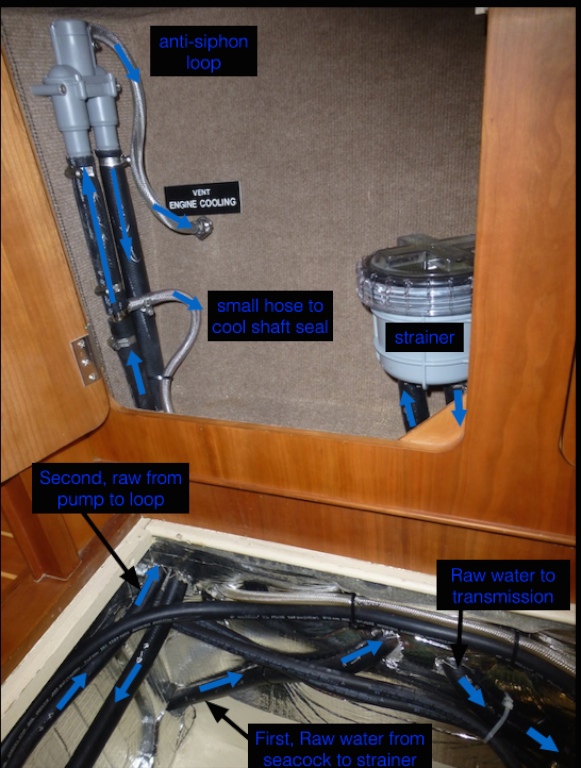
#2  This photo shows the peak of hose spaghetti; now you can begin to understand why it has taken me so long to understand my engine cooling loops.   Click on the photo to follow the paths.   The basic idea is: seacock to strainer,  strainer to transmission, transmission to under the engine, under the engine to the water pump, water pump to anti-siphon loop.   Next take a right at the house with windows.  Makes sense?  I told you the directions were easy.

When a engine overheats, the first thing you should check is your strainer.  Make sure an octopus is not blocking the flow.   With a flash light, you can examine the strainer without opening it.   We do this before leaving the dock.   If you do need to unscrew the lid and remove a pesky octopus, first close the seacock.


Strainer

Strainer


#3  When the engines are running, the strainer should be filled to the brim with water.   Only a couple of bubbles.   Any less and you are not getting great pressure in your system.    First action we take is to throw the captain overboard to clean the thru-hull.  It pays to do this in the Bahamas, not New York Harbor.   I had cowlings on my thru-hulls; I have removed one after the designer warned me that they attract more sea-life than they prevent.    This is a hotly debated topic so I am on the fence with one engine in each camp.


Raw water cools transmission

Raw water cools transmission


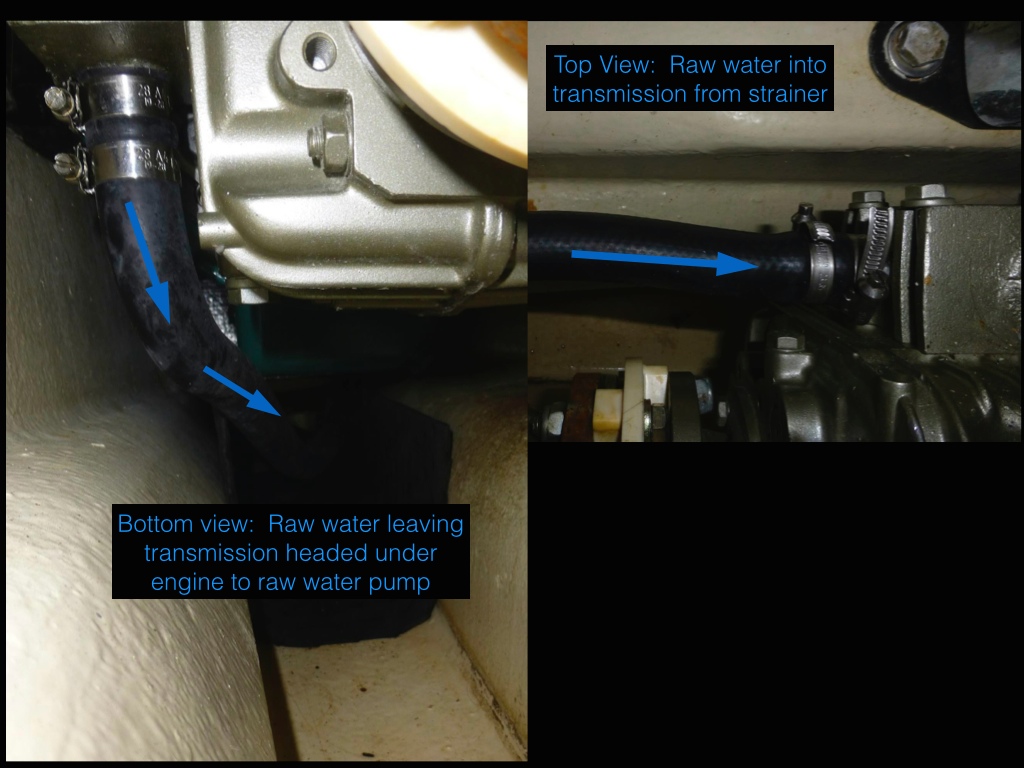
#4  The back of the transmission has a heat exchanger to keep the transmission cool.   This will warm up the sea water about 1 degree Celsius.   Over time, the path of the raw water may need cleaning.


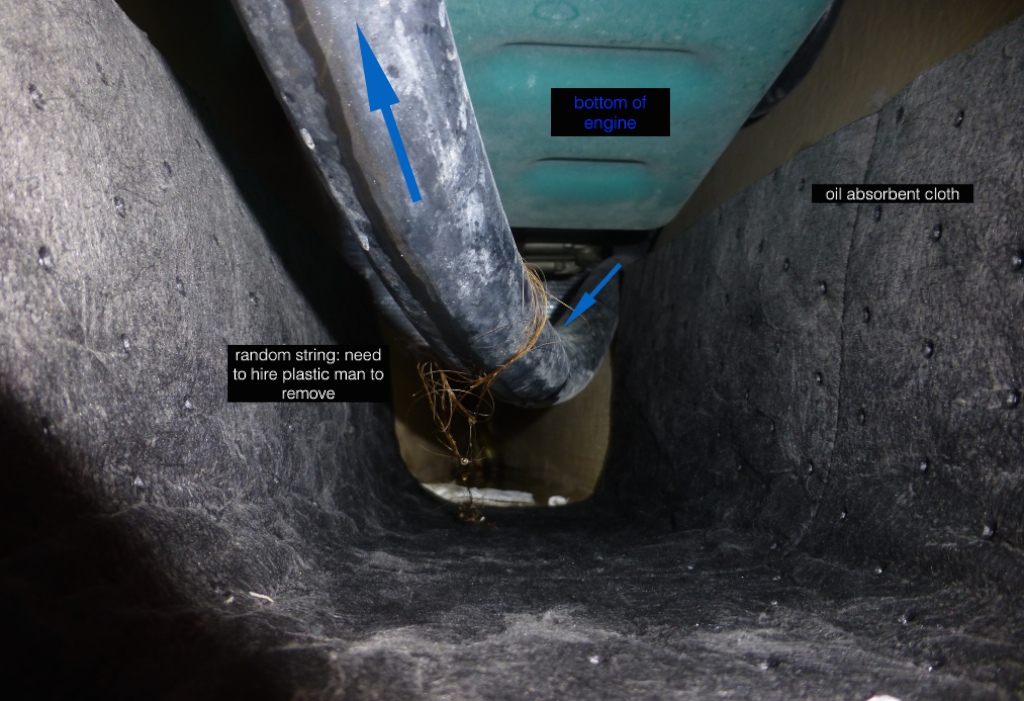
Sea water passes under engine on to raw water pump

Sea water passes under engine on to raw water pump


#5  It took me a while to figure out the path of the raw water circuit and this hose was the key.   It runs from the transmission to the raw water pump.


Raw Water Pump

Raw Water Pump


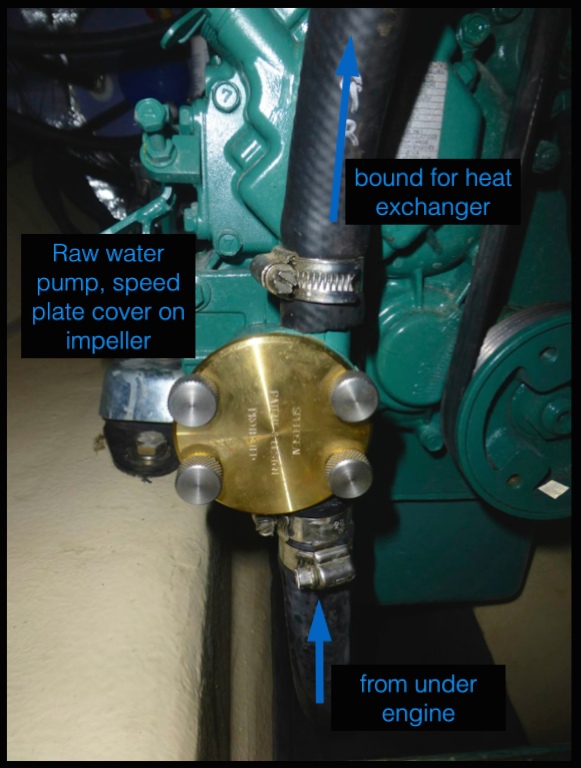
#6  I have extolled the virtues of Speedseal impeller covers in my video from Fort Lauderdale, so I will spare you another lecture.  I did discover since then that the front of my engine can be reached easily by removing the panel separating the engine from the bilge.  Just four screws and the fire-proof wall comes out.  You learn something every day.   I like  fresh impellers so I change them more frequently than required.  My profligate purchasing of spares must be putting at least one Volvo employee’s child through college.  I hope it also keeps Two Fish running without faults.


Plumbing to anti-siphon loop

Plumbing to anti-siphon loop

Anti-siphon loop and splices

Anti-siphon loop and splices

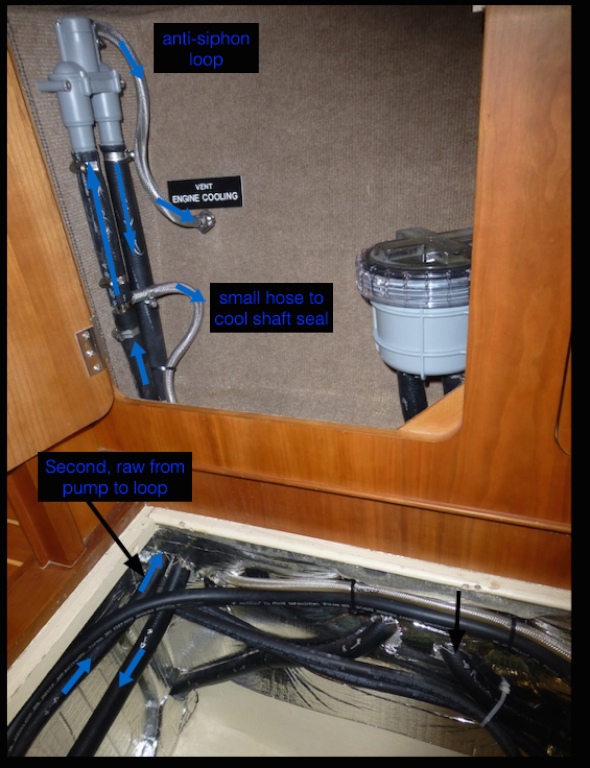
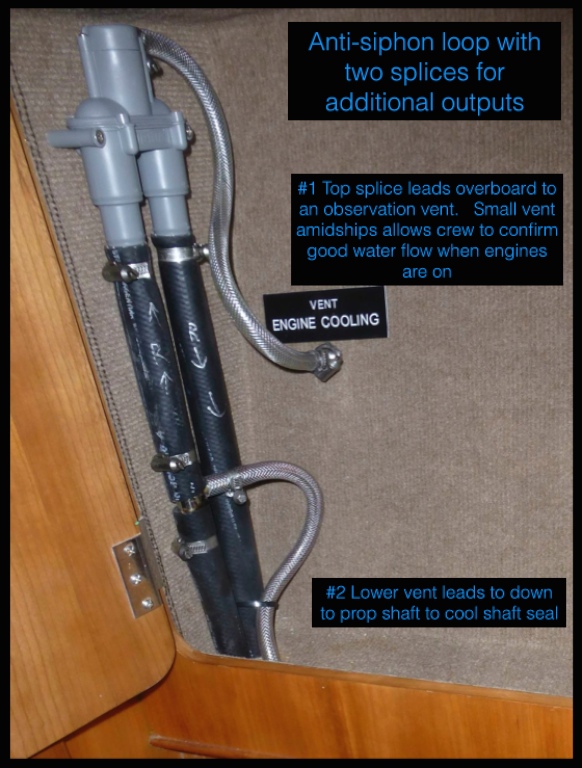
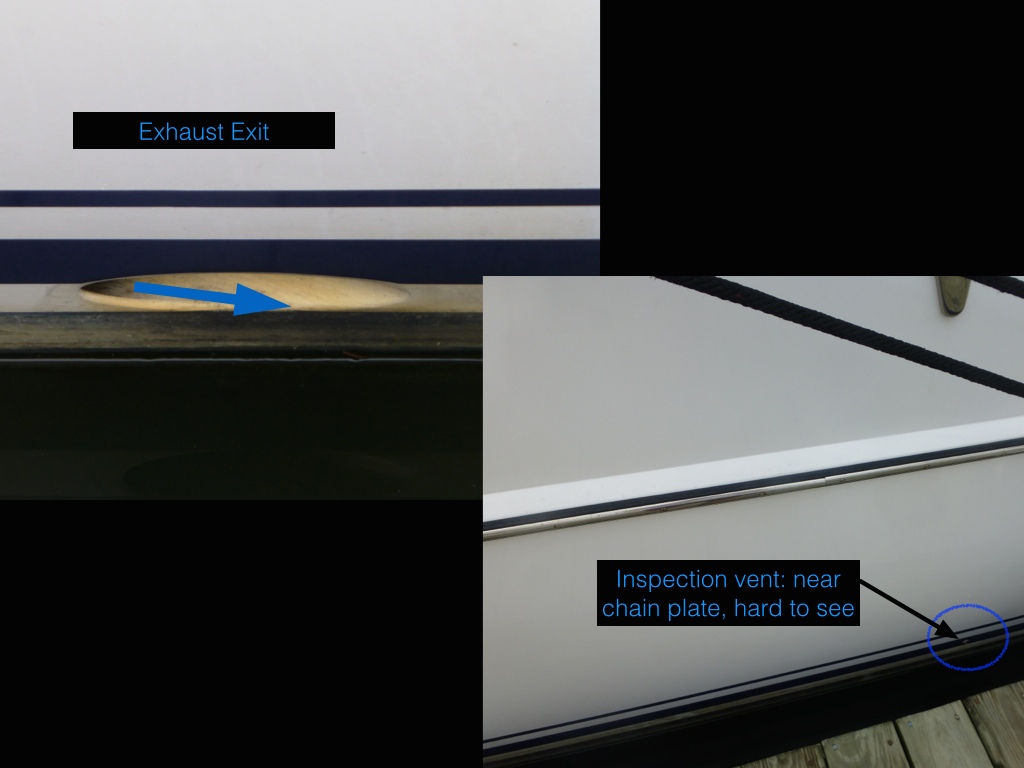
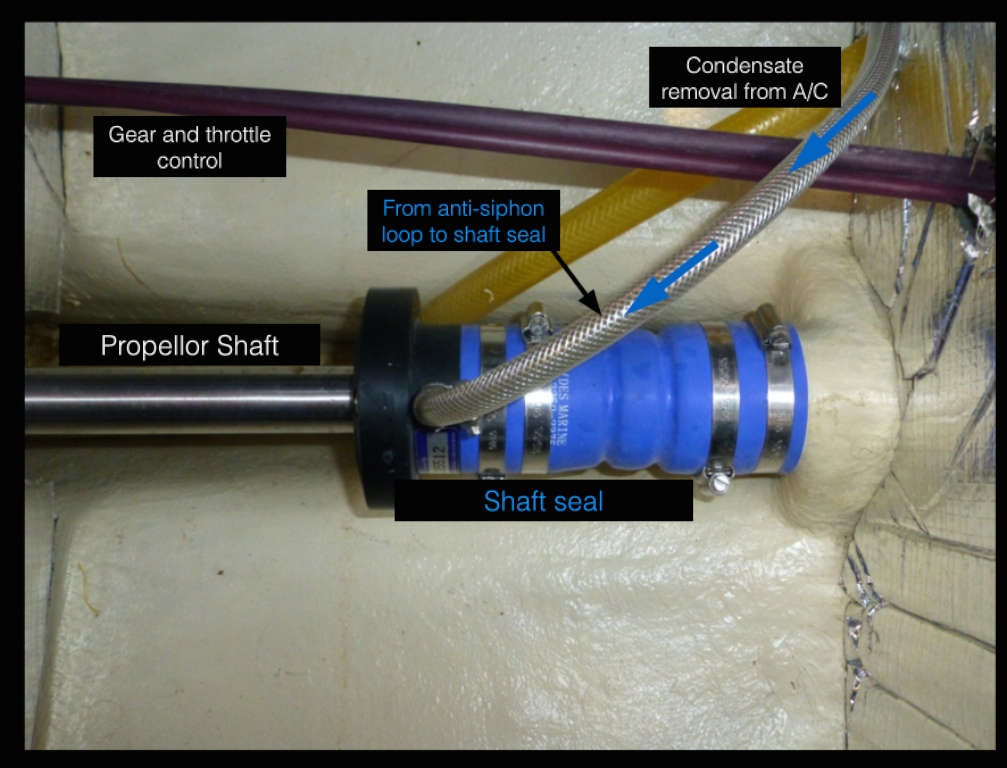
#7 Anti-siphon loops may be foreign to motor boaters since their engines are always operating while they are moving.  When a sailboat is sailing, the raw water seacock can start to suck water into the boat.   This uninvited water is frowned upon by most sailors.   As an aside, our bilge pump for the generator locker has an anti-siphon loop that exits the boat near the bow.   Originally it was too short and as the bow dove into a wave the sea water came aboard.   After making the loop a bit higher we have been sea water free in the generator bilge.   Our anti-siphon loops on the engine are a bit more complex.  There is a valve at the peak that should be inspected with some regularity. The loop also sends raw water to other locations.   At the top of the loop, the water is sent over an inspection vent.   After starting the engine, you can see water coming out of  this vent.   It is more consistent than the exhaust water and makes it easier to see if you have a problem.  If there is no water flowing out, then shut off the engine and check your impeller.   The flow will be a trickle in neutral and a weak hose flow at 2,200 rpm.   The second splicing of the  raw water loop sends cooling water to the shaft seal.

Shaft seal cooling

Shaft seal cooling

#8 The drive shaft for the propellor requires a hole in the boat.   This would be problematic as water would ingress the boat at this location.   Sir Shaft Seal invented a device that keeps the water out but allows the shaft to spin freely.   The eponymous naming of the device always troubled the elder Sir Seal as he wished to retire in obscurity.   The ingenious device has one requirement – it must have a moderate amount of water flowing through it to keep it cool.   The white hose that splits off from the anti-siphon loop satisfies this requirement.   This flow should be measured regularly to ensure long life of the Shaft Seal (the object, not the person).


Heat exchanger

Heat exchanger


#9  After the anti-siphon loop, the water travels to the heat exchanger. We have covered the heat exchanger in much detail in the coolant loop discussion.   The raw water side does need regular cleaning and also has zincs, that need to be replaced.   A broken impeller may also strike up residence in the heat exchanger and this will negatively impact water flow.  If you do open up this side of the heat exchanger then a new gasket will be required, when putting it back together.


Muffler

Muffler


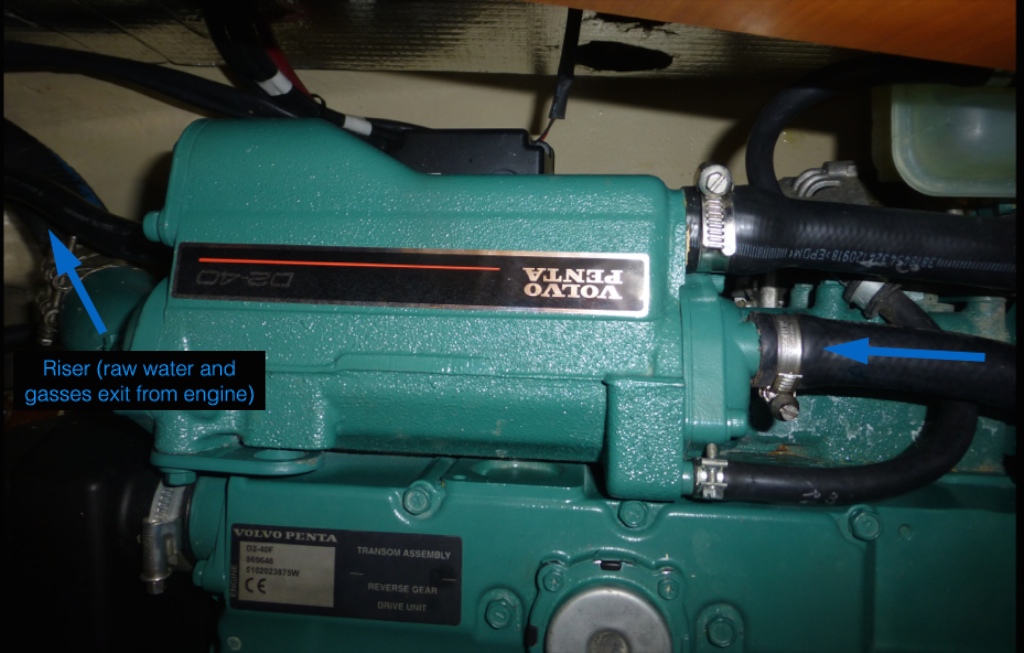
#10  Mufflers are great ways to keep your hands warm on a crisp day.   However, Antares seems to have put ours in a remote location at the foot of each of the beds.   The gas and raw water are mixed in the riser and now, I suppose, are muffled in the muffler.   I have not worked with this device at all.


Exhaust exit through locker

Exhaust exit through locker

Raw water exit

Raw water exit


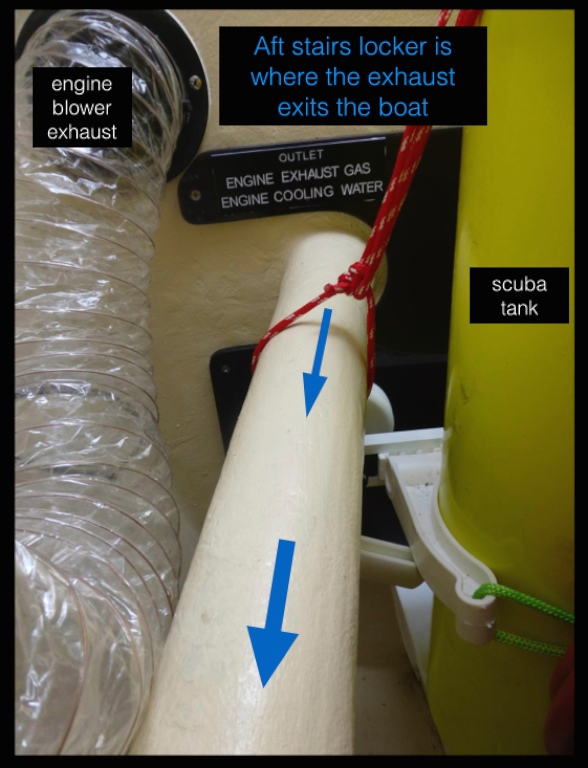
#11  Good bye raw water.   After a quick sprint down a very sturdy tube that shortcuts both stern lockers, the water exits via an obvious port.   The slight yellow tint is a a clue that this is the exhaust point.  I hope to return it to a pristine state on the next haul-out.


Fun with Pyrometers

Using a heat gun has been a great way for me to better understand the coolant loop.   We have not mastered measuring the hose temp without being fooled by heat from another source.   Our engines are typically 90 degrees Celsius, which the heat gun reads at the thermostat and the gauge displays at the helm.   At this temperature, the thermostat is partially closed.   We do see the raw water loop gain about 10 degrees C before it exits the boat.  The coolant does not drop temperature when passing through a warmed hot water heater.   Unfortunately, our coolant out/in numbers were not reliable enough to publish on this post.   The coolant drops roughly 10 degrees C during  its cool-down lap.   We will continue to perfect our heat gun technique and we will report back with more data.  Take the following data with a grain of salt.    Or better yet, measures yours and drop me a line with the results.

Thermostat @2,750 rpm:   90 degrees C  (coolant out at end of heat exchanger 70 degrees C)

Thermostat @3,00rpm:   100 degrees C  (coolant out at end of heat exchanger 80 degrees C)

Injectors @ 2,300 rpm:  77C

Top of engine @ 2,300 rpm:  75C

What was the cause of the overheating?

Attempts that did not fix the issue:

1)  I dove the thru-hull twice to make sure raw water was coming in unimpeded. It was.

2)  Ensured strainer was empty of obstructions, was filled with water and that the lid was sealed tightly.

3)  Checked that impellers were in good condition.  Replaced impellers for good measure.   Tested that the speed plate upgrade did not create the problem.

4)  Hours spent trying to remove coolant loop air pockets from the engine and hot water heater.   Used gravity, pressure and temperature to try to coax out any air pockets.

5)  Checked raw water side of heat exchanger for scaling.

6)  Checked oil/coolant/belt.

7)  Considered removing hot water heater from the coolant loop.

What did work:

A thorough cleaning of the coolant loop.  Some brown stuff came out.   I will send it to the lab for analysis.   Our boat builder thinks the product is harmless and not surprising in a new engine.  I think it is a bit early to have foreign product in the coolant loop, but as you know I am new to this game.   After we finished cleaning both cooling loops, a friend emailed us an article in which the author described the same problem and solution.  I have asked other new owners and they have brown in their coolant reservoirs.    My advice: clean it now.


Comments { 6 }

A day sail turns into more

After three weeks of working on Two Fish, it was time for a sea trial to test our efforts. Sea trials are required before long passages whenever systems on the boat have received major maintenance.  Engines, generators, running rigging, water maker, electrical, plumbing, sails and more have all been worked on by ourselves and pros. The boat has been a beehive of activity.

The sky was grey as we headed out on our sea trial, searching for gremlins.   We invited Mark and Bill, who have been graciously hosting us at their convenient, posh dock.   In return, we tortured them with a condensed sailing academy in which they excelled.   Three minutes into the trip, I handed the helm over to Bill for motoring drills.   As our gelcoat will attest, he passed with flying colors.  We practiced many of the sailing maneuvers but I think the eye opener was “heaving to”.   NO, none of the crew tossed cookies.  “Heaving to” is the term for putting the boat in park by having the two sails set up in opposing directions.

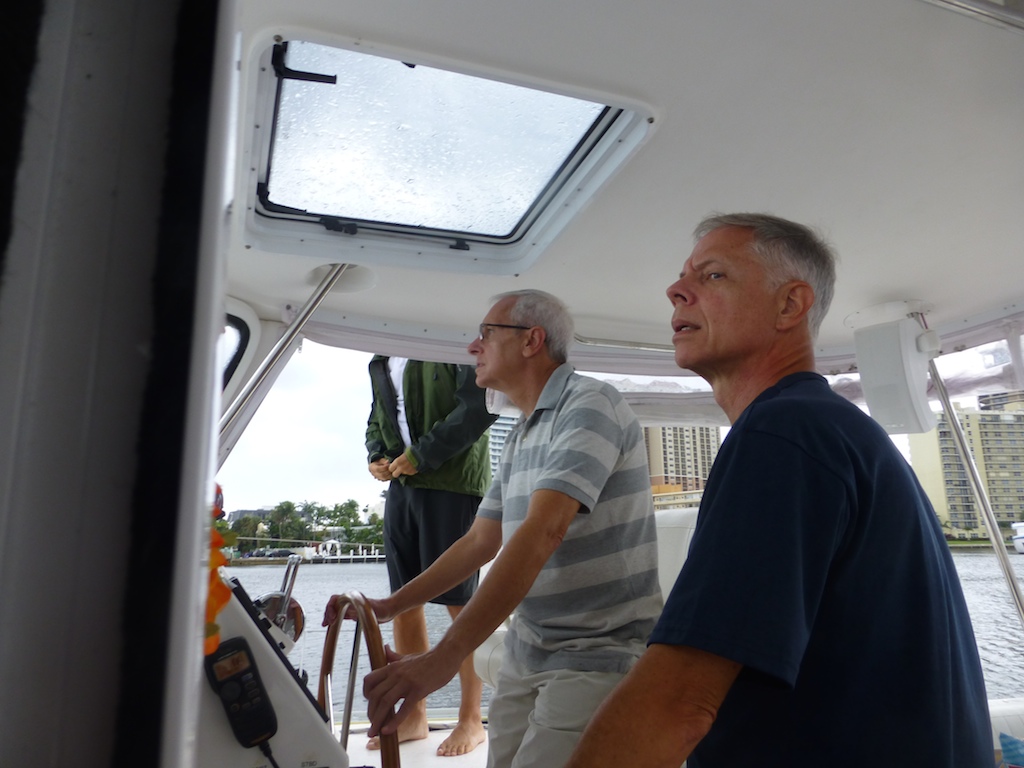
At the end of the voyage, we motored back to Port Everglades, seeking flatter water for lunch.   I increased the revolutions on the engines to race away from a nasty looking cloud.   Suddenly, the port engine heat alarm began to wail louder than an infant.   The temperature gauge had firmly entered the red zone.  I found this situation somewhat disturbing and quickly shut the port engine down.  I was now in the middle of one of my persistent boating fears.   I was being forced to operate the boat in close quarters, maneuvering with only one engine.   I tried to put on a brave face so as not to distress our guests, but this was uncharted territory for me.  I had just begun to consider my options, when Mark asked me “What if the second engine begins to overheat?”  This was one of the pre-saiI homework questions that I had given Mark in advance of the sail.  My dinghy is in the shop, so a dinghy tow was out of the question.  If I lost another engine, our only options were to quickly hoist sails or anchor.   I was on a lee shore so the sailing option would be tricky and I was entering one of the busiest US ports so anchoring was not feasible.

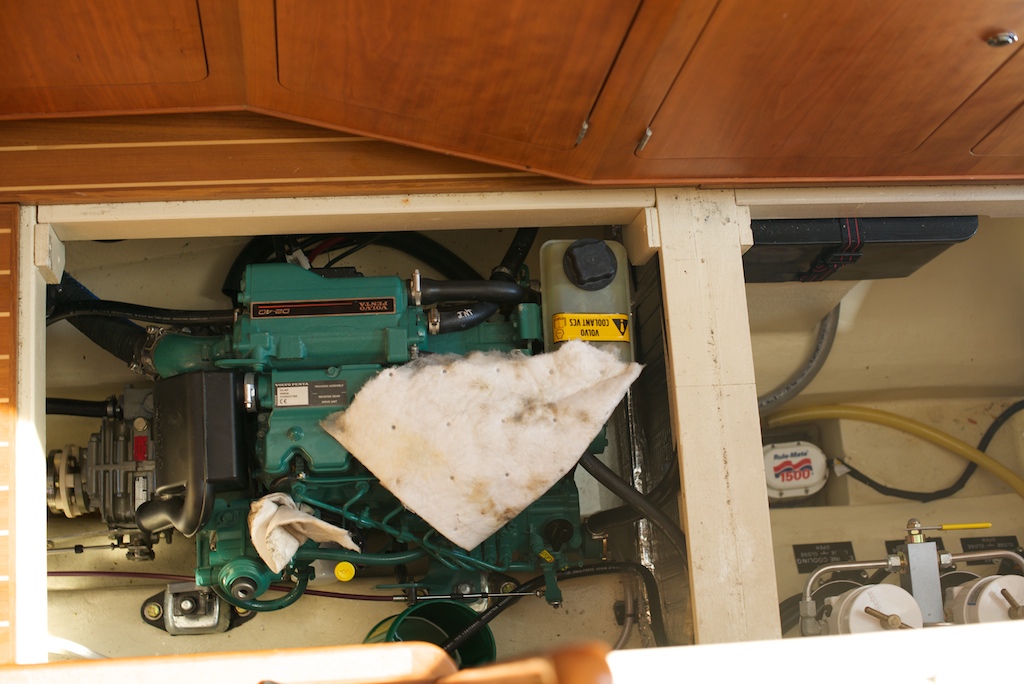
Engine trouble

Engine trouble


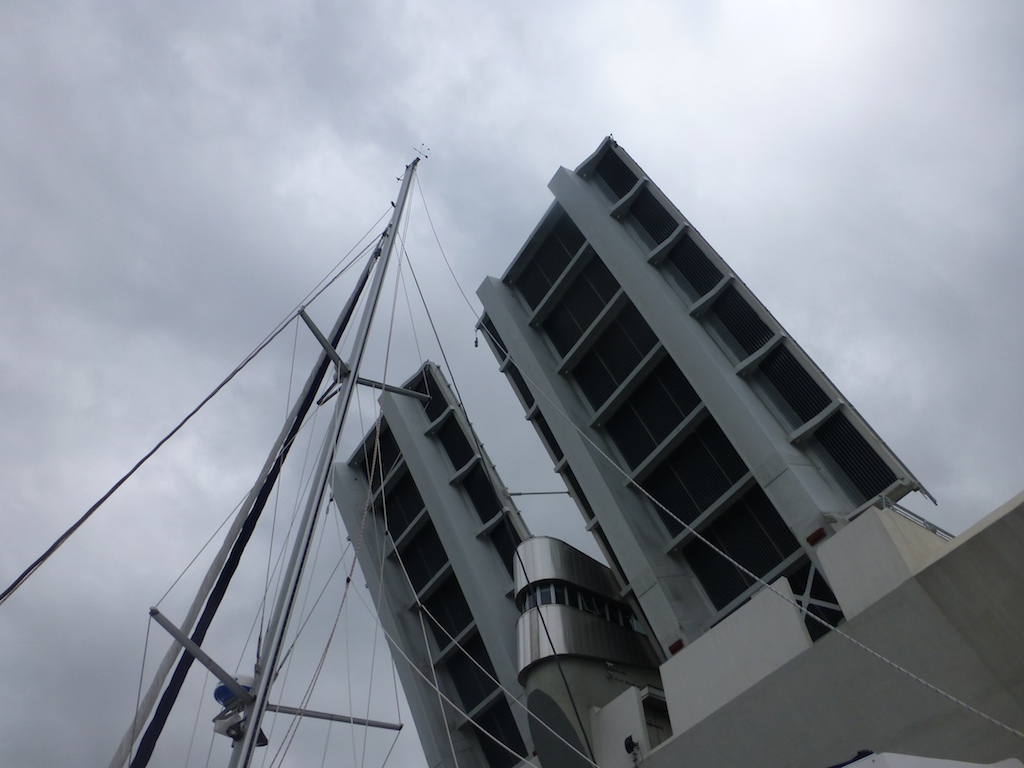
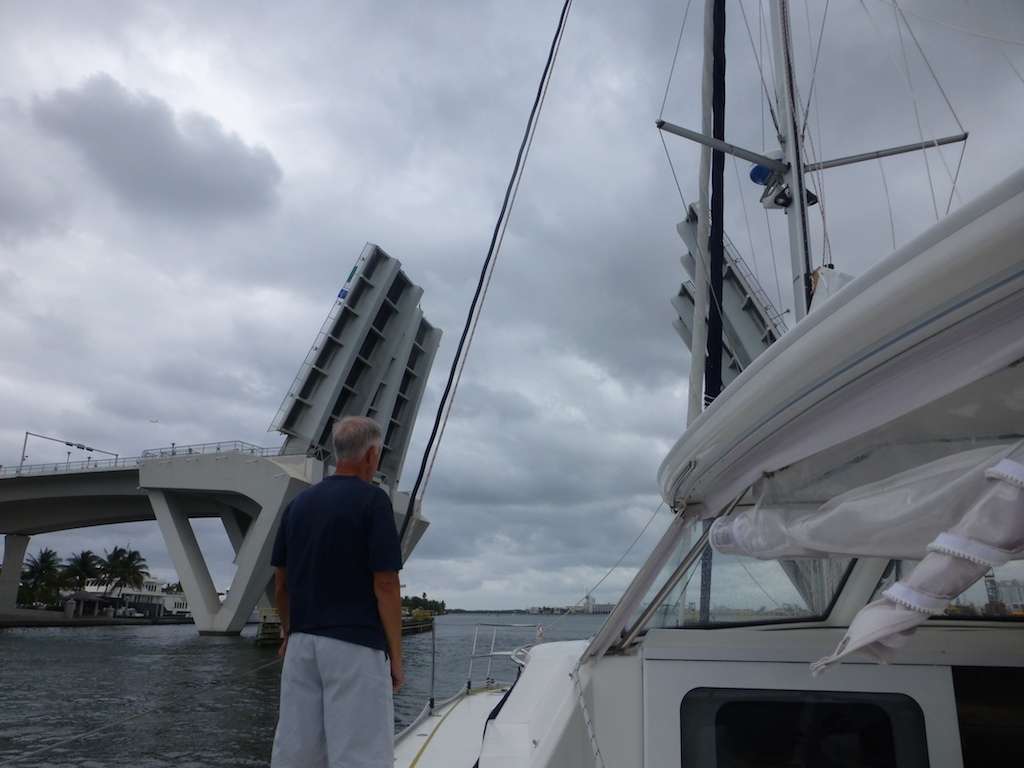
We motored gingerly into the Port Everglades turning basin.   Should I stop at the fuel dock just after the 17th Street bridge?   This would only require passing under one bridge and I could start working on the engine immediately.   I decided against this course of action, since the engine temperature was too high for servicing and I would not be allowed to stay at the fuel dock for the night. Pride stopped me from calling a tow service with one engine running.  Being towed to the dock would be tougher than docking on one engine, but much easier than zero engines if starboard followed suit.  A third option would be to anchor and call for a Volvo technician.   Again, pride encouraged me to press on.  Worst case we drift onto the neighbors dock?   The wait between bridge openings afforded me time to practice holding station with the boat on one engine.   I was now steering a monohull that was super-wide with the engine placed 12 feet from center.   I practiced the old monohull trick of rotating the boat with repeated slow movements forward and then reverse.  The boat equivalent of the 3 point turn.   Because rudders require water flow, and the propellors send water to the bow, the rudder can not steer in reverse. The helm gets busy with helm turns and gear changes.   If the process failed, and we drifted into a mega yacht I had planned to slink away from the scene while removing the Two Fish logo.


We passed under the 17th and Las Olas bridge without incident, despite the Las Olas opening being half-filled with a construction barge.  Now it was time to approach the dock.  The story has an anti-climatic ending as the wind and current were kind.   Two Fish knew where I wanted her and she coasted slowly up to the piling where Gail and Mark briskly attached the bow line.   I applied a bit of reverse on the working engine and the stern drifted up to the dock.  Two Fish was so gentle in her approach that I had enough time to lasso a cleat with the stern line to complete our docking.

Two Fish back at the dock

Two Fish back at the dock


The next day we tried to debug the overheating engine.   Engines are cooled by two systems, fresh and raw water systems.  The fresh water is grossly misnamed as it is full of poisonous coolant similar to a car’s antifreeze.   A Volvo mechanic had changed our coolant the day before.   He had slightly overfilled the engine.   Could this be the cause?   My mother’s turkey baster was used to remove the excess.   We will buy her a new one before she returns from her trip.  We kept looking for the cause as I had never heard of excess coolant causing overheating.


I then switched my focus to the second cooling system, raw water.   Another poorly named system, the water is neither raw nor cooled; it is just water sucked out from the sea.  I examined the flow from the seacock to the engine’s heat exchanger but nothing looked out of position. I checked the strainer and it was empty.   The impeller check took no time as I have speed seals.   All the blades were accounted for, eliminating the impeller as the culprit.    Finally, I theorized that the blockage could be underwater at the scoop that protects the sea water input from sucking in a trash bag.   Could this scoop be jammed by some flotsam?  We store a map of Two Fish’s many thruhulls on the inside of a cabinet door in case of emergency; we used this to remind us of where to head for on the hull.


After no discussion, I was assigned the task of diving the boat.  Into the canal I went with the mental map.   I began to miss the gin clear waters of the Bahamas as the canal waters were so murky I thought I was cave diving.   Gail equipped me with an underwater flashlight so that if I encountered a man-eating octopus, I would be able to identify the sub species.  I was also given a marine scraper similar to what is used by motorists to remove frost from windshields.  With some effort, I found the scoop covering the raw water input.  It was a barnacle farm.  As I scraped, the boat disappeared in a cloud of marine organisms.  After several trips to the surface for a fresh lung of air we had clean scoops for all the systems (A/C, genset, engines and water maker).  I found half a small fish in one of the scoops.  Not so yummy.   I was greeted with a scientific surprise when I swam to the opposite hull.  The scoops were in much better shape.   Why?   We have been on a dock Fort Lauderdale for three weeks.  The outside hull gets much more sunlight as the inside hull is covered in the dock’s shadow.  The barnacles grew faster on the outside, sunny hull.


After cleaning the scoops I ran the engine for 30 minutes.   I watched the engine temperature rise to and stop at its typical operating temperature of 90 degrees Celsius. The swim might have been the fix,  but to be safe I will do a longer test in the morning.   I also used this time to learn more about my engine temperature.   I used a pyrometer (think radar gun for temperatures) to shoot and record a bunch of temps across the engine from the heat exchanger to the engine block and by each injector.   I will keep a log of this in the future.


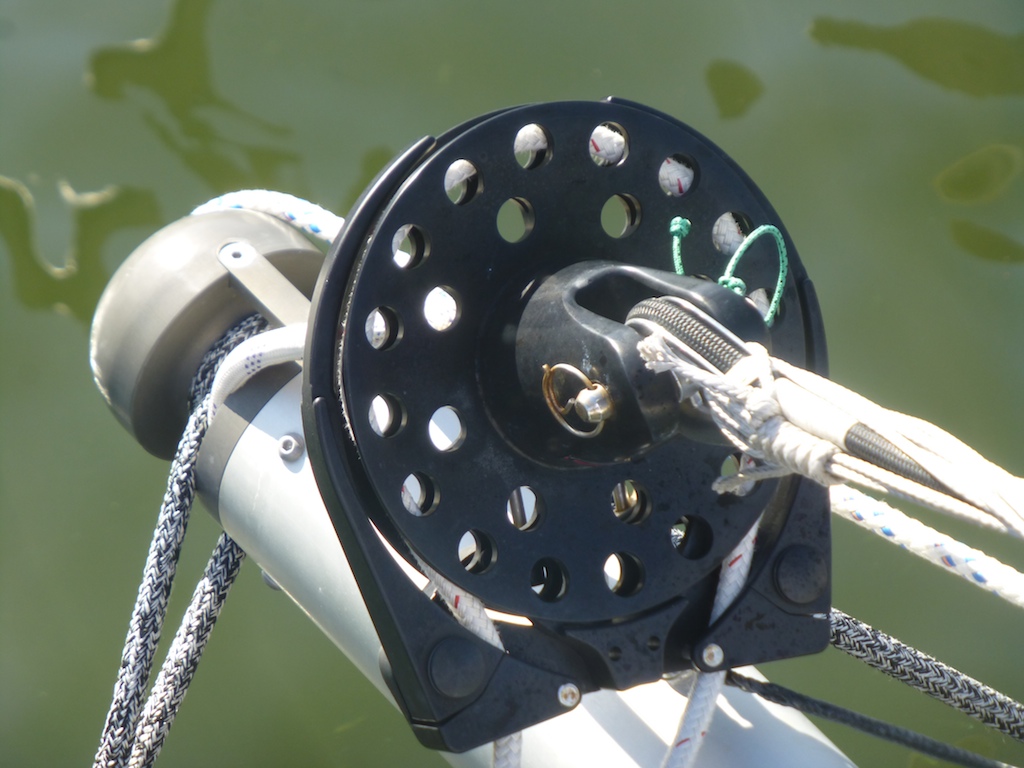
Earlier in the day, our sea trial had one other adventure.   The furler for the Screecher is temperamental.   You must keep tension on the lazy side to avoid letting the line exit the jaws. Ours exited the jaws and we were faced with three choices. We did not take the dangerous option and walk the pole,  Nor did we drop the sail, as it is too cumbersome.   Instead we folded the pole while easing the halyard and the sheet.   With the pole close by the bow we rethreaded the furling line.   Gail was amazing.  She quickly did a complex maneuver in a stressful setting.   We then stowed the Screecher and the problem was sorted.


Screecher drum

Screecher drum

The next day at the comfort of the dock we decided to make sure the Screecher was working properly and the line popped out of the jaws again. And again.  And again.   We could not understand why it kept popping out because it had been trouble free for the past seven months.   I sent a photo to Harken and confessed that I had just reinstalled the system after servicing.    Three minutes later Harken tech support politely informed me that I had not put the furling lines inside the cotter pins.   Oops, bonehead move by me.   That is why a sea trail is important before a long passage. Harken has fantastic technical service.


We keep learning.  Sometimes new sailing terms and sometimes new curses.


Comments { 4 }

Why is Two Fish stopped in Fort Lauderdale?

Two Fish fans have noticed that the boat tracker has not moved in two weeks.   This is the longest she has stayed put since she splashed in Buenos Aires 7 months ago.   Two Fish is finally receiving her annual service (a bit early) and some of her warranty work. Every day we head to “work” to fix, clean and service all the systems on Two Fish. We had professionals come and bless our water maker, after its horrific start. Good news: the system got a passing grade. We also had a pro come from Brownies to fix our dive compressor. The unit is just fine, but we need to have a strong fan installed when operating the compressor. We may just run it at dusk, when the temperature drops. We also had a Furuno representative on board. We think he may have solved our rebooting screens issue. Seems we had one extra terminator in the NMEA network so the resistance on the network was only 40 ohms. The solar panels seem to be better after changing the too large connector to the fuse. Next week, the generator and Volvos will also receive some professional service. We can’t be too careful with the engines. A few changes are being applied to the running rigging, sails and fuel lines, but I will blog about that later. I have enjoyed doing the annual service as a way of  learning the boat.   I learned that my stuffing box is water cooled from the anti-siphon loop of the raw water loop.   Clever engineering.   The more I know about the boat, the quicker I can fix it if an engine stops while at sea. This video is on par with the Lord Electron post in terms of number of sandy beaches. However, if you are a boat owner you may find it action-packed. I would wager that some other cruisers may wait 3 years or more to service their winches.

Comments { 4 }

Back Stage Tour of Two Fish

Ice Maker

Ice Maker

For our readers who  want to peer behind the glitzy exterior of Two Fish and know what is going on behind the scenes:
ICE MAKER:

It seems over-the-top to have an ice maker on a sailing vessel, but, what the heck, we have one in the salon.

Pros:   Cold drinks can take the edge off a long day. On a great day, my solar power can feed the fridge, freezer and ice maker.  As a catamaran you are hosting the party, so you might as well do it in style.

Cons:   16 amps consumption wired off the inverter.     The units have a reputation for breaking down, but no issues on Two Fish (fingers crossed).   While producing ice, the unit gets very hot.   Final con is that it takes up some very useful space.

Overall:  Jump ball as the space would be nice to have and I can live without ice and/or buy ice onshore.


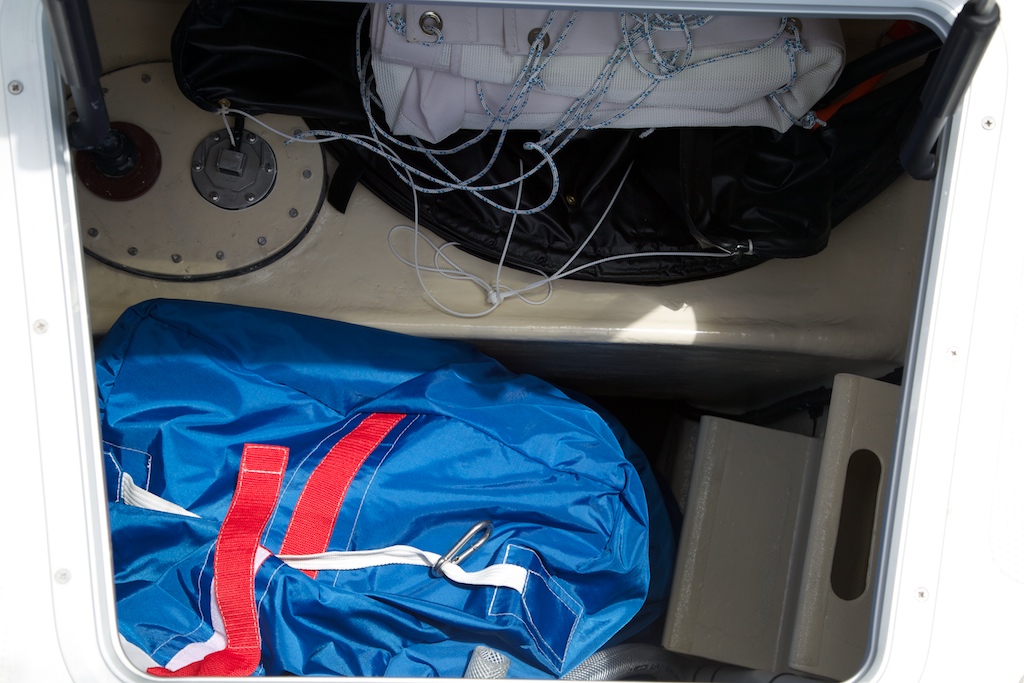
Sail Locker

Sail Locker

SAIL LOCKER

Two Fish has a choice of 4 different head sails.  Typically, the code zero (second biggest) and genoa (workhorse)  are on the furlers.  This leaves the spinnaker (huge pink one)  and jib (smallest) to be stored in the sail locker.   The locker also holds a few sail bags and the mainsail cover.

Pros:   Nice to have a proper place for the sails.   We do not use it for extra dinghy anchors, spare boots and other odds and ends so it is easy to find what you need.

Con:   The ladder is annoying and occupies valuable space.   We would like more open space to make it easier to extract the chute  in the large turtle (spinnaker bag) through the hatch.

Overall:   Love my sail locker, only wish it was a bit bigger and did NOT have the ladder.

Dive Compressor

Dive Compressor


DIVE COMPRESSOR – SCUBA TANK FILLER

Hidden in her port aft locker is a nifty Brownie’s Marine dive compressor.

Pros:   You are your own scuba shop.  Breathing under water is just fantastic.   A few times we have really benefited from having a dive tank for boat maintenance or safety.    I would not  go far afield without a Scuba tank.   Obviously, you can fill scuba tanks at dive shops instead of this complex set-up.   As an aside, 60 liter aluminum tanks fit in the stern rope lockers.   About to buy a pair.

Cons:   Lawn mower loud.   Needs to be kept cool.   Ours has a glitch which we will get fixed in Ft Lauderdale next month.

Overall:   Need more time with the unit.

GENSET LOCKER

Our genset locker is so big, many have called it the genset village.  Like the title implies, it holds our generator which makes 110 electricity so the boat can feel like a house.   The genset is very large for our needs.   It can run the air conditioners, water heaters and other power-hungry items.   We have never felt under-powered with this unit.   When charging the batteries, while at sea, it takes about 1 hour to raise the charge level 10%.  Servicing the impeller-eating genset is easy since it is installed at waist height.   To keep the genset company, we also have fishing poles, long lines and our diesel box.   This toxic box contains anything that has touched fuel or oil besides me (Jason).

Pros:   What a luxury to have a locker designed for purpose.

Cons:  Leaks.   Our anti siphon loop was too short so water  entered.   Easy fix.   We also have a slow leak in the mushroom.   We tried sealant but will have to try again soon.

Overall:   This is a luxury that makes life easy.  We need to get it bone-dry with no small leaks.

ANCHOR LOCKER

One of the reasons I bought this boat, was the outstanding set-up for two anchors.  Boats can go years without needing a second anchor but when you do need it, you might really need it.

Here is a story of an Antares sistership.   They dropped their anchor close to Two Fish and as luck would have it, their anchor hooked Two Fish’s chain.    They tried to move their boat by raising their anchor and madness broke out.   Their anchor proceeded to take a promenade up the Two Fish anchor chain.    They tried to ease the rode but the nylon rode was jammed in the gypsy.   So the captain made a brilliant call and cut the rode.  Their boat was now free and avoided bashing into Two Fish.  Two Fish was very happy as there was no damage.  As a thank you, the next morning I dove with my scuba tank and found their anchor and chain.   I attached a fender to aid in its retrieval.    Lesson learned: before the problem spirals out of control find a way to be back in charge.    Most boat owners would only start thinking about how they will anchor when their primary buzzes by them to sleep with the fishes.   However, our sistership just dropped their second anchor.  With the dual anchor set-up, all the necessary parts are in place and ready to go.

Pros:   Nice bridle.  Very secure set up for the 33kg Rocna.   Easy to use.

Cons:   We are still working on reducing the bee hiving of the anchor chain.  The pin through our anchor roller failed – a dramatic moment but an easy fix.

Battery Locker

Battery Locker


BATTERY LOCKER

This space is at the foot of the mast.   We store our fenders, dock lines and spinnaker sheets in this locker.   The batteries are easy to access when adding water or doing other battery maintenance.   The chase for halyards is also accessible from this locker.   The windlass motor can be seen in the lower right hand corner.

Pros:   Again easy work space.

Cons:  None


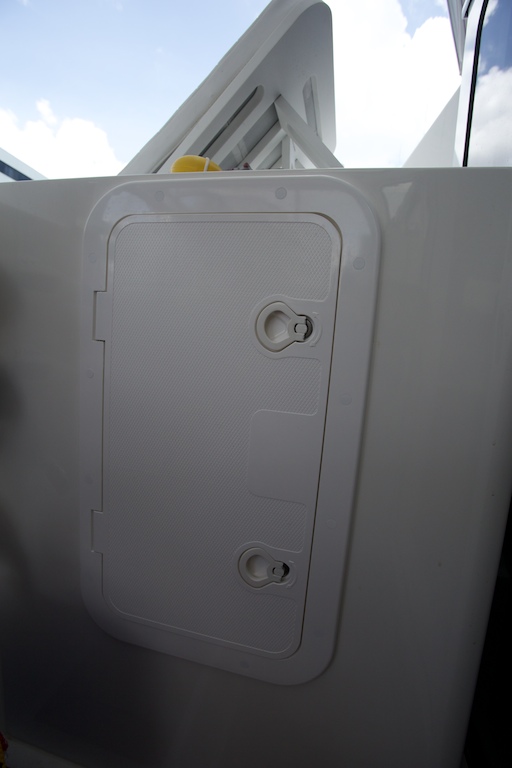
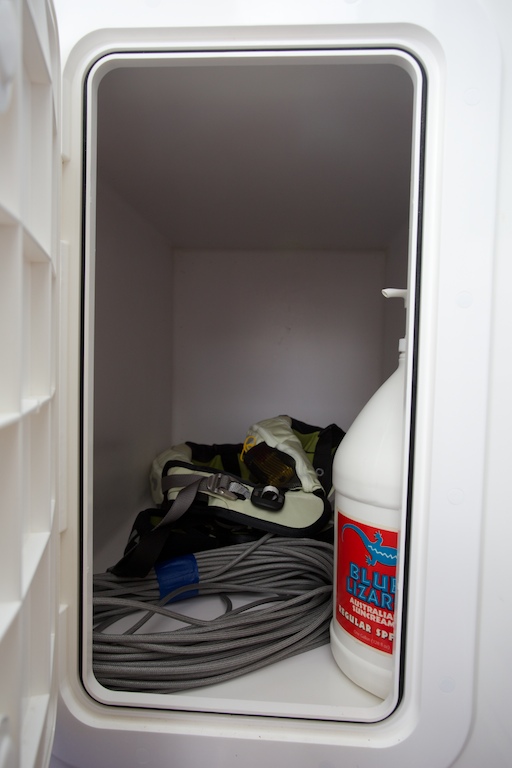
COCKPIT CUDDY

The most important safety equipment on board is our sun tan lotion stored in a small cuddy in the cockpit.   We also store extra line, safety harnesses and other frequently used equipment.   It usually is a messy jumble but was cleaned for this photo.   This is not a standard set up for the boat.  We find it very helpful as I do not like having a messy cockpit.

Pro:  More storage

Con:  Cost

BONUS PHOTOS

We have readers that stare at photos and examine every angle to better understand the boat.   I know I was one of them before we moved aboard Two Fish.   Now I get to do it in person.   So here are some extra photos for those folks.

Comments { 6 }

Replacing a lost Propellor Zinc

Boats and electricity are a poor mix.   When in marinas, stray electrons look for homes.   They will eat your expensive propellors or prop shafts.   Owners install sacrificial hunks of zinc. Stray current is attracted to the zinc, allowing your expensive prop to be protected at the cost of a 10 dollar piece of zinc.   Good economics if you ask me.   Here is a video of us attaching new zincs after our valiant zincs gave up the fight.


Zinc Change from Two Fish on Vimeo.

Comments { 4 }

Two Fish is hooked by a fishing line


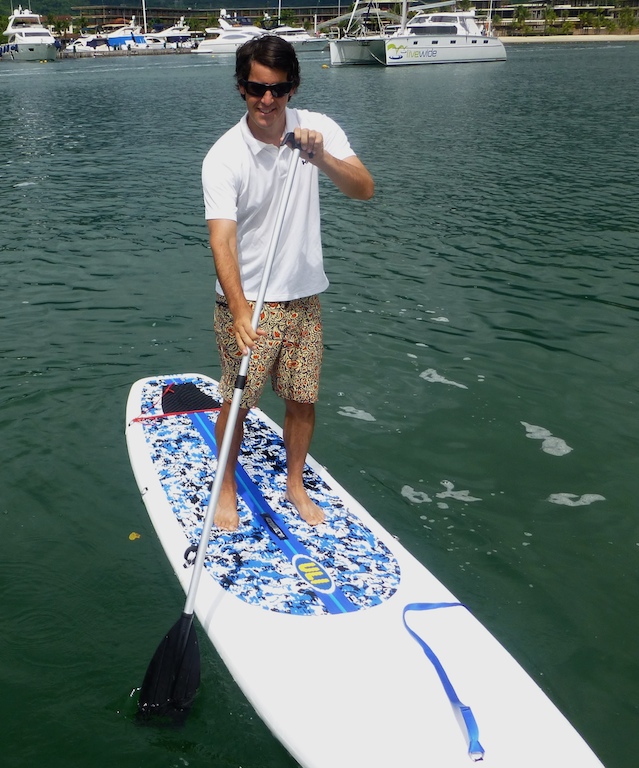
At the end of one of my almost daily swims, I grabbed a scrub brush to clean up Two Fish’s water line.   She still had the brown tint of the Rio Plata and some orange by-product from the engine exhaust.    The proper technique is to use the paddleboard and our suction cup clamps as a sturdy platform to vigorously scrub the topsides. However, my focus was on goofing around more than on proper boat work.  The less efficient technique that I employed was treading water, and swiping at the boat with the brush.  My apologies to graduates of the nautical sanitation engineers college.

During the scrubbing of the waterline, the “two of everything” on a catamaran became tiresome.   While scrubbing away, I felt like I was cleaning a grossly over-sized MacMansion (a 7,000 square foot suburban home).   Two 44 foot hulls equal an 88 foot yacht .   This was just a passing thought, as I was enjoying thrashing in the water like an over-the-hill water polo player.   I kicked hard to reach parts of the topsides that were a few feet out of the water only to have gravity pull me back.  Overall, the topsides are in good shape – no dings yet in the gelcoat from poor docking.    It will happen someday – like a first ding in a new car.

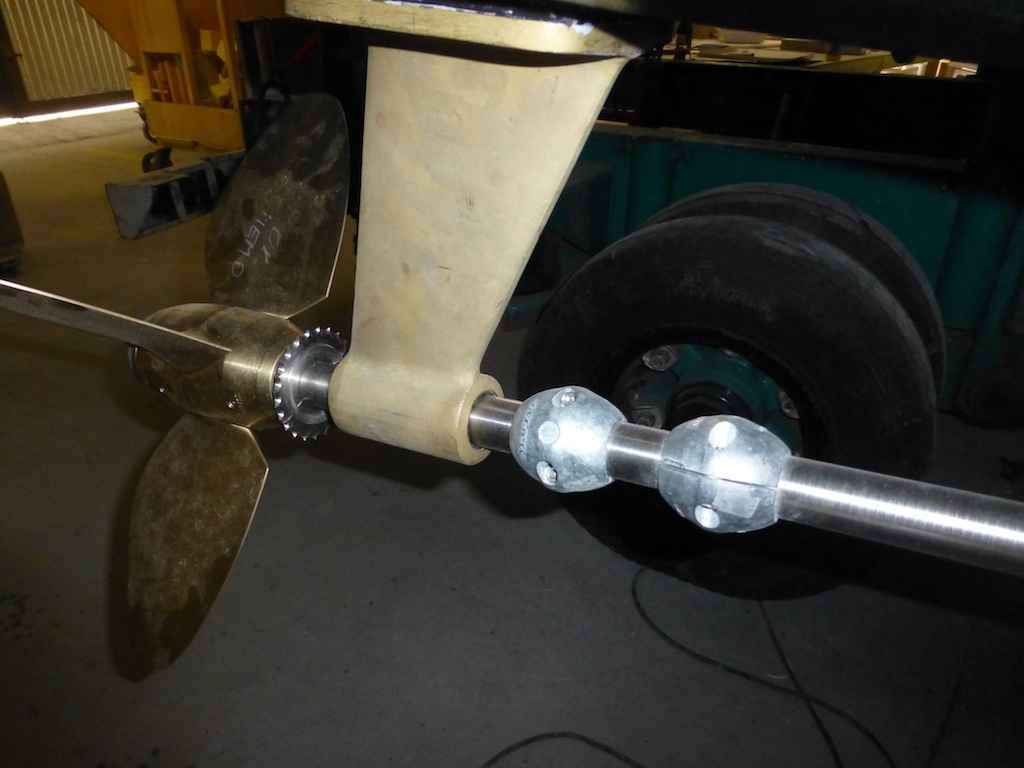
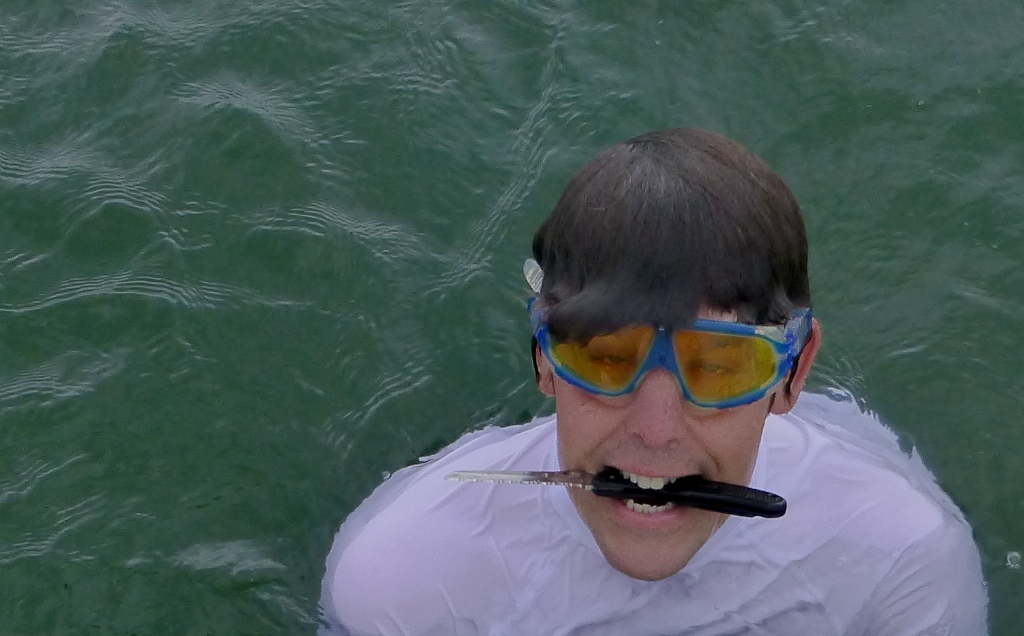
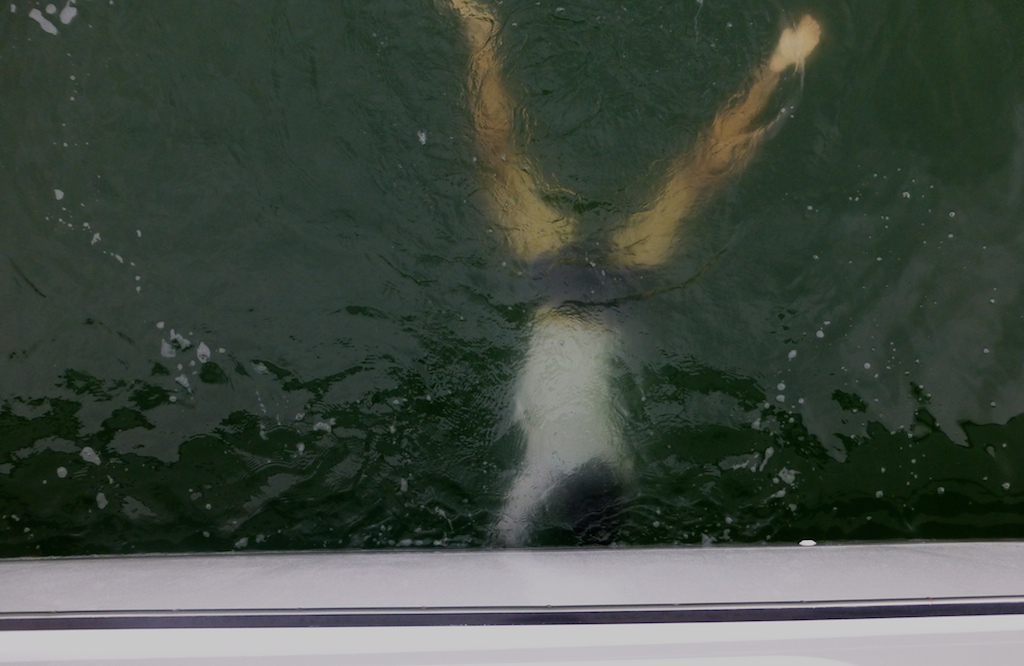
As I was finishing up my cleaning project, I chose to dive under the boat to check the propeller.   We have 4-blade feathering props.   While sailing, the blades feather to create less drag.  I was greeted by a bird’s nest of small diameter polypropylene line wrapped around the prop shaft.    I was excited – a real job that requires swimming.

In order to set the right tone, I informed Gail of the importance and potential danger of the mission.   She cobbled together gear to help increase my chances of surviving unscathed: gloves, a folding knife with a serrated blade, and a dive line (Gail rigged a line from the toe rail abeam to the propeller for my use while descending).   All was set for a scene from a Bond film as I could use my knife to cut an enemy’s air supply.  Without frogmen to distract me, I made short work of the festooned prop shaft.   My technique was to cut the line with the blade facing away and then try pulling at the mess to remove loose bits.   I had two concerns – one rational and the other crazy.   Crazy was my fear that the engine could come alive and in no time the propeller would become a Cuisinart producing a fresh batch of Jason burgers.

The less dramatic risk that had a real probability was my concern of cutting myself on the Shark Shafts.   We had Shark Shafts installed on both prop shafts.  The Shark Shafts are after-market serrated knife rings added to our propeller shafts to cut lines away that might otherwise foul the prop.   Do we like them?  Without a video camera down by the prop, we will never know their efficacy.    While diving, I wished they were not there.  When Two Fish first hooked the fishing line, did the Shark Shafts cut enough of the line to keep the props running fine?   Instead of a mid-ocean repair, all I had was an at-anchor clean up?   There was evidence that something sharp had damaged the fishing line.  Shark Shafts are like a flu shot – you never really know if they worked.

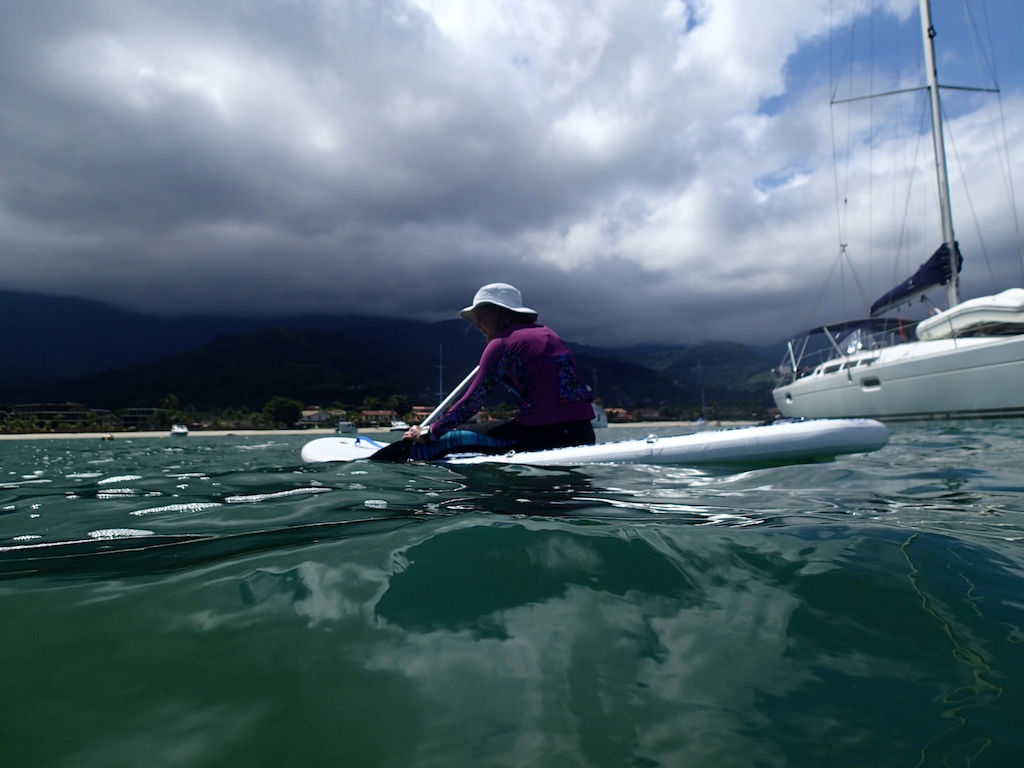
A few paddle board photos to end the post.

Comments { 4 }