Archive | Boat Systems and Gadgets RSS feed for this section

Photo Tour of the boat

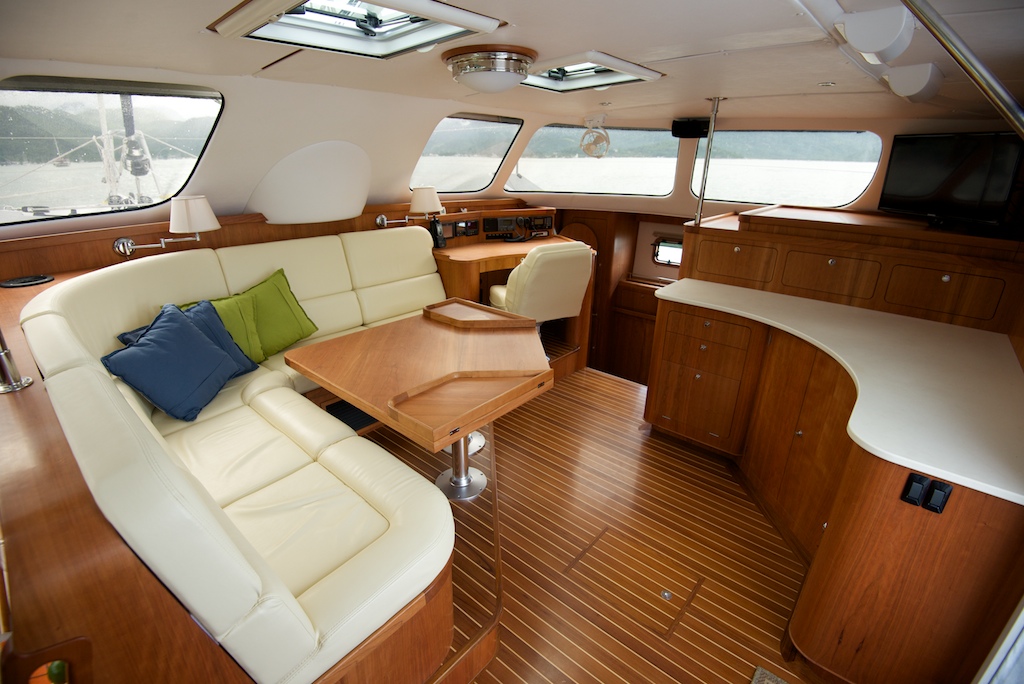
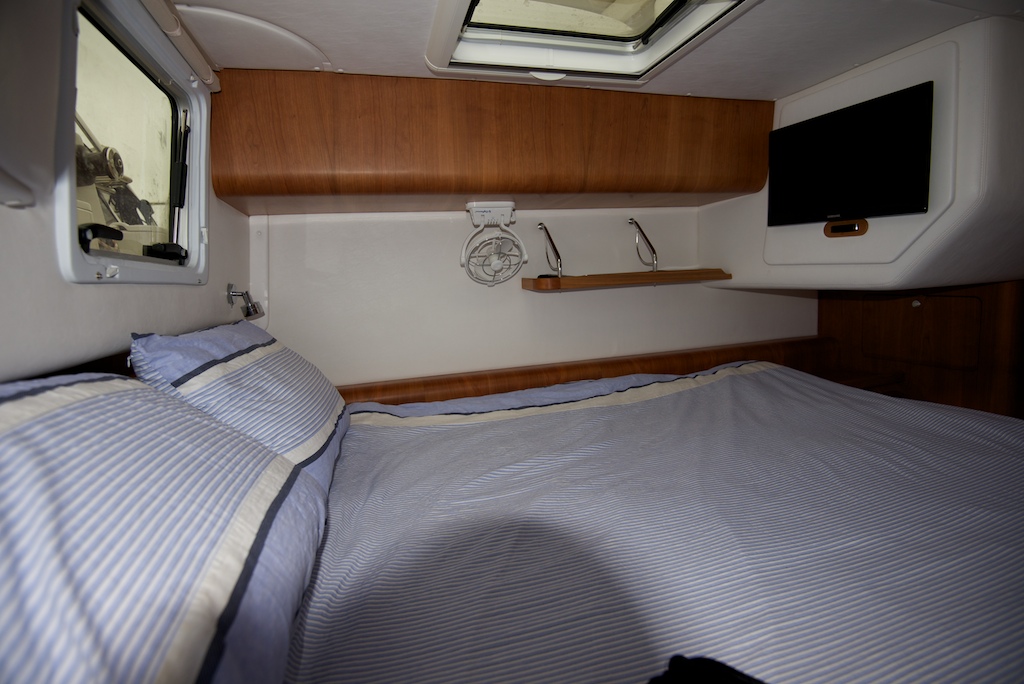
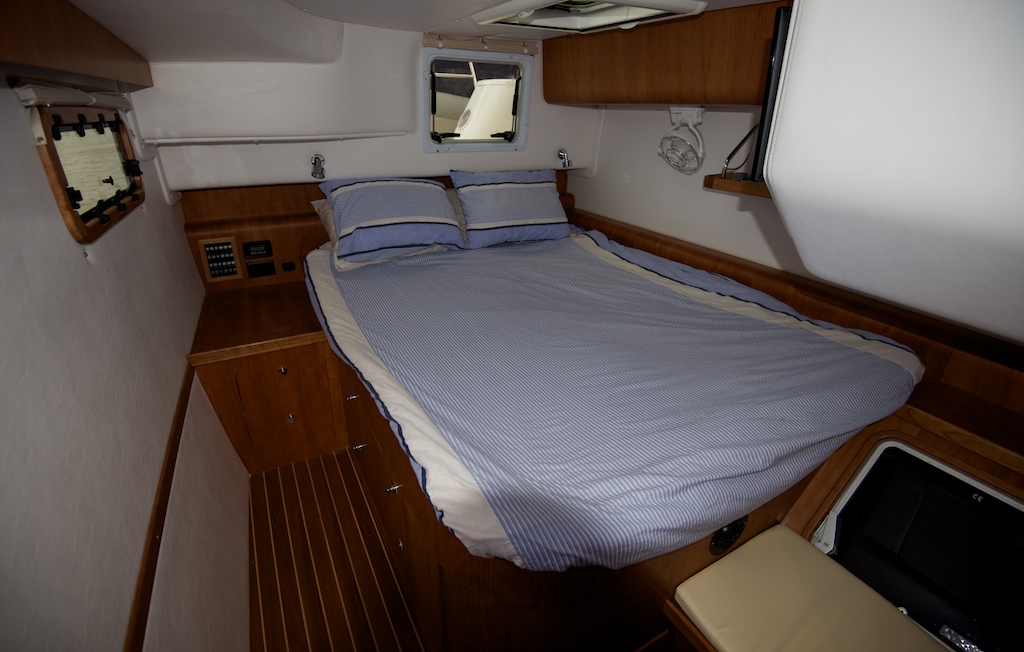
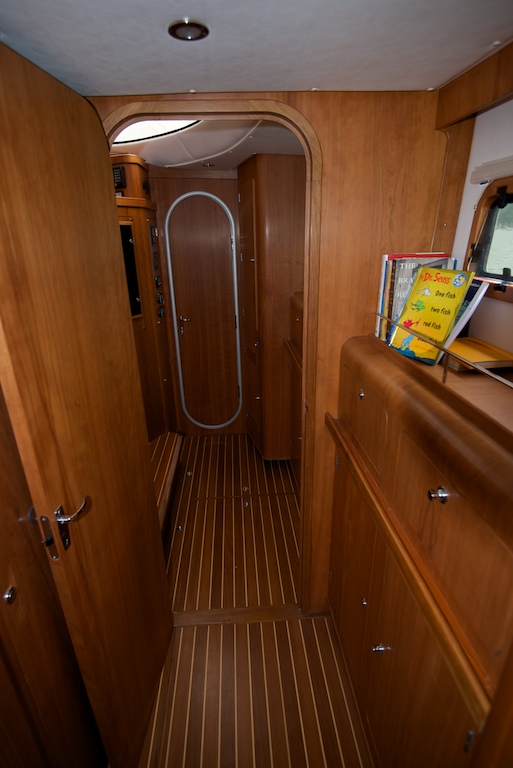
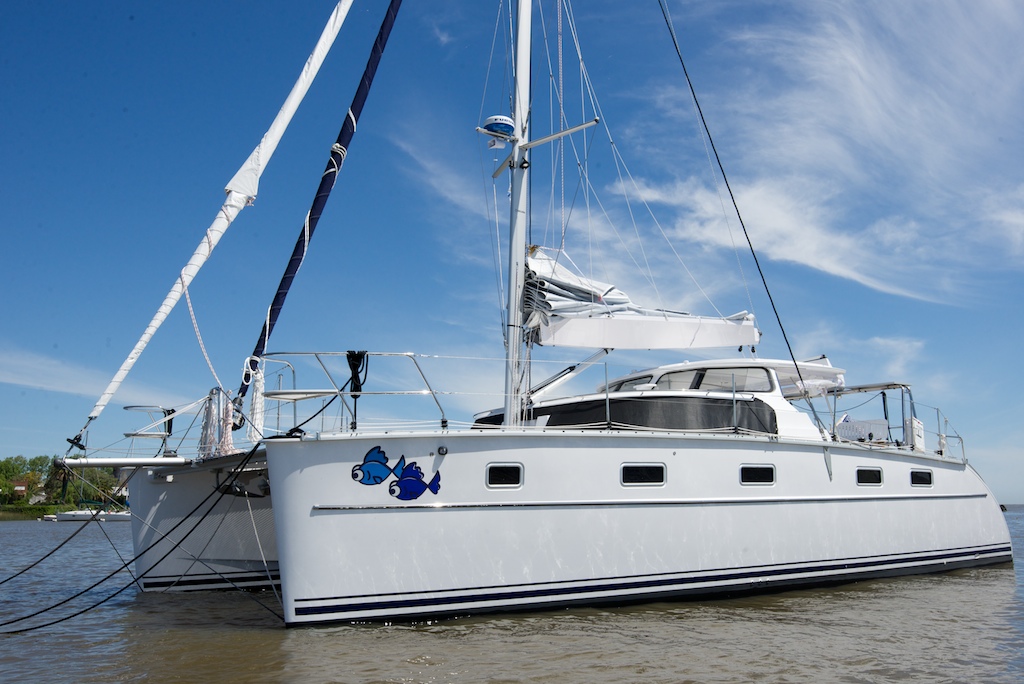
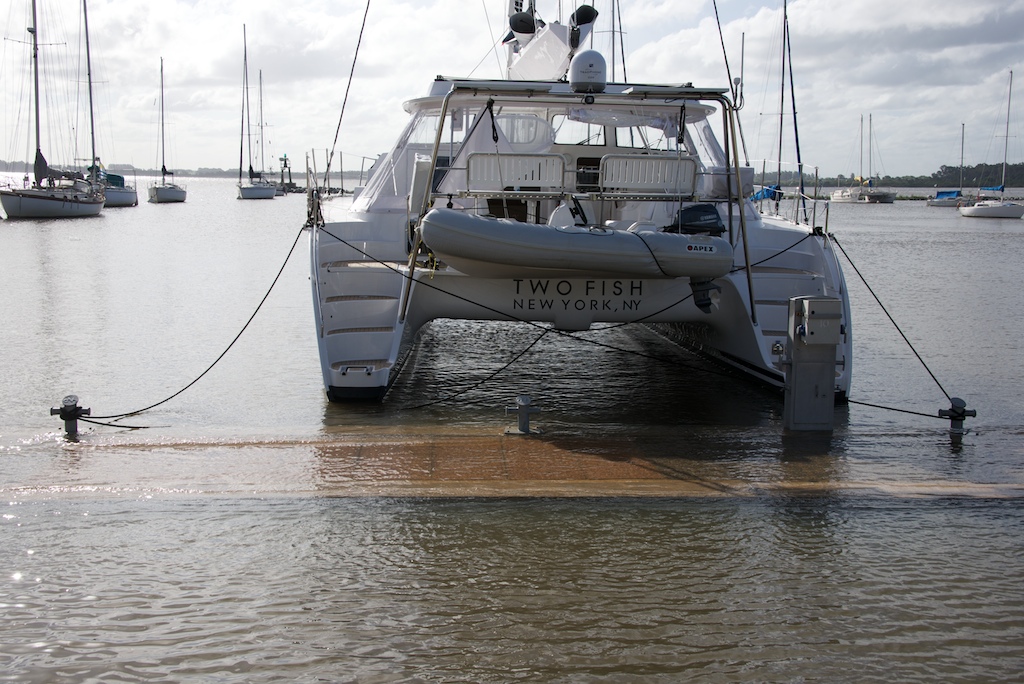
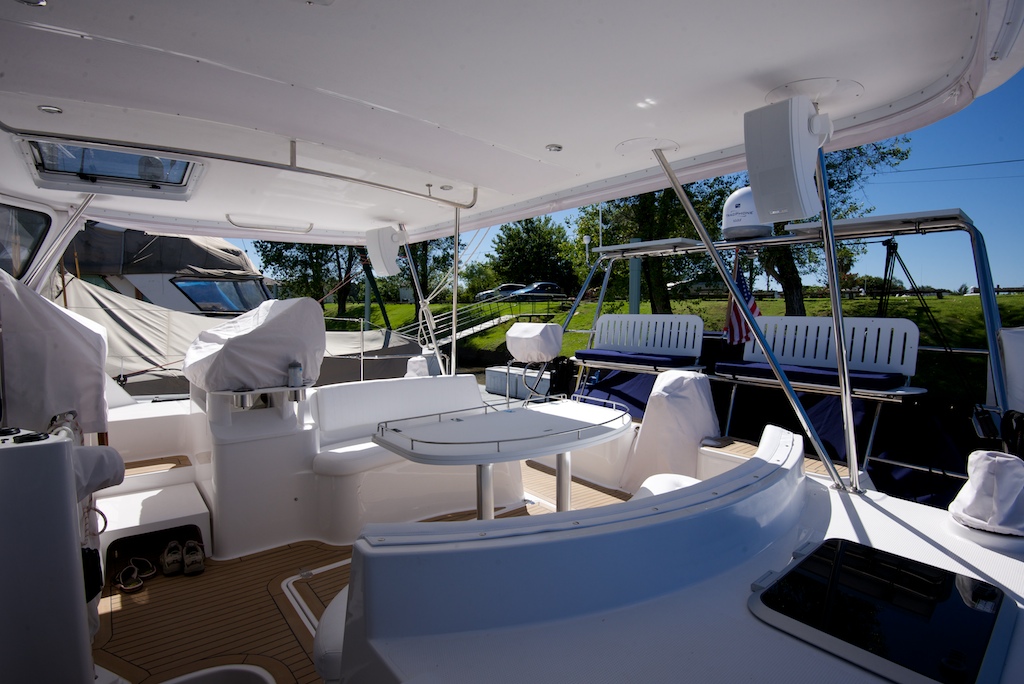
In response to requests from our readers to see more photos of the boat, I have posted a few photos.   It did require cleaning the boat and finding internet.  Both are tough jobs.   My tips for cleaning an Antares are to get on your hands and knees.   I use swiffer cloths for the wood and no soap.   (Yes, I am shocked that I am sharing cleaning tips, but this is the new Jason. Sorry, no photos.)   The second tip is to keep shoes off the boat.  Not even on tip-toes.   To fight bugs, we have dunked our fruit and vegetables in the ocean before they came aboard.   Bananas seem a great place for a village of odd bugs to live.

Another cleaning quandary is how to rid the boat of the new boat smell.   The boat closets leach a strong freshly made fiberglass odor.   It is so strong that cracker stored without a lid will taste like fiberglass.   Our solution is to air out the cabinets when in calm harbors.   Smarter tips from our readers?


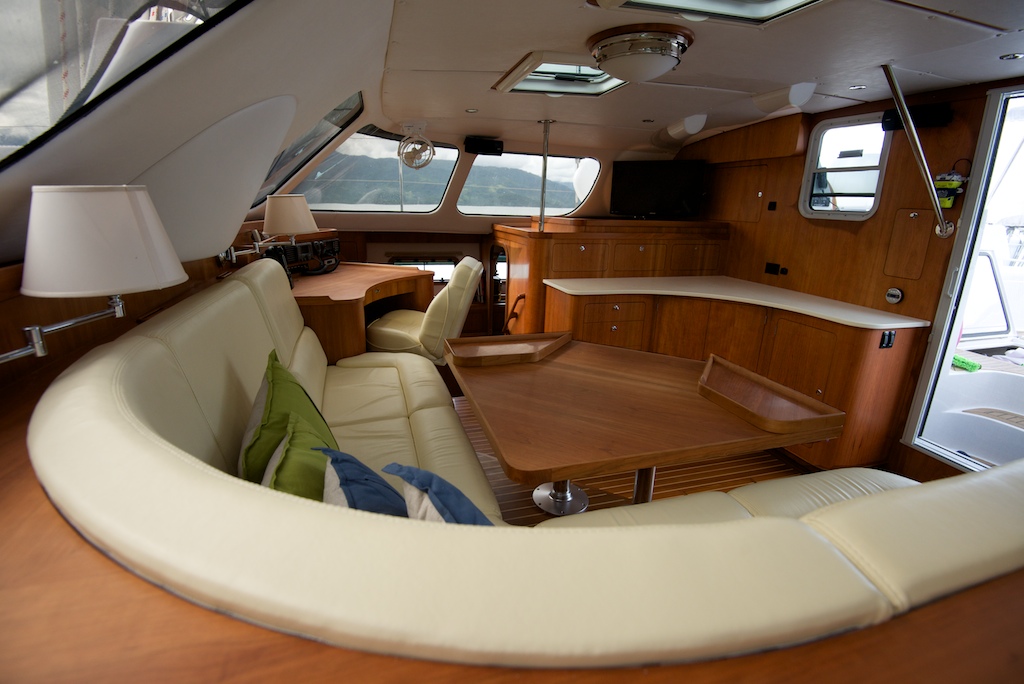
Nav station

Nav station

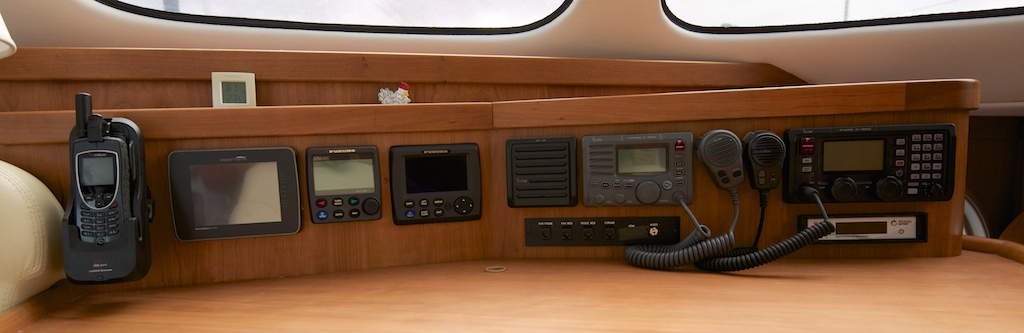
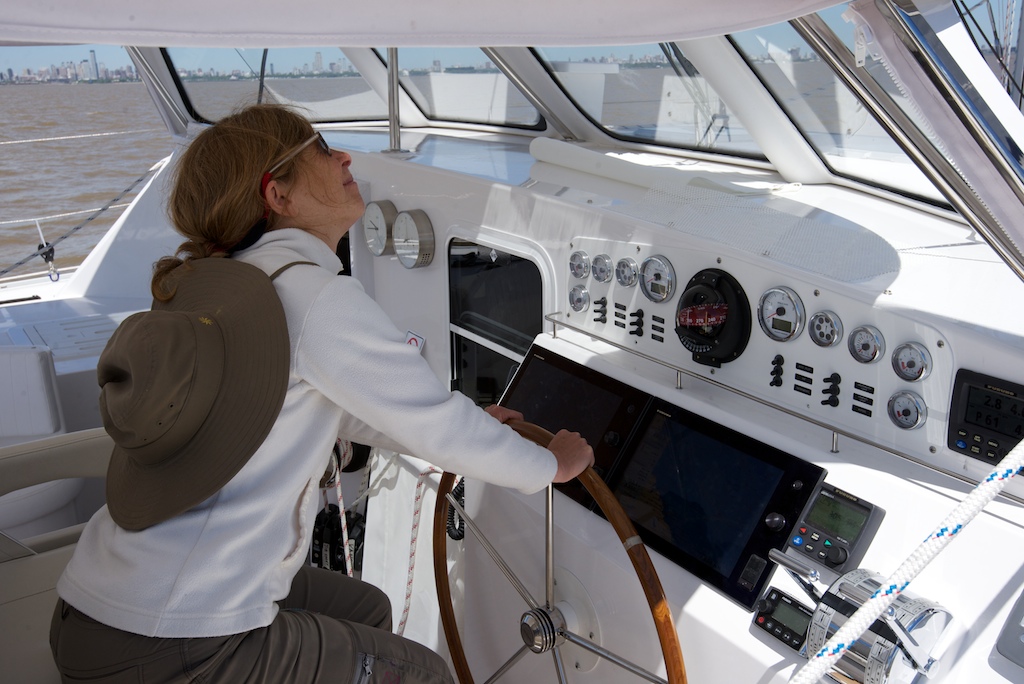
Here is the photo of the navigation station.   We use it as the office desk while at anchor.   There is a great view of outside through the windows.   I kept an eye on Gail while she paddle-boarded from here yesterday.   What are all the electronics?   Left to right:

Iridium Extreme Satellite Phone:  Primary use: emergency phone,  Secondary use: very slow dowload of weather files.   The phone is in a cradle to access an outside antenna, but it can be used like a cell phone from the life raft if the worst happens.

Vesper AIS:   Primary use:  brains for our AIS.  This nifty device listens for short radio messages in electronic format from other boats with their location, speed, name etc.   It then puts this data on the network so all electronics can use it to avoid contact.  It also sends out data about Two Fish.    Vesper or Furuno brand AIS?   Vesper looks much cooler but needs an anchor alarm application ASAP.

Furuno Autopilot:   You can steer the boat from inside using a little knob.   Would not try this for docking but in cold weather, away from other big objects, it is a great option.

Speaker for Single Side Band radio:  Yup, it is a speaker.

VHF radio:   Used for chatting with nearby boats.   Everyone should be listening to channel 16.   And then we switch to another open chanel for longer chats.   “Huge supertanker, this is Two Fish”   “Two Fish this is the Super Carbon”  “Please continue on 71”

SSB radio:   Should be useful for long distance communication.   We have not tried it yet.

Black strip with white writing in second row:   Various places to plug in to the other satellite phone (KVH v3), TV, stereo and such.

White object in second row:   Modem for the SSB.   We will try that soon.


Comments { 4 }

40+ knots of wind … How did we do?

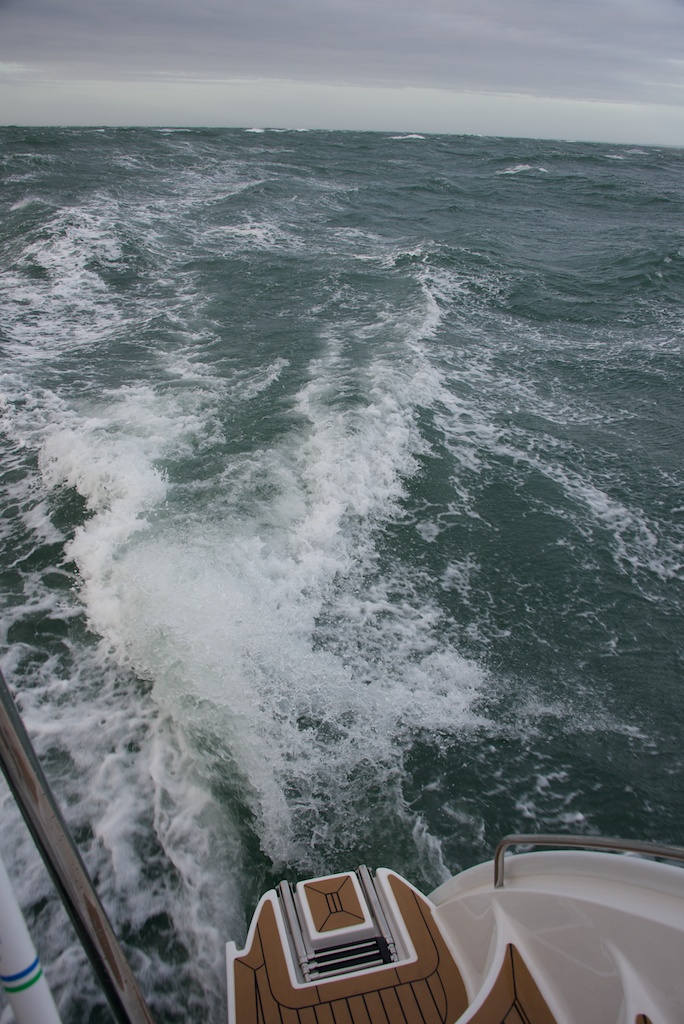
Because I am writing this post, we clearly survived.   Let me cover the numbers first.   Max wind speed was 48.6 knots.  The Beaufort scale (think Richter scale for sailors) describes a force 9 wind as “High waves whose crests sometimes roll over. Dense foam is blown along wind direction. Some branches break off trees. Construction/temporary signs and barricades blow over.”  We did not see any construction signs blow over but there is a paucity of  construction 10 miles off the Brazil coast.  We only had 40+ knots for 6 hour stretches so the seas did not build to Mr Beaufort’s level.

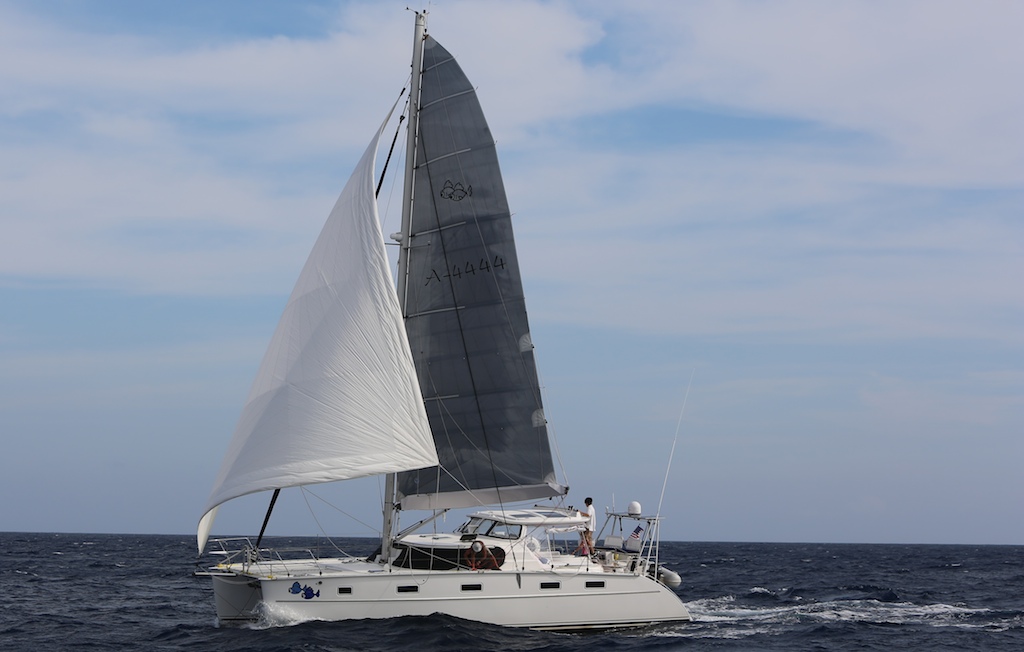
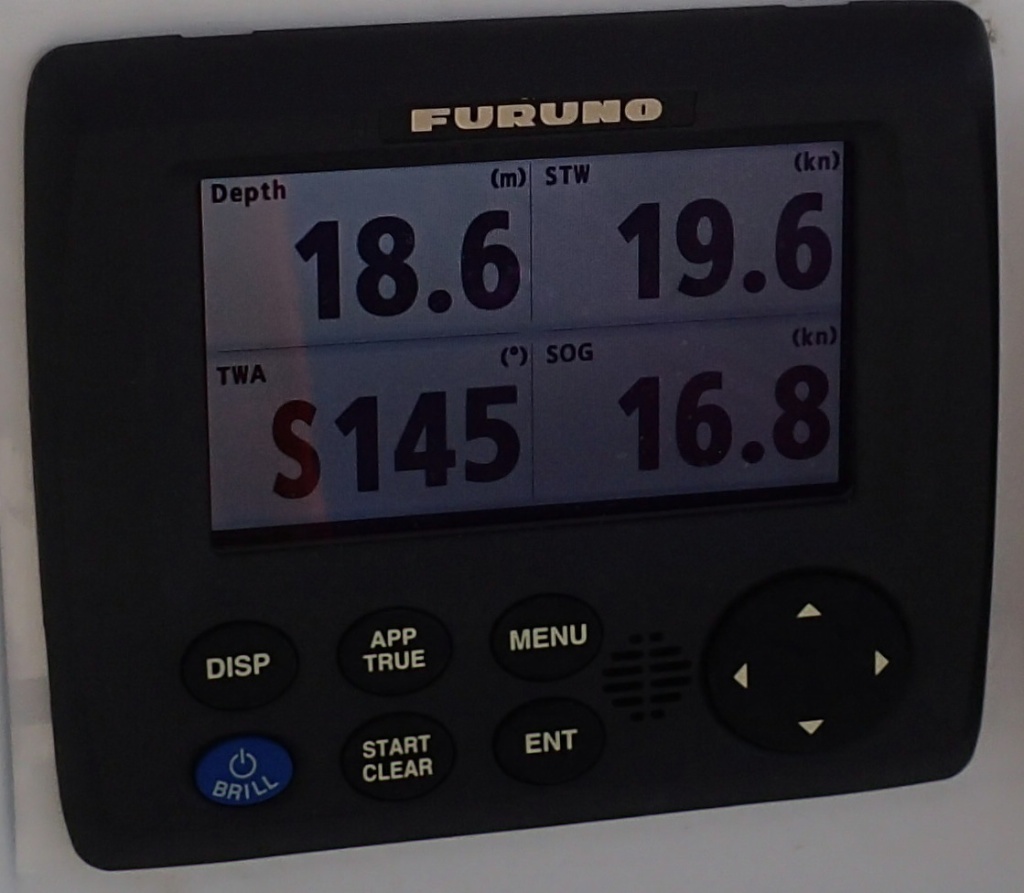
Two Fish’s max speed over ground (SOG) was 19.0 knots (fast enough for a ticket in a school zone).   The top speed occurred when I turned the autopilot off and hand-steered.  At the top of the wave, I let the boat descend into the trough and set my personal record.   There is so much buoyancy in the bows that the boat was never thinking about burying a bow.

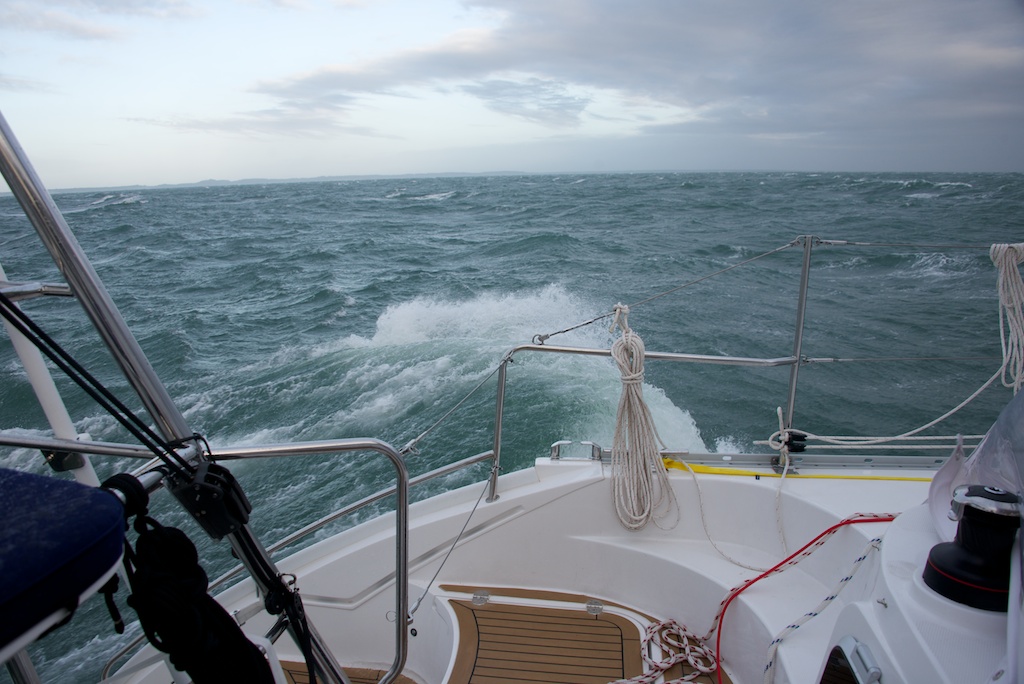
My first take-away from two days of near gale and gale conditions was massive confidence in the boat.  Inside the cockpit enclosure, it felt like 20 knots on a smaller boat.   However, it is not the wind but wild seas that sailors fear.  The professional skipper on our buddy boat, Live Wide, insisted that the wave heights to exceeded 5 meters, but I rated them at a more conservative 4 meters.  Two Fish has a reassuring motion in these following seas.  She never falls to hard into a trough and seems to lift herself gracefully over the wave sets.   Before this post drifts into a marketing piece for Antares, I must discuss the noises. Monohull sailors will be shocked by the loud noises that all catamarans produce in vigorous seas.   After 12 hours, I began to recognize certain sounds –   the whirring noise of the bobstays parting the water as the bows head down a wave is followed by the boat slowing down as it climbs up the next wave and the random slaps that the inner sides of the hull receive from opposing-angled waves passing under the bridge deck.   While under the master cabin bed working on the water maker, I watched the hull flex under the pressure of some of the waves.  All were within operating tolerances,  but it does take a few hours to be comfortable with the experience.   Gail’s reaction to the cacophony of new sounds was to bury herself face down in bed.   After 20 hours, I pried her out of bed and she did a portion of my watch.


TECHNICAL MUMBO JUMBO

ENCLOSURE:   My first thought was not to keep an enclosure up on any boat in over 30 knots.   Years ago I delivered a boat from NY to Florida and we kept the enclosure on up to 50 knots; however, I spent the entire time concerned it would rip away.   On the Antares in 45 knots true (37 kn apparent) there was no sign of stress.  I think this is because the enclosure was part of the initial design.   The enclosure was so solid it was tough to know that it was blowing hard.    I was wearing my PFD (lifejacket) but with the enclosure up, this was probably overkill.   Some other day I will discuss the Spinklock PFD with AIS.

SAILS:   We had two different set-ups in 40+ with true wind angles of 140-165.  The first time we had only a two-reef main.   This would not have been my first choice, but it was very easy to handle.  The full length battens kept the shape nicely and the preventer line rigged from the end of the boom to the mid-cleat created stability.   This set-up would be good for breaking waves as the main is much higher than the genoa.   For our second encounter, we had the genoa at 1.5 reefs.   The genoa leaves you prepared for further windspeed increases, but the sail often loses shape as you sail down waves.

WEATHER HELM:   The main-only set up had about 9 degrees of weather helm.  This is not ideal for speed, batteries and steering gear.   The helm was more neutral under genoa.

ROLLER MAIN:    Our buddy boat, Live Wide, has the furling main so we had multiple chances to compare this to our slab reef main.  The roller main is probably better than the tradition main when the breeze exceeds 40 knots.   This is because the roller allows for easy deployment and can be furled to a smaller size than the double reefed traditional main.   The two reef main on the traditional rig is about the size of the genoa.   Too large for over 40.   Several more experienced owners have wished that the boat had a third reef or a deeper second reef.   Too early for me to weigh in on the topic.

REROUTE JIB SHEETS:   We found that having the sheet led to a block forward as a barber hauler and then to a second block attached to the aft cleat was ideal for this wind condition.   The barber hauler block allows for a nice sail shape and the aft block gives a sheeting angle that protects the enclosure.   It is key that this block comes from the cleat as the sideways load would be too much for the toe rail.   The downside of this set up is a sheet cutting across the stairs.

CHAFING:   We were careful to protect the main from chaffing on the spreaders.   We did observe chafe on the preventer line and main sheet blocks.   The cause was using undersized line for the preventer and temporarily over-trimming the main sheet.

FOOD: Lots of Jamon y Queso on Pan. Second round we pre-thought a bit more and made some Pasta Salads to keep in the fridge. For Gail it was strictly a Quaker granola cookie diet.


Comments { 5 }

How much water is left in the tanks?

On land, when you have guests over to your house, they often enjoy the nickel tour.   They examine the kitchen, admire the living room and glance at the office.   Imagine if they went straight for your electrical panel or your water pump.   Boat guests do just that and it takes some time to get used to the change in personal space.   Cruisers are running little cities.   We produce water, manage its supply, run generators, and have small solar arrays.

The finite resources on board are water, diesel, electricity and food.   Diesel is often considered king as it can create electric power via the generator, which among other things powers the water maker.  In the muddy waters of the Plata our water can only come from a hose on shore – and we consume it at a brisk pace.   We use it to wash dishes, wash bodies (we have a nice shower) and supply our fresh water head.   Most boats use salt water to run their heads but this can bring smelly sea life onboard.    Without being strict on our consumption, one  of our two water tanks lasts about 2 days.  With our current easy access to water, we have been a bit profligate.  Kind of like the economy with easy money?

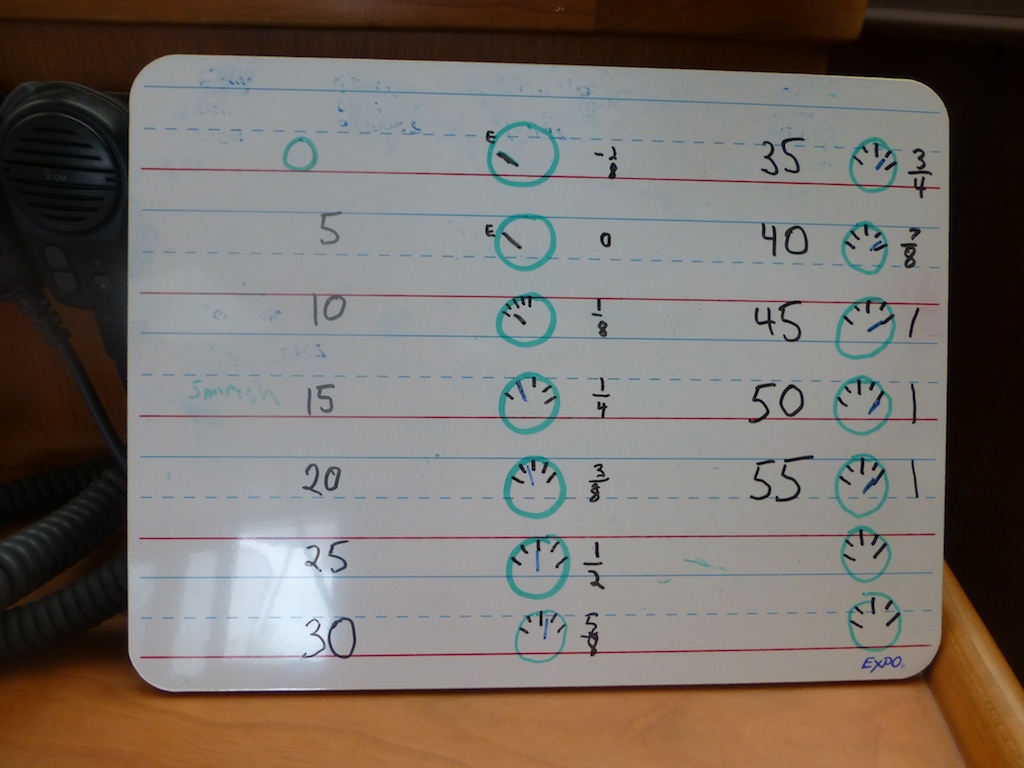
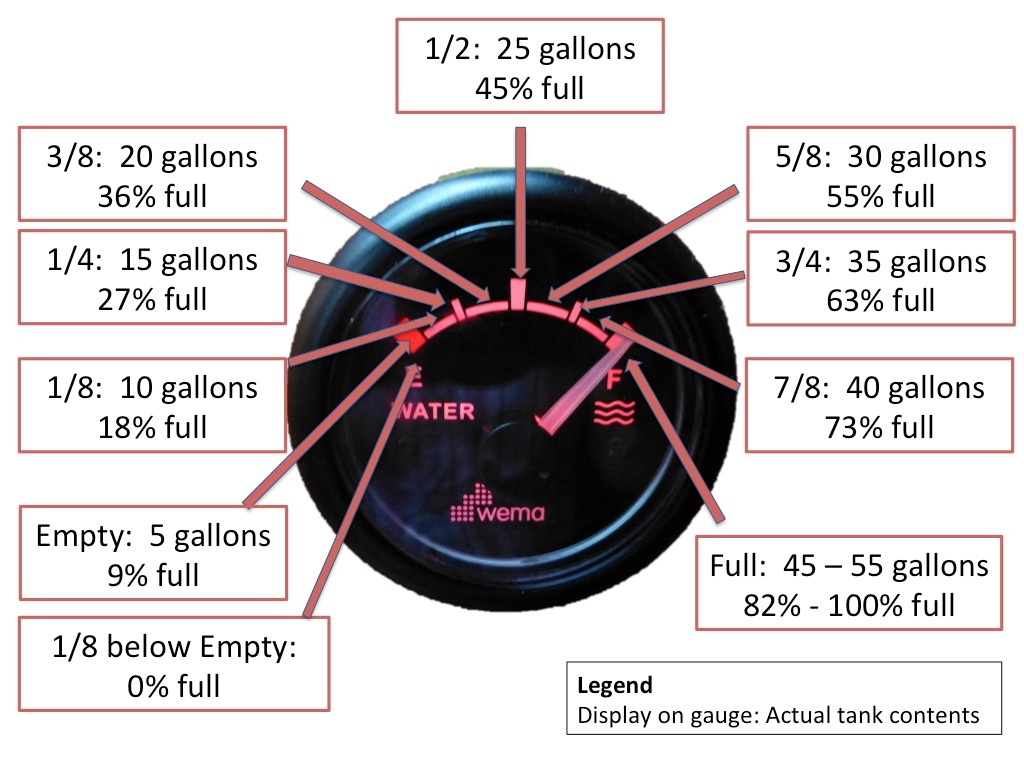
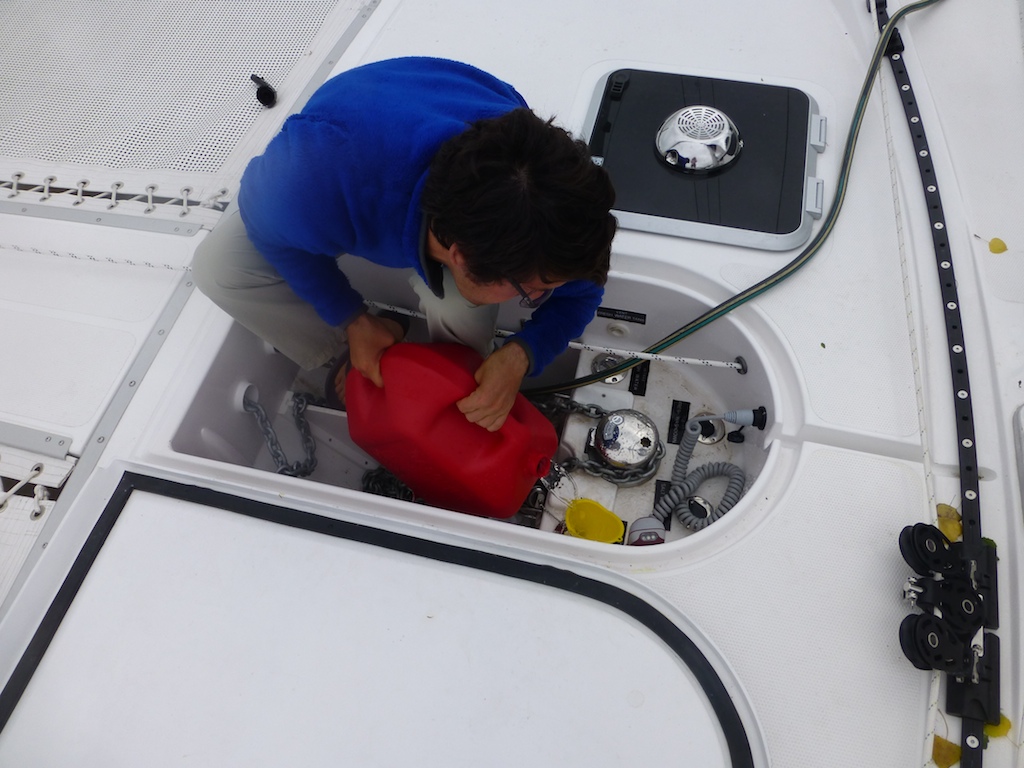
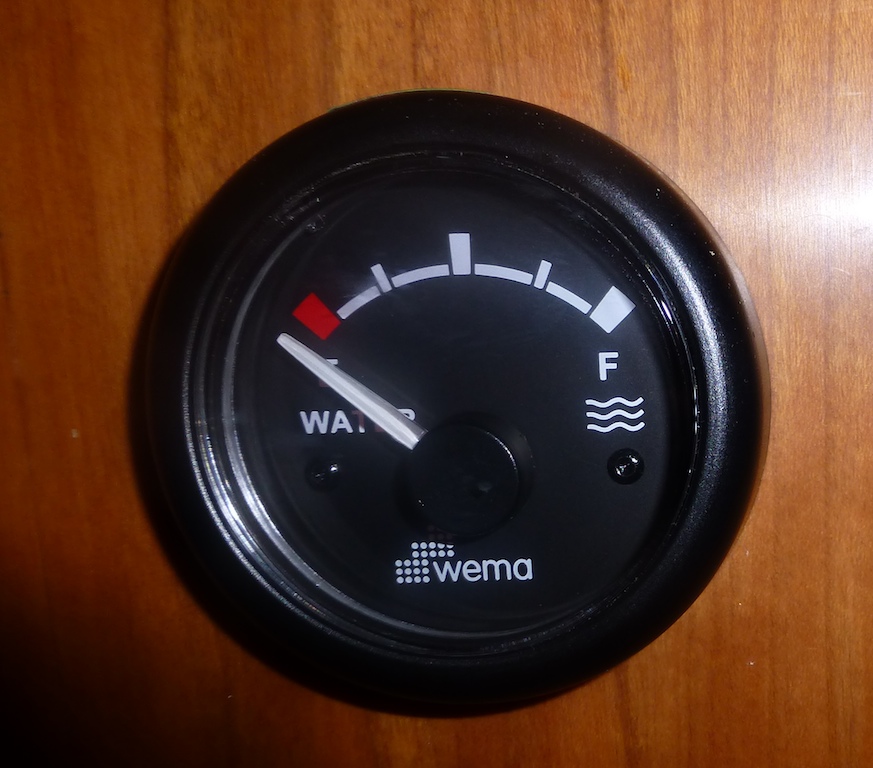
The water tanks follow the shape of the hull, so they are wider at the top than at the bottom.   I was curious to measure the accuracy of the water gauge.   So began an epic time-wasting mission.   With my starboard tank empty, I manually filled the tank using a 5 gallon jug.    I quickly discovered that the full gerry can weighs 45 pounds.   After each gerry was emptied, my reluctant assistant took a photo of the tank gauge.   45 minutes later and we discovered that the gauge is pretty good.   We were expecting the tanks to hold 60 gallons, but they held 55 gallons.    The position of the pick up ,can attribute to some of the missing gallons.  If you care, this drawing should help you obsessively manage your Antares water tanks.

Water gauge (Display vs Reality)

Water gauge (Display vs Reality)


Comments { 6 }

Putting a Boat in Park

The killer app for boats would be an ability to shift into park like a car.   Instead, one employs many lines, anchors, mooring balls and more to hold the boat in place when in a harbor.   On our cruise, we tried a variety of methods for putting the boat in park after the sailing day ended.

First, life at a dock  is a cake walk.   You attach the bow/stern lines to dock cleats, add a few spring lines for good measure and adjust your fenders.   Expect to lose sleep only when your neighbors’ late salsa music wakes you.

Mooring Ball

Mooring Ball

The next level up is a mooring ball.   This is an easy move in the BVIs where the balls are serviced regularly and have a friendly pennant line to make attaching to the ball a breeze.   In Uruguay, the balls lack the pennant line and are also impossibly heavy to lift, so we used a modified strategy.   Rather than grab the mooring ball from the bow,  I maneuvered the boat so that the mooring ball was near the stern steps and Gail gracefully attached a long line which could then be walked to the bow.  We hopped in the dinghy to attach to a second line to make a bridle.    This was also stress free – until 2 am when the tide ran out of energy to flood and switched to ebb.  This was when we realized that the mooring balls were not spaced properly for a 44 foot boat.   This news did not arrive via a friendly email but by a gentle thumping noise.   As I am a new boat owner, I leapt out of my skin and raced on deck to check on what was left of my stern.   Not even a scratch.   Gail used the boat hook to joust with the mooring ball  from the boat from 2 to 3am until she was releaved of duty by a change in the wind.   The sailboat companies do not list those early wake ups in the advertisements.

Anchoring is a topic about which volumes have been written.   Ask four sailors how to anchor and you will get 5 opinions.    Dropping and raising anchor has become much more civilized since the time of Nelson.   As long as your thumb is in decent shape, you should be able to press the up button on the windlass and from the depths will come pounds of chain, an anchor and sometimes unwanted mud.   No octopuses or treasure chests have come aboard Two Fish, yet.  The anchor can be raised from the bow or from the helm.


Mediterranean Moor

Mediterranean Moor

Where the fun really started for Two Fish was the Mediterranean moor.   A Med moor is like tight mens’ swimsuits – a European convention that the US has not embraced.   The boat crew drops the anchor and then reverses towards the sea wall, where stern lines are attached.   The result is that you can hop from your stern to the shore and buy a fresh baguette.   The sailing brochures fail to mention that this type of mooring can raise your heart rate when there is a crosswind and the marina staff are watching you as if it is the Sud America Football Cup.  Med mooring with a cross wind is like parallel parking a car except the spot is moving slowly away from you.  What is moving seemingly quickly towards you is another boat or, in my case, a metal barge.  Like most things in life, there is a trick to make Med moors easy.   Just drop the anchor upwind of your desired position on the seawall and the cross wind will put you in the correct spot.     The process for leaving a Med moor is to quickly lift anchor before contacting your neighbors.   Again a trick can help.   BUY VERY LONG DOCK LINES.   250 feet is a great line since you can go forward and raise your anchor while your stern is still attached.   Ah, Mr Crosswind I have defeated you again.

The next day, the mooring gods came up with a new trick.   The marina staff came by moments before our departure and dropped their maintenance vessel’s anchor and chain on top of our long and heavy anchor chain.   We waited patiently so as to be good guests.   The staff then realized their mistake and tried to rectify the error.   This is when Keystone Cops began.   The marina staff dinghy had a 6 hp engine.  Not enough power to pull two kegs but the determined dock worker had a plan to execute, even if the laws of physics were against him.  Newton be damned.   His plan was to use sheer arm strength to lift our strongly-set 75 pound anchor from the muddy harbor bottom.  Finally, he realized the futility of his mission and decided to duck their 3 pound anchor under our chain.   We were free to go.

Putting the boat in park is always an adventure.  Just think of this the next time you park your car at the mall.

Comments { 1 }

A Review of the Sails During Our Uruguay Cruise

After an enjoyable and busy shakedown cruise in Uruguay, I have some thoughts on the sailing part of the sailboat.  This post will be full of  uneducated preaching on sail handling, so I am eager to hear corrections and comments from sailing veterans.  My target audience for this post is small.   If you are not a sailor, then this post will seem pompous and needlessly technical.   If you are an accomplished sailor, then you will be able to correct this post in my attempt to  teach others.   So, I am looking for that one person who is massively interested in sailing but knows less than me.

The Antares has fewer lines than a comparably-sized race boat.   No topping lift for the spinnaker pole, no jib cunningham,  no twing lines and only 4 halyards.   The boat moves we need to execute are simple, but we need to be able to do them with one or two crew and in 40 knots.   A dumb move on a Laser in high winds results in a swim but on a large cruising yacht you may lose a finger or two.  Cruising is all about slow and steady.  Do it right every time.  To strengthen our skills, we invited Michael Domican of the BVI to tutor us for two weeks.   His sailing resume is impressive: for the past 12 years he has taught catamaran sailing and prior to that he trimmed the mainsail on the 12 meter UK challenger for the America’s cup.  He is an amazing teacher and we can not thank him enough.  If you are looking for help on how to sail the boat safer, faster and more comfortably, give him a call.   This post is my memory of his lessons.    Any of the smart stuff is credited to Michael and any stupid stuff is credited to my poor memory.

So, imagine you have just motored out from your anchorage location and are ready to enjoy the breeze on a nice, sunny day….

The first sail to go up is the Main Sail and typically with the motors running so as to help keep control of the boat.

Process for raising the Main Sail

    1. The sail needs to be free so “Release the Corners”  (Vang off, Reef #1 and #2 off  (if raising to full Main), and add a bit of slack to the reef lines at the mast for good measure)
    2. Sail Ties off. (sounds simple but easy to forget)
    3. Topping lift.   Before sailing I like to leave it attached to the stanchion out of the way unless the conditions are vang abusive (choppy and light air).  It just is another hazard for raising the main and I hope to get my ideal twist with vang, sheet and traveler.   I put it back on when not sailing to avoid stressing the vang.
    4. If you frapped the halyard while anchored, quickly remove the slack from the main halyard.
    5. Traveler should be on centerline UNLESS this is being done while hove to.   If hove to, move the traveler to align with mainsail. Up to this point, you can take your time as not much is going on to unsettle the boat. After this, don’t be maniacal but don’t daydream either.
    6. Release the mainsheet –  In light air, you may need to manually pull on it a bit near the mast.
    7. Tips on holding a boat head to wind. This is crucial when raising the sails.   Use the boom to determine if you are head to wind.  Skip this if you are hove to. Holding a catamaran head to wind is all about your engine control skills.  It is easier to stay head to wind while maintaining some forward momentum, but often to avoid the prospect of raising the sail in lumpy seas, you are in a protected harbor with limited sea room.  If you go blasting forward at 2 knots you will crash into the pier.  Try these tricks to be a pro:
      • Lock out the wheel with the rudders straight.   Do not use it at all. Stop it – I just saw your hand creep back to the wheel.   Use your engines to steer.
      • Make sure to have a good view of the boom, windex, other boats and the water.   All are great ways to see where the breeze is coming from, assuming there is no current.   Try not to use the electronics.
      • To adjust the boat head to wind use forward on one engine and reverse on the other.    Now look at the background behind the forestay and see how quickly your are turning.   Too much power and you will turn quickly and need to over-correct   Too little and you are not turning at all.   Next, line up a reference point on shore with a nearby stanchion.   Are you moving forward or backward?   If moving forward then your next throttle adjustment might be only a reverse on the appropriate engine. If you can’t find a good lateral reference point on shore, watch the bubbles on the water surface.
      • Practice “holding station” a bunch as this is great skill for raising sails, docking, and being boarded by the Prefectura (the spanish Po Po).
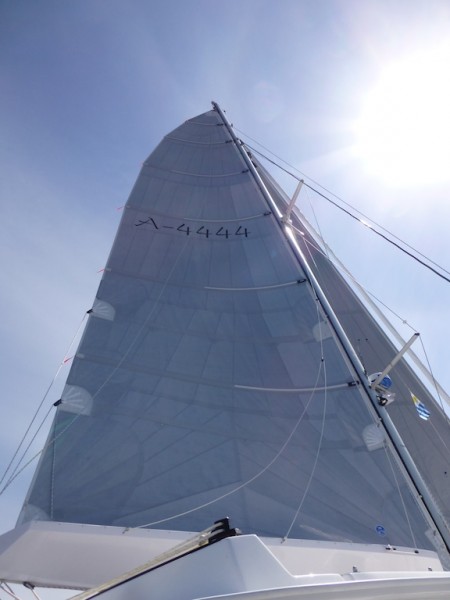
Full Main

Full Main – Two Fish Logo coming soon – Notice reef Blocks sewn in leech

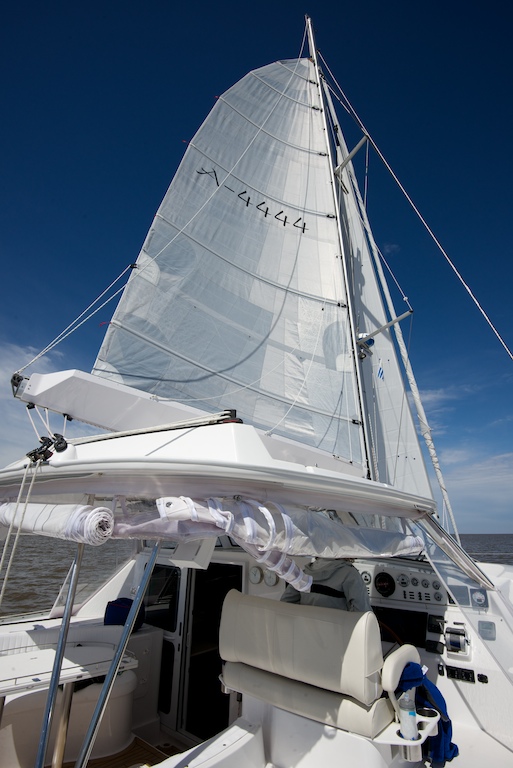
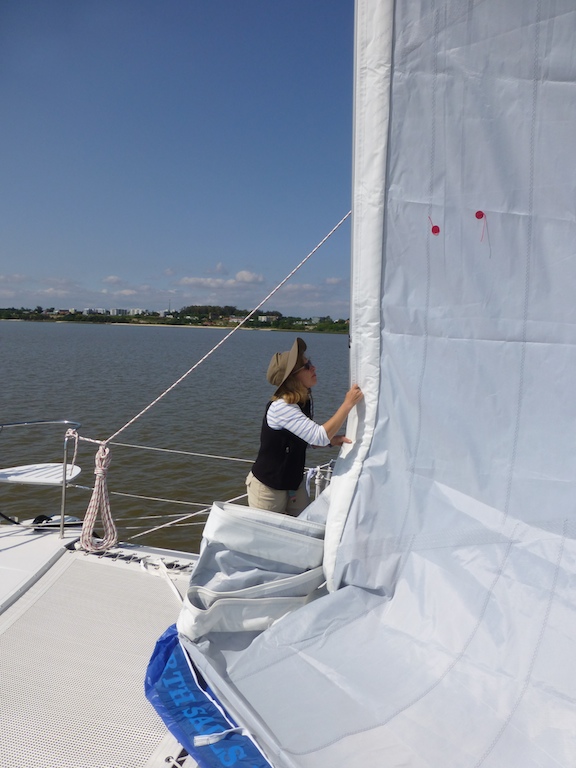
  1. Holding the boat head-to-wind, raise the Mainsail.   I like to use “power Jason” at first, instead of the power winch. I do this to ensure nothing is jammed – the power winch has no subtlety, the two gears are up and rip.  Then I use high gear for the first 90% and low gear for the last 10%.   Keep your eyes on the sail.   First, make sure you are actually raising the main, not using the spin halyard in a mistaken effort to remove a stanchion – a costly move for you, but fun for others to watch.   Then make sure the Main clears the lazy jacks.    Now watch that reef two is coming out cleanly. Did you last sail the boat double reefed and forget to release the clutch?   The reef lines sometimes like to hook around the end of the Park Avenue boom.   The next hazard to watch for is reef one.   A few feet later, I switch to low gear on the power winch.   The helm person can see the luff better and can help get the right luff tension for the current wind speed.   Too taut and the luff has an odd fold.   Way too taut and the ripping noise will be a clue that you made a mistake. Note from Gail – I am too short to see what is going on with the sail while standing by the winch. I like to stand on the aft bench, holding on to the stainless, and use my foot to control the power winch.
  2. Your Main will now look like a sail from a polynesian vessel.   The vang ram will be forcing the boom 2 feet higher than its proper position.   Trim the mainsheet, which will initially act like a Vang and you can now bear away to your proper course.    Now remove the slack from the vang line.  The Vang over-raises the boom because of the design of its peak power point.  When compressed it can handle more loads but when not under load, this creates a bit of the Kon Tiki effect.
  3. One more check that the reef lines are not causing troubles and  remove any slack in them with a light hand.
  4. You can now shut off your leeward engine and get ready for a head sail.   With only the full main up, the boat has a decent amount of weather helm so it is important to keep your windward engine running until a head sail is rolled out.

Head Sail Unfurl / Furl

  1. Rig the Genoa or Code Zero (sometimes called a Screecher) sheets and choose the Jib Car position.    Typically, the Genoa sheets go inside the shrouds and the Code Zero sheets go outside the shrouds.   Wrap both sheets with two wraps around their appropriate winch and remove slack.
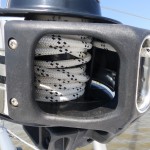
  2. To unfurl a head sail, it is easy to just pull on/grind the sheet. But you will create a future problem at the furling drum.  While furling sails are an established technology, you still need to keep your drum under control:  always have friction or light resistance on the furling line when unfurling.  When the sail is going out, line is going in the drum and can you can create overrides and/or have bunched up line if there is no resistance.

    You are trying to create a tidy-looking drum.  Might be worth checking on your drum once and a while.  If it gets bunched or wrapped you could be unable to furl.   That would suck since it most likely jam half way furled and in a big breeze.   Your only option is cut the sail as dropping the halyard would do nothing.

  3. Code Zero

    Code Zero

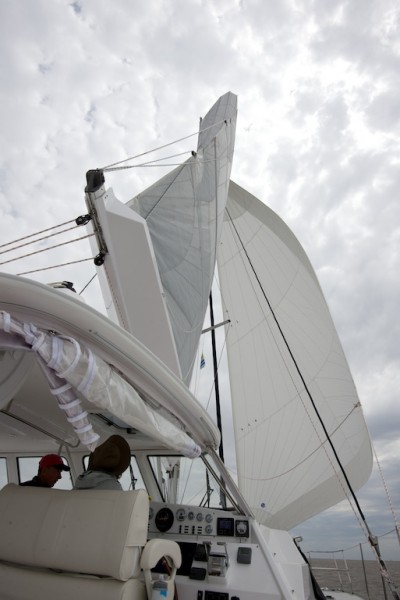
    The Code Zero does not have a drum to store the furling line; the headstay is turned via a code zero furler – a simple mechanism that looks like a pulley at the foot of the sail. Before furling or unfurling, check the lines and the code zero furler to make sure the lines are taut and the line is well seated in the furler. Don’t just look forward, walk all the way to the furler. (We learned this the hard way). In the cockpit, there are two lines at all times.  One short and one long.  There is no labeling, but it is easy to remember, in all cases pull hard on the short one and lightly ease the long one.   For example,  to unfurl, pull the short end and keep light friction on the long one while someone is using the working code zero sheet to unfurl the sail.  After unfurling, your formerly short line is now long and the long line is short.   To furl, pull the short one and keep friction on the long one.  Easing needs to be controlled to keep the lines neat but the sail not fully loaded.   Even with sailing deep downwind, furling the code zero can require some strong pulling.   The factory supplies you with a pennant line that allows one to lead the Code Zero furling line to the aft power winch.   I would use this as a last resort.   The Code Zero is furled with the shiny side hidden because the other side has UV protection.  If you don’t keep tension on all lines, it is easy for the line to exit the furler.    If this happens you can drop the code zero on the deck by releasing the halyard.  This is not a bail-out option for the Genoa/Jib.   Then, fold in the pole and rethread the furling line.   Cowboys may wish to climb out on the pole to fix it quickly, but this is not recommended by the chief safety officer.

  4. Be kind when you rewind, do it off the wind!   If you are steering 140 degrees apparent wind then the loads on the system are very small.  You will get a nice furl and will have a sail set up for action the next time you need it.    One person uses the helm side power winch to bring in the furling line for the Genoa/Jib.  The other person creates symmetric friction on the two sheets.    I like both sheets with 1 wrap on their respective winches while I am holding the two sheets while standing by the toe rail.   I then have a great view of the sail and can ensure that it is wrapping up neatly.    At the end I allow the clew/sheets to wrap 3 times to keep the genoa nice and closed in case of a storm.   If you are sloppy during this step you have a chance that a storm wind might pry open your genoa.   Not a good thing.   Then flake the sheets and tie them to the seagull striker.
  5. Furled Headsails

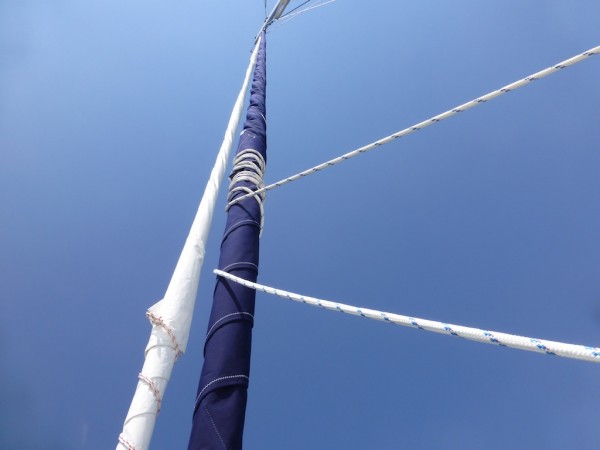
    Furled Headsails – Code zero (sloppy) Genoa (clean)

    How tight should you furl?   A really tight furls sounds great but it is hard on the genoa or code zero to be compressed.   The furl should be not too tight but neat so that there are no gaps for a storm to attack.   If you furl extremely tight  then you most likely you are furling the sail under load.   The winch is strong but this is a bad habit that will catch up with you.

  6. Another check is that the furling line should have 4 wraps on it when the sail is furled.   Those extra wraps are there for when you do furl under load.   Stuff does happen where you do not have sea room and need the sail away ASAP.   If you have more than 4 wraps your drum might get crowded when unfurling the jib.
  7. Shut off engines and put the morses in correct position. What is that? It depends on your propellers-folding or feathering. Volvo props and Gori props are folding props-these fold backwards while under sail and centrifugal force opens them when under power. If you have folding props, leave the morses in Neutral or Reverse (according to the Volvo manual). Remember to take them out of gear first. Max-Props are feathering. These have a mechanism to rotate the edge into the water flow while under sail. When under power they rotate into different positions for forward and reverse. If you have Max-Props, once the engines are both in neutral and powered off move the morses to max reverse to stop the blades from spinning. Wait a minute and listen for a change in sound.   Your props are now feathered.  Then move the morses to max forward to avoid the genoa sheets from getting fouled in them during a tack.
  8. One last note: to Reef the Genoa, just furl it in to the desired point rather than furling it in all the way. Your sails might have guides taped on them to help you determine a good first reef and second reef point for these. After a while, you will get a feel for the size of the sail that you are looking for.  The Furlex manual also has some tips on reefing. They propose you unfurl the full sail and then furl back to the reef point to create a tighter luff for sailing.   This tight furl would not be good for storage but gives the sail a finer entry which is useful when sailing to weather.


Reefing the Main
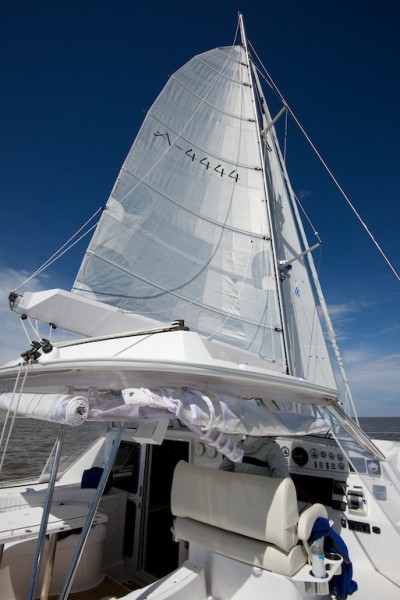
Single Reef in the Main

Single Reef in the Main

  1. There are two ways to skin this cat.   One is to be head to wind and the second is to heave to.   As the latter is more likely let us discuss this process (who wants to be head to wind in 30 knots with the genoa/jib banging when you can heave to instead?).
  2. Heave to by either tacking into it or grinding into it.
    • Tacking into heaving to is to tack but let the Genoa/Jib back-wind by not releasing the jib sheet.   After the tack, while the main is eased, turn the helm to be in opposition of the jib’s force (For example, if you are on starboard tack, you tack to port. The main is on port tack but the  jib is has remained trimmed on starboard, trying to pull the boat more to starboard. Turn the wheel fully to port and lock the wheel. Note from Gail – a simple unsanctioned way to think of it is if you turned the wheel to starboard to tack into heave to, when the jib is backwinded turn the wheel fully in the opposite direction, to port).
    • The grinding into process does not require a tack;  the lazy sheet is ground and the working sheet is eased, such that the sail is now backwinded to windward.   The tacking-into hove-to technique on the Antares is kinder on the Genoa as the radar and diamond strut get in the way of grinding into it.  Either way, this maneuver should be done with a reefed Genoa to allow a better balance of your center of effort and less Genoa interaction with the radar. You still need to turn the wheel in opposition to the Genoa/Jib pull.
  3. Now the boat should be calmer and stable while drifting slowly under hove to.    Ease the main halyard looking for your mark on the halyard that indicates your first reef while also watching the sail.  Ease one foot past the mark and cleat off the main halyard.
  4. Slowly sheet in the first reef line.   Ensure that the reef line is not caught on the aft portion of the main tamer. Then watch as the tack will be pulled down first.   After this is completed the clew will start to be pulled down.   Keep stopping to make sure you have this in clear view to avoid damaging the sail.   When both reef points are snug, engage the reef #1 stopper.
  5. Add main halyard tension to ensure a flatter sail shape than when under full main.   Also, when trimming this sail in high winds you may want to induce more twist to spill wind.
  6. To exit hove to, unlock helm and begin steering while the jib is trimmed properly.   To release the jib and avoid a violent thrashing of the sheet, employ an incremental process.   First, ease 3 feet on the backwinded sheet.   Trim in all the slack on the old lazy sheet (soon to be the working sheet).   Then go back to the backwinded sheet and ease 3 more feet.   Trim in again on the new working sheet.   Yup, just keep doing this until the jib is back in its correct spot.

The Jib
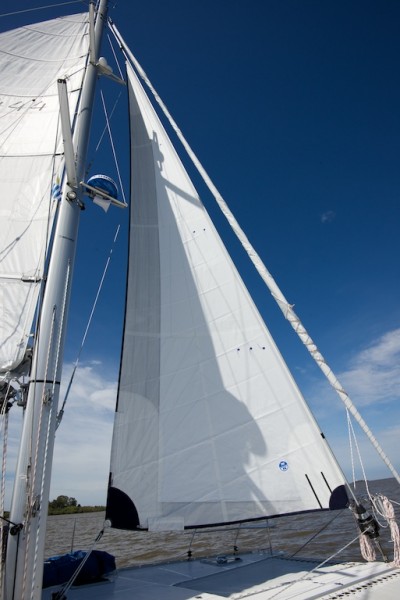
Jib (smallest headsail)

Jib (smallest headsail)

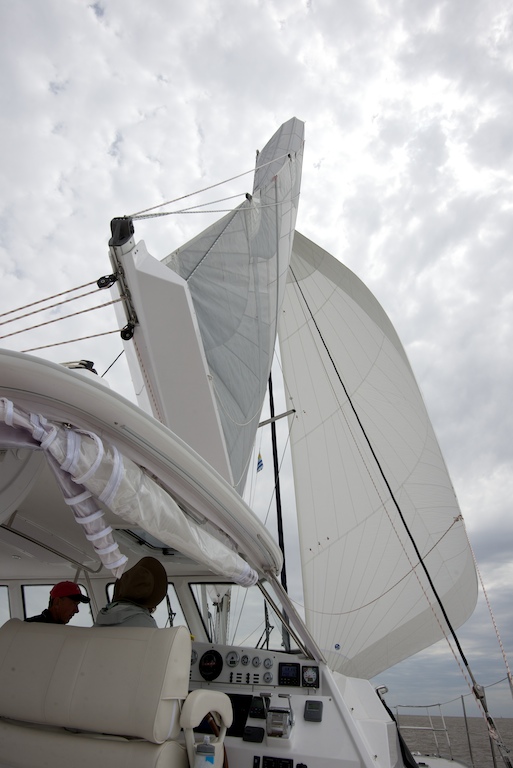
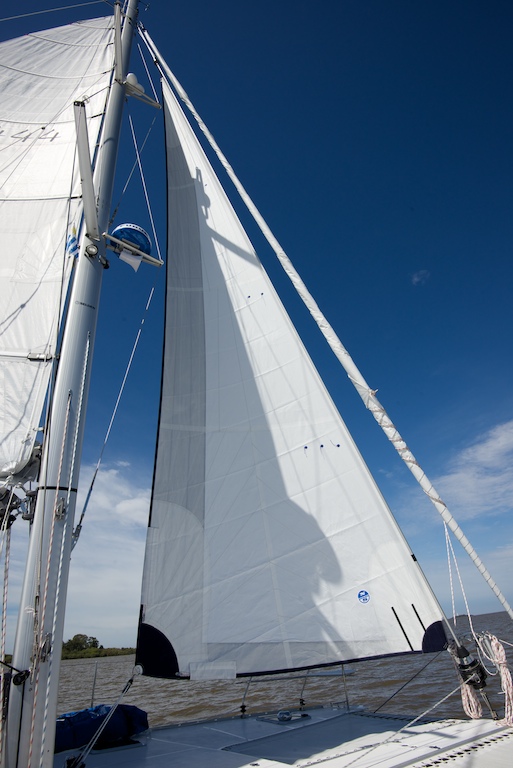
I love this underused sail in the Antares arsenal.   As you can see it is about one-third the size of the full Genoa.   Many owners have told me about sailing in 40 knots with just a scrap of the Genoa unfurled; it is great to know that the Genoa can handle such strong wind.   But my preference would be to have the Jib up in those conditions because: it is made from a sturdier cloth that loves the big breeze, the luff is much thinner than the furled genoa, and, the cut of the sail is flatter.

The only problem is that you must have the forethought to change from the Genoa to the Jib before the breeze gets too strong.    We did a few sail changes in easy conditions, but with a strong breeze and green seas I can imagine this might be a bit more action-packed.   The Jib is also auto-tacking which is great for short-handed crew.    Since the mainsheet and jib sheets are controlled very close to the helm, one person can have plenty of control of the boat.   The cost of the auto-tacking configuration is the process for heaving to.   You either have to go forward and move a stopper that will prevent the jib sheet from auto-tacking or lead a temporary line from the jib blocks aft that will restrain the jib from auto tacking.   A bit more forethought.   I am not a legend in the forethought arena.   Gail will need to help on this one.

The jib sheet is attached to the clew via a harken shackle.   This shackle does not have a captive pin so be careful when attaching or detaching the jib sheet for this smaller sail. (and carry some spares).
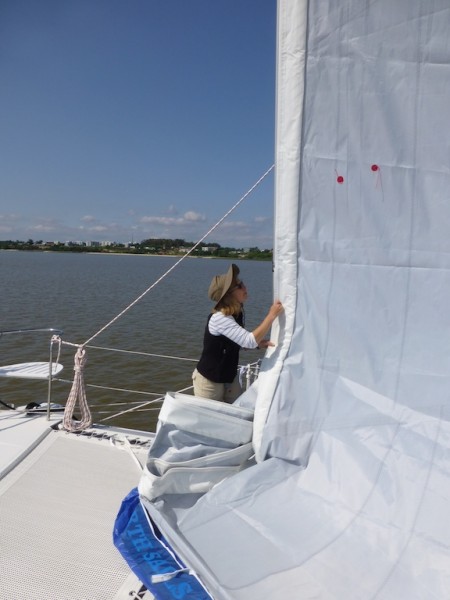
Raising Genoa

Raising Genoa


Dropping and Raising Headsails

  1. Dropping – Try to be off the wind so as to use the main sail to block the breeze and make the job easier.
  2. While the sail is not loaded, ease 2 feet of Genoa halyard.  Use the genoa sheet during this process to keep sail close to the boat and to not drop it into the water (keep it inboard of lifelines).
  3. Crew detaches the bottom shackle and and gets the sail out of the headstay groove.   Crew signals for more halyard drop.   Drop as quickly as the crew can consolidate the sail onto the trampoline.    When the head swivel arrives, tie it to the dolphin striker using a sail tie-down.
  4. Detach shackle from head of sail and attach to swivel.
  5. Flake sail and place into sail bag.   If you are dropping the Genoa, then tie the long sail bag to stanchions, to avoid loss of bag.
  6. Raise a new sail by repeating the above process in reverse order.   Make sure the sheet is already cleated in on the appropriate side at loose trim.


You may want to take a break and get a drink now but I am almost done writing.

Tacking

It is more fun to hand steer the boat during a tack or gybe but when short-handed it might be better to let the autopilot take charge, if you have an autotack feature.   Press the turn button and 4 choices should appear (two tacks and two gybes).   The tacks (port to starboard and starboard to port) are programmed to go fast since catamarans like to get caught in irons.   I programmed a wide tacking angle of 110 degrees.   This will not win races, but will make it easier to keep the boat moving.  Furuno autopilots are polite and wait 10 seconds to start the tack after the button is pressed.

Solo tack plan for a Genoa

  1. Ensure sheets are prepared for a tack.   Remove figure 8 coiling of sheet off the active winch.   Flip the pile so the bitter end is on the bottom to ensure a cleaner release.    Ensure that the lazy sheet has two wraps and that the winch handle is near by.
  2. Make sure that where you are tacking to is clear.    Check for other boats and chart for any issues. Even if using the auto feature at the helm, think about where you will be pointing at the end.
  3. Instruct Furuno to tack the boat. (Push the button, fortunately there are no Siri’s in sailing)
  4. Walk safely to the active sheet.
  5. Release the sheet when the headsail has some quantity of back-winding.   Less for windy days and more for light air days.   When releasing the sheet,  first remove sheet from the stripper and keep 4 wraps on winch until you see the backwinding.   Then, remove wraps briskly while ensuring your hand is clear of the winch and you have a clear running sheet.
  6. Sheet in on the new sheet while the winch has two wraps as the sail is crossing over.
  7. Add two more wraps and put the line through the stripper (shiny metal part) before the sail loads up.
  8. Winch in to the appropriate trim. If you are human, utilize low gear(counter-clockwise) when high gear (clockwise) doesn’t work anymore.
  9. Return to helm and check again that you are on a good course and have no obstructions.
  10. You may want to adjust the traveler to fine tune the Mainsail.

Tacking the other head sails

The three headsails require slightly different techniques.   The auto-tacking jib requires nothing as long as the jib sheet car stopper is placed in the correct location for the new tack.  If so then turn the wheel when it is safe to go.   It would be odd to tack the code zero since it is an off wind sail and you would probably be gybing it. The alternative to gybing it is to furl it, gybe the boat and then unfurl it on the new gybe.

Gybing

The risk during gybing is to gybe too quickly, thus damaging the traveler and/or other gear.

  1. Ensure the course you are gybing to is clear.    Check for other boats and look at the chart to find any other issues.
  2. Center the traveler and make sure both traveler controls are not slack.
  3. Instruct Furuno autopilot to gybe the boat.   There will be a 10 second delay if you have programmed that into your Furuno autopilot.
  4. Make sure to select gybe NOT tack.   The boat will turn much slower for a gybe
  5. Start trimming in the main sheet.    The goal is to have the main near  centerline when the apparent wind angle is greater than 140.   Too early and you are fighting the boat, too late and you will not have time for your next maneuver.
  6. Remove the mainsheet from the stripper and be ready to allow the sail to ease when it gybes.   Watch the leech of the main sail.   IGNORE THE JIB.  It most likely will gybe earlier but do not concern yourself with this sail until much later.
  7. POW!!  Main is over but the movement was not violent because the main started at mid-ships and was eased as it changed sides for a “soft” landing.   Do not ease too far or you will cause a violent impact with the shrouds.
  8. Now clean up the jib by using the technique used for exiting the backwinded jib.   Ease 3 feet on the old active sheet and then trim in on the new sheet.   Repeat until you have proper sail trim.
  9. Adjust trim on main sheet and traveler for optimal sail shape.    Keep an eye out for shrouds chaffing the main.

A long post by me, mostly written as a review for Two Fish but hopefully, a few of our Do’s and Don’ts will help you avoid some of our previous mistakes.
 

Comments { 7 }

Coming soon…

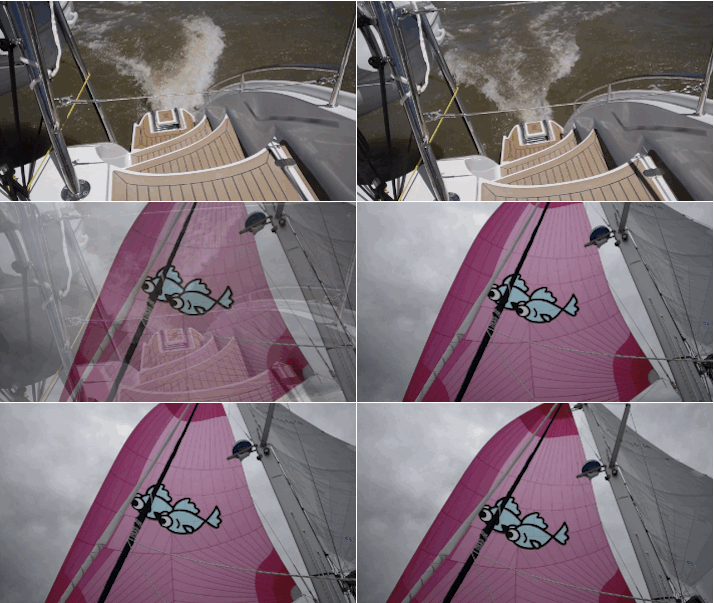
Chute gif

We have some longer posts in the works covering our 2 week Uruguay cruise and tips on sailing the Antares.   In the meantime we thought a few images might provide you with your fix of Two Fish action.
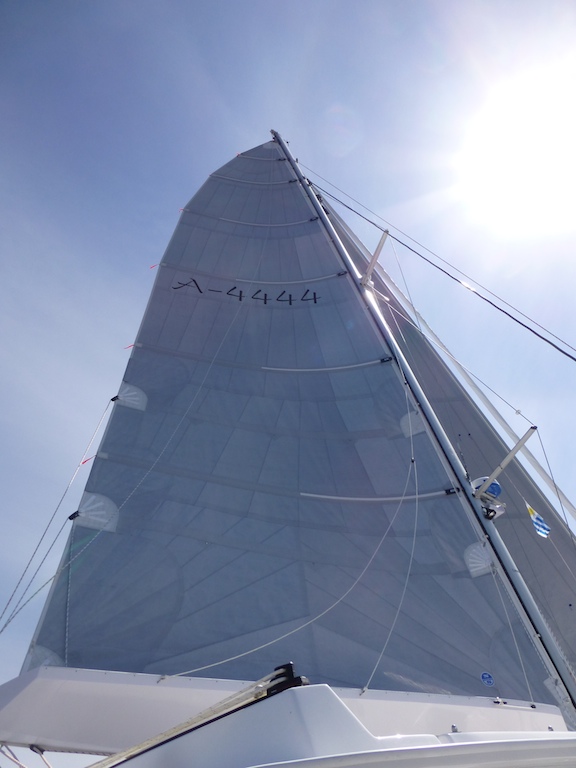
The “movie” is of our spinnaker with our boat logo.   The sail is the size of a NYC two bedroom apartment and takes a bit of skill to put away.


Comments { 4 }

Big Day

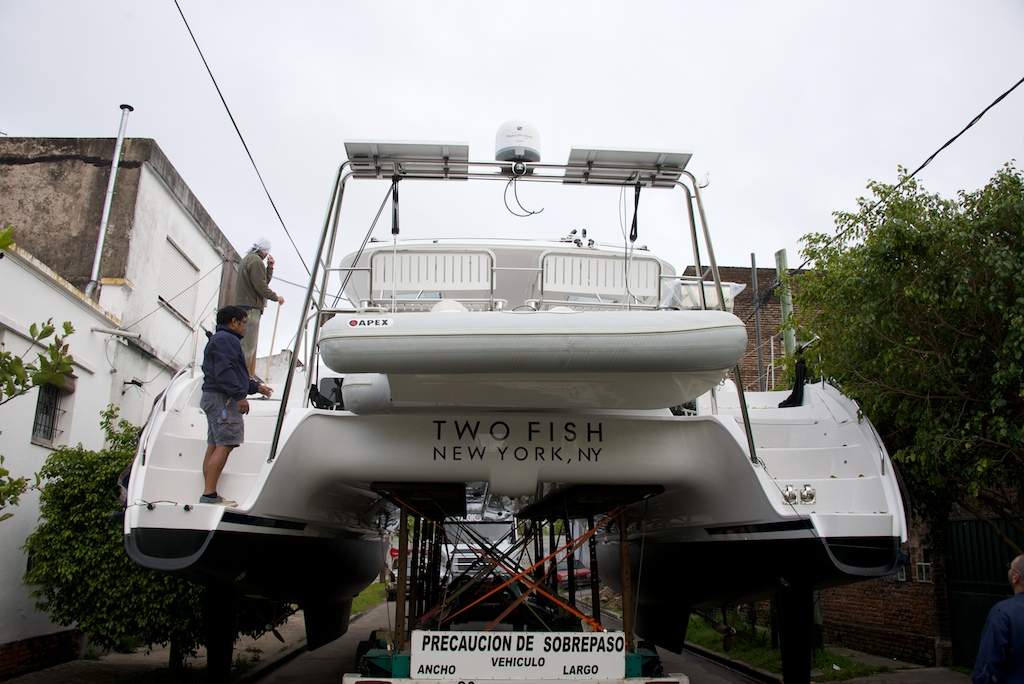
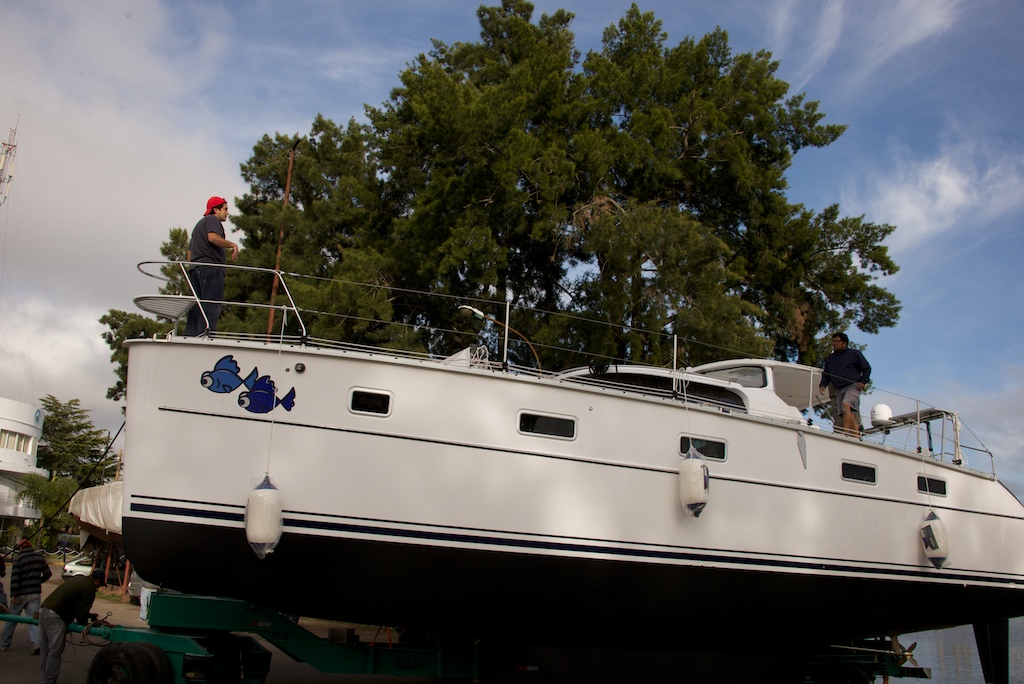
After 10,000 hours of labor, at 8:38 a.m., Two Fish splashed. She weighs 20,000 pounds and 7 ounces and is 528 inches.  Mother, Father and boat are healthy.
 

Boat Splash from Two Fish on Vimeo.

Everyone woke up early today to put Two Fish in the water. The tides and wind had delayed us for a few days so everyone really wanted to hit the 8am high tide mark. It takes a while to move the boat but remembering the rule of twelfths we knew we had a little bit of leeway. (The rule of twelfths pertains to tide levels. The height does not move down uniformly with every hour from high to low tide. In the first hour it moves down 1/12, second hour 2/12 and so on.)

The streets of San Fernando are not designed to transport a 22 foot wide catamaran. Horizontal clearance during the trip is impeded by cars and recent branch growth. At least the branches can be trimmed with a machete. Vertical clearance is impeded by overhead wires but brave boat builders help to complete the trip.


Comments { 16 }

EPIRB Purchase

What is an EPIRB?  How do you dial 911 when you are mid-ocean?   Cell phones don’t work.   Message in a bottle seems a bit slow.   The answer is an EPIRB (emergency position-indicating radio beacon).   It has only one switch and when you turn it to the MAYDAY position it starts getting you help.    Step one: it uses the onboard GPS to figure out where you are.  Step two: it sends your location and name to one of many satellites floating in space, along with the message “Two Fish needs help and is off the coast of Brazil”.   Then the Coast Guard takes the message to see if it is a false alarm.   To figure this out, it calls your loved ones to check in if you should be at sea.   Your loved ones at this point will panic.   The call will go something like this,  “Hello this is the Coast Guard,  we got a MAYDAY message from Two Fish.  Do you think we should respond?”   It is very very unlikely we will ever use the EPIRB, but it is nice to know that we have one.  The EPIRB is waterproof and has a tether so you can tie it to your arm or a life raft if the situation calls for abandoning ship.

So what were the choices we made in selecting the ACR GlobalFix iPro 406 MHz EPIRB?

Pro for the ACR:  When testing, there is a small digital screen that shows the results of the tests.   So no guessing if  three green flashing lights followed by a long pause means your EPIRB is up to snuff.   Imagine the tension in the life raft: “I think it is transmitting.  Did you bring the manual?”.

Con for the ACR:   The battery must be changed by a professional.  So in 6 years time we will need a new battery and changing it is half the cost of buying a new one.  Kannad makes a unit which has a replaceable battery.  The Kannad unit is also cheaper and better looking, but we were swayed by the small digital screen.  Not the first time we fell for more gizmos.

CAT I vs CAT II:  On Alaskan fish boats the EPIRB must deploy automatically when sensing water (CAT I).  We thought this would create false alarms and went with the simple CAT II which is switch activated.

Where to Install:  Our plan is to  install the EPIRB inside the salon, right by the door, which is two steps from the helm.  Nice combination of easy access but protected from the natural elements and the unwanted element.

GPS connection:  The unit can refresh its GPS from the NMEA network so the EPIRB can send a message faster and not wait to find its location.  After the first message the EPIRB uses its internal GPS.   We are not going to take advantage of this feature for a few reasons.  We like keeping the EPIRB simple and independent.   Could lightning damage the EPRIB if connected to the NMEA network?  Also this connection would be an ugly wire in the salon.  We can always change our mind later.

After  you buy and EPIRB, you still have work to do.  You need to register the beacon so that when the Coast Gaurd  receives your MAYDAY they can quickly obtain your details and send resources to your rescue.   It is free to register.  Save your password because you need to update the numbers of your shore contacts when they change phone numbers.  You do not want the Coasties to be greeted by “Aunt Edna does not live here anymore” while you are inside the whale’s stomach.   Even if your family has strong roots and never moves, the database folks ask that every two years you confirm your contact list.    That is all, not so tough, right?   In a later post I will describe the complex process of having a legal SSB.(Single Side Band radio).

For those of you who have EPIRBs, we would love to know which one you chose and why.

The following video is an ad for our EPIRB.


Comments { 3 }

Choosing our GPS tracker

The fun part of preparing for our launch is choosing all of the technology for the boat.    It certainly feels like too much of a good thing.   Visualize an ice cream fan being forced to finish the entire ice cream bar in the cafeteria.   We usually over-research gadgets for months before making our decisions on the perfect running watch or the ideal speakerphone.   But the pace of the boat does not allow for such for deliberation, or, is it over-analysis?   Today we need to decide on what GPS tracker to purchase as it drives our location screen on the site.

A GPS tracker allows readers to track the boat in real time and can also relay text messages. The brief text message updates will be displayed on our front page under “Live: Satellite Updates“. If we are lucky, readers will check our location page and send us tips when we are headed to their hometown.  I must warn you that watching the tracker will make lawn bowling seem exciting.    Every few hours, the GPS tracker sends the information from the little brick on the boat to a satellite which transmits a position to our website.   Other cruisers have commented that their blog followers do not really value the GPS location screen, but we have two Moms and I think they will enjoy the comfort of seeing the dot on the screen.  Warning!!  The system has outages so do not assume the worst.  Try us on the sat phone before a full blown panic is warranted.

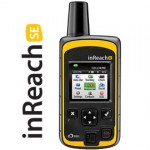
During the research process I found three candidates:   Spot, In-Reach, and our existing Iridium phone.   All three solutions send tracking coordinates, send text messages and allow for tracking websites.  Here is how I compared the three choices.


Spot

Spot

Pros:  Has been used by many boats.  Price is cheaper.  200 a year for unlimited tracking and 500 messages.  Works with Spotwalla, a tool created by a motorcycle rider who is an avid Spot user.   This free service lets you embed nice maps on your own website.  When Spot hardware is turned off, the Spot website from the manufacturer shows no data.   Spotwalla wisely shows last location.  The Spot website is fairly ugly as an embed, especially the side menu of past data points. In addition, the webmaster can not control the default zoom.     So far we love Spotwalla and will be sending the programmer a donation.

Cons:    Spot can not receive messages but we have plenty of email access via Sailmail and satellite phone.   Spot is controlled only by the iPhone via Bluetooth, i.e. no keypad on the device; that is ok by me.  The only big shortcoming for us is that Spot coverage has some big holes.   However, our travel plans will keep us within the coverage range.   DeLorme is on the Iridium network and has almost no holes unless you want to hang out with polar bears and penguins.

USELESS FACT:   Why are polar bears and penguins never seen together?   Please answer using the comment feature.

GSTARcoveragemap 1009

inreachse_m01In-Reach

Pros:  Delorme (manufacturer) has a good tracking website but it is still inferior to the after-market Spotwalla.  Not sure why all the companies have poor websites.   I do concede that we are particular as we are embedding this in our front page.  In-Reach can send and receive SMS messages.  Two-way messaging is cool, but not critical for our set-up.   In Reach can be controlled by iOS and the front rocker switch.

Cons:  $300 per year (Unlimited tracking included in the price as are 40 messages per month).  A bit too pricey!  Fewer In-Reach users threaten the potential for cool updates and website enhancements.  Initial purchase price also higher.


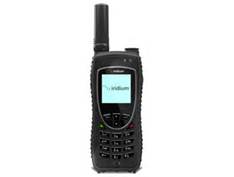
Iridium

Iridium Extreme

Pros:  We have the hardware already meaning less expensive and less clutter aboard.    Coverage region – almost everywhere as long as you are not trying to relive Roald Amundsens’s glory.  That is kind of where the pros ended.

Cons:  I am not sure the web tracking service is offered anymore.   It was sold under a few names and they all seemed to be turned off.   Bit of a deal killer?   I did see pricing on an old provider that cost more than the In Reach for very limited usage (4 fixes per day for $24 per month).   I am not surprised that the “charge more, get less” model drove them out of business.   The ability to embed the data, if it did work, seemed poor.  Seems like they are targeting truckers, not boaters.  Email us or post a comment if you are aware of a better Iridium tracking plan.

Gail is going to press me to buy Spot unless one of the clever readers can tell us where we have gone wrong.

Comments { 6 }

Boat Building Photos

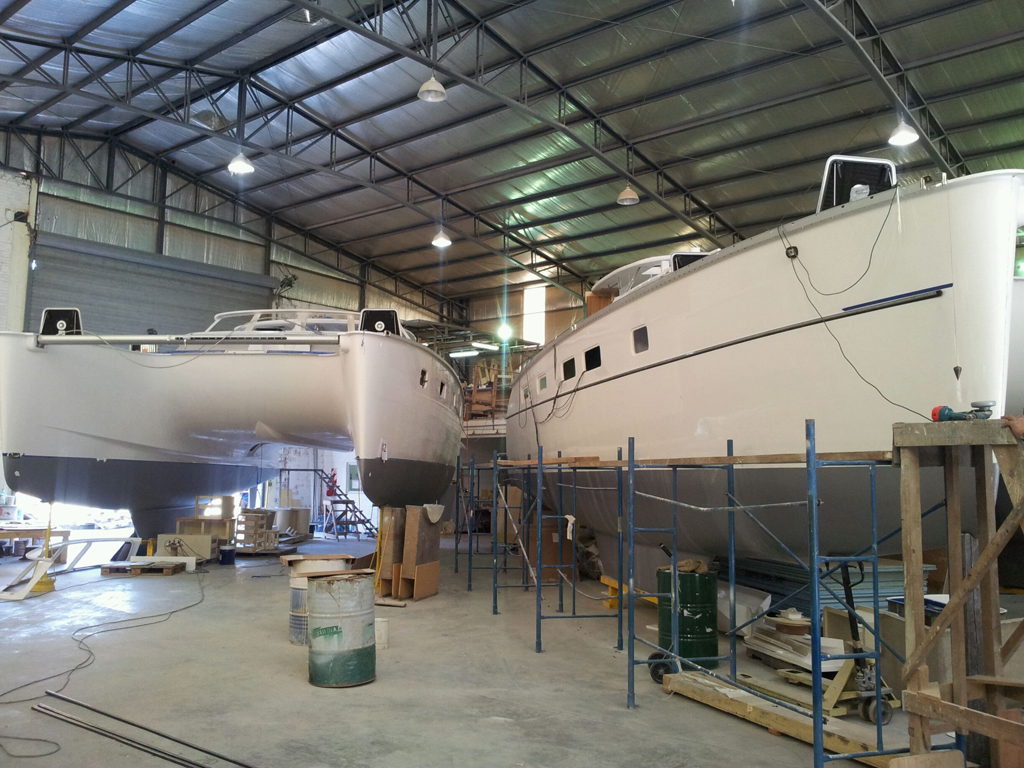
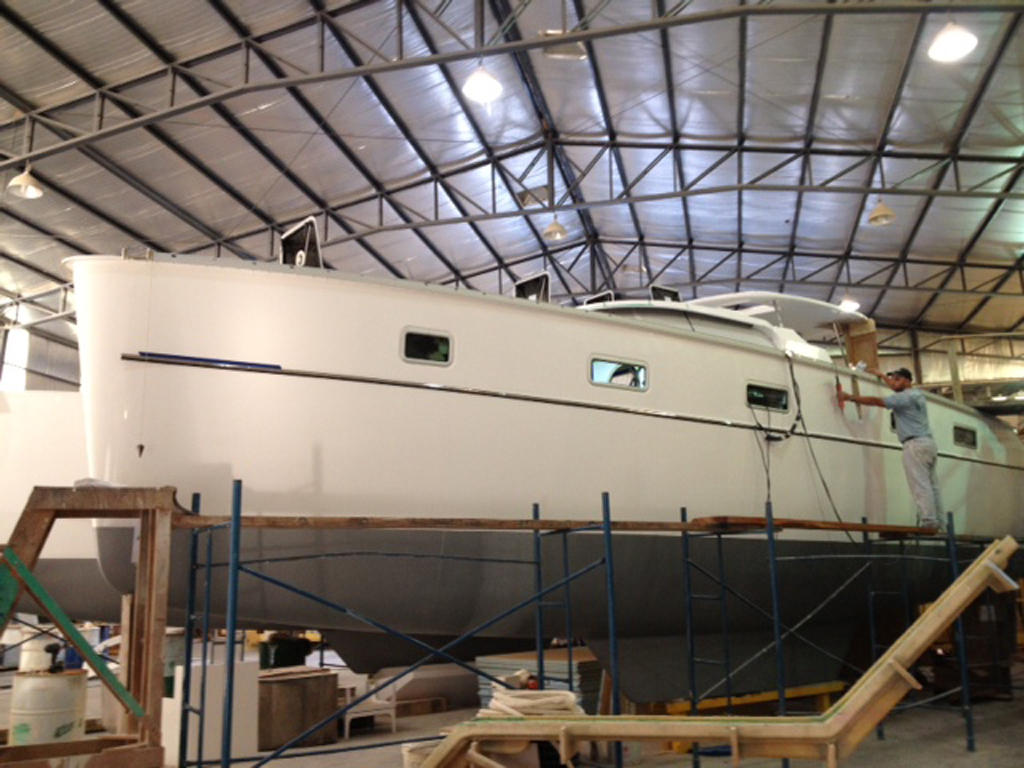
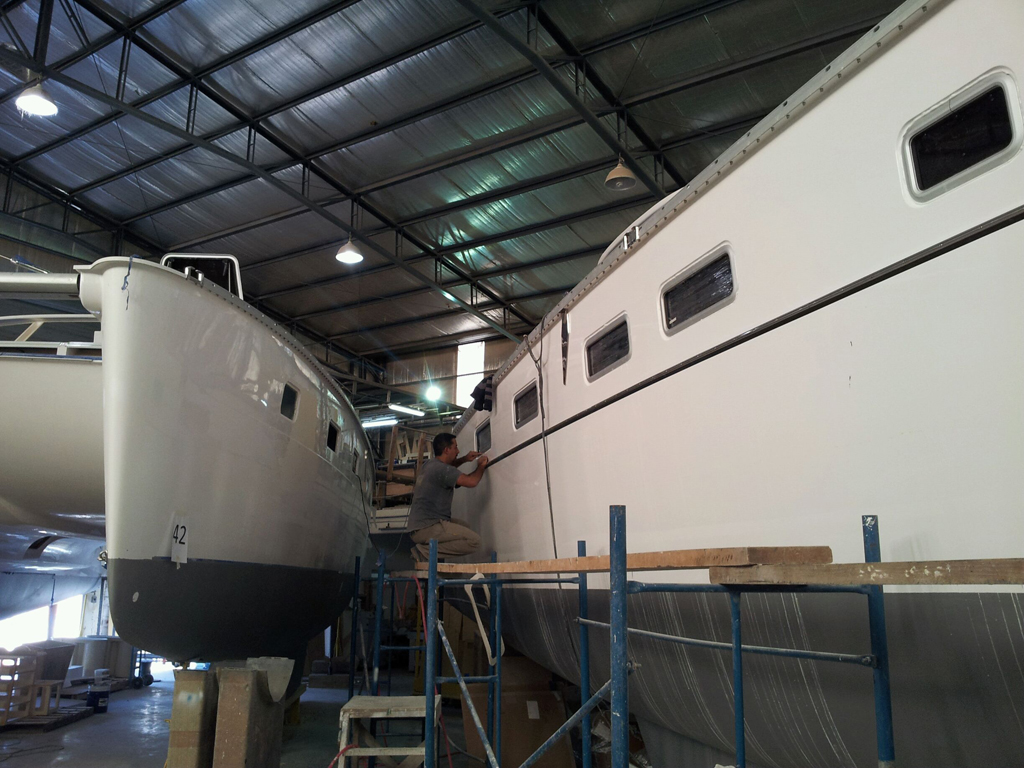
A few more photos were sent to us from Argentina today.   Progress!   We are eager to see the interior, which is a major time sink.  Hull #42 is ahead of us on the wiring and other interior work, but we are ahead on the cosmetics on the outside.

Here are some definitions of nautical terms used in the photo titles.

PORT

Port is left but a port left open is a window and any port works in a storm.

RAIL

Boats have rub rails and toe rails.   A rub rail is a metal strip that runs across the side to prevent docking dings to the hull.  Check it out on your car, you may have one running across the middle of the doors.   Toe rails are at the edge of the deck and serve a few purposes.   Firstly, they create a lip on the edge of the deck to prevent sailors from slipping off the boat.   They also are a great place to attach blocks and other sailing bits.

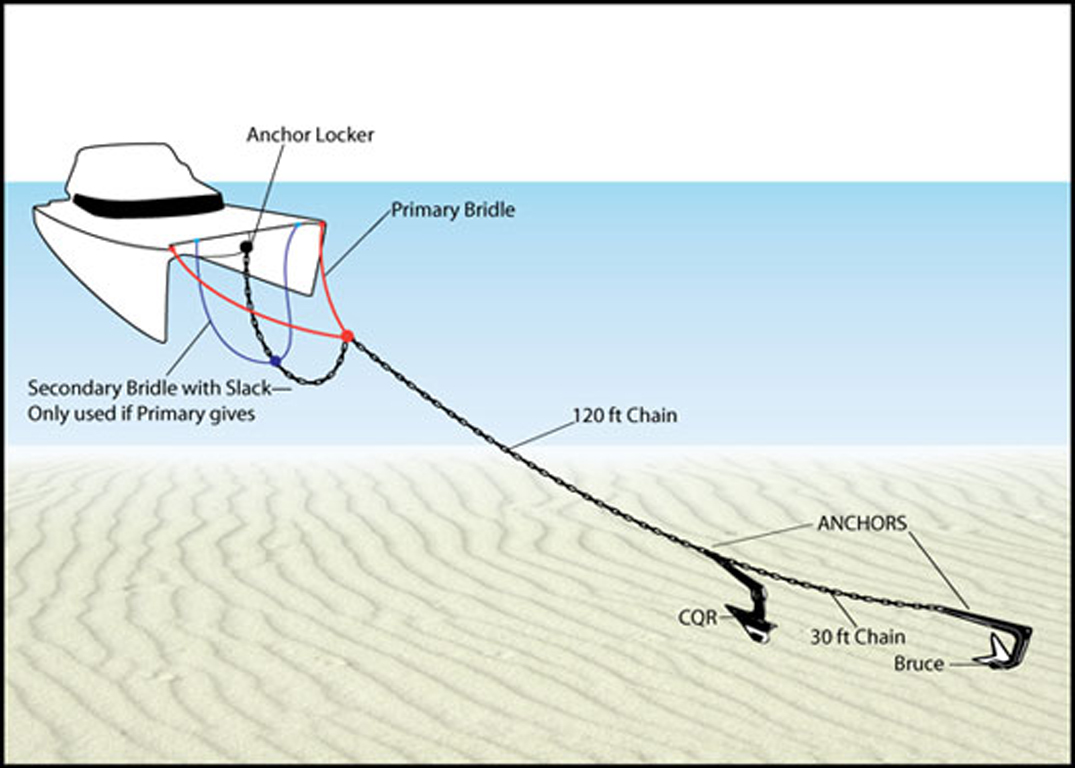
BRIDLE

Bridle DrawingAnchors hold boats in place.   There are entire books* written on the topic of anchors, but I will offer up the 4 sentence version  (warning: this is copy-written content of the Two Fish Corporation).  Anchors hold because: 1) the anchor sets (digs into the sea bottom), 2) the anchor chain  (anchor rode) provides weight to hold the anchor in place,  3) the anchor rode is a shock absorber, and, 4) when the anchor is set, there is an angle from the anchor to the boat (scope).   Scope is the ratio of anchor chain to the depth the boat is anchored in and reduces the strain on the set up.  More scope means your boat will hold better but will also take up more space in the harbor.   Many times sailors settle for 5 to 1.   So in 20 feet of water they have 100 feet of anchor rode.  Yikes, I am sailing and still having to do math!  The anchor rode is attached to a windlass which is on deck.  The windlass is a powered winch that helps raise the anchor. Did I mention that our anchor weighs 33 kilograms, not including the heavy chain?   Catamaran owners have a trick when it comes to scope.   Since the deck is 5 feet above the water,  to achieve 5 to 1 scope in 20 feet of water one needs 125 feet of anchor rode (5 * (20+5)).   The trick is that the bridle allows the anchor rode to be attached at the water line.   No need for the extra 5 feet and  now you only need 100 feet of anchor rode.   And there is less chance of taking up the whole harbor and “making” friends in the middle of the night.

Enough sailing lessons.  Enjoy the weekend.

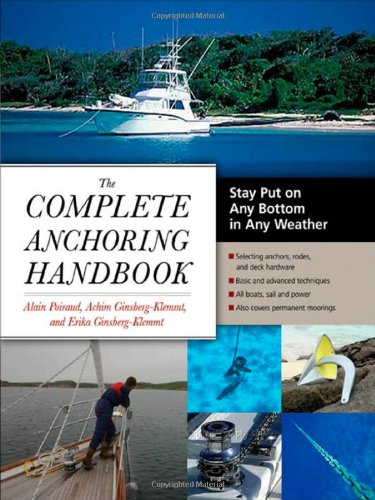
*  I read “The Complete Book Anchoring Handbook“. 

The Complete Anchoring Handbook


Comments { 0 }