Archive | Journal RSS feed for this section

Lobsterman

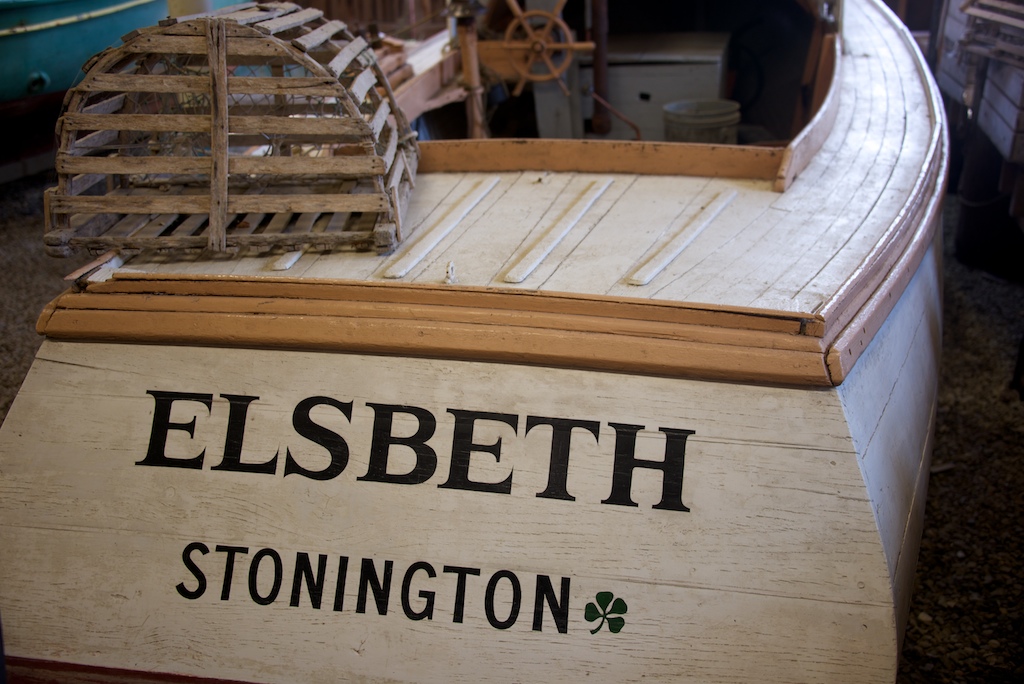
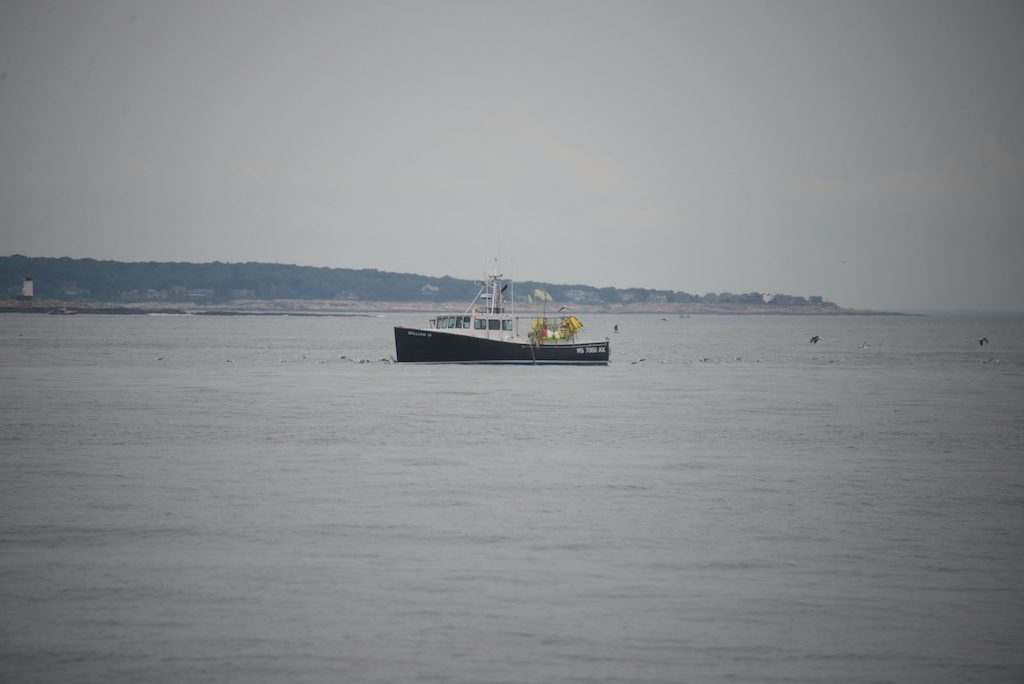
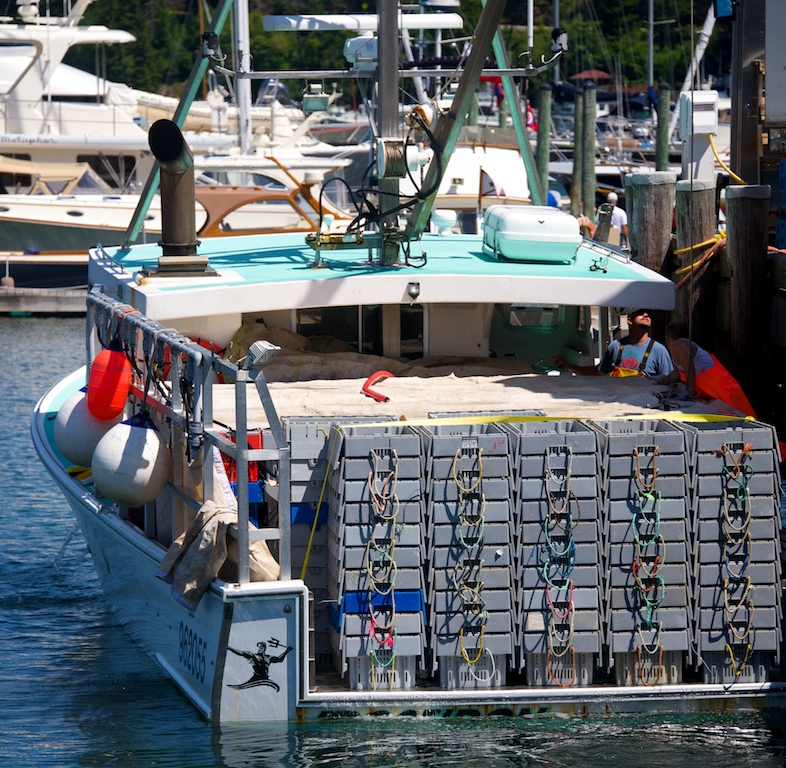
A large lobster fishing boat

A large lobster fishing boat


New England’s most Northern state could be a separate country.   Mainers are self-sufficient.   Maine lacks metropolitan centers and endless suburbia.   Instead, the state is dotted with small villages whose proximity is masked by the rocky coastline.  The  lobsterman was created by Maine’s landscape and history.  Lobsters flourish in Maine because of the ideal combination of a rocky bottom, cold water and forward thinking fisheries policies.   Fisheries rules require lobsters to be tossed back based on certain sizes and whether they are carrying eggs.   Lobster bodies are measured when caught and must be between 3.25 and 5 inches.   However, if you ask a lobsterman if a 10 pounder is tasty they may accidentally reveal they kept some above the size limit.

Lobsters have their claws banded after being caught to prevent cannibalism.   I suppose even lobsters know that lobsters are tasty.

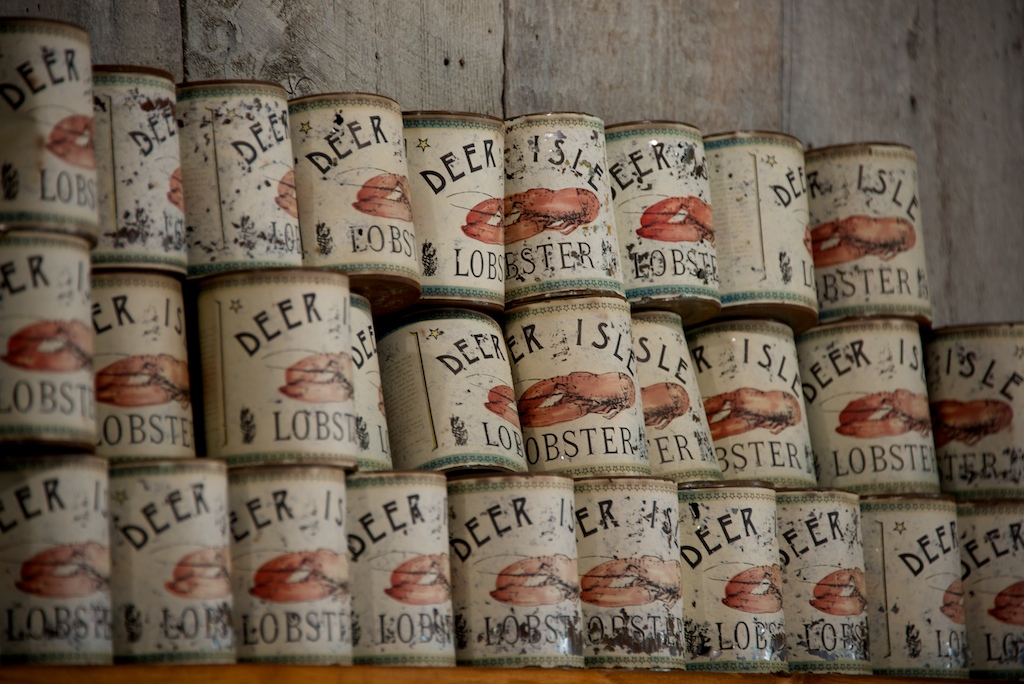
Initially, Lobsters were not considered a delicacy and were only eaten by locals, not gourmands.  The first major advancement in expanding the transport of lobsters was a “well smack” that circulated  sea water into the tank holding the catch, keeping it fresh.    In the 1880’s, the canning of lobster became the primary output for the catch.  But by the 1950’s lobsters, were flying cross-country and Californians could eat real lobster instead of spiny lobster.

To get a license to fish for lobster, you need to do a two year apprenticeship.   Also,  you need to own a boat and traps and do the fishing yourself.   These rules prevents large corporations from buying a fleet of boats and hiring captains.  The maximum number of traps a lobsterman can work is 800.   After the apprenticeship, the aspiring lobsterman might have to wait years for a license as some regions require three lobsterman to retire before they issue each new license.

Lobster fishing encomasses a few steps:

1) Baiting the trap with crab, herring or something else stinky.  Note:  Do not moor to leeward of a lobsterman baiting his traps.

2) The bait is placed in the Head (first half of the lobster trap).   The lobster will enter the Head but is unable to back out so they proceed to the Parlor where they are trapped.   The Parlor also holds a brick to keep the trap on bottom of the sea.

3)  The Parlor has an escape hatch for small/young lobsters.   Lobstermen claim the escape hatch is to protect the youthful lobster but I see something more sinister.   They are trying to teach lobsters at a young age not to be fearful of the traps.   Then, when the lobster grows larger, he realizes the lessons of his youth were all wrong.

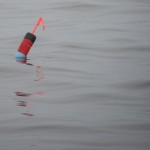
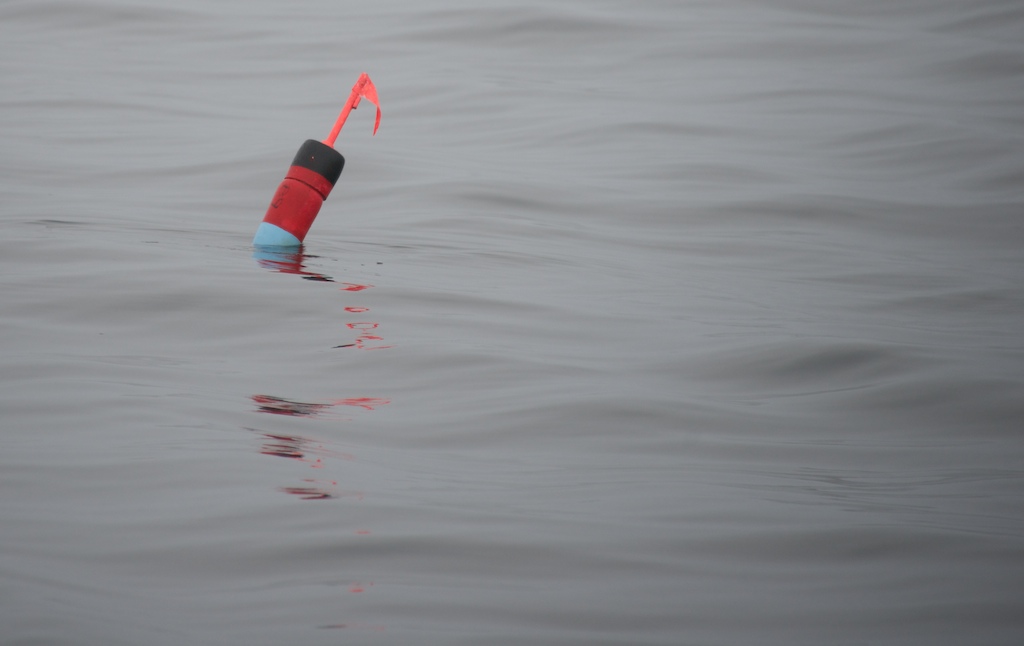
3)  The traps are laid and then, 48 hours later, the traps are picked up.  The traps are marked by a buoy with a unique coloring scheme associated with the lobsterman.   One to three traps are attached to each buoy.


Hope you enjoy E.B. White’s take on the Lobsterman. Also, if you would like to learn more about Maine’s history, Gail enjoyed reading The Lobster Coast: Rebels, Rusticators & the Struggle for a Forgotten Frontier, by Colin Woodard

Lobsterman by E.B. White from Two Fish on Vimeo.

Comments { 0 }

One Fish and Crew Motor Up the CT River

Two Fish is out of the water so we can fix our propellers.   A few days ago, we were in the middle of the mooring field when I realized that our engines could only run in reverse.  This was not my most relaxing moment, but we had a bit of luck and wiggled out of the mooring field using only reverse-sorry, no video.    We could see that the throttles were shifting the transmission, the shaft was rotating one direction in forward and the other in reverse, but the boat would only move in reverse, no matter which gear we were in.  We do not know for sure, but we think that the cause was the propellors not properly feathering.   To allow us to sail faster, our propellors twist to a low resistance position while sailing.   They also change orientation between forward and reverse.   This is very handy as it gives us more power in reverse.  If the prop gets frozen in reverse mode, then the boat becomes a beast to handle.   I will write a longer post on this when we have all of the facts.

Two Fish was hauled out of the water for further investigation.   The water in the Connecticut river is too brown and swift for good underwater work.   We hit a bit of bad luck when the boat was pulled out of the water.   The yard’s hoist operator managed to hook our propellor and damage the strut and shaft.   Our short visit on land became a bit longer.   “Let us make some lemon into lemonade.”  So Gail quickly arranged 1,000 things so our boat could get fixed.  Our friend Beth helped us buy a new strut.  The yard has taken responsibility and has been great as we added a few extra items (new bottom paint, clean topsides, check cutlass bearing etc…).   We have to wait 2 weeks for our strut so we have time for some fun.   We plan on exploring the Connecticut river and going back to NYC to prepare our apartment for a new, as yet unidentified, renter.

One Fish ready for a trip

One Fish ready for a trip

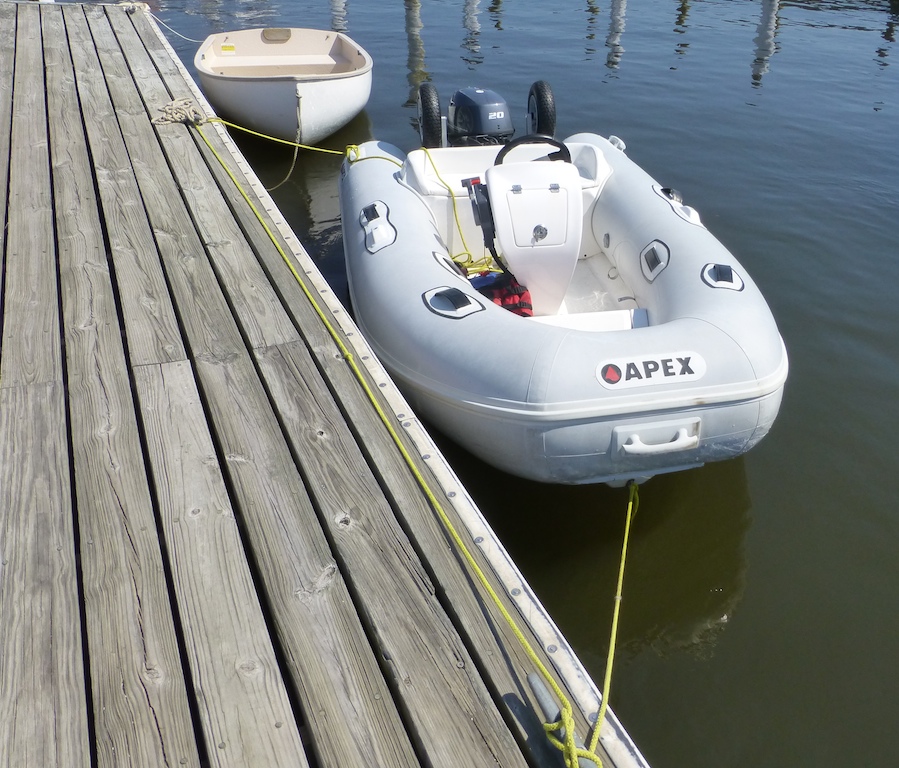
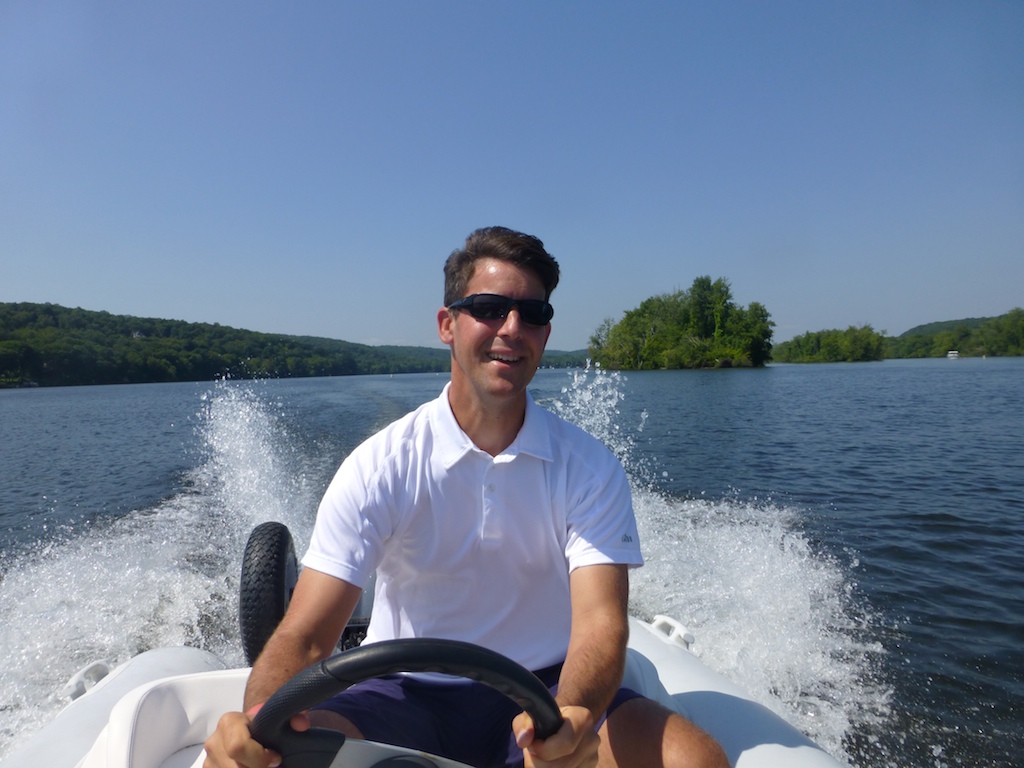
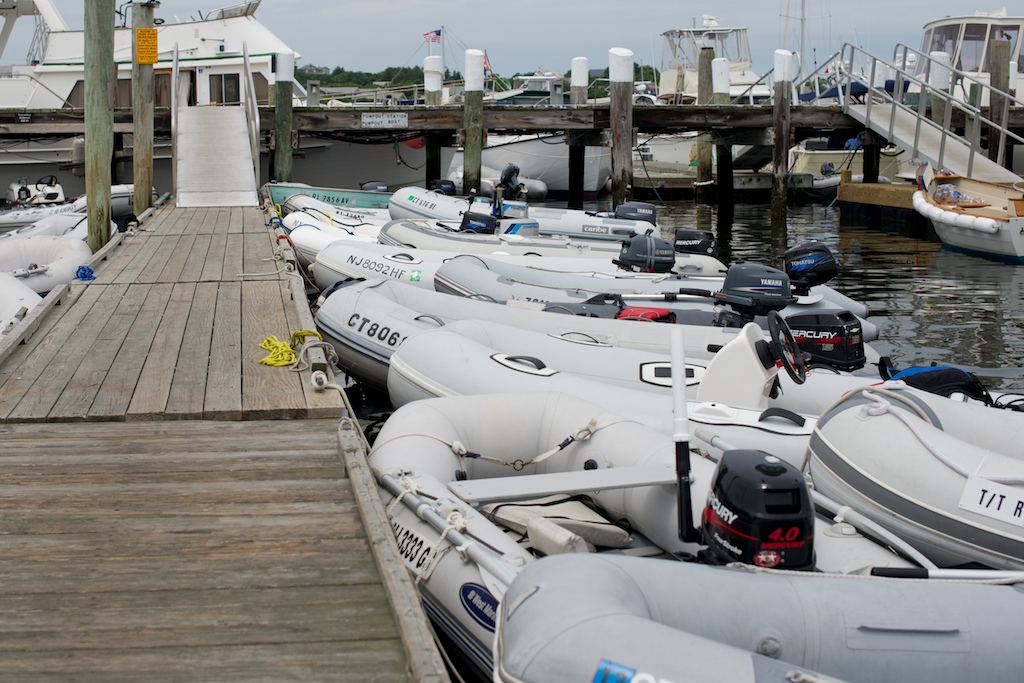
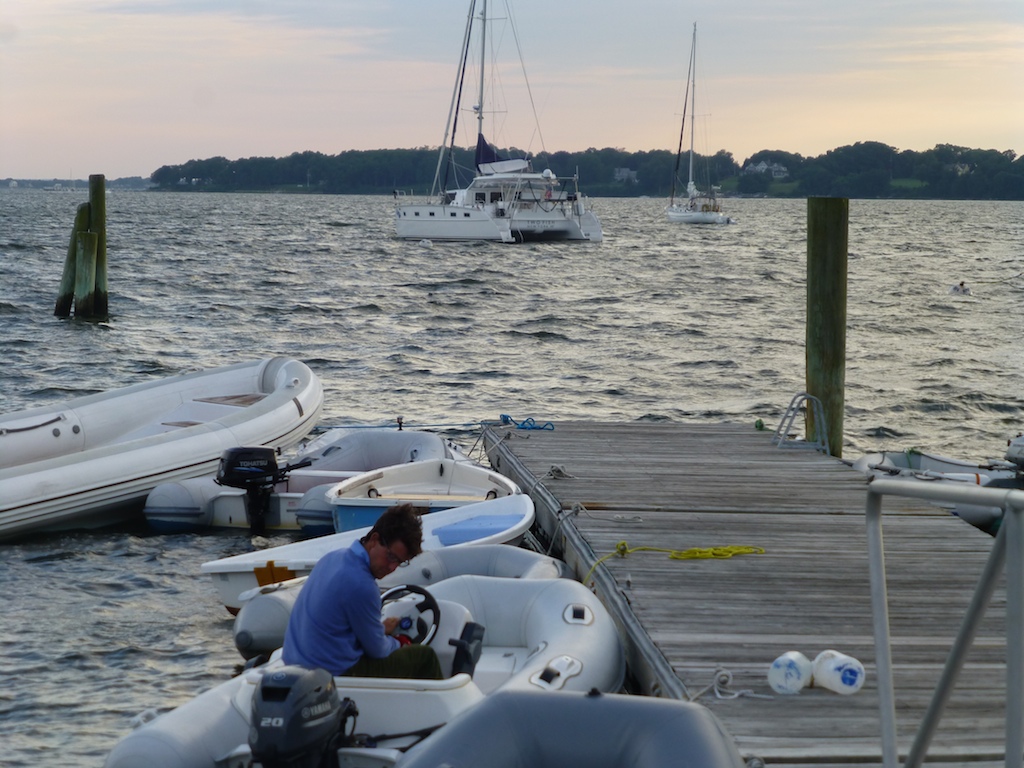
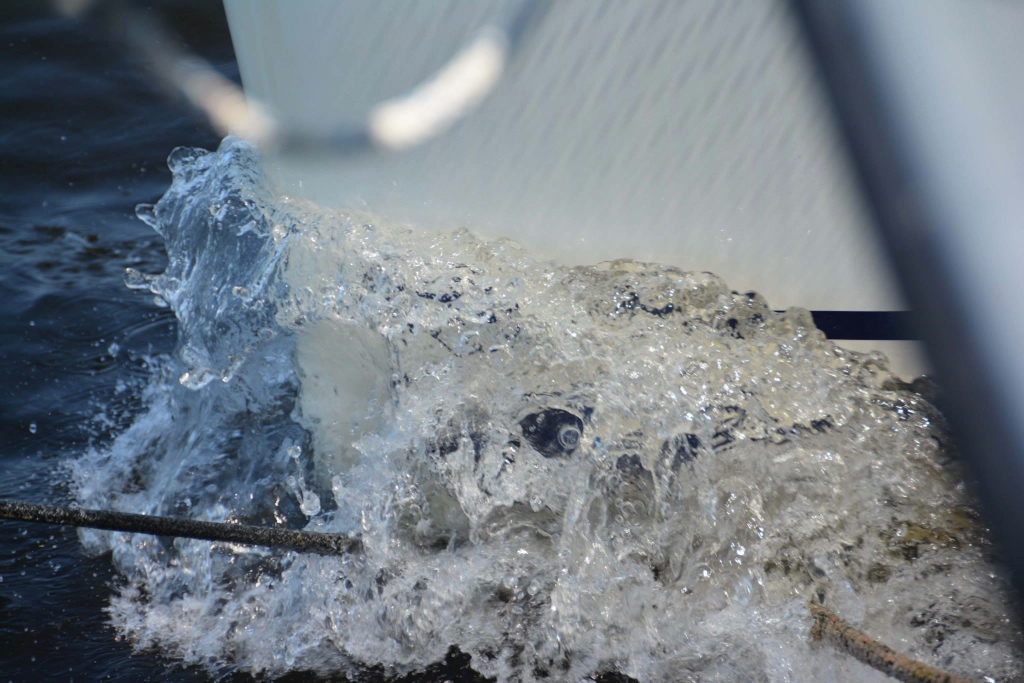
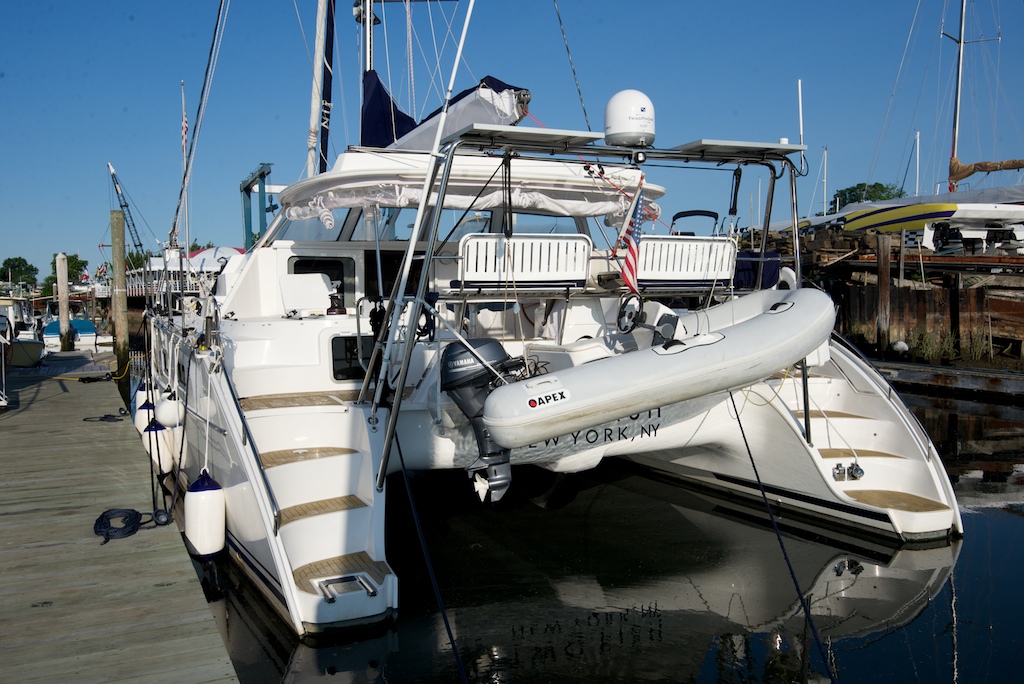
One Fish, our dinghy, was ready for a trip.  She has been idle recently since we have been in mooring fields and have ridden yacht club launches.  Makes coming home late at night (8pm) easier for the crew.   We have made some improvements and wanted to see how they performed.  We added a heavy duty fuel filter, installed wheels for beaching in the Caribbean, moved our fuel tank to the bow and did some general clean up.    The boat ran perfectly.   In flat water, under a helpful tide she reached a top speed of 20.7 knots.   You have to stay focused when you are at that speed-the next mark comes up quickly.   The removable wheels are prominent in the photos but do not impact travel while underway.

Max speed with twin rooster tails from wheels

Max speed with twin rooster tails from wheels

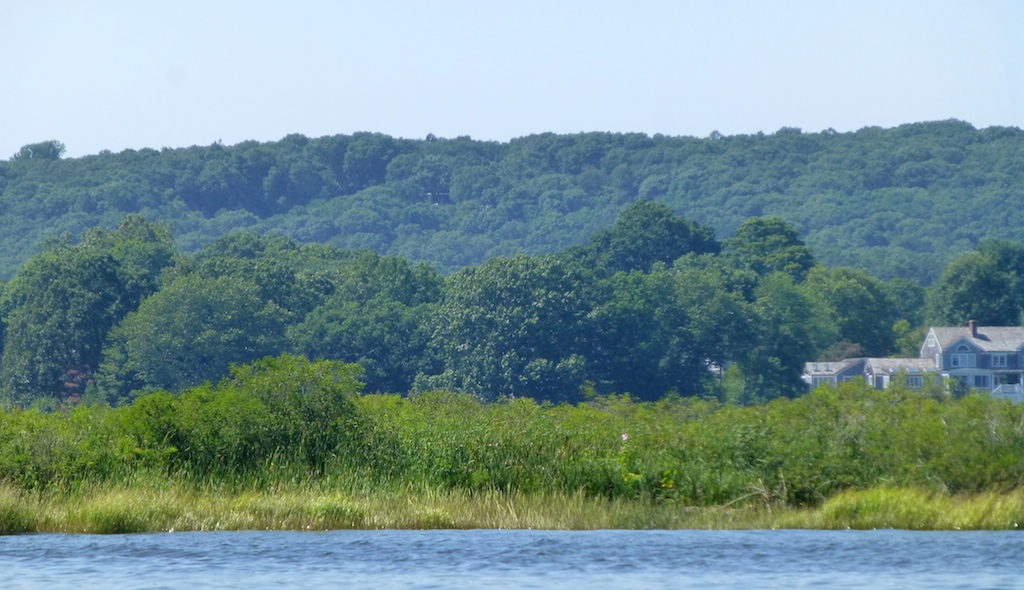
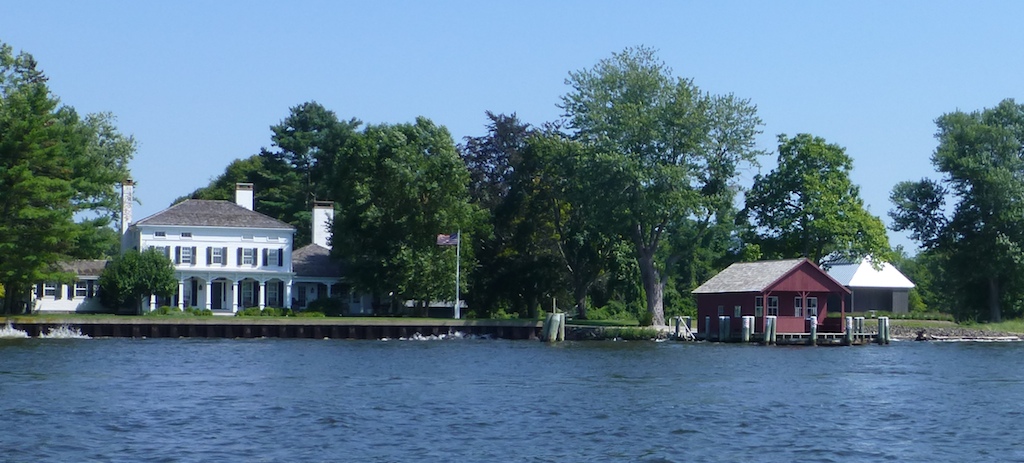
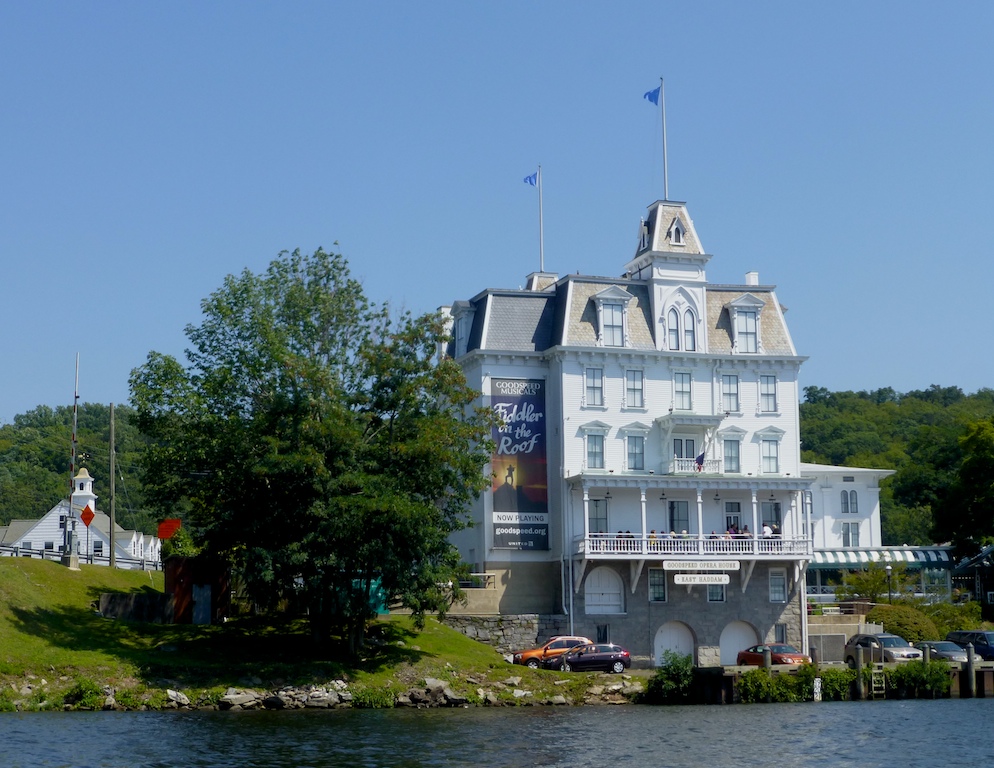
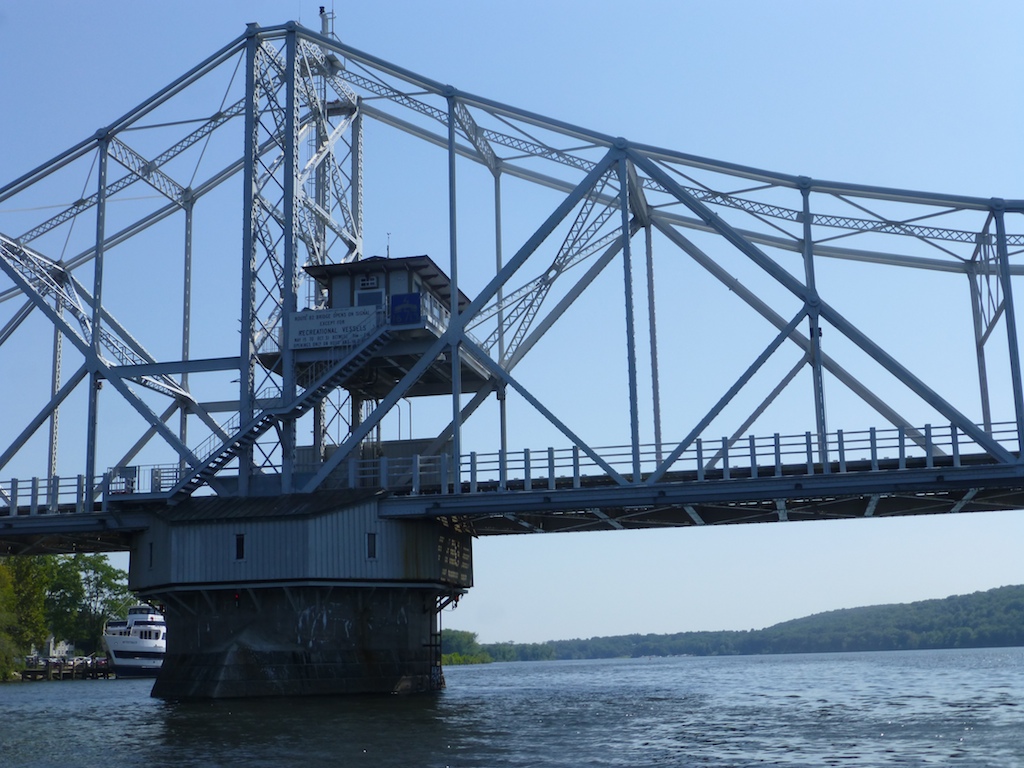
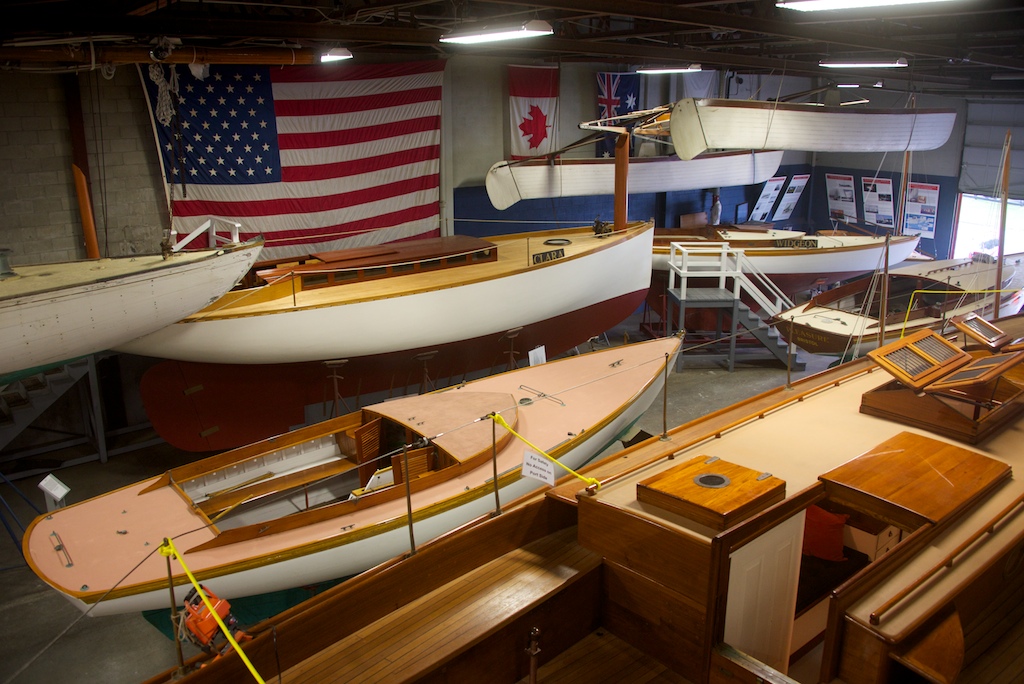
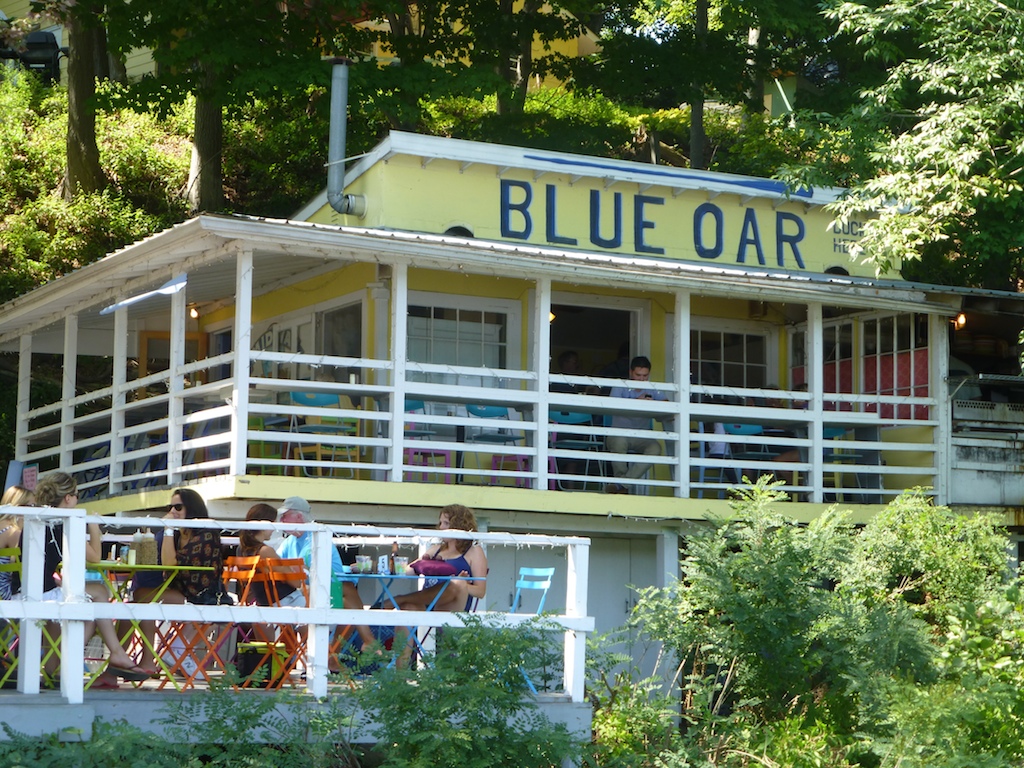
The river has a museum which taught us about the war of 1812, the industrial boom in the Connecticut River Valley, the steamships that plied the Long Island Sound and the 1970’s clean up of the river.  We spotted some of these features as we went upriver 10 miles to find lunch at the Blue Oar.   Not a bad place for a calm riverside meal.   Then we headed home at a good clip on mostly flat water.


Comments { 1 }

Avoid I-95 Traffic-Cruise the Long Island Sound


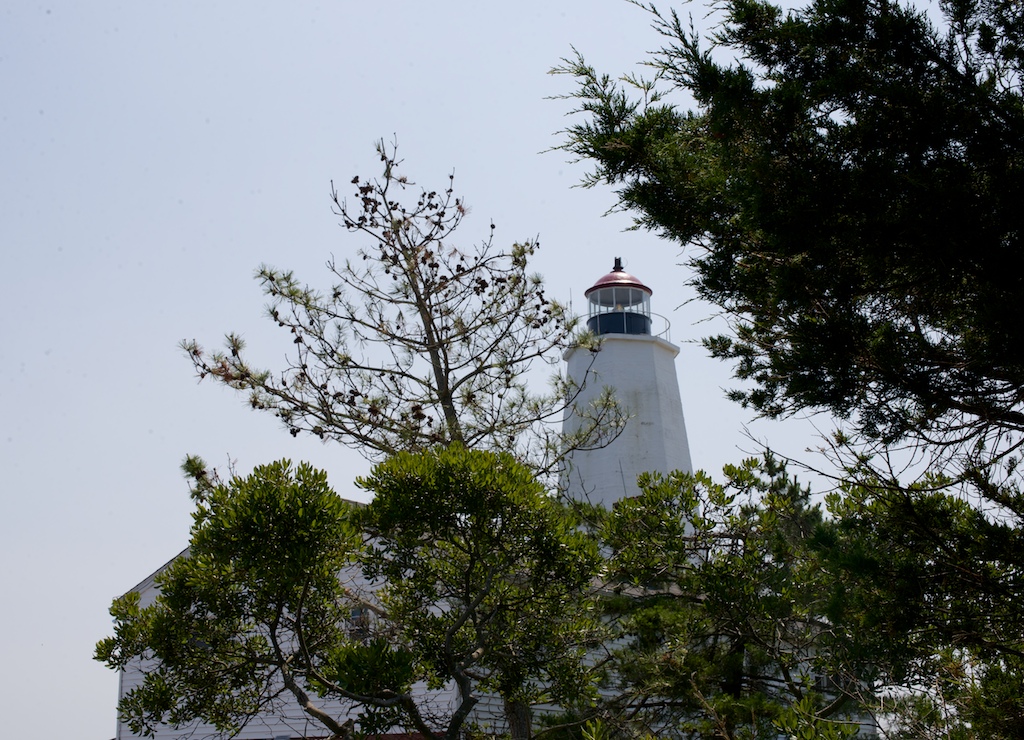
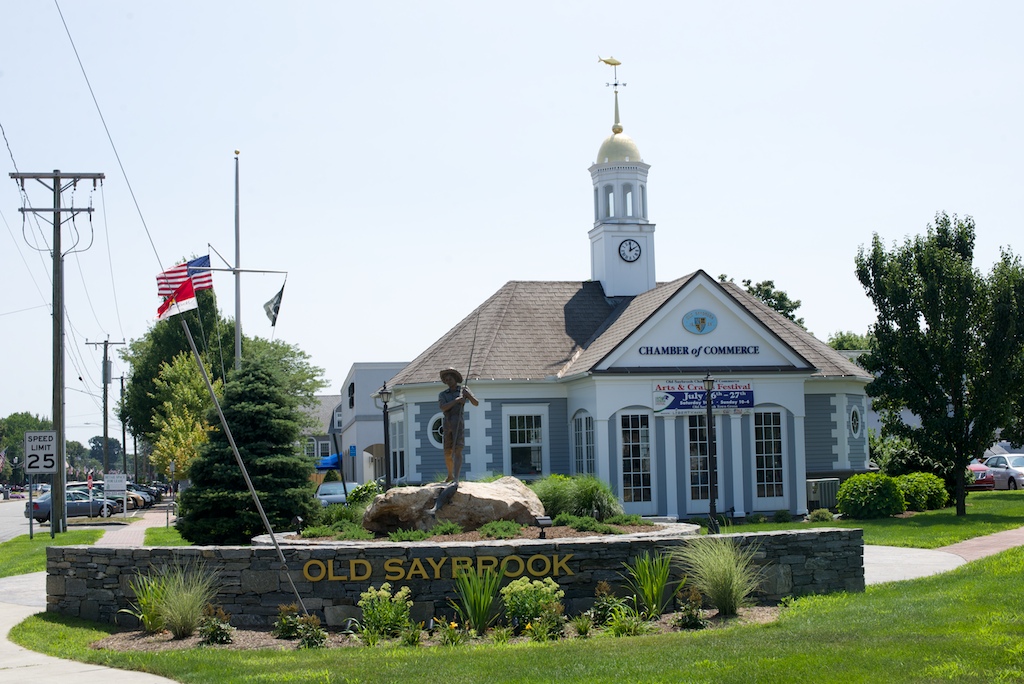
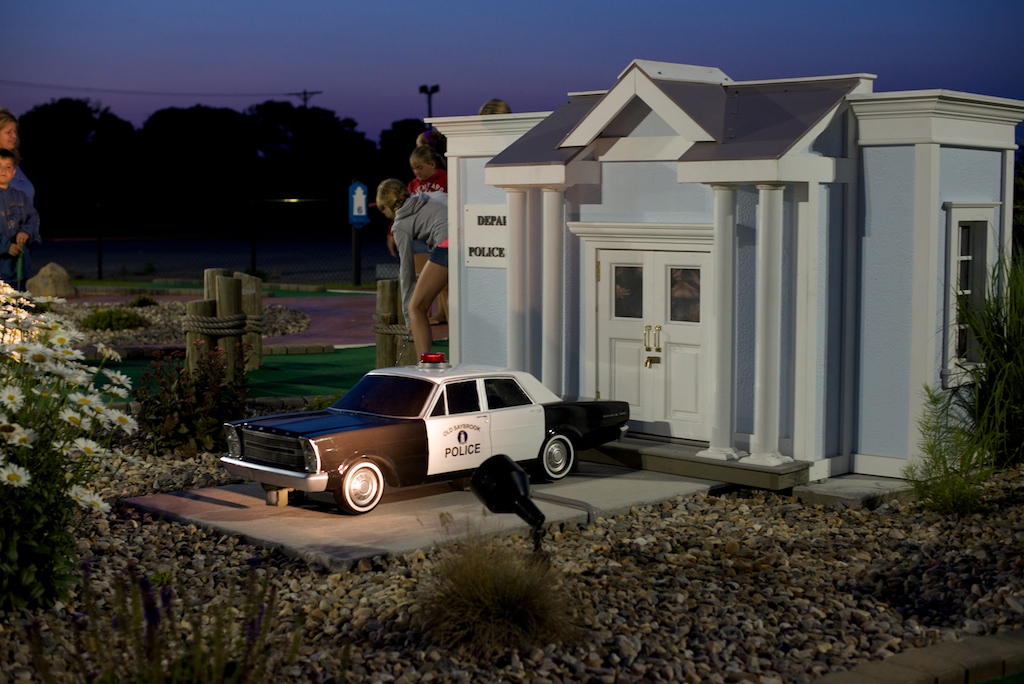
Except for requisite visits to Mystic Seaport,  Eastern Connecticut has always been a long stretch of I95. I hardly ever thought beyond the highway railings. So, when we took a bike ride around Saybrook Point, it opened my eyes to the wonderful towns that can be found along the way. The houses, waterfront and town were picturesque and our lunch at the Monkey Farm Cafe made us feel like locals. However, after suffering a crushing defeat in mini-golf, Jason decided it was time to leave town.

Earlier, when Jason had asked me where I wanted to sail to in the Sound, I didn’t hesitate before giving my response-Block Island. I had only heard of sailboat races around the Island and it was remote enough to seem exotic. My goal was reinforced by the serene pictures in cruising guides of boats moored in the Great Salt Pond. Our friends graciously offered us their mooring ball for a few days, and our course was set. We arrived in 20 knot winds-where did that sheltered harbor go?- and I scoured the mooring field for their ball. Hmmm, this is going to be tight. We used our much practiced technique of stern step pick-up but a combination of me being slow to bring the line in after attaching, Jason being slow to rotate the boat, and the brisk wind, resulted in the line getting caught under Two Fish. There we were, line caught in a rudder and Jason trying to steer with no rudders and one engine. Somehow he got clear of other boats and I sacrificed my fleece arm to the pond and freed the line. Attempt number two went much more smoothly and soon we were attached at both bow cleats and cleaning up the boat. After a visit from Beth and Dave, we headed to shore for a beachside concert and family picnic.

Having heard that it is a great island to bike, we stopped by the bike store, where we were greeted by the surly teenage attendants-the only time that I have visited a bike store where the people could care less about biking. We also decided that being only 44 feet away from each other all day wasn’t stressful enough, so we rented a tandem. Since there is just one chain being driven by the cranks, we needed to constantly communicate to keep from being hit in the ankles with flying pedals, while adjusting our positions, or trying to glide (me) on the downhill. We really enjoyed our time there, but Two Fish keeps moving and we headed to Narragansett Bay and the Herreshoff Museum in Bristol-free admission with your mooring fee!

Once again, we “discovered” a wonderful small town with revolutionary-era houses and a fantastic lunch spot. At the Beehive Cafe, they serve a great breakfast burrito, only to be surpassed by my post-dinner ginger ice cream at Gray’s Ice Cream. Since the Beehive was closing for renovations, we decided to move on and headed towards Pocassett Bay, sailing away from the Long Island and Rhode Island Sounds and into Buzzards Bay. Next stop: Cape Cod Canal.

Pocassett

Pocassett

Some bonus photos taken by our friend Elaine.

Comments { 0 }

Trailer Park Specailist

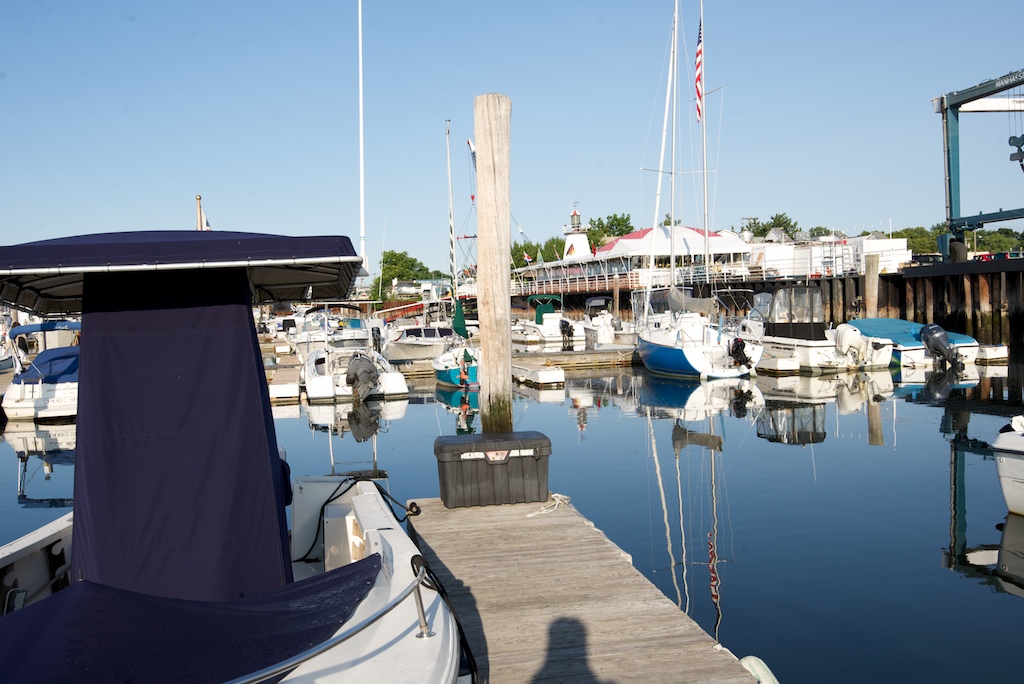
A friend refers to boaters who spend significant time in marinas as “trailer park specialists”.   After staying at a few marinas, we consider this to be a harsh and unfounded review.   After a few weeks in Port Washington solving our engine cooling engine issue, we have learned the pros and cons of marina life.   We stayed at the very pleasant Manhasset Bay Marina; the associated restaurant, Lamottas, filled our bellies more than once when the Two Fish galley was declared closed.

The first thing we realized about Northeastern Marinas is that many of the liveaboards have jobs.  People with jobs are a rarity when cruising the Caribbean.  Working liveaboards have many challenges that we do not face.   How to get to work each day.  How to keep your suit from being wrinkled.   Since they do not get to move their boats often, they focus less on fixing their running rigging and more on optimizing their water and power hook-ups in ingenious ways.   When Arthur (the Hurricane) was approaching,  I spent plenty of time adjusting Two Fish’s tie-down system but the veteran liveaboards did not flinch.   They probably had not untied since the last big blow.  [Tie down tips.   If you plan to test your engines at the dock while tied down make sure you are up to date on your insurance, the cleats are strong, and that multiple lines are doing the same job so as to spread out the load ]  Liveaboards  use bubblers to keep the hull from freezing in the winter.  They also get involved in Marina life by adding services or butting heads with management.  So don’t fall into the labeling trap – look at their lives through a different lens.

Odd dual anchor

Odd dual anchor

100 gallons per hr

100 gallons per hr

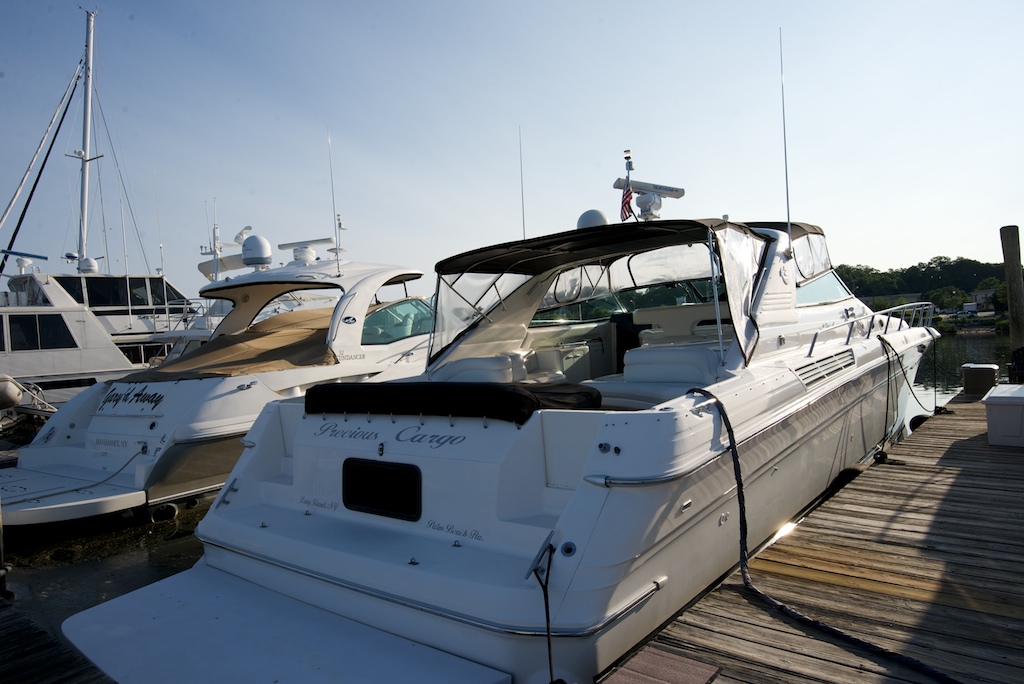
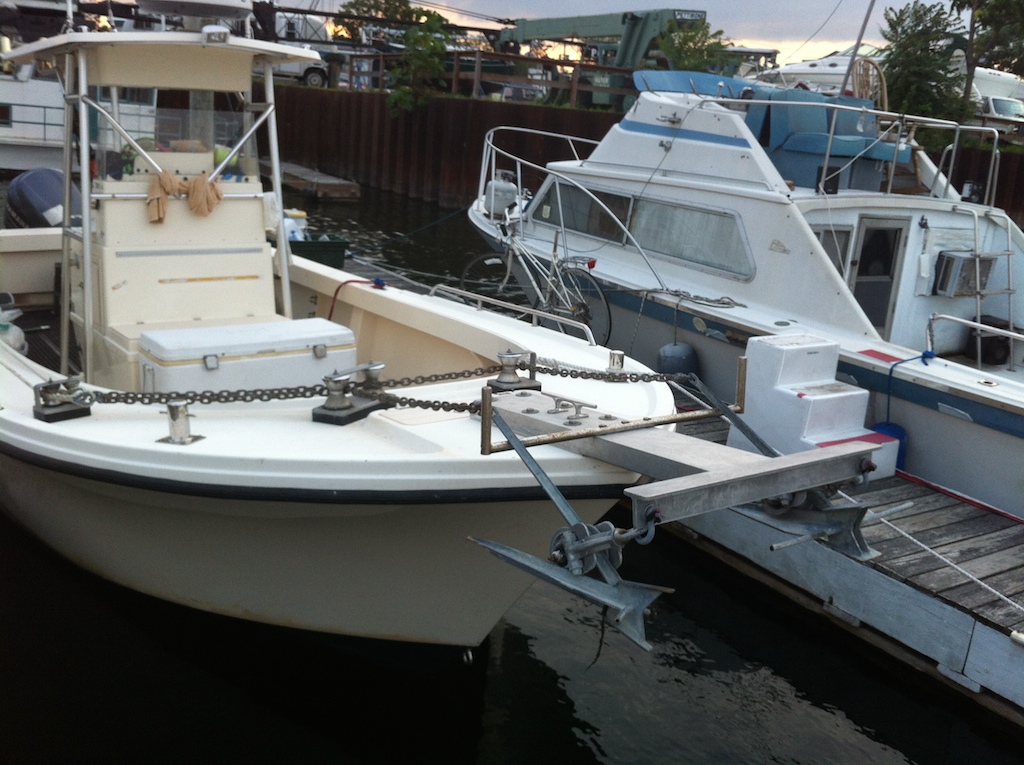
This is an oddity I discovered in our marina.  It is a runabout which had dual anchors led back to the helm.   I was impressed that the owner had rigged this complex set-up and would have loved to have witnessed it in action.   The local marine shop must have rolled their eyes when the owner came in to buy all the parts.   I also learned how much fuel motor yachts consume.   A nearby boat (right hand side) was owned by a very friendly family.  The captain (also Dad) told me that they burned 100 gallons of diesel per hour.   A simple 2 hour spin in the boat can cost 1,000 bucks!   Wow, Two Fish burned about 60 gallons on her last 1,100 mile trip.

Powered by Paddle Wheel

Powered by Paddle Wheel

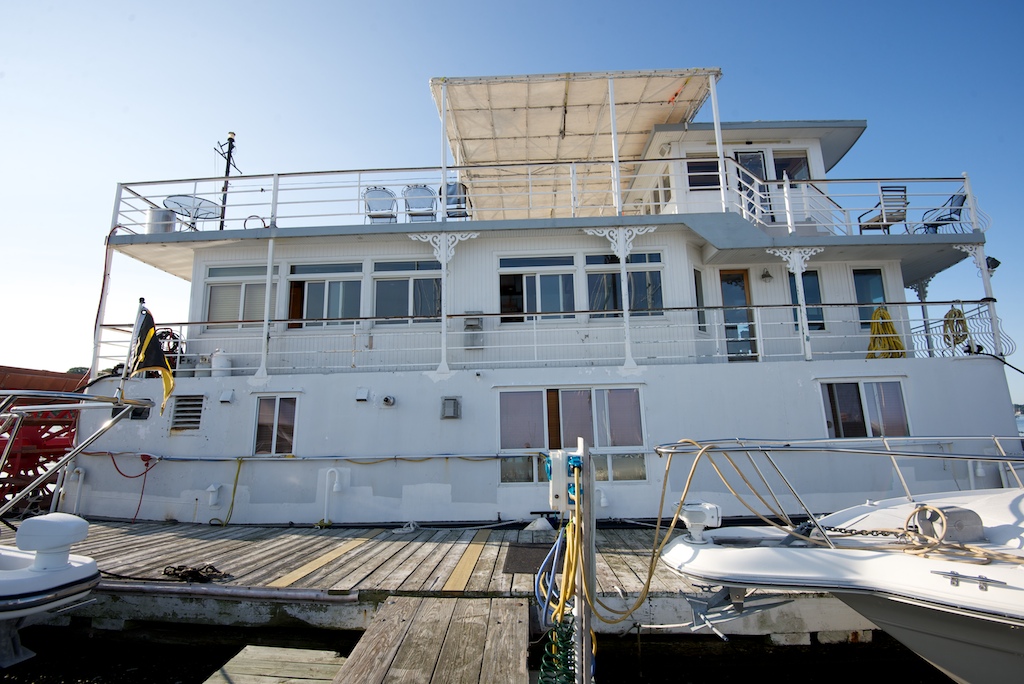
3 Story boat

3 Story boat


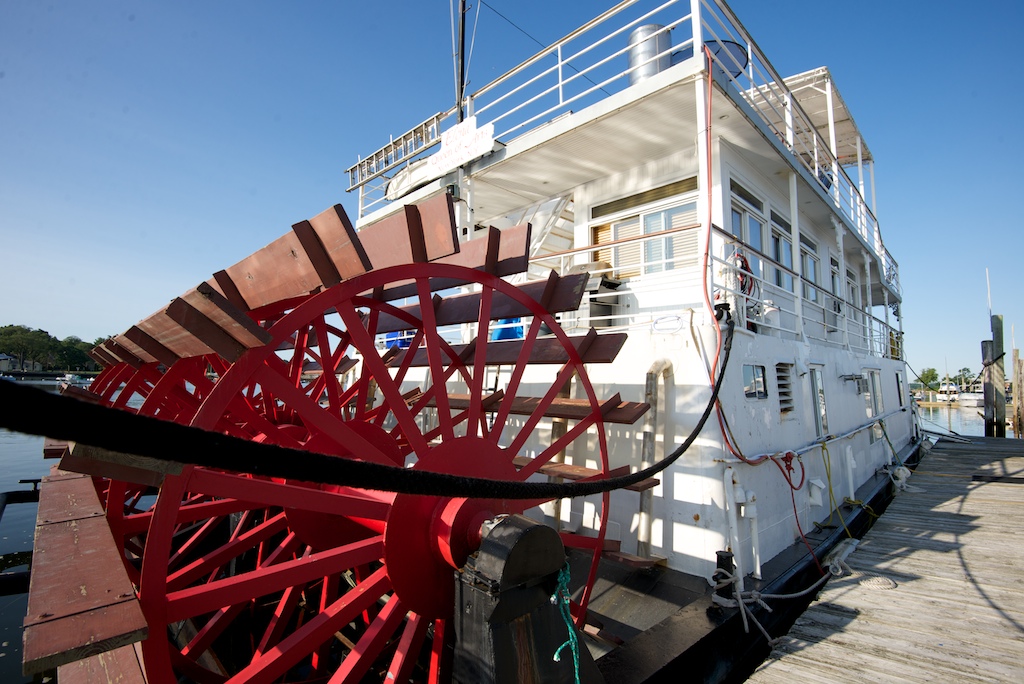
At the end of our dock in Port Washington, there was a 70 foot replica of a paddle wheel riverboat.   It was built in the 80’s for some rich guy.   The current owner does the sound and lighting for a popular Broadway show.   He moves the boat every year.  The paddle wheel has much more square footage than an average home.    She has been in the open ocean once when coming up from Baltimore.   Theocean trip was done with much trepidation and the utmost care for the weather as large waves would easy come over her low freeboard.


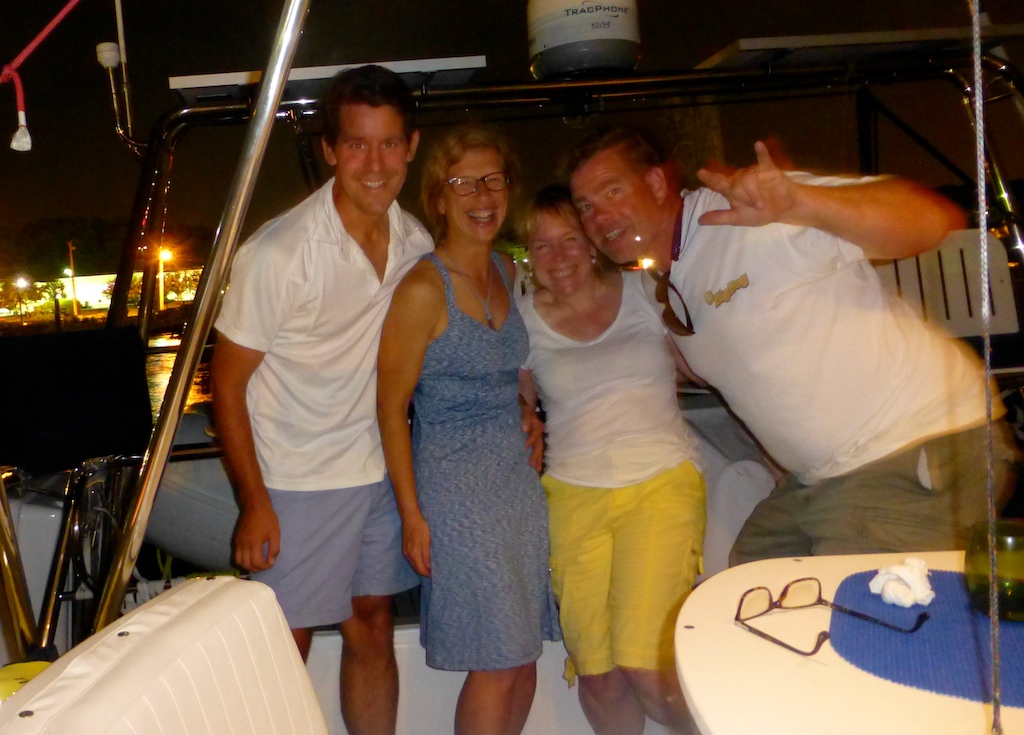
Lars and Alison

Lars and Alison

Stair master for exercise

Stairmaster for exercise


We made fast friends with our liveaboard neighbors.  They had a full size stairmaster and rowing machine aboard.   I still can not understand how the stairmaster does not topple over in big waves while underway.   Our neighbors leave the dock about six times a year.


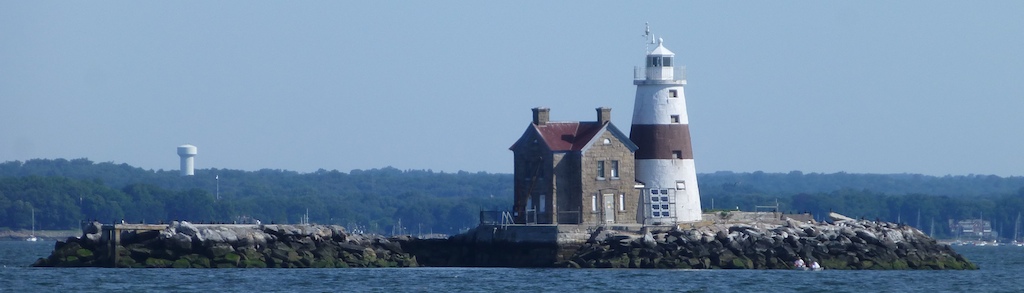
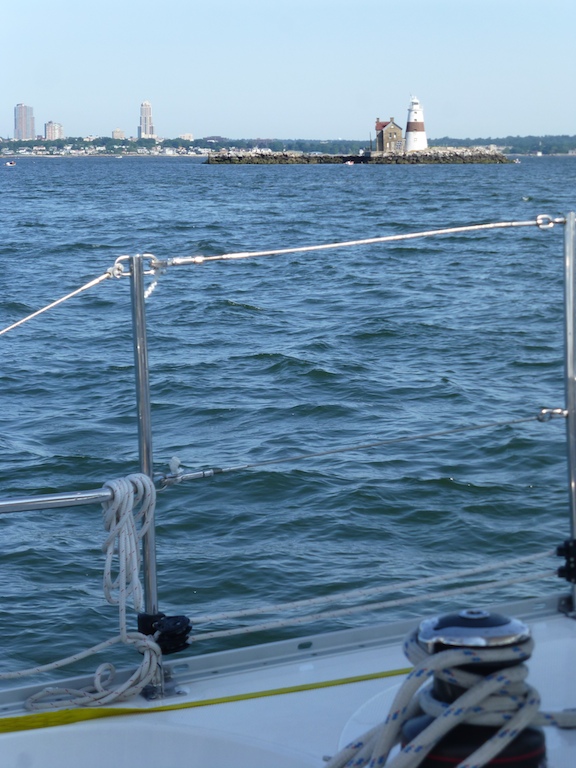
When we finally got the engines running, the grass on the sugar scoop indicated we were overdue for a passage.  We did a short hop across the sound to Westport, Connecticut.   During the early part of the trip we passed Execution Rocks, which are allegedly named after cruelties committed by the British during the Revolutionary War.   The poor patriots were chained to the rocks at low tide and killed by the rising waters.   Not sure whether it is true, but the story gets my patriotism boiling.

Execution Rocks

Execution Rocks


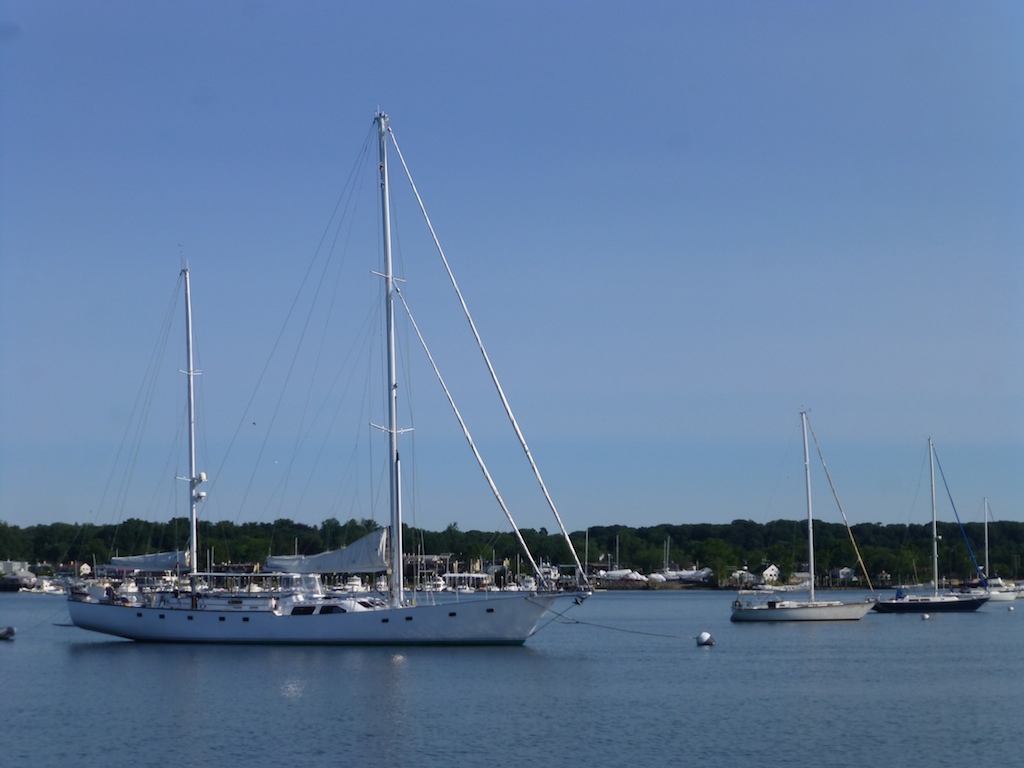
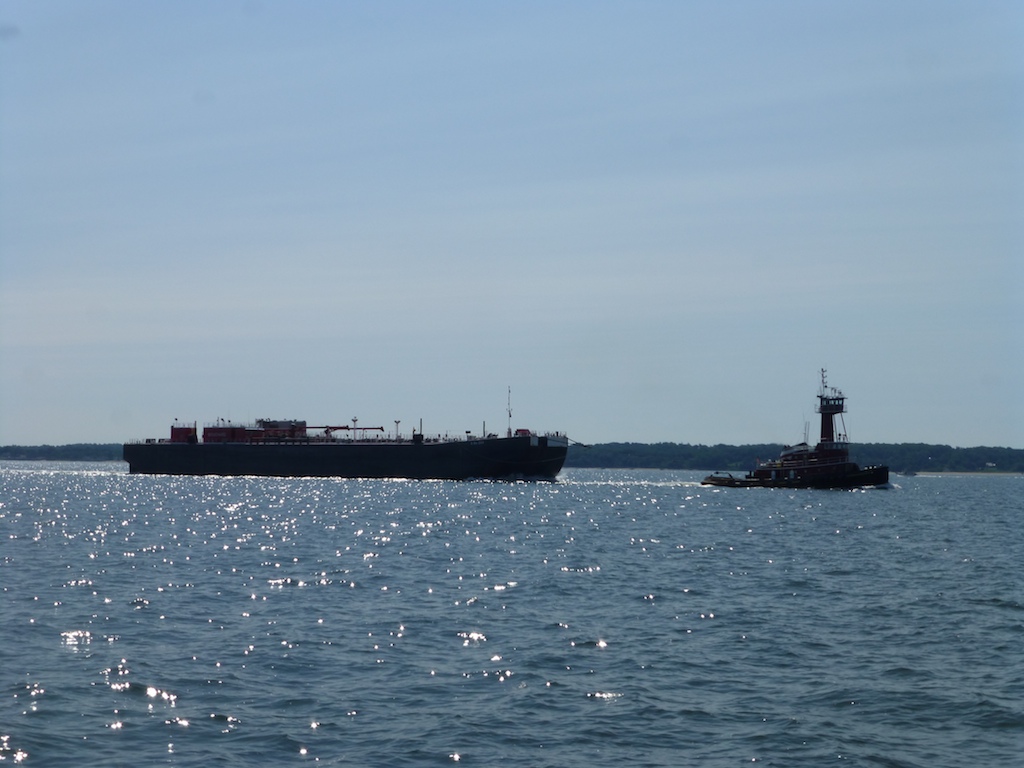
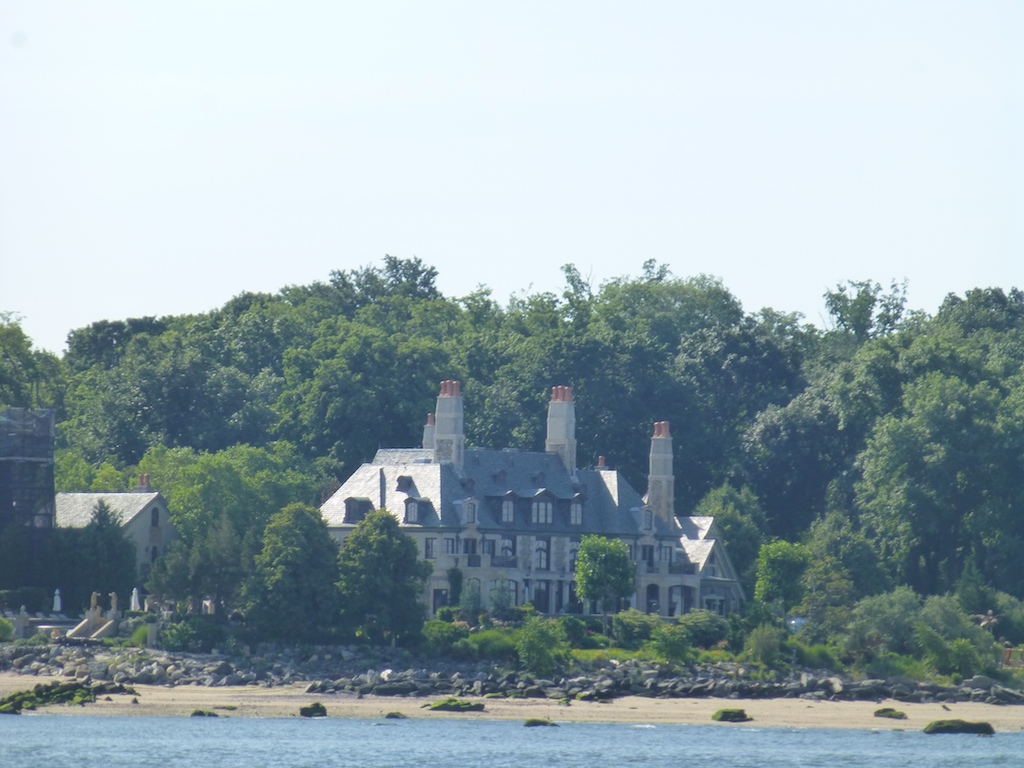
Some photos from the cross-sound trip.  Taking photos from aboard is very tricky.   The vistas are huge and you are trapped aboard.  I need some photo tips!


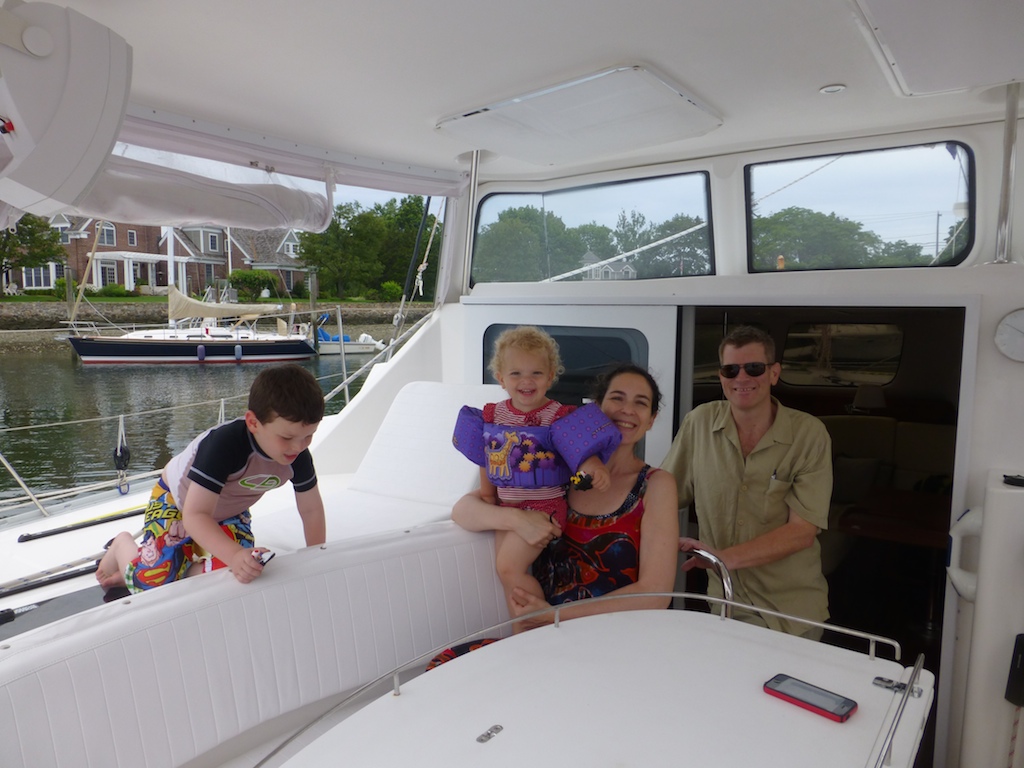
Westport is a town we knew from “our old life” and it was a treat, as always, to have some visitors stop by.


Comments { 0 }

Manhattan Yacht Club Speech: Part 3 of 3

This is the end …


MYC Speech Part 3 of 3 from Two Fish on Vimeo.

Comments { 1 }

Manhattan Yacht Club Speech: Part 2 of 3

Part 2 of 3 is ready. After this you will be in the same location as you are with the Hobbit: 2 parts watched and waiting for part 3. In both cases wondering – did it really have to be that long?

MYC Speech Part 2 of 3 from Two Fish on Vimeo.

Comments { 1 }

Boomerang Kid?

During the past few years, I have read several articles about “boomerang kids”  who return to their parents’ house after college or a brief career and don’t seem to move out. After borrowing my Mom’s car for a week and doing several loads of laundry, I couldn’t help but wonder whether that moniker might apply to me.

Don’t worry, we didn’t move in, just had bagels & lox and shared some good meals. It was great to show off Two Fish to the Long Island crowd.

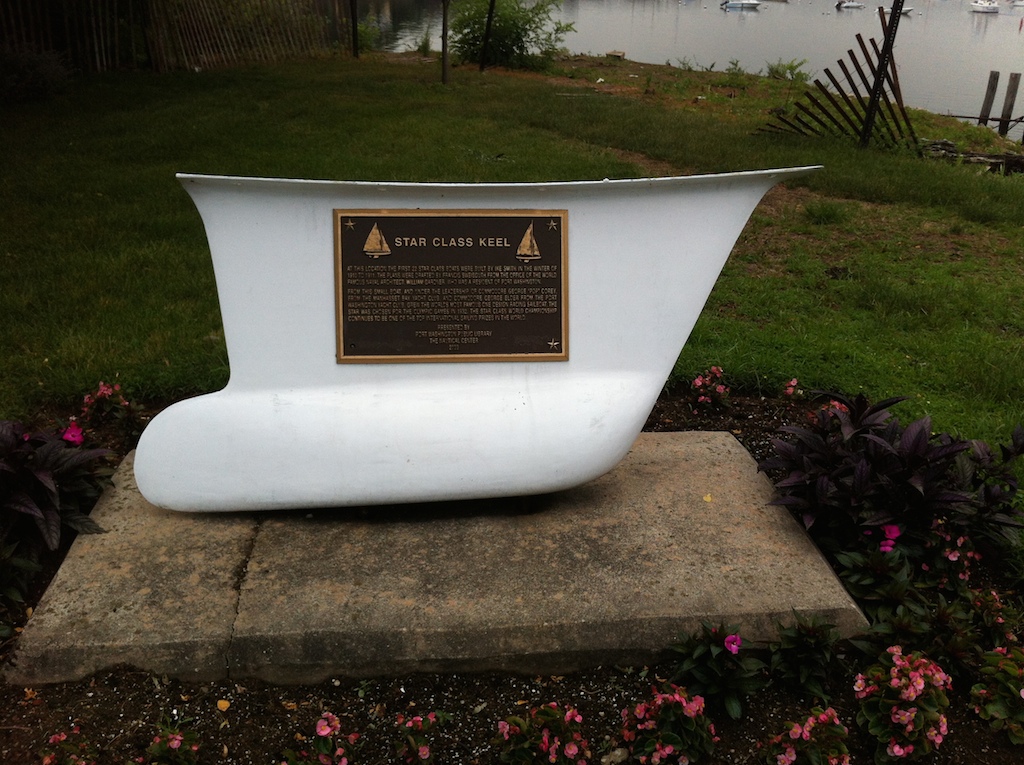
Since we were going to stay in Manhasset Bay, I thought I should re-read The Great Gatsby. I wondered whether the 14 year old, who read it many years ago, really picked up on the characters’ relationships and lives. We are currently near fictional East Egg but I grew up in fictional West Egg. The only change has been the arrival of a Bare Burger restaurant. Manhasset Bay’s other claim to fame is as the birthplace of the first Star.  This mono hull has been captained by almost every famous sailor.   Lowell North, the founder of the company that made Two Fish’s sails, won a gold in the 1968 Olympics, racing a Star.   Brazil will be the first Olympics in many years without the Star class.   Jason objects to the decision to replace this classic with a more modern boat.

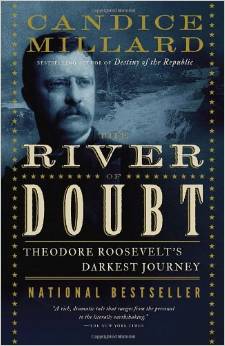
Continuing in my thematic reading, I just finished The River of Doubt. It is an interesting tale of Theodore Roosevelt’s journey through the Amazon, across unknown territory, down a dangerous river. He started the trip after being invited to Buenos Aires. I can safely say the similarities in our journeys end there. Having just finished the book we decided to visit Sagamore Hill , Roosevelt’s home in Oyster Bay.

Sagamore Hill

Sagamore Hill

Comments { 5 }

NYC Welcomes Two Fish

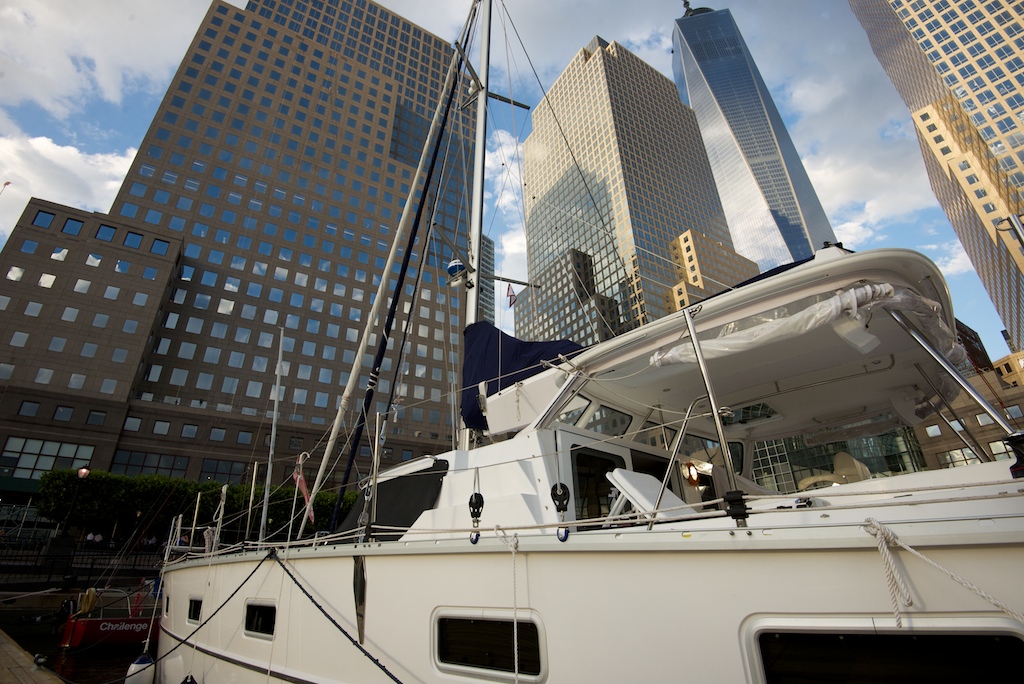
Two Fish dwarfed by Midtown

Two Fish dwarfed by midtown

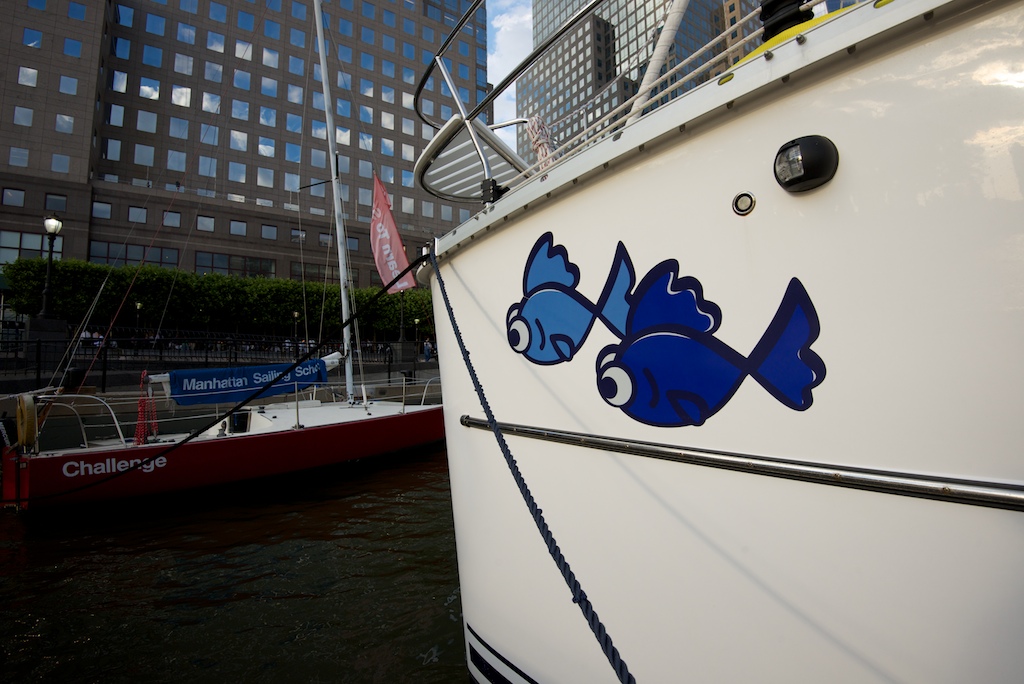
We stopped by our hometown NYC and decided to splurge on a few nights at North Cove Marina, located near the Freedom Tower (ex -World Trade Center).    We had many visitors and it was a real treat to see our long-lost friends.   We left as quickly as we arrived because the swell from the passing ferries is jarring on the boat and the dockage fee is jarring on the wallet.  What a luxury it is to walk off the boat and have Manhattan food choices.  No offense Long Islanders, but your towns will not be a match for NYC.

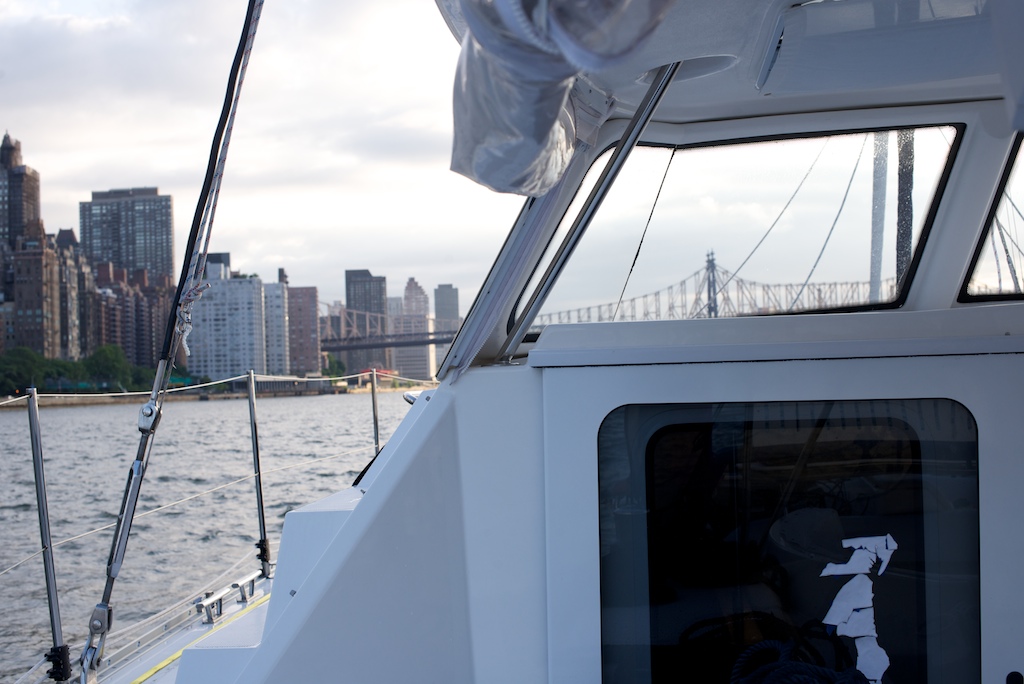
We left the Battery two hours after low tide to enjoy the strong flood through the East River.   Our speed was 9 knots at one point with both engines at only 1,400 rpm.   Over 4 knots of current assist – was it worth the 5am wake up?

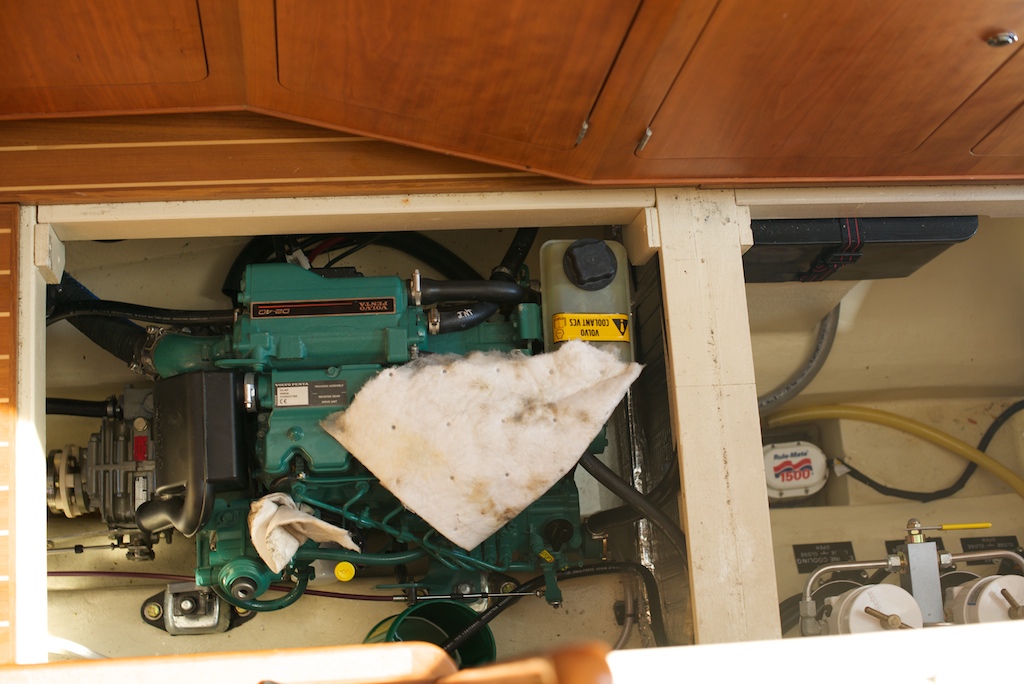
The engines have been quirky so we are still working on removing the gremlins.   Serves me right for having a professional Volvo mechanic come to work on them in Florida.  The fix will be easy but we will need to go through the process of elimination.   Could there still be an air pocket in the coolant system after all the bleeding we did?   Or is there something in the heat exchanger with no damage to the impeller?     Good news – the engines worked for many hours on the trip up from Florida.

Today’s trip was emotional.   During the 2 year wait for our boat to splash, we would regularly stroll by the river discussing boat life.   We covered everything from the smallest details to Gail’s concerns to nautical quizzes to what fantastic places Two Fish would deliver to our stern steps.  The trip has been much different than those uninformed walkers could imagine, but for every set-back the rewards are only sweeter.   Welcome home Jason and Gail,  it is bagel time.   First one since August of 2013.

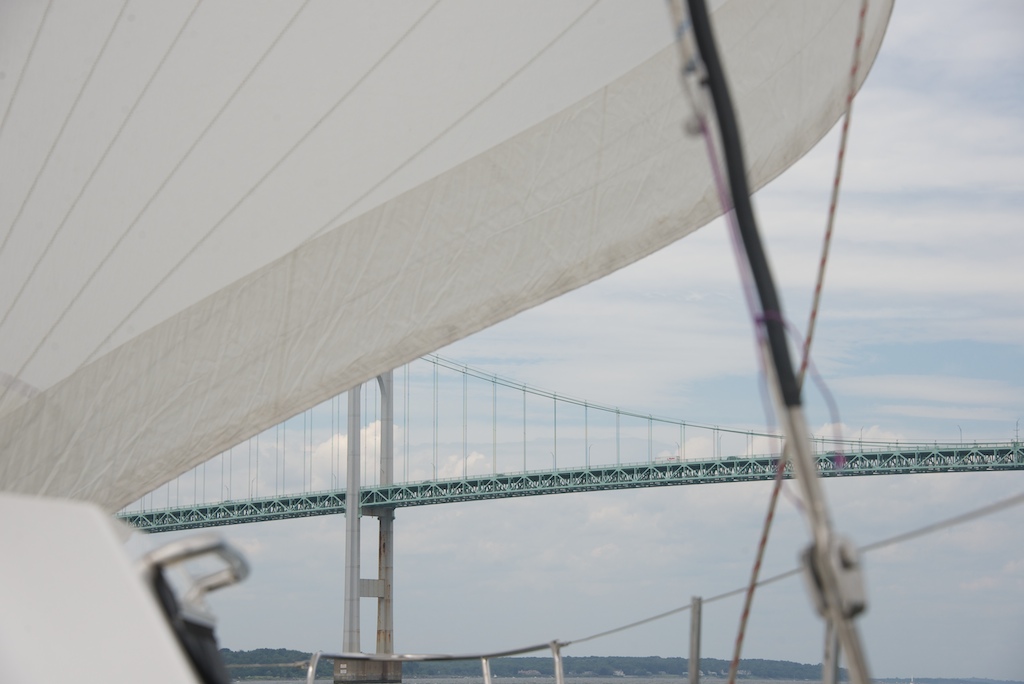
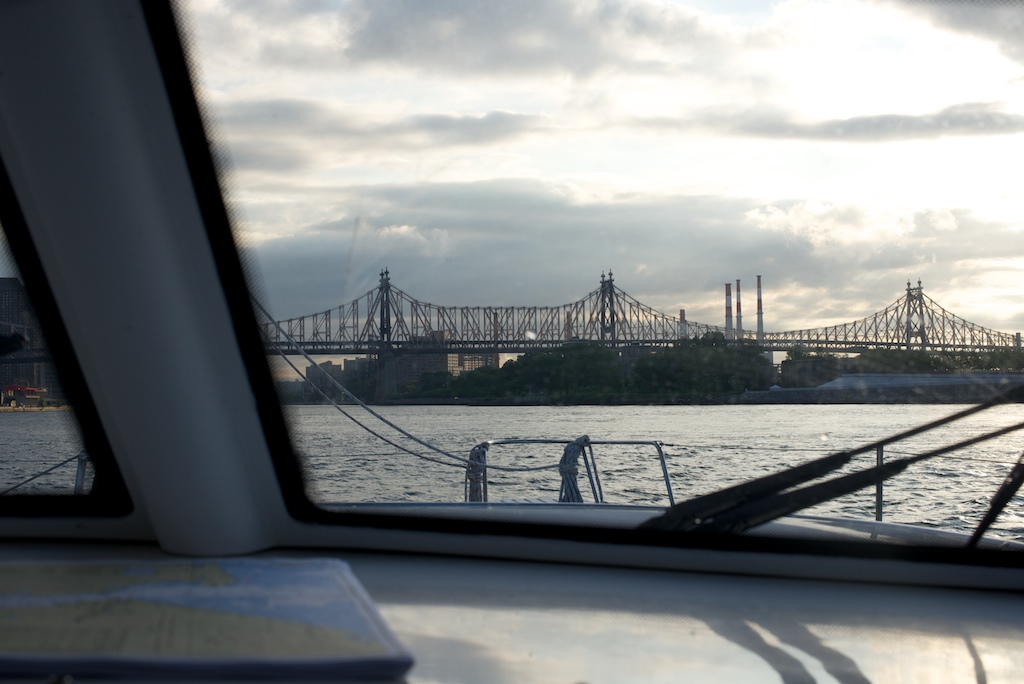
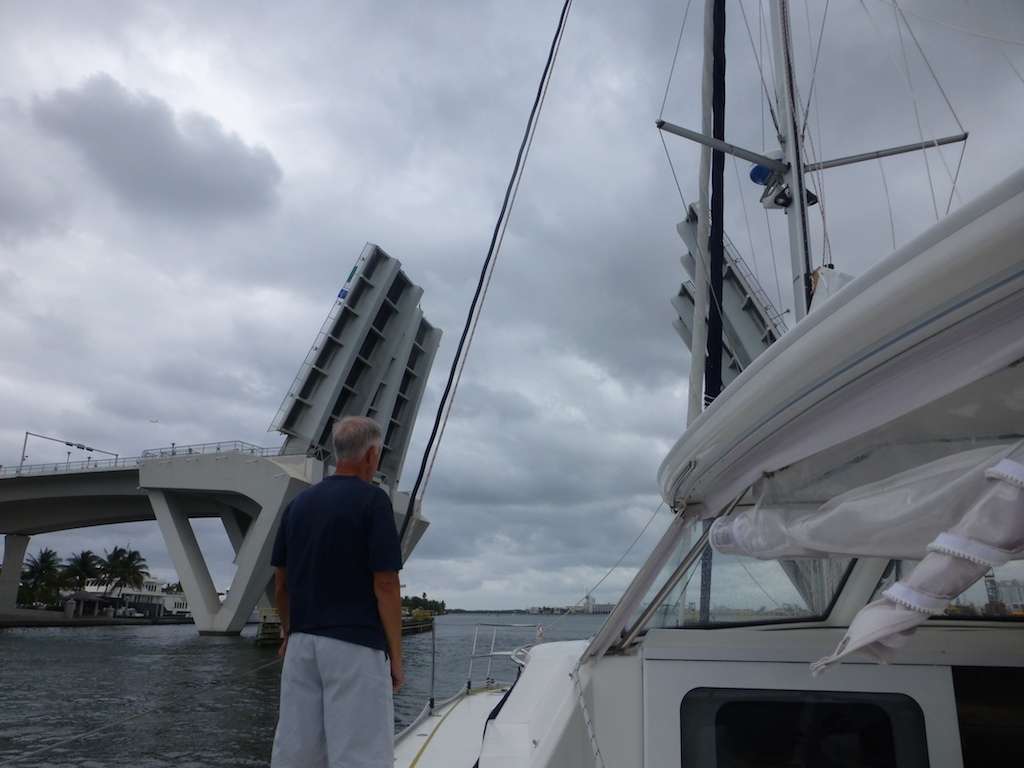
Gail has traveled by car over the Throgs Neck bridge more times than she can count. Today she passed under the bridge for the first time.   Another first for us courtesy of Two Fish.

Our plan now is to wander East and North.   Connecticut fans get ready.   We will host a party soon.   Then is it on to Cape Cod?   Western Long Island seems to discourage anchoring so we will drift East at a faster pace.


Comments { 2 }

A day sail turns into more

After three weeks of working on Two Fish, it was time for a sea trial to test our efforts. Sea trials are required before long passages whenever systems on the boat have received major maintenance.  Engines, generators, running rigging, water maker, electrical, plumbing, sails and more have all been worked on by ourselves and pros. The boat has been a beehive of activity.

The sky was grey as we headed out on our sea trial, searching for gremlins.   We invited Mark and Bill, who have been graciously hosting us at their convenient, posh dock.   In return, we tortured them with a condensed sailing academy in which they excelled.   Three minutes into the trip, I handed the helm over to Bill for motoring drills.   As our gelcoat will attest, he passed with flying colors.  We practiced many of the sailing maneuvers but I think the eye opener was “heaving to”.   NO, none of the crew tossed cookies.  “Heaving to” is the term for putting the boat in park by having the two sails set up in opposing directions.

At the end of the voyage, we motored back to Port Everglades, seeking flatter water for lunch.   I increased the revolutions on the engines to race away from a nasty looking cloud.   Suddenly, the port engine heat alarm began to wail louder than an infant.   The temperature gauge had firmly entered the red zone.  I found this situation somewhat disturbing and quickly shut the port engine down.  I was now in the middle of one of my persistent boating fears.   I was being forced to operate the boat in close quarters, maneuvering with only one engine.   I tried to put on a brave face so as not to distress our guests, but this was uncharted territory for me.  I had just begun to consider my options, when Mark asked me “What if the second engine begins to overheat?”  This was one of the pre-saiI homework questions that I had given Mark in advance of the sail.  My dinghy is in the shop, so a dinghy tow was out of the question.  If I lost another engine, our only options were to quickly hoist sails or anchor.   I was on a lee shore so the sailing option would be tricky and I was entering one of the busiest US ports so anchoring was not feasible.

Engine trouble

Engine trouble


We motored gingerly into the Port Everglades turning basin.   Should I stop at the fuel dock just after the 17th Street bridge?   This would only require passing under one bridge and I could start working on the engine immediately.   I decided against this course of action, since the engine temperature was too high for servicing and I would not be allowed to stay at the fuel dock for the night. Pride stopped me from calling a tow service with one engine running.  Being towed to the dock would be tougher than docking on one engine, but much easier than zero engines if starboard followed suit.  A third option would be to anchor and call for a Volvo technician.   Again, pride encouraged me to press on.  Worst case we drift onto the neighbors dock?   The wait between bridge openings afforded me time to practice holding station with the boat on one engine.   I was now steering a monohull that was super-wide with the engine placed 12 feet from center.   I practiced the old monohull trick of rotating the boat with repeated slow movements forward and then reverse.  The boat equivalent of the 3 point turn.   Because rudders require water flow, and the propellors send water to the bow, the rudder can not steer in reverse. The helm gets busy with helm turns and gear changes.   If the process failed, and we drifted into a mega yacht I had planned to slink away from the scene while removing the Two Fish logo.


We passed under the 17th and Las Olas bridge without incident, despite the Las Olas opening being half-filled with a construction barge.  Now it was time to approach the dock.  The story has an anti-climatic ending as the wind and current were kind.   Two Fish knew where I wanted her and she coasted slowly up to the piling where Gail and Mark briskly attached the bow line.   I applied a bit of reverse on the working engine and the stern drifted up to the dock.  Two Fish was so gentle in her approach that I had enough time to lasso a cleat with the stern line to complete our docking.
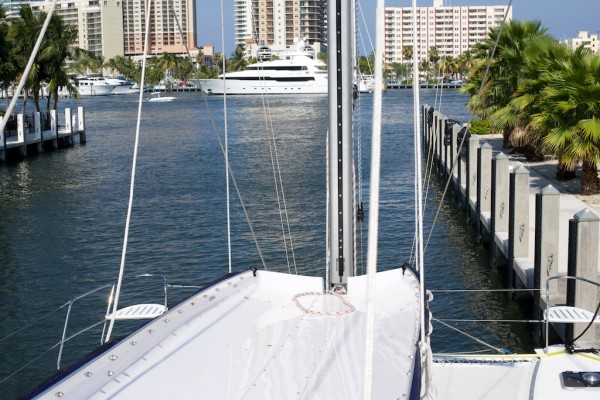
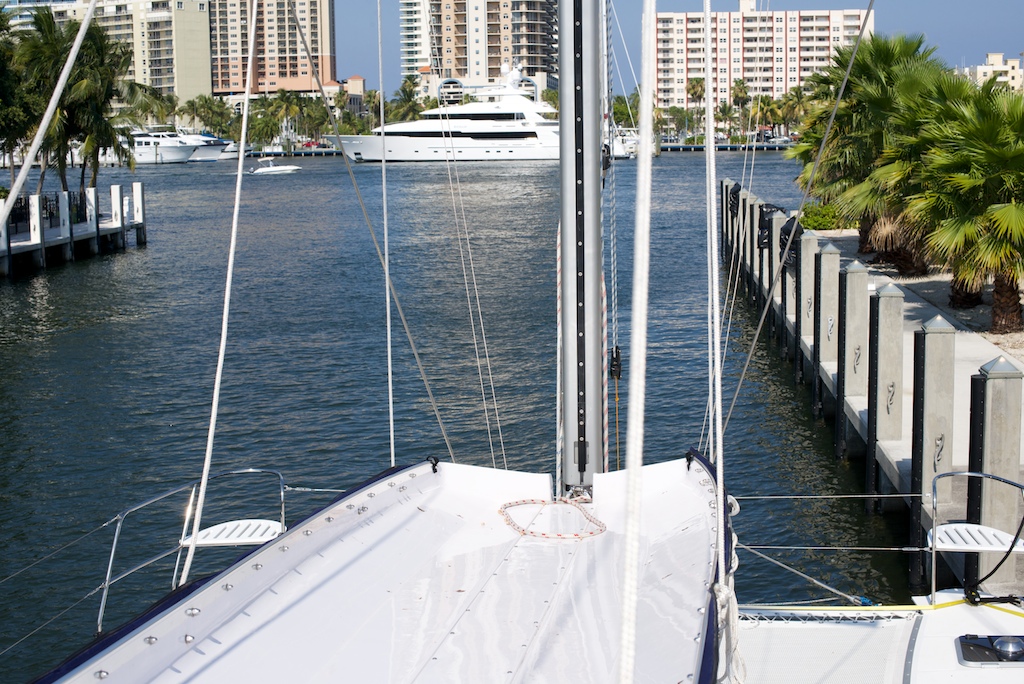
Two Fish back at the dock

Two Fish back at the dock


The next day we tried to debug the overheating engine.   Engines are cooled by two systems, fresh and raw water systems.  The fresh water is grossly misnamed as it is full of poisonous coolant similar to a car’s antifreeze.   A Volvo mechanic had changed our coolant the day before.   He had slightly overfilled the engine.   Could this be the cause?   My mother’s turkey baster was used to remove the excess.   We will buy her a new one before she returns from her trip.  We kept looking for the cause as I had never heard of excess coolant causing overheating.


I then switched my focus to the second cooling system, raw water.   Another poorly named system, the water is neither raw nor cooled; it is just water sucked out from the sea.  I examined the flow from the seacock to the engine’s heat exchanger but nothing looked out of position. I checked the strainer and it was empty.   The impeller check took no time as I have speed seals.   All the blades were accounted for, eliminating the impeller as the culprit.    Finally, I theorized that the blockage could be underwater at the scoop that protects the sea water input from sucking in a trash bag.   Could this scoop be jammed by some flotsam?  We store a map of Two Fish’s many thruhulls on the inside of a cabinet door in case of emergency; we used this to remind us of where to head for on the hull.


After no discussion, I was assigned the task of diving the boat.  Into the canal I went with the mental map.   I began to miss the gin clear waters of the Bahamas as the canal waters were so murky I thought I was cave diving.   Gail equipped me with an underwater flashlight so that if I encountered a man-eating octopus, I would be able to identify the sub species.  I was also given a marine scraper similar to what is used by motorists to remove frost from windshields.  With some effort, I found the scoop covering the raw water input.  It was a barnacle farm.  As I scraped, the boat disappeared in a cloud of marine organisms.  After several trips to the surface for a fresh lung of air we had clean scoops for all the systems (A/C, genset, engines and water maker).  I found half a small fish in one of the scoops.  Not so yummy.   I was greeted with a scientific surprise when I swam to the opposite hull.  The scoops were in much better shape.   Why?   We have been on a dock Fort Lauderdale for three weeks.  The outside hull gets much more sunlight as the inside hull is covered in the dock’s shadow.  The barnacles grew faster on the outside, sunny hull.


After cleaning the scoops I ran the engine for 30 minutes.   I watched the engine temperature rise to and stop at its typical operating temperature of 90 degrees Celsius. The swim might have been the fix,  but to be safe I will do a longer test in the morning.   I also used this time to learn more about my engine temperature.   I used a pyrometer (think radar gun for temperatures) to shoot and record a bunch of temps across the engine from the heat exchanger to the engine block and by each injector.   I will keep a log of this in the future.


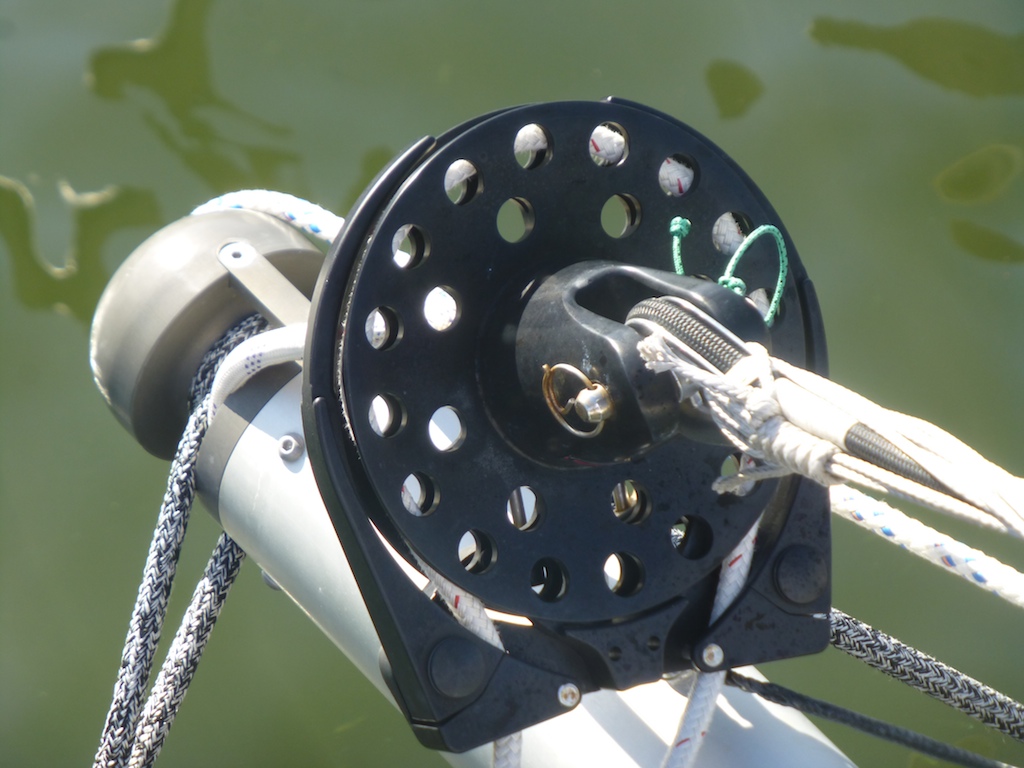
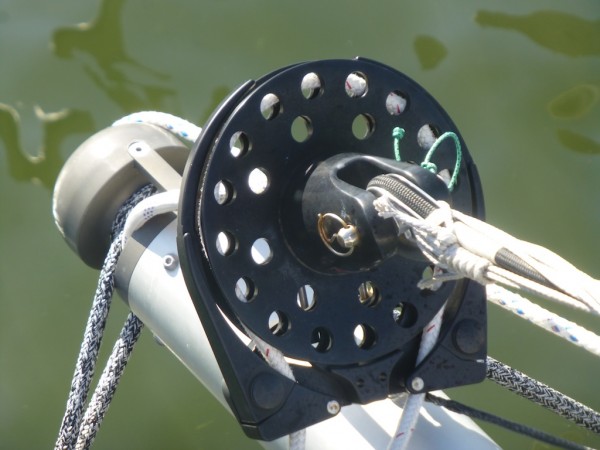
Earlier in the day, our sea trial had one other adventure.   The furler for the Screecher is temperamental.   You must keep tension on the lazy side to avoid letting the line exit the jaws. Ours exited the jaws and we were faced with three choices. We did not take the dangerous option and walk the pole,  Nor did we drop the sail, as it is too cumbersome.   Instead we folded the pole while easing the halyard and the sheet.   With the pole close by the bow we rethreaded the furling line.   Gail was amazing.  She quickly did a complex maneuver in a stressful setting.   We then stowed the Screecher and the problem was sorted.
 

Screecher drum

Screecher drum

The next day at the comfort of the dock we decided to make sure the Screecher was working properly and the line popped out of the jaws again. And again.  And again.   We could not understand why it kept popping out because it had been trouble free for the past seven months.   I sent a photo to Harken and confessed that I had just reinstalled the system after servicing.    Three minutes later Harken tech support politely informed me that I had not put the furling lines inside the cotter pins.   Oops, bonehead move by me.   That is why a sea trail is important before a long passage. Harken has fantastic technical service.


We keep learning.  Sometimes new sailing terms and sometimes new curses.
 

Comments { 4 }

Uncharted Territory

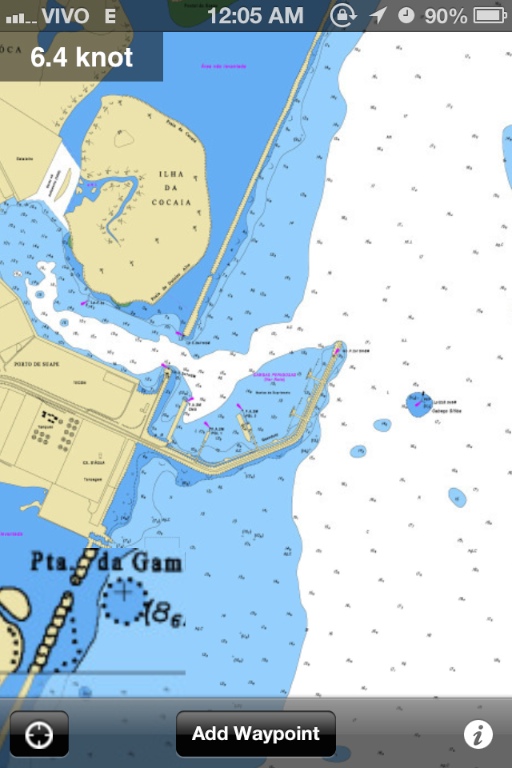
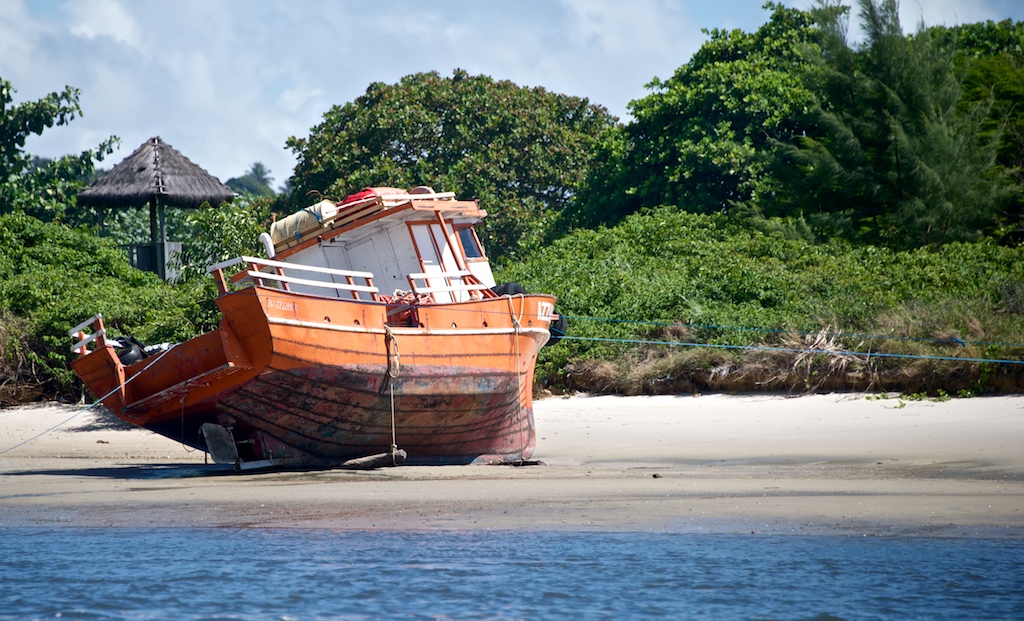
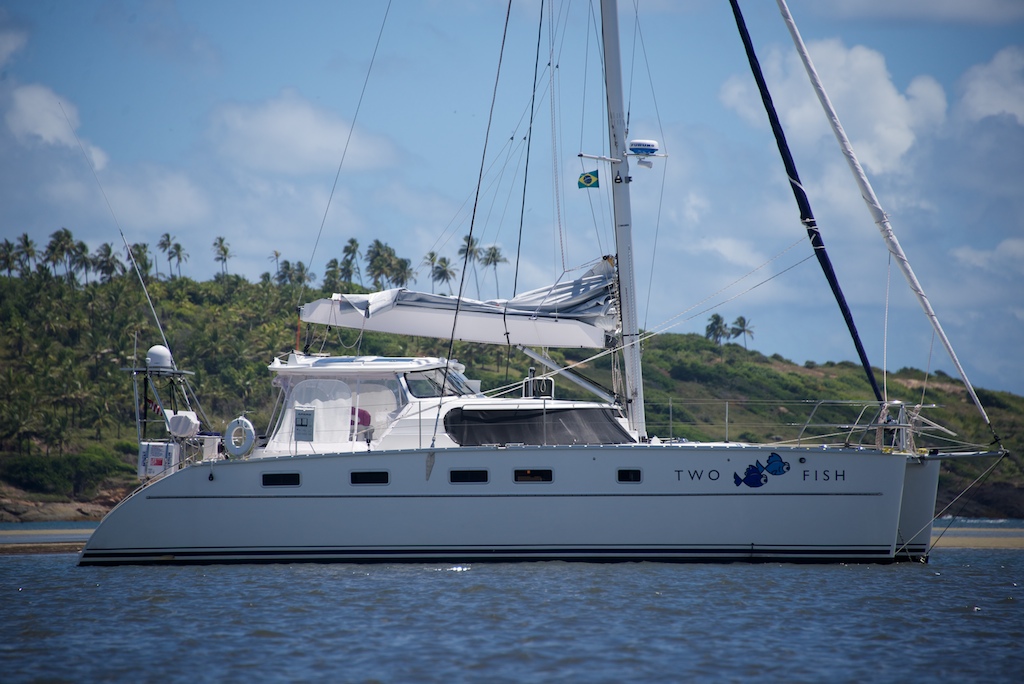
Pulling one’s car into a parking space is usually pretty simple.   Just steer the car between the yellow lines.  Two Fish decided to “park” (anchor) in a spot which had no guiding lines; in boat-speak, that means it is uncharted.
Our target was the uncharted bit

Our target was the uncharted bit

Instead of depth readings, the chart only contains some Portuguese text that we translated to something about not having gotten around to measuring the depth.

The cruising guide write-up was appealing: great views, palm trees, nice water and calm seas. Since our fancy charting system was useless, we relied on a hand drawn map in the cruising guide.  This scrawl of a chart could pose for a pirate’s treasure map.  Our trust of the pirate map was a bit shaken by the misnaming of the lagoon’s primary island, but we decided to head there anyway.
 

Treasure Map

Treasure Map

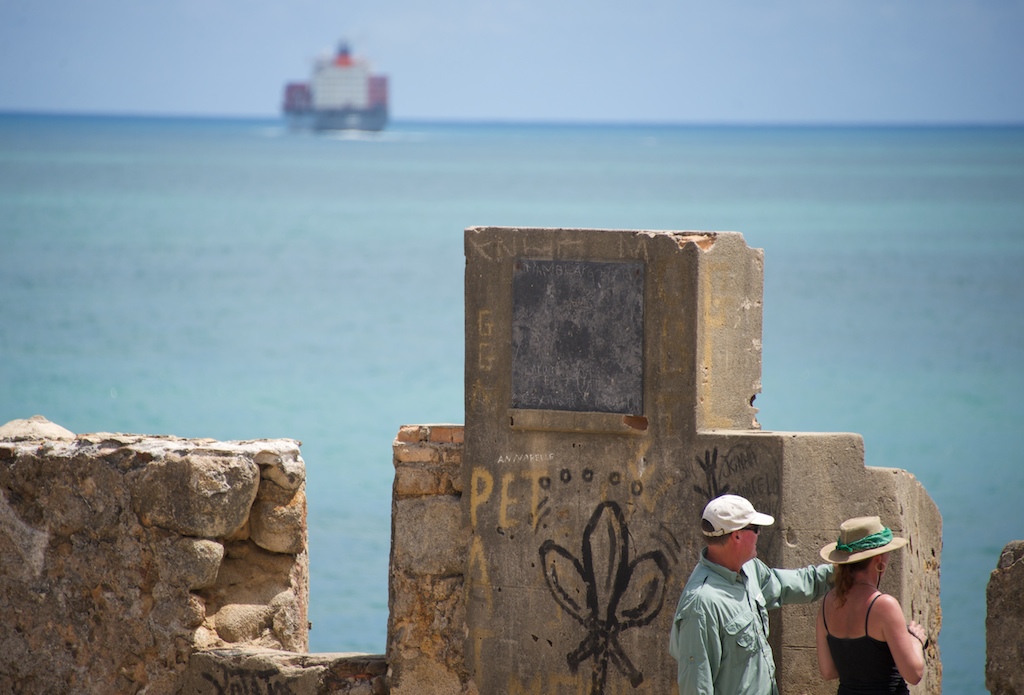
After a day of light winds and bright skies we approached the harbor.   The wind gods wanted to make sure the approach was difficult, so they gave us 22 knots of breeze and rain as we arrived.  Of course, to add to our challenge, sunset was fast approaching and we needed light to see hazards.    We also discovered that the lagoon shares an entrance with an active port that must have sprung up after the pirate map was drawn.

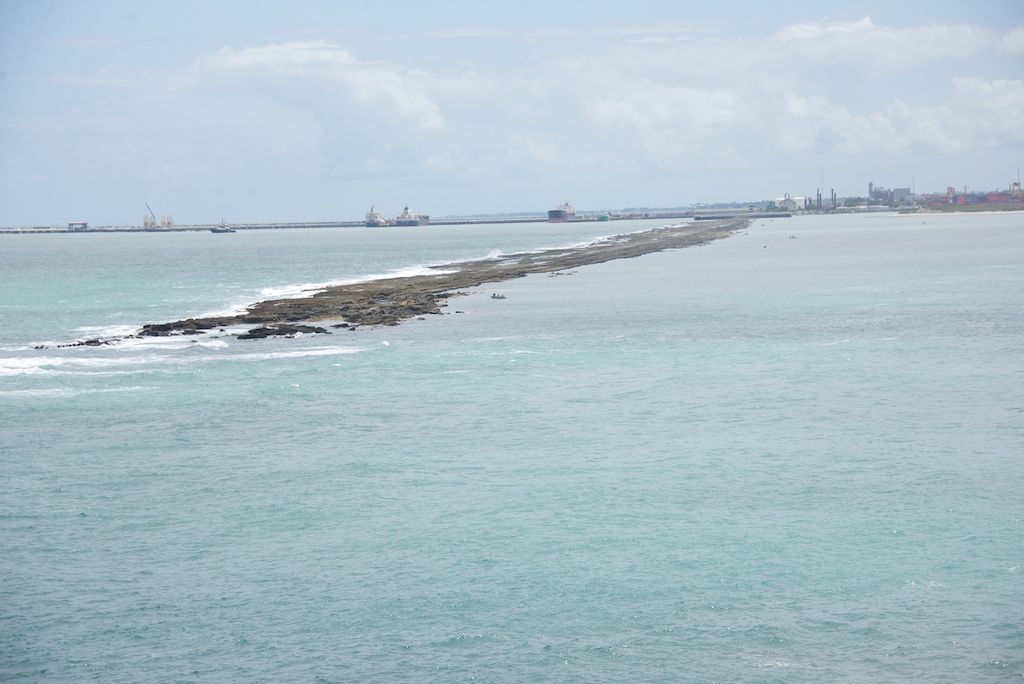
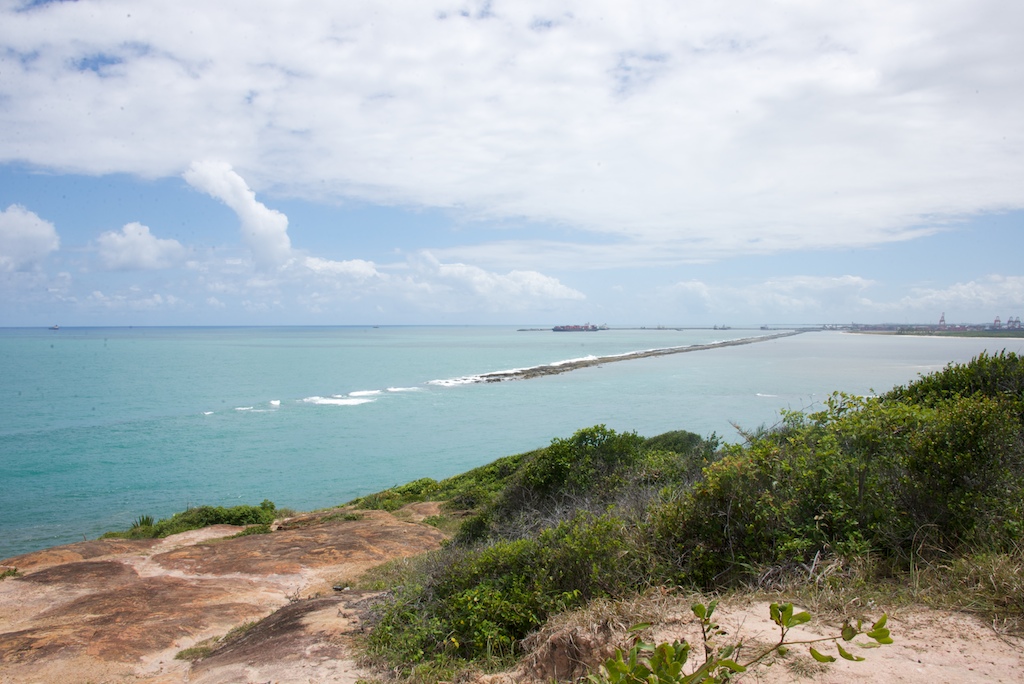
After avoiding a few 700-foot ships, we headed for the farther of the two entrances to the lagoon.   Our treasure map had its first epic failure. The path had been replaced by a pair of huge dry docks.   This fell short of our dreams of palm trees on the shore.   Our spirits were buoyed when we saw a power boat head to the other entrance.   The cruising guide offers this advice for the second approach:  “Stay within 10 meters of the nasty boat-eating coral reef and you will find a pittance of water to pass your boat over.” We tried to follow these orders, but the violent waves crashing over the reef inspired Jason to give it more room.   There is no yellow sign declaring “Reef Here” so we looked for breaking waves and black spots of rock through the dim light and rain.

To further taunt us, the cruising guide claimed that, in the late 90’s, this route was staked by flags.   However, the fallible guide went on to state that no flags had been seen since 2002.   There are two types of risk for the keel of Two Fish. First, sandy bottoms that are too low will trap the boat temporarily and only release on the next rising tide.   This is usually benign and only requires patience.

Rock, paper, fiberglass?

Rock, Paper, Fiberglass?

As kids we all learned the classic children’s game of  “Rock, Paper, Fiberglass.”  REMEMBER ROCK BEATS FIBERGLASS.  The second risk is rocks.

We used our depth sounder and our fish finder to better understand the bottom.   We decided that If the depth dropped to 2 meters, we would turn back towards the reef for more water.   (Two Fish swims in 1.2 meters.)   Forward-looking sonar would have been nice.

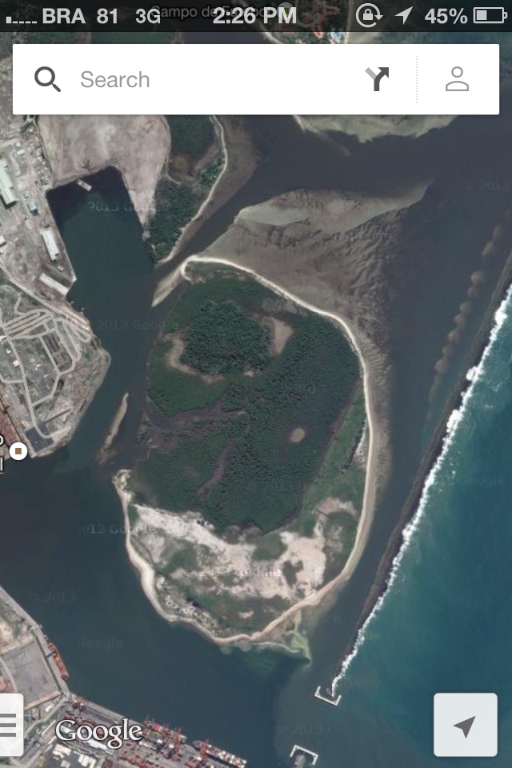
Mud from above at low tide

Mud from above at low tide

Finally we saw a marker (simple white cube).  We referred to this marker as a lunch box because it looked like a wayward cooler.  Finally, we narrowed in on a place to drop the hook.  Jason chose a spot downwind and we dropped our anchor and made adjustments. The next day, at low tide, I realized how good Jason’s choice of an anchoring spot was.  Three feet away and we would certainly have grounded.

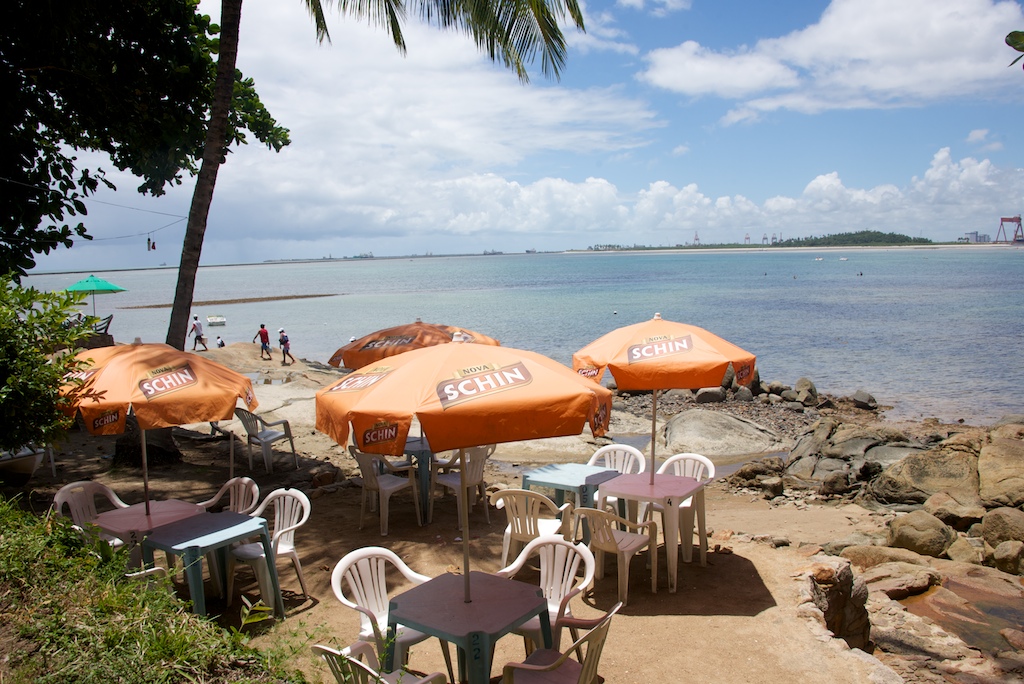
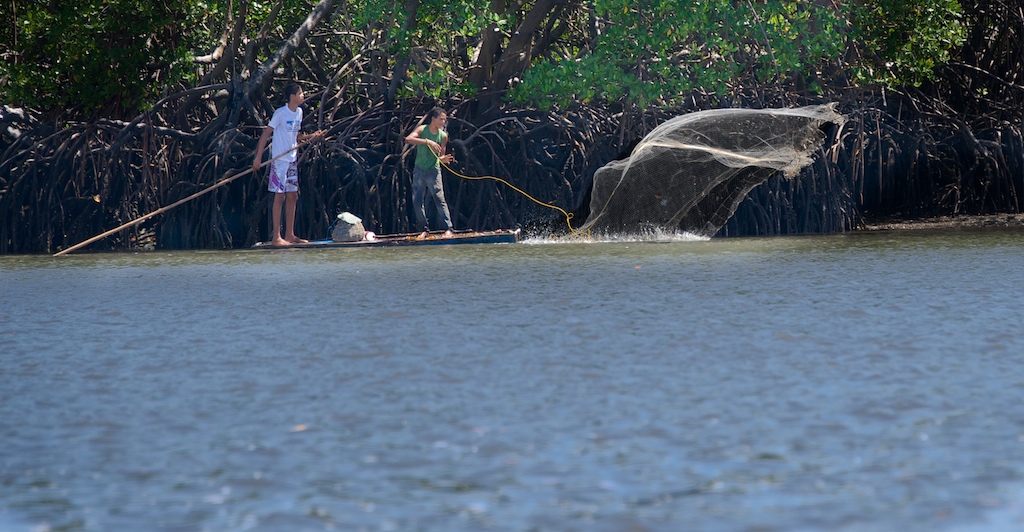
The rhythm of the tide governed the village. At 6am, the fishermen in waders walked by with their poles. Later, someone put up a beach umbrella in the now-exposed mud. We provided some entertainment for the teenage boys who challenged each other in a race to the boat and back. Later in the day, the people receded together with the sand bank and I brought up the satellite image of the mud with the dot of our lat/long. Just a step away, there was the mud. How did he do that?
While I enjoyed the view from the boat, the others headed to shore to explore the town. They missed the teenage boys racing one another from a sandbar to the edge of Two Fish and back but they had a good time anyway.


Comments { 2 }