For mammals, summertime is about finding shade and keeping cool. For marine engines, keeping cool is a year-round obsession. Two Fish’s engines started running hotter than usual and, during the process of investigating this, we have learned a bunch about engine cooling. (I used a silver Sharpee to draw arrows on my coolant hoses to remind me of direction and contents.) Fortunately, the engine never heated above the safe operating range so there was no damage. Two Fish has easy to see gauges which protected our valuable engines. In some sailboats, the vital gauges are located at the helmsperson’s ankle.
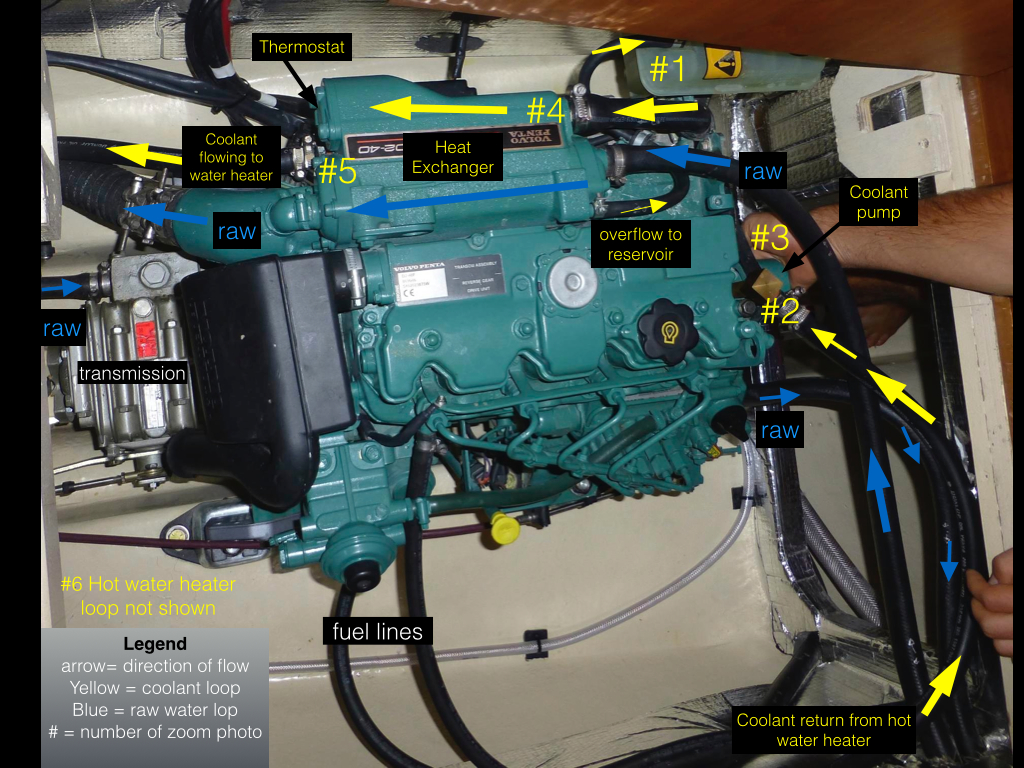
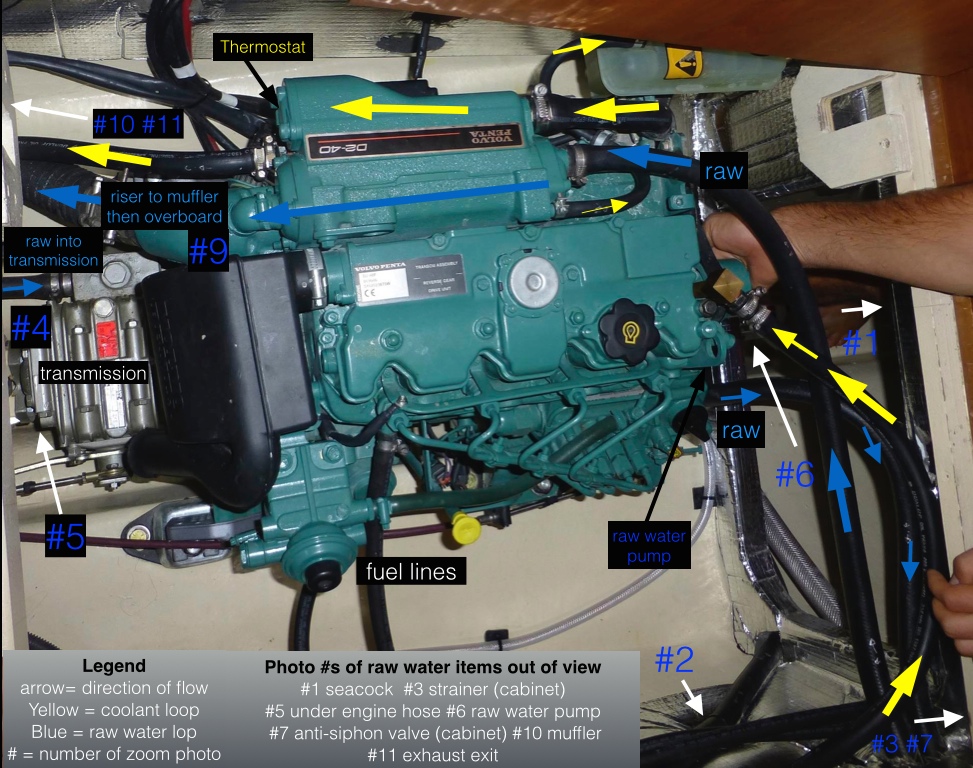
The below photo is an overview of the cooling flows. Think of it as the imaginary kingdom in a fantasy novel. It makes little sense at first, but it will help you to refer back to it while reading this post. The star players are Volvo D2-40 Engines, Quick hot water heaters, Vetus strainers and Vetus anti-siphon loops.
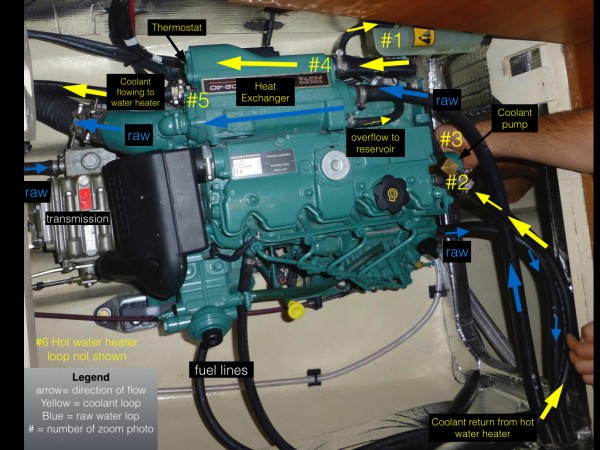
Overview – coolant loop
Coolant, derived from the latin word coolium (fluid that cools chariot wheels), keeps our engines from overheating. Coolant technology has advanced since the Roman Era and is now used in most engines. Coolant is mostly water with some toxic stuff that raises the boiling point and lowers the freezing point. The miracle chemicals also protect the engine from rusting. These Volvo engines demand a particular Volvo coolant (VCS yellow) and nothing else is allowed inside the engines. Now we will track a drop of coolant’s path through the circular loop.
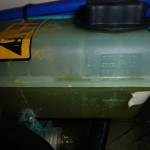
#1a Reservoir for coolant
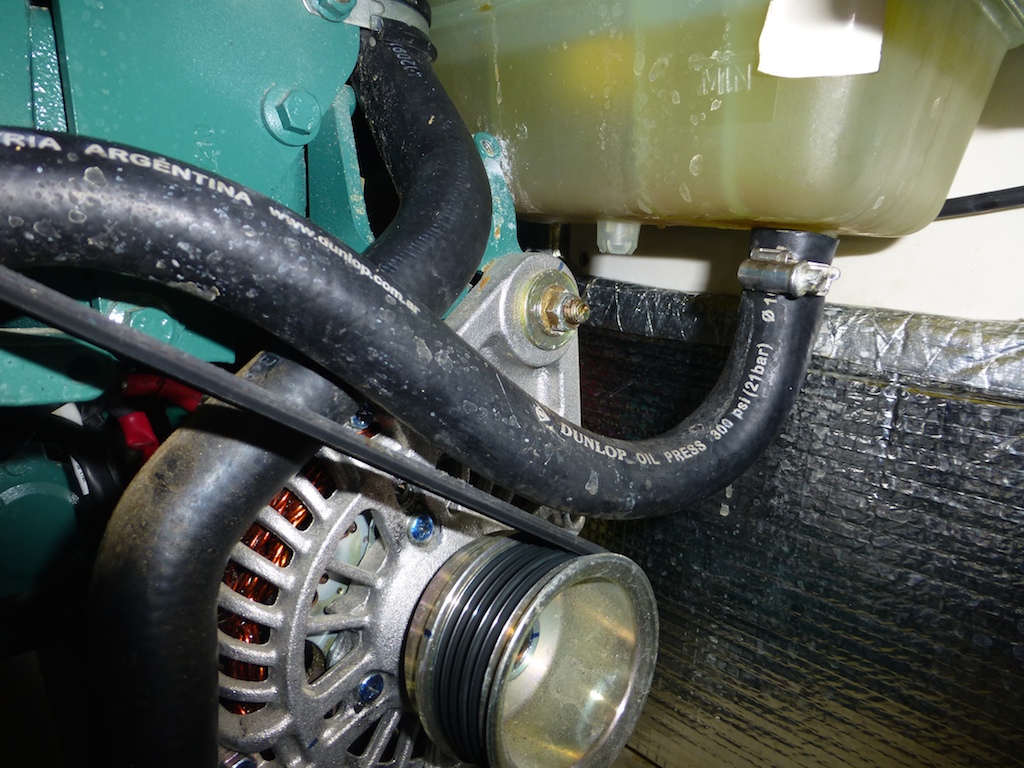
#1 The coolant is poured into the reservoir bottle, which has to be the higher than any part of the engine and the hot water heater. When refilling coolant, you can lift up the bottle so that the filling point is higher. This will ensure that there are no nasty air pockets in your cooling system. Air is poor at transferring heat and can disable the cooling system, so great care must be taken to remove it from the cooling loop. Another air pocket defeating trick is to slowly unscrew the cap of the reservoir after the engine heats up. If you feel suction being released, you had an air pocket. Please be careful when doing this to avoid burning yourself with coolant. Burnt by coolant sounds oxymoronic? Volvo claims that the D2-40 engines are self-purging and thus the engine does not have a radiator style cap for burping the engine.
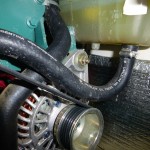
#1b Coolant path to pump
#1b At the bottom of the bottle, there is a a hose that leads to the top of the coolant pump. I have placed white electrical tape on the side of the bottle marking the most recent coolant level. After changing coolant, there can been major drops as air is purged from the coolant loop. Once the coolant has stabilized, the bottle should stay fairly constant. A large change in coolant level could be a sign of an overheat that was not detected. You can never spend enough time in your bilge looking for things that are not right. Gail is great at this and uses old photos to confirm her suspicions. Take lots of photos of your boat so you can find part numbers and what things looked like 3 months ago before you unscrewed everything. The digital camera is in our top 10 best tools list. Mirrors and flashlights can not compete.
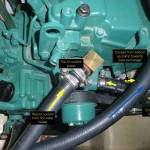
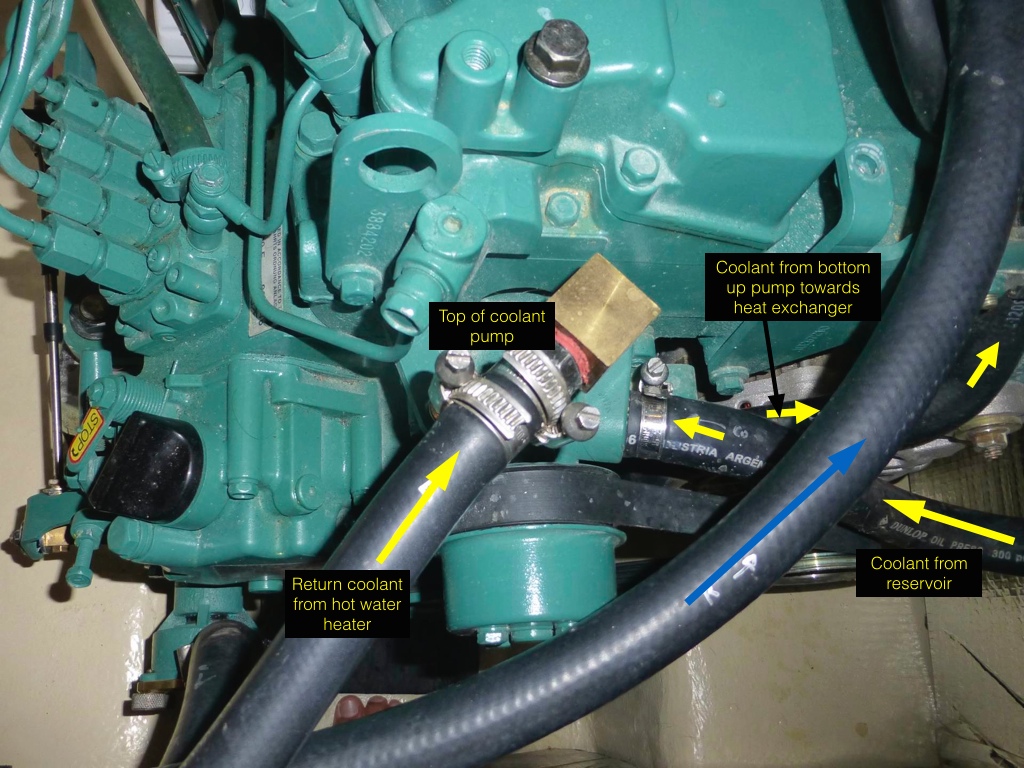
#2 Top of coolant pump (input)
#2 The coolant pump is driven by the main belt that also drives the alternator. The pump sucks coolant from two hoses that feed into it from above. The first hose is from the reservoir and the second hose is coolant that has completed the full lap of the engine. Because this boat uses the hot coolant to warm hot water for showers and dish cleaning the plumbing might look different than other boats. Without a water heater, coolant would return directly to the pump from the heat exchanger.
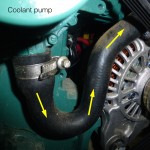
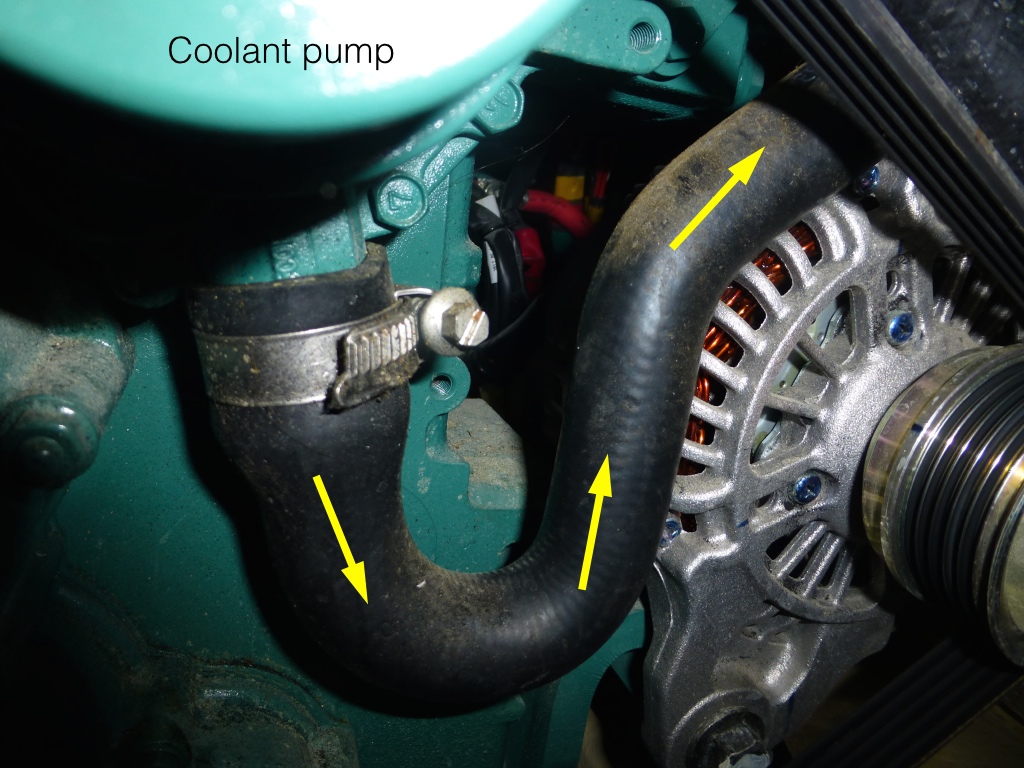
#3 Bottom coolant pump (output)
#3 The coolant pump sucks the coolant from above and sends it through a hose that snakes over the alternator and heads up and to the other side to reach the heat exchanger. In theory it should be coolest now as it prepares to enter the engine and absorb heat. I have not serviced this pump yet.
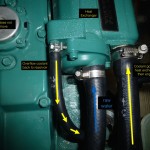
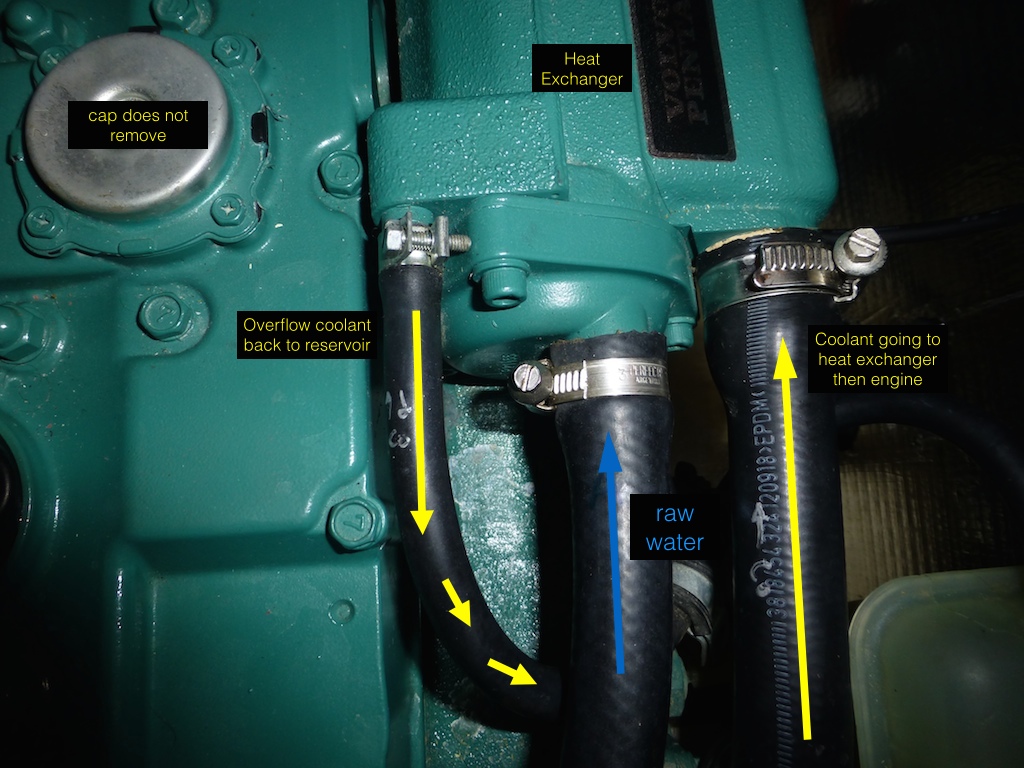
#4 Coolant enters heat exchanger
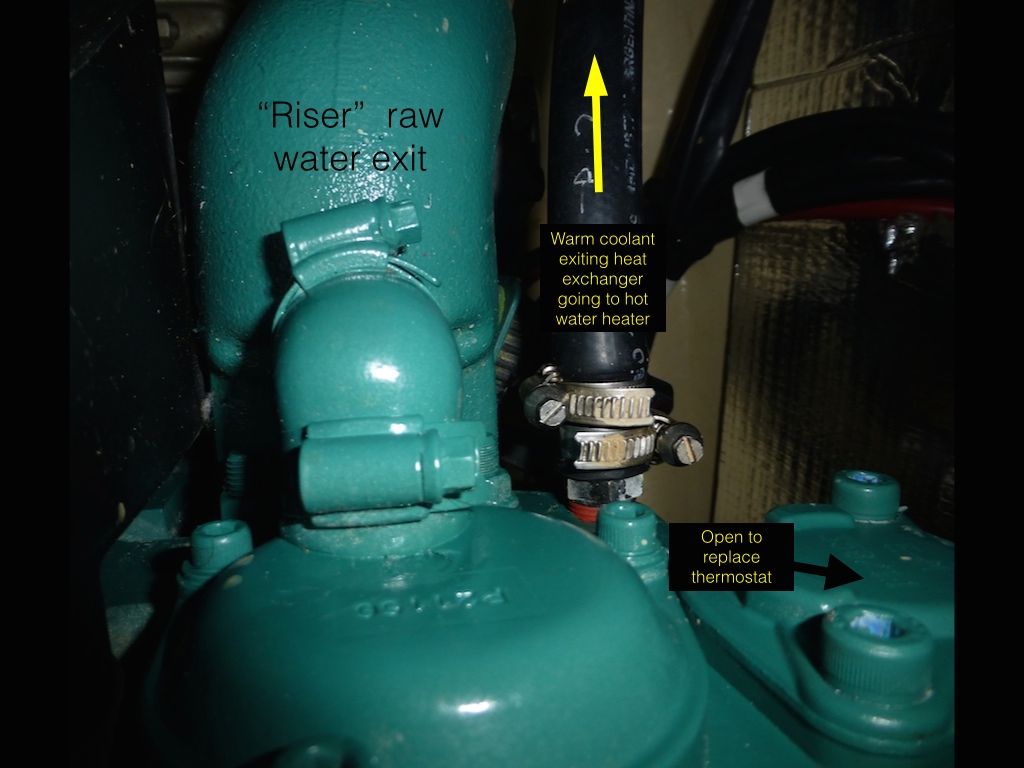
#4 The coolant enters the heat exchanger on the outboard (right) side and the cooler raw (sea) water enters on the inboard (left) side. The coolant then enters passages in through out the engine. The now warmer coolant reaches the thermostat. If it is hot enough to melt the wax in the thermostat then it gains entry to the heat exchanger. The heat exchanger should raise the temperature of the sea water and lower the temperature of the coolant. The metal passageways are designed to have large surface areas and the adjacent passage of raw water cools the heat exchanger. The raw water and coolant never mix and like forbidden lovers are kept apart by metal walls. The raw water now having done its cooling job will be dispatched overboard. The coolant will be ready for another circuit through the loop. The small diameter hose is for coolant overflow. If the system overheats, this would send excess coolant back to the reservoir.
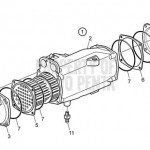
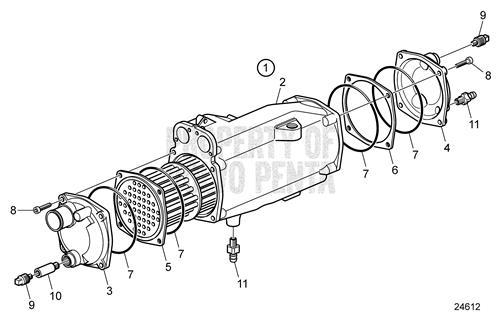
Volvo Heat exchanger
This diagram shows a heat exchanger’s interior and the complex surfaces that encourage heat transfer from the coolant to the raw water. At the end of the exchanger is a thermostat. If the coolant is hot enough the thermostat will allow the coolant to enter pathways within the engine. I am still searching for a drawing of the coolant path for the Volvo D2-40 engine block. I replaced both of my thermostats while tracking down my heating problem. The thermostat opens at 90 degrees Celsius (194F), which is near the typical operating temperature. When the temperature rises to 102 (215), the thermostat is fully open.
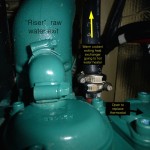
#5 Coolant leaves engine
#5 Hot coolant leaves the engine and heads towards the hot water heater. The coolant then passes throughout the hot water heater, even if the water in the hot water tank is fully warmed. If the water in the tank is cool, the hot water heater pathway will transfer heat from the coolant to the water.
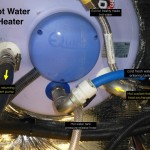
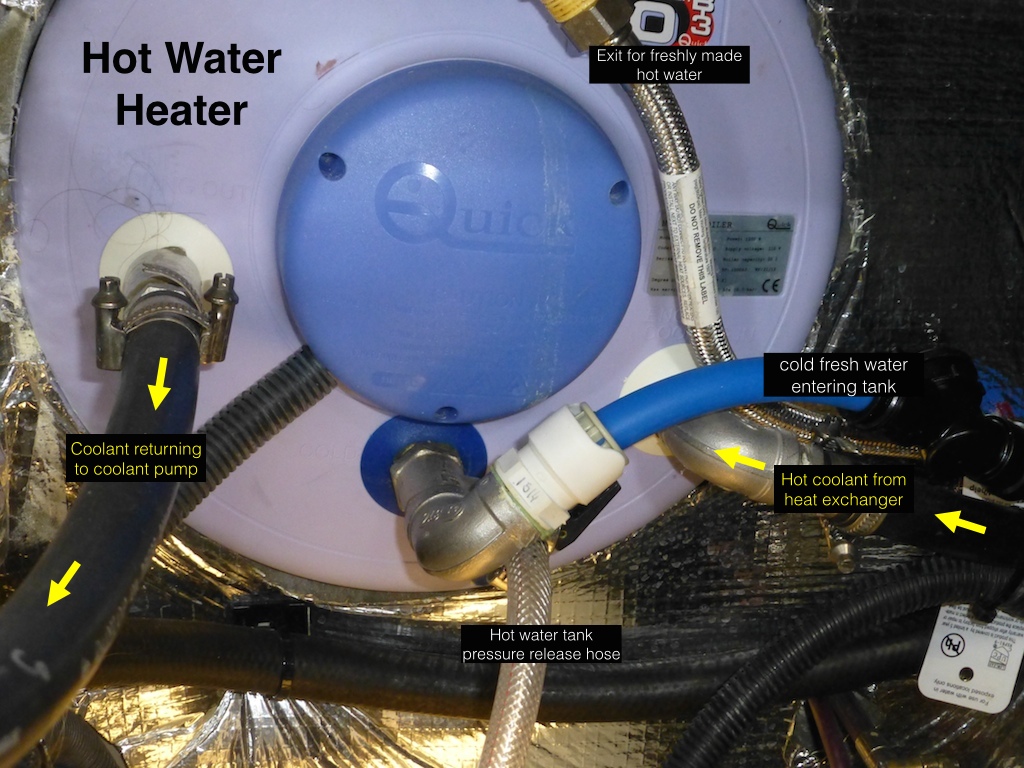
#6 Inflow and outflow – hot water heater
#6 On the right side of the photo, the hot coolant comes into the tank. After a brief travel through a helix shaped passage, it exits the tank on the left side. Hot showers can now commence! If you are not motoring, the hot water tank can be warmed using 110 volt power. Showers do not taste like coolant, since the coolant never mixes with the drinking water in the hot water tank. The coolant now takes the long trip back to the coolant pump and our loop is complete.
THE RAW (SEA) WATER LOOP
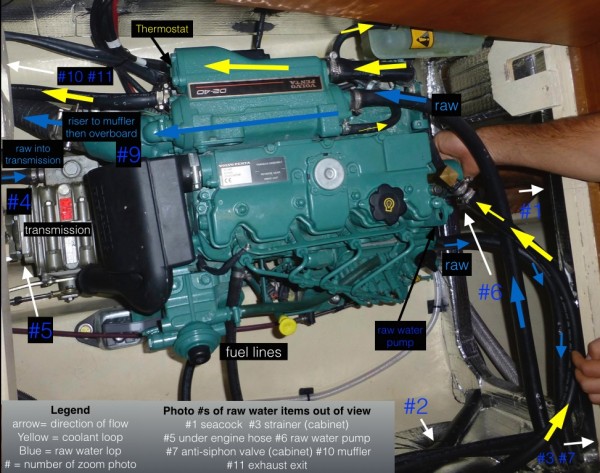
Raw water loop overview
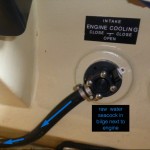
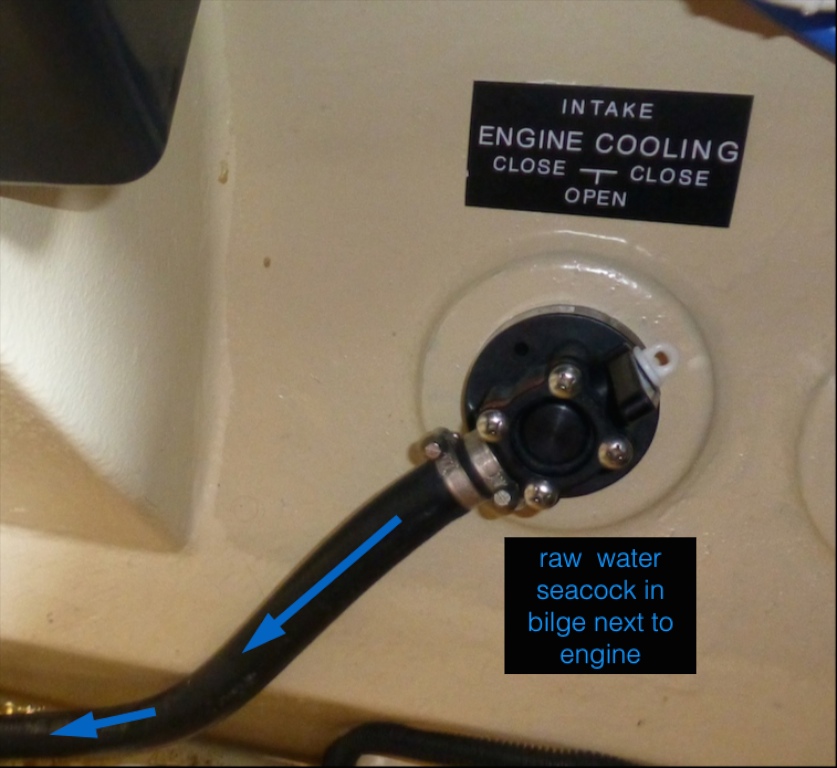
#1 Raw water enters boat at seacock
#1 The seacock brings seawater into the raw water circuit. If you are ever servicing the raw water circuit, you will need to close the seacock. If you fail to close the seacock, water will flow in until the oceans are empty. If you fail to open the seacock and then run the engines you will most likely shred your impeller. Not a ton of fun but not the end of the world, unless all of the bits get sucked into your heat exchanger. It is not a bad idea to exercise you seacock handles.
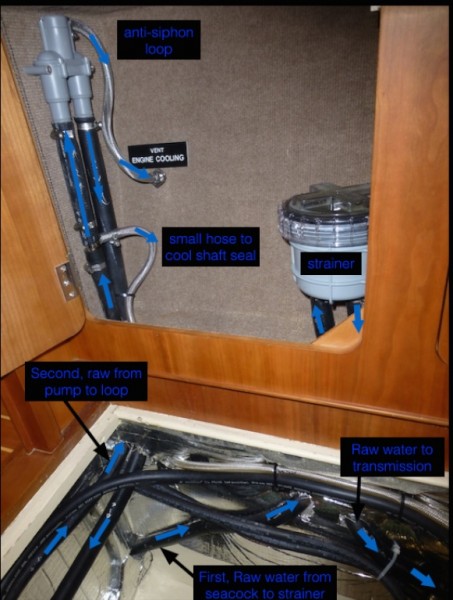
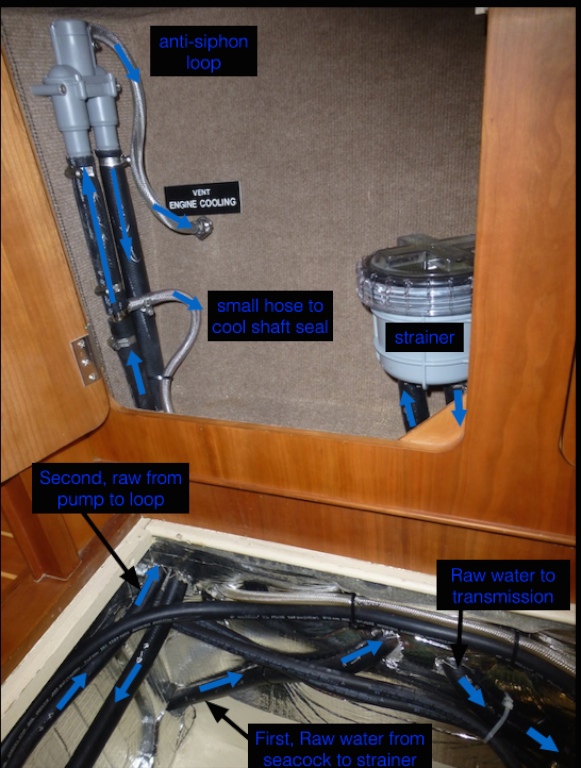
Plumbing from seacock to strainer
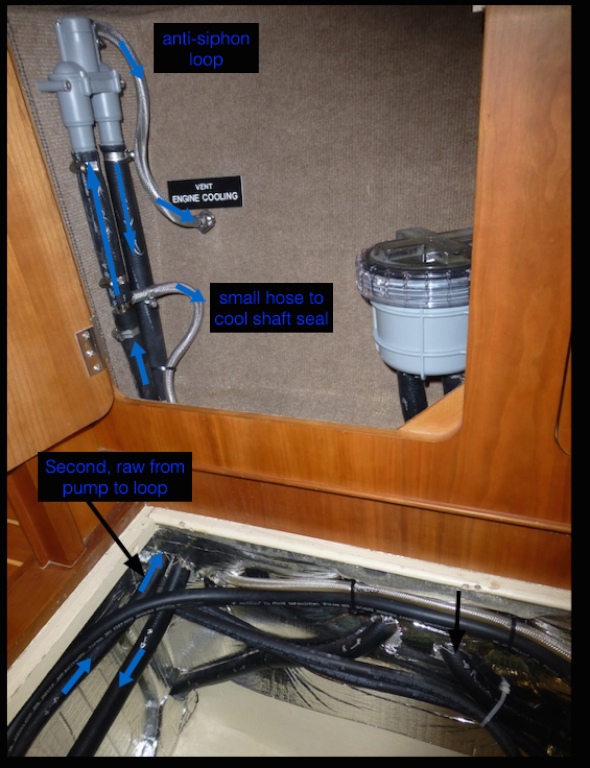
#2 This photo shows the peak of hose spaghetti; now you can begin to understand why it has taken me so long to understand my engine cooling loops. Click on the photo to follow the paths. The basic idea is: seacock to strainer, strainer to transmission, transmission to under the engine, under the engine to the water pump, water pump to anti-siphon loop. Next take a right at the house with windows. Makes sense? I told you the directions were easy.
When a engine overheats, the first thing you should check is your strainer. Make sure an octopus is not blocking the flow. With a flash light, you can examine the strainer without opening it. We do this before leaving the dock. If you do need to unscrew the lid and remove a pesky octopus, first close the seacock.
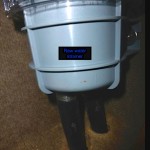
Strainer
#3 When the engines are running, the strainer should be filled to the brim with water. Only a couple of bubbles. Any less and you are not getting great pressure in your system. First action we take is to throw the captain overboard to clean the thru-hull. It pays to do this in the Bahamas, not New York Harbor. I had cowlings on my thru-hulls; I have removed one after the designer warned me that they attract more sea-life than they prevent. This is a hotly debated topic so I am on the fence with one engine in each camp.
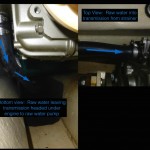
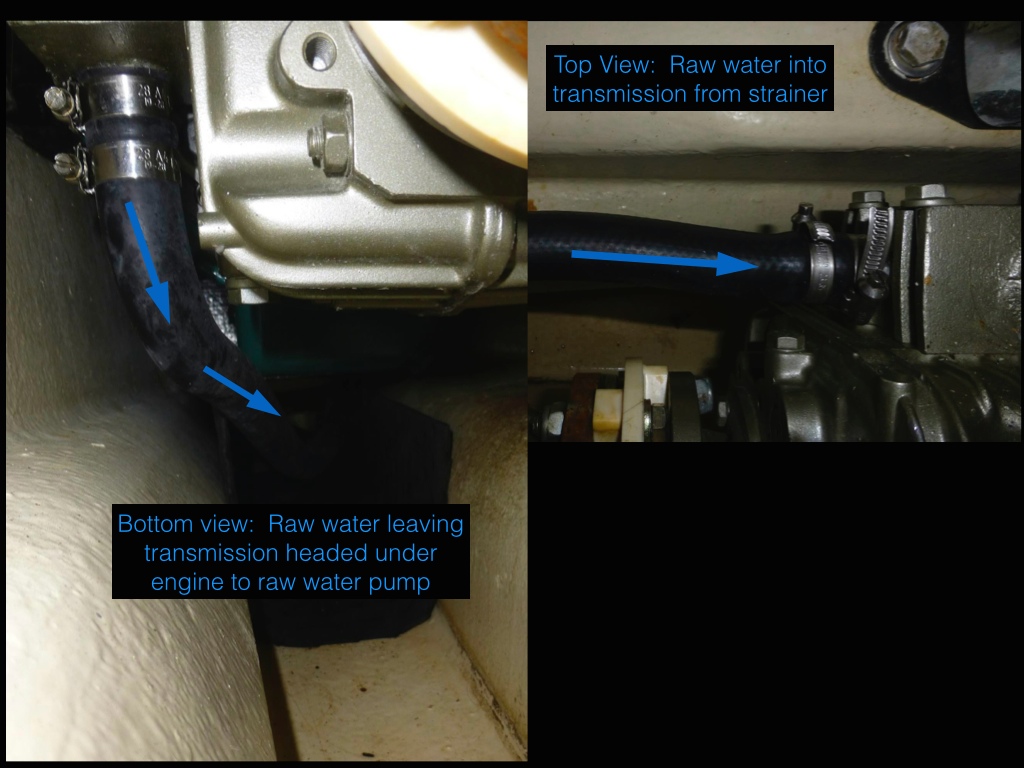
Raw water cools transmission
#4 The back of the transmission has a heat exchanger to keep the transmission cool. This will warm up the sea water about 1 degree Celsius. Over time, the path of the raw water may need cleaning.
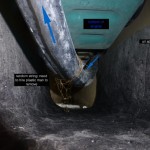
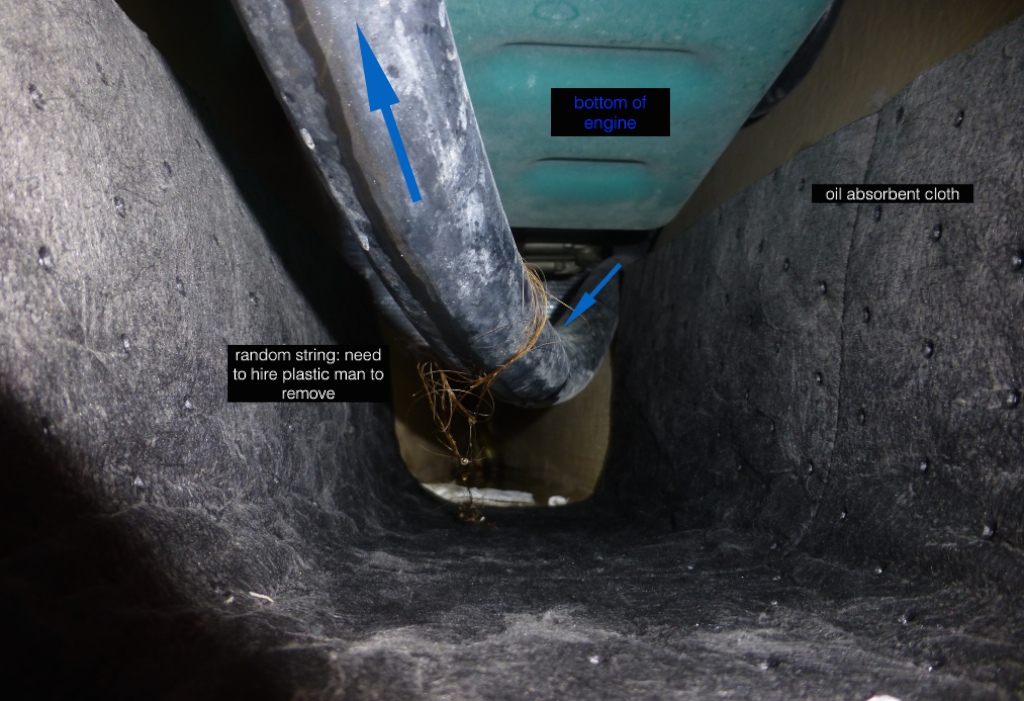
Sea water passes under engine on to raw water pump
#5 It took me a while to figure out the path of the raw water circuit and this hose was the key. It runs from the transmission to the raw water pump.
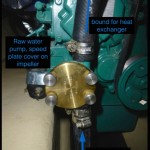
Raw Water Pump
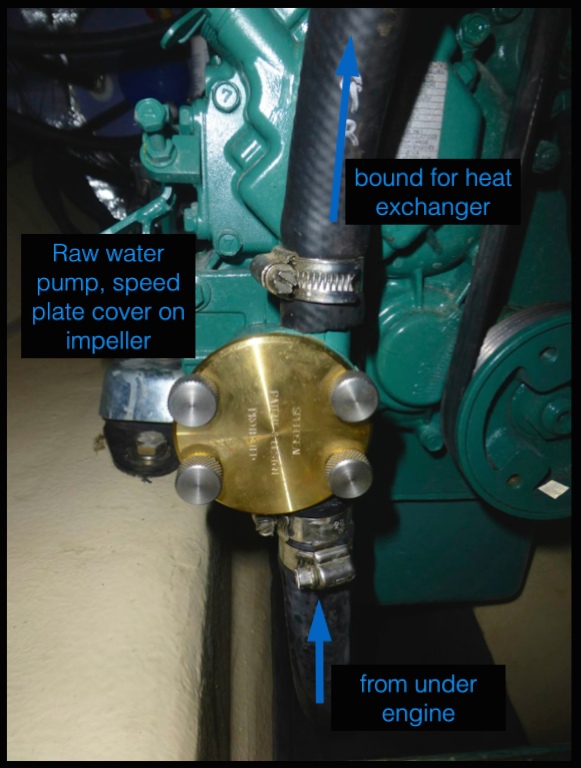
#6 I have extolled the virtues of Speedseal impeller covers in my video from Fort Lauderdale, so I will spare you another lecture. I did discover since then that the front of my engine can be reached easily by removing the panel separating the engine from the bilge. Just four screws and the fire-proof wall comes out. You learn something every day. I like fresh impellers so I change them more frequently than required. My profligate purchasing of spares must be putting at least one Volvo employee’s child through college. I hope it also keeps Two Fish running without faults.
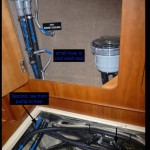
Plumbing to anti-siphon loop
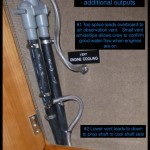
Anti-siphon loop and splices
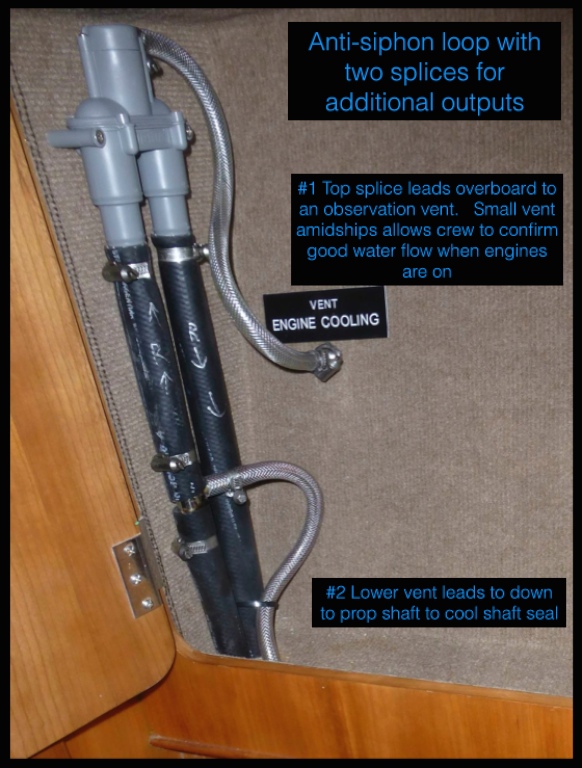
#7 Anti-siphon loops may be foreign to motor boaters since their engines are always operating while they are moving. When a sailboat is sailing, the raw water seacock can start to suck water into the boat. This uninvited water is frowned upon by most sailors. As an aside, our bilge pump for the generator locker has an anti-siphon loop that exits the boat near the bow. Originally it was too short and as the bow dove into a wave the sea water came aboard. After making the loop a bit higher we have been sea water free in the generator bilge. Our anti-siphon loops on the engine are a bit more complex. There is a valve at the peak that should be inspected with some regularity. The loop also sends raw water to other locations. At the top of the loop, the water is sent over an inspection vent. After starting the engine, you can see water coming out of this vent. It is more consistent than the exhaust water and makes it easier to see if you have a problem. If there is no water flowing out, then shut off the engine and check your impeller. The flow will be a trickle in neutral and a weak hose flow at 2,200 rpm. The second splicing of the raw water loop sends cooling water to the shaft seal.
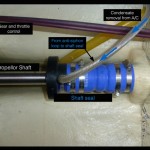
Shaft seal cooling
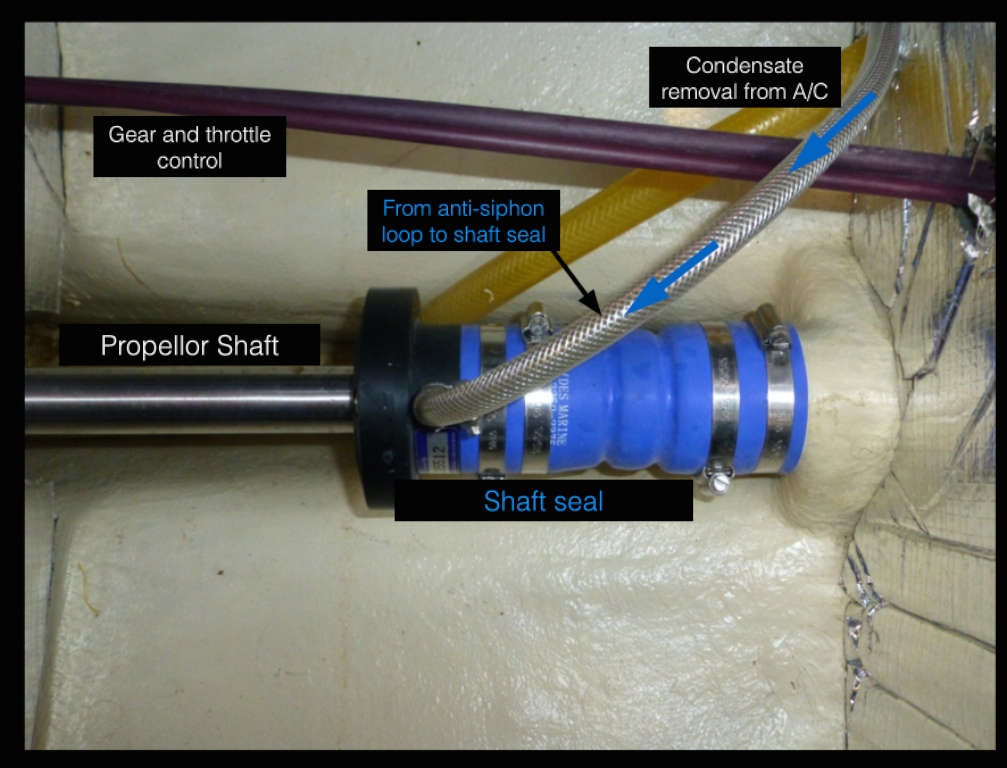
#8 The drive shaft for the propellor requires a hole in the boat. This would be problematic as water would ingress the boat at this location. Sir Shaft Seal invented a device that keeps the water out but allows the shaft to spin freely. The eponymous naming of the device always troubled the elder Sir Seal as he wished to retire in obscurity. The ingenious device has one requirement – it must have a moderate amount of water flowing through it to keep it cool. The white hose that splits off from the anti-siphon loop satisfies this requirement. This flow should be measured regularly to ensure long life of the Shaft Seal (the object, not the person).
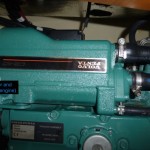
Heat exchanger
#9 After the anti-siphon loop, the water travels to the heat exchanger. We have covered the heat exchanger in much detail in the coolant loop discussion. The raw water side does need regular cleaning and also has zincs, that need to be replaced. A broken impeller may also strike up residence in the heat exchanger and this will negatively impact water flow. If you do open up this side of the heat exchanger then a new gasket will be required, when putting it back together.
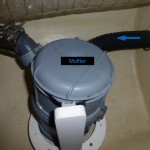
Muffler
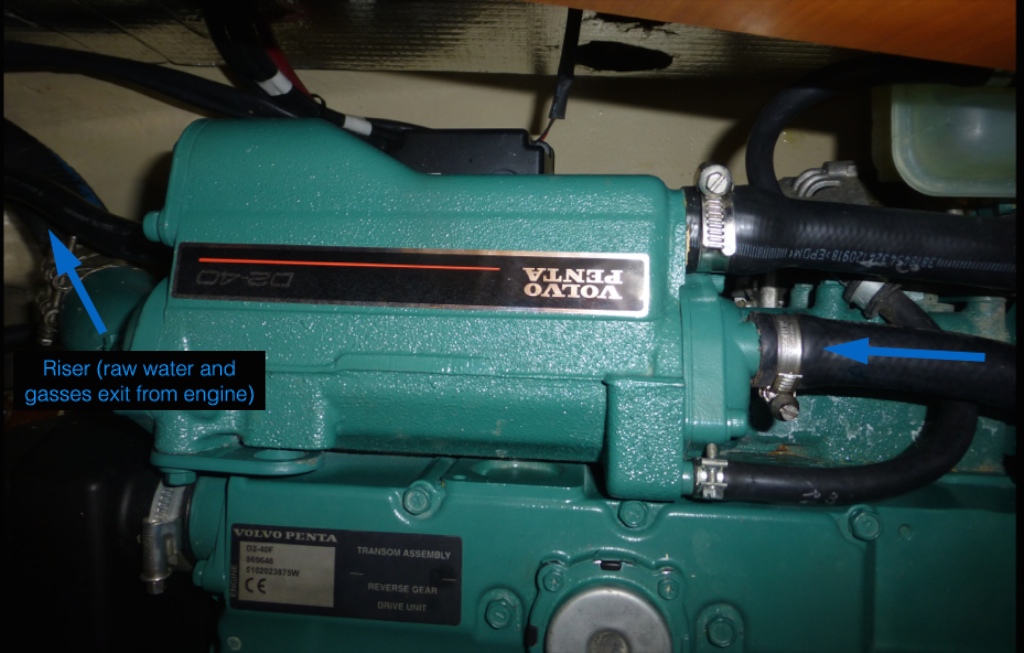
#10 Mufflers are great ways to keep your hands warm on a crisp day. However, Antares seems to have put ours in a remote location at the foot of each of the beds. The gas and raw water are mixed in the riser and now, I suppose, are muffled in the muffler. I have not worked with this device at all.
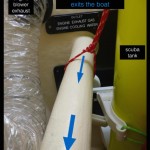
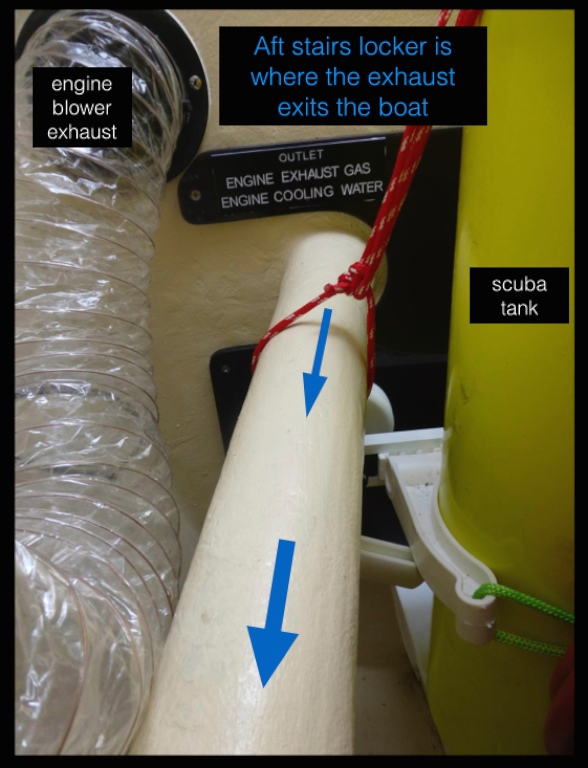
Exhaust exit through locker
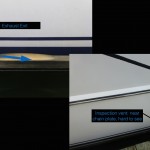
Raw water exit
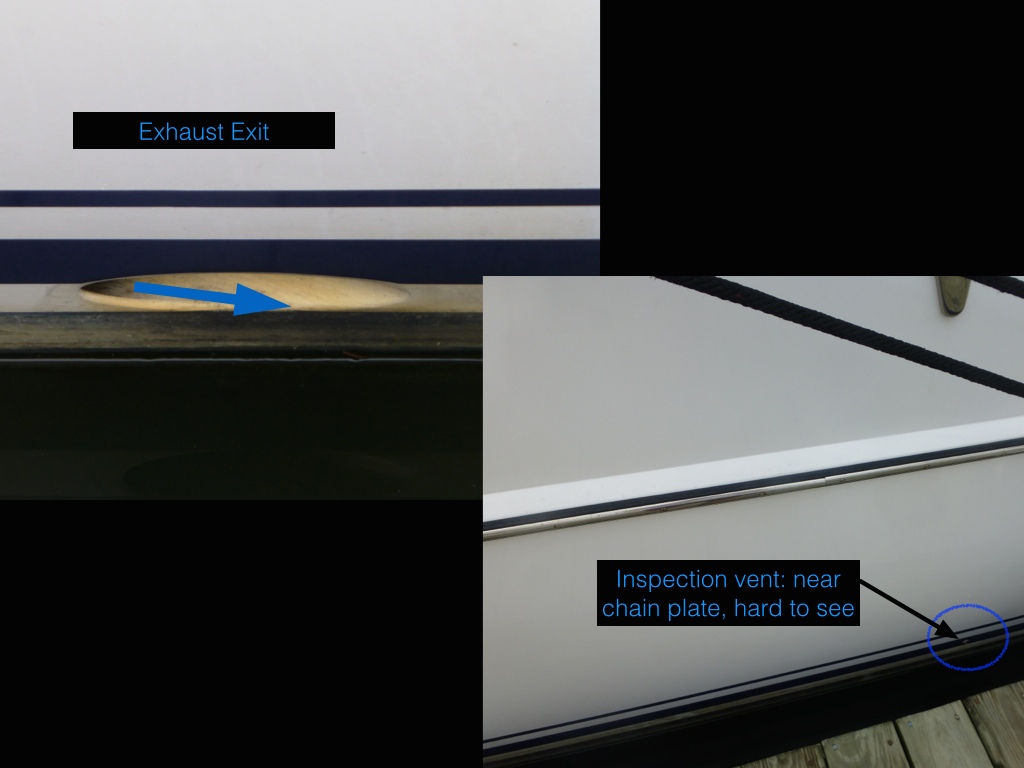
#11 Good bye raw water. After a quick sprint down a very sturdy tube that shortcuts both stern lockers, the water exits via an obvious port. The slight yellow tint is a a clue that this is the exhaust point. I hope to return it to a pristine state on the next haul-out.
Fun with Pyrometers
Using a heat gun has been a great way for me to better understand the coolant loop. We have not mastered measuring the hose temp without being fooled by heat from another source. Our engines are typically 90 degrees Celsius, which the heat gun reads at the thermostat and the gauge displays at the helm. At this temperature, the thermostat is partially closed. We do see the raw water loop gain about 10 degrees C before it exits the boat. The coolant does not drop temperature when passing through a warmed hot water heater. Unfortunately, our coolant out/in numbers were not reliable enough to publish on this post. The coolant drops roughly 10 degrees C during its cool-down lap. We will continue to perfect our heat gun technique and we will report back with more data. Take the following data with a grain of salt. Or better yet, measures yours and drop me a line with the results.
Thermostat @2,750 rpm: 90 degrees C (coolant out at end of heat exchanger 70 degrees C)
Thermostat @3,00rpm: 100 degrees C (coolant out at end of heat exchanger 80 degrees C)
Injectors @ 2,300 rpm: 77C
Top of engine @ 2,300 rpm: 75C
What was the cause of the overheating?
Attempts that did not fix the issue:
1) I dove the thru-hull twice to make sure raw water was coming in unimpeded. It was.
2) Ensured strainer was empty of obstructions, was filled with water and that the lid was sealed tightly.
3) Checked that impellers were in good condition. Replaced impellers for good measure. Tested that the speed plate upgrade did not create the problem.
4) Hours spent trying to remove coolant loop air pockets from the engine and hot water heater. Used gravity, pressure and temperature to try to coax out any air pockets.
5) Checked raw water side of heat exchanger for scaling.
6) Checked oil/coolant/belt.
7) Considered removing hot water heater from the coolant loop.
What did work:
A thorough cleaning of the coolant loop. Some brown stuff came out. I will send it to the lab for analysis. Our boat builder thinks the product is harmless and not surprising in a new engine. I think it is a bit early to have foreign product in the coolant loop, but as you know I am new to this game. After we finished cleaning both cooling loops, a friend emailed us an article in which the author described the same problem and solution. I have asked other new owners and they have brown in their coolant reservoirs. My advice: clean it now.

















































































 Designed by Team Twofish. Powered by