See You (Cu) Later

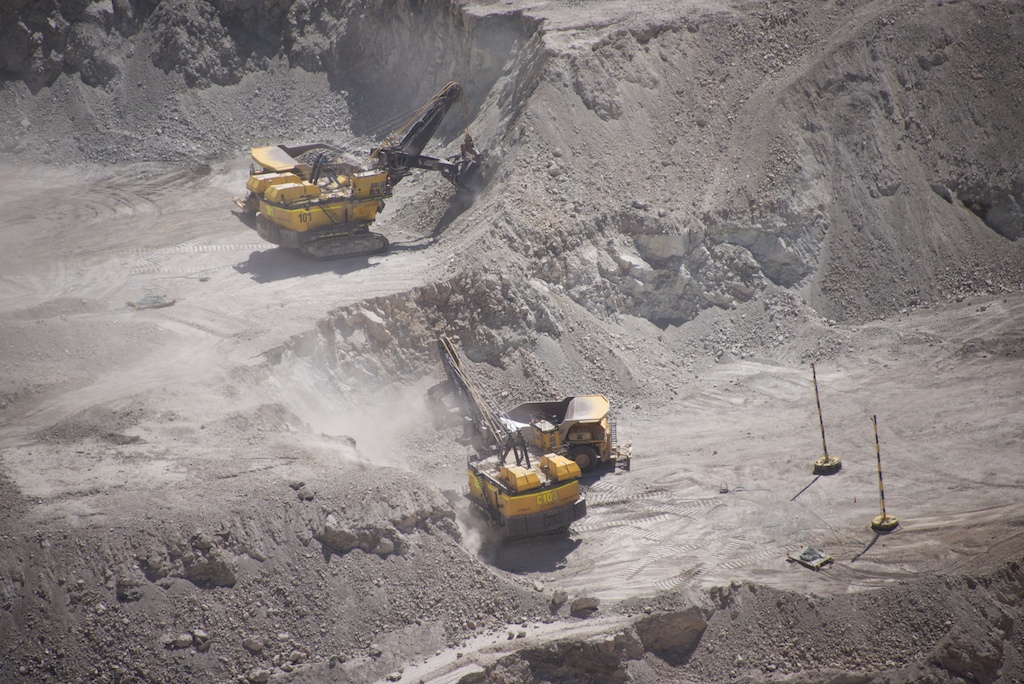
Huge Trucks

Huge Mining Trucks


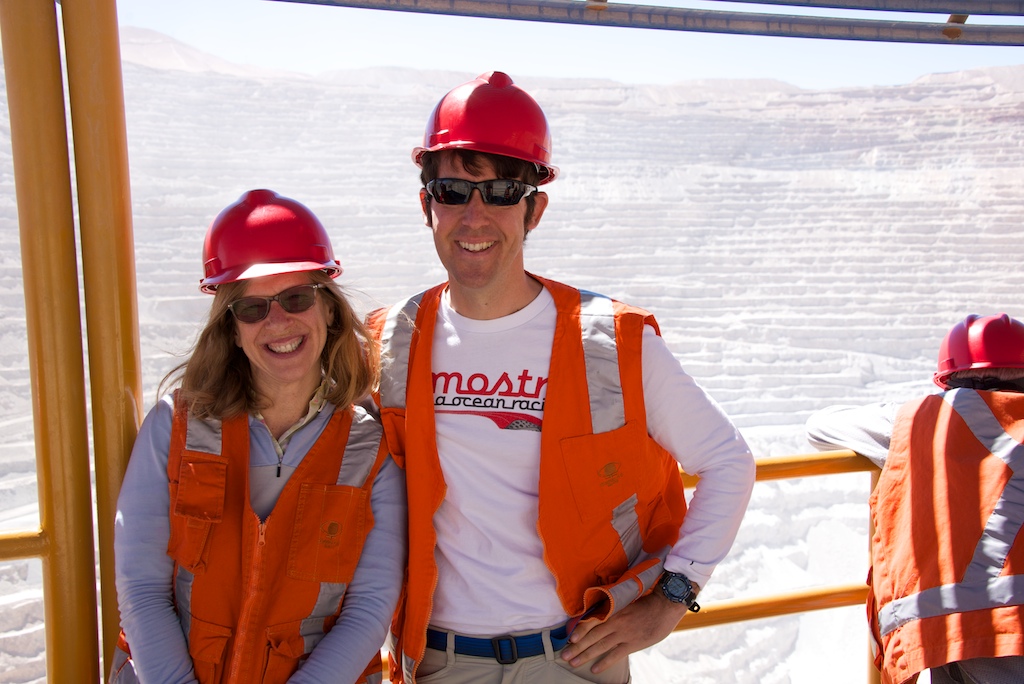
Copper (elemental symbol Cu) is the dominant portion of the Chilean economy, so we visited Chuquicamata mine in northern Chile to understand its production.

How did the Chilean government end up owning the mines?

The mines were initially developed by US and European engineers and in the case of Chuquicamata, the mine as an investment was bankrolled by the Guggenheim fund.    By the late 1950’s the bulk of the Chilean copper mines were owned by two US companies (Anaconda Copper* and Kennecott Copper).   *Anaconda Copper is now owned by BP, but does not extract any minerals; it exists to pay  for previous environmental damage done in the US.  The copper business is not clean.   Back to our story:  In 1969, the Chilean government bought 51% of the Chuquicamata mine in a “negotiated nationalization” to avoid conflict with the US.    Anaconda and Kennecott copper agreed to a plan that allowed the Chilean government to buy the remaining 49% of the major mines, if certain financial targets were achieved by the Chileans.

When Socialist Allende took charge in 1971, he chose a more aggressive approach and took all the mines with zero compensation for the North American investors.   He had huge Chilean support for this action and now on July 16 the Chileans celebrate National Dignity Day.   The United States had a cold response to Chile’s actions.    However, I can see the Chilean point of view during the 1970’s.   Copper is their country’s natural advantage. As two visitors, it is tough to judge the ownership, as the Chilean’s did gain the territory via a war with the Peruvians and Bolivians.  It was 80% of the economy in the 60’s.   How can the Chileans expect to grow with this huge asset  owned  by foreign corporations at off-market rates.

During Pinochet’s rule, the Chileans did a reversal and encouraged outside investors.  The “Codelco Law” of  1992 encouraged foreign direct investment into the copper mines and gave foreign investors protection from another round of nationalization.   The Chileans have embraced  the challenge to grow other industries besides copper, but the Chileans are still proud of the copper industry.


How do you mine copper?

Open pit mining

Open pit mining

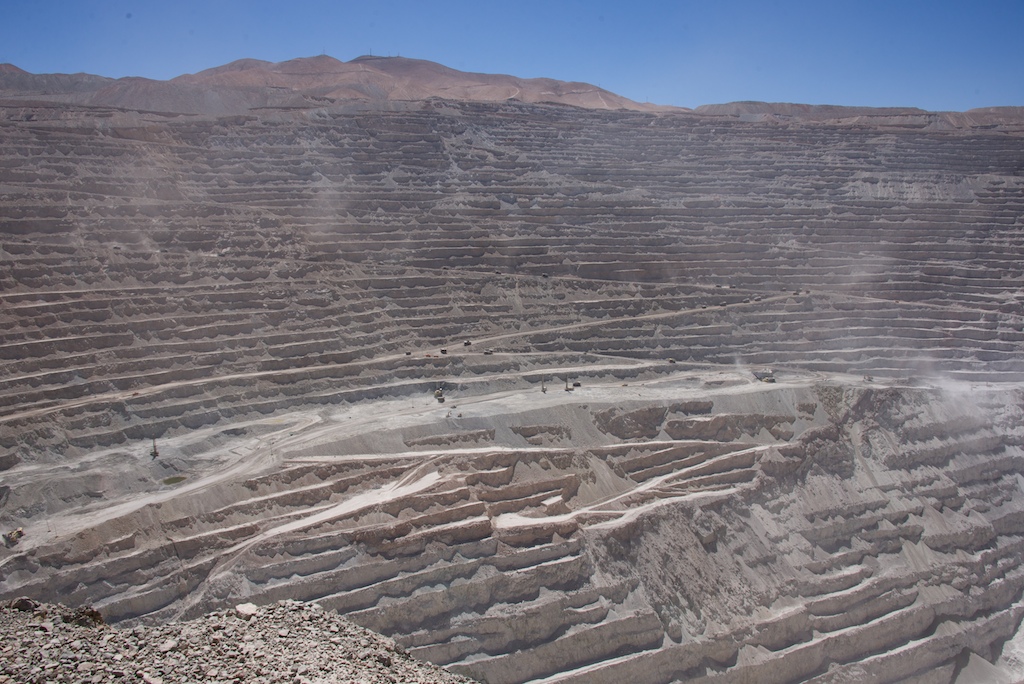
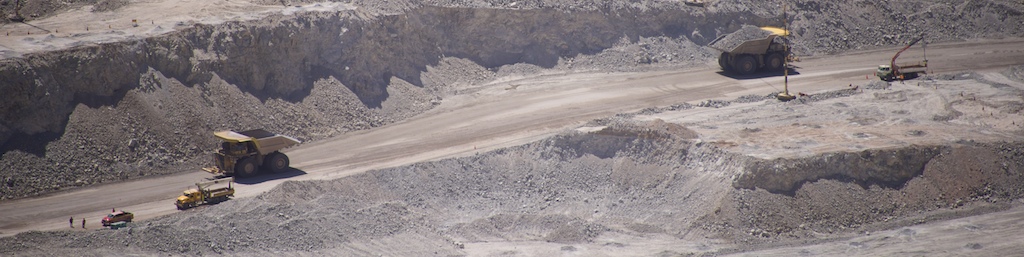
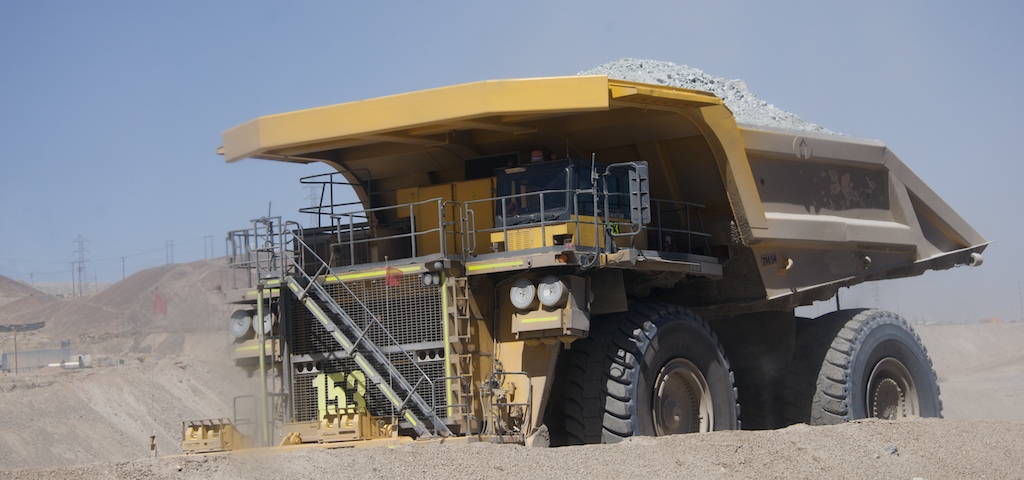
The above photo is a portion of the Chuquicamata open mine. About 90% of what you see is rock that is being moved to gain access to the copper.  This useless rock is discarded and creates many man-made hills distinguishable by their flat tops.   If you squint at the photo you can see the huge trucks whose USD 40,000 tires are 15 feet high. The copper being mined lies along the same fault that runs through Los Angeles, the San Andreas Fault.

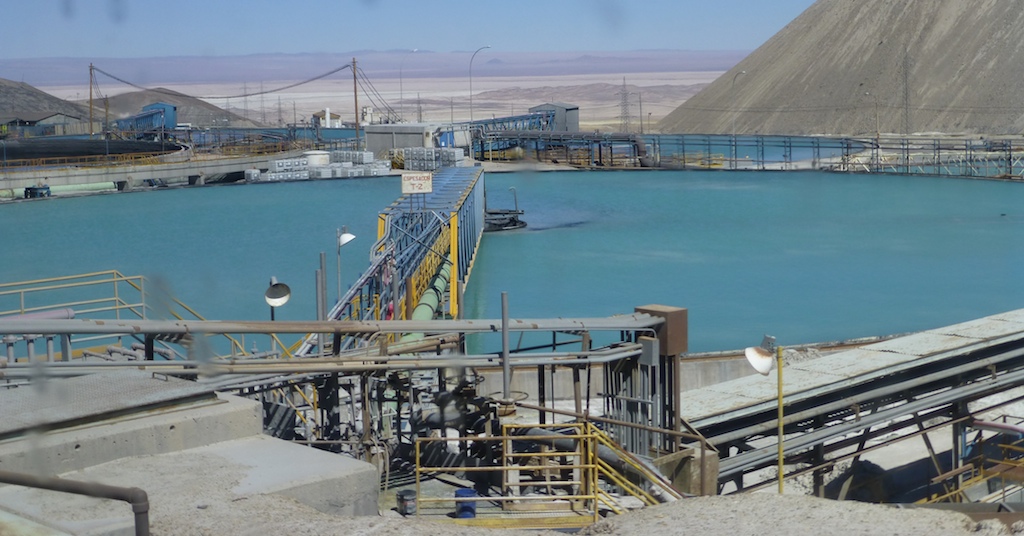
Copper ore must  be beneficiated (concentrated) since the rock is only 1% copper. The first step is crushing the ore.  We only saw the outside of a very large building with lots of pipes, conveyer belts and plenty of dust that was dedicated to the manly task of crushing rocks.  Much like coffee, the iron ore is roasted to convert sulfides to oxides.    After the crushing process, electrolysis raises the copper purity to 99%.  There are two types of copper ore from Chuquicamata, sulfide ores and oxide ores.  Oxide ores do not require roasting and thus are less costly to mine.   I skipped a few steps since I doubt any of our readers plan on opening a copper mine.   The skipped steps are floating the copper ore in a pool to sort the copper from the other content, drying the output and dousing it with Acid.

2 CuS + 3 O2 → 2 CuO + 2 SO2
CuS + O2 → Cu + SO2

This is dirty work and there are many toxic by-products such as sulfuric acid and arsenic.   At Chuquicamata the sulfuric acid is reused in the copper extraction process.   They even have a bunch left over which they sell to other users.   As for the arsenic, it is a sad story as the local water and the blood of the residents nearby have heightened levels of arsenic.   The copper company guide did not highlight the arsenic issue on the tour.


The Town of Chuquicamata 

Chuquicamata Town

Chuquicamata Town

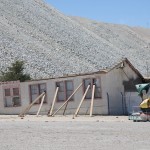
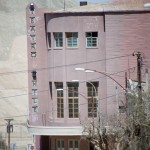
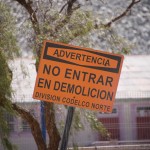
When the Chuquicamata mine was founded almost 100 years ago it was more than a one company town.   It was a town owned by the copper mine.  The residents were all miners and their families.   The company owned the land, houses, church, school and stores.   As the environmental problems of living close to the mine became evident, the company decided everybody had to move.   The miners were given new homes in the town of Calama.   The company has decided to “freeze” the town in time.   During our visit, a worker was watering the grass in the main square.

At the same time, Coldelco, the mine owners, have allowed for large portions of the town to be buried with the mine waste.   A huge rock pile covers the hospital.   Walking the town during the tour was eerie.   I though I was in a Sci-Fi movie in which aliens had snatched all the humans.  Thirty thousand people used to live in this town.  Their new housing may not be as charming, but their blood stream will thank them for having fewer toxins.


Read full story  · Comments { 8 }

El Desierto de Atacama

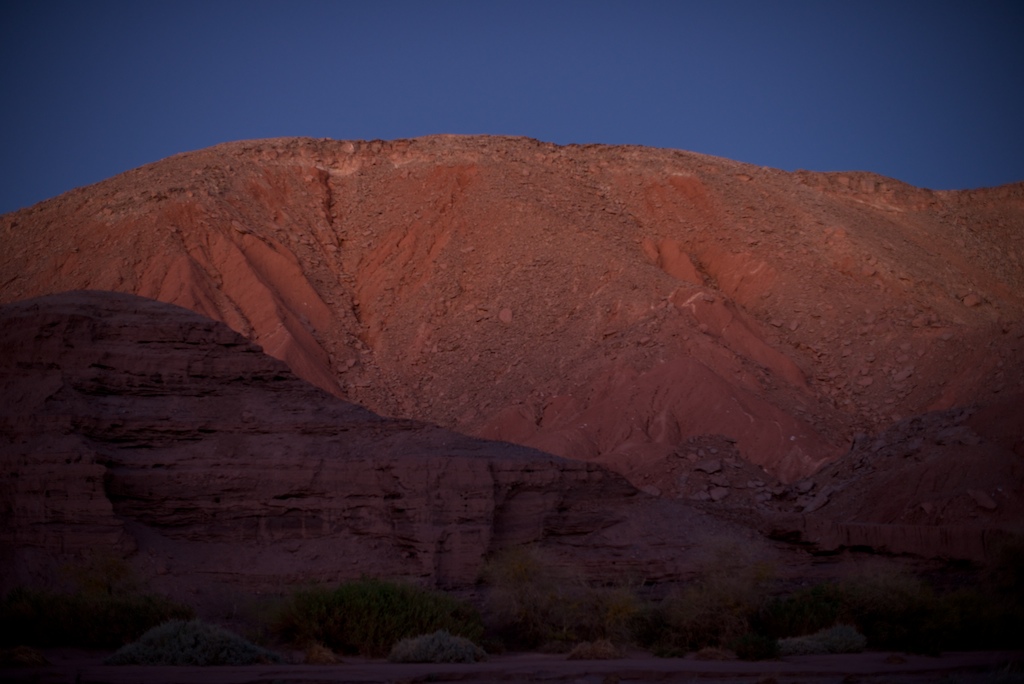
Soon we will be heading out to the Atlantic, so we decided to explore the opposite end of the spectrum-the Chilean desert.  The desert really suits me. The top five things I like about the desert are: Number 5- Sand is really soft to fall on (click here to see our sandboarding attempt), Number 4-it is only one letter away from dessert; Number 3-limited bug population; Number 2-it is warm; and, the Number 1 reason-the low humidity keeps my hair under control.

Oh, yes, of course it is beautiful and the landscapes are like nothing I have ever seen before.

Night Falling

Night Falling

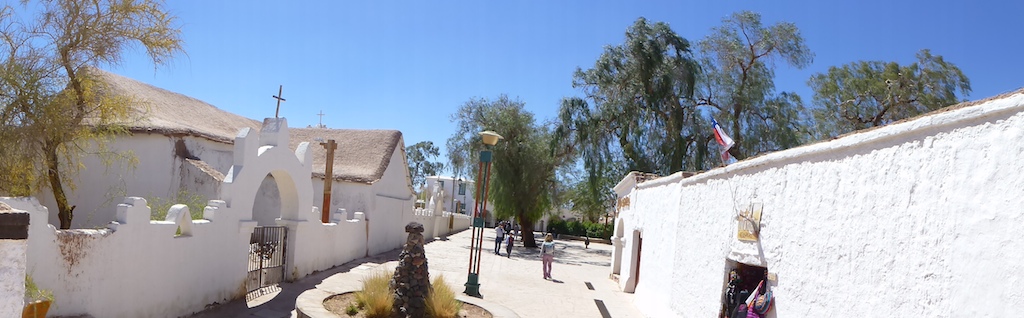
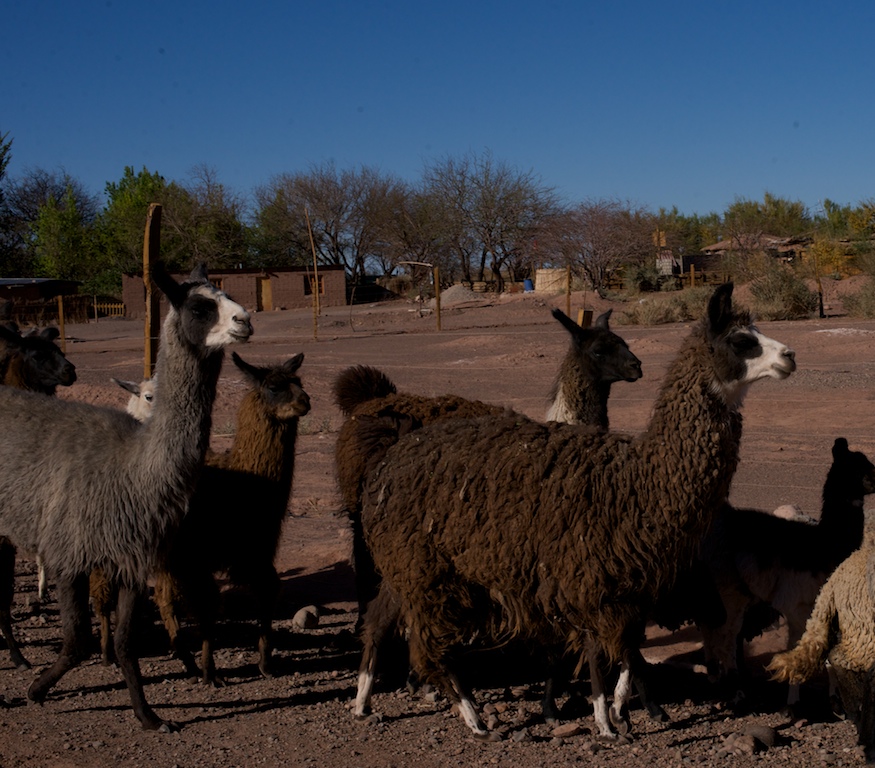
Our town is San Pedro de Atacama in Northern Chile, very near to Bolivia and Argentina. Years ago, before the Spaniards, these regions shared a common culture and way of life. These days, the Bolivians want the land they ceded to Chile in a 1904 Treaty, and Argentina never turned on the pump to Chile’s heavily invested LPG pipeline, so the Pueblos don’t mix as much. (Ask Jason if you want to know more about Nat Gas politics.)  Many years before that, the Incan trail passed through the area.
The town is at 7900 Feet Above Sea Level. We stayed at a wonderful hotel and Cristobal, our local guide, led us on our daily excursions. Although I could hear Paul Theroux sneering in my ear at our pampered existence, we enjoyed it thoroughly.  The town is filled with small shops and hostels but was originally a small settlement. At the local museum, we learned a bit about the progression of settlers: the Atacamans, then the Incans, followed by the Spaniards. The Spaniards were fooled into coming over the mountains because the Incans told them there was gold to be found. They were greeted by a barren desert. Good way for the Peruvians to get the Spaniards out of their hair.

San Pedro de Atacama

San Pedro de Atacama

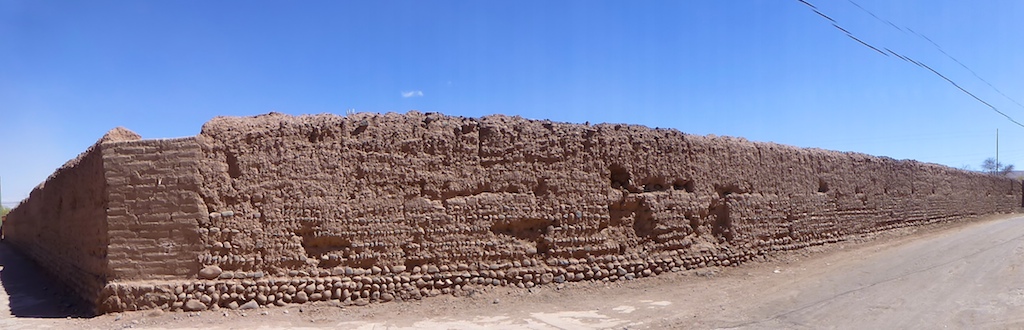
Most of the buildings are made of adobe and many have adobe walls around a small courtyard. The adobe walls are great at keeping the afternoon desert winds away.

Adobe Wall

Adobe Wall


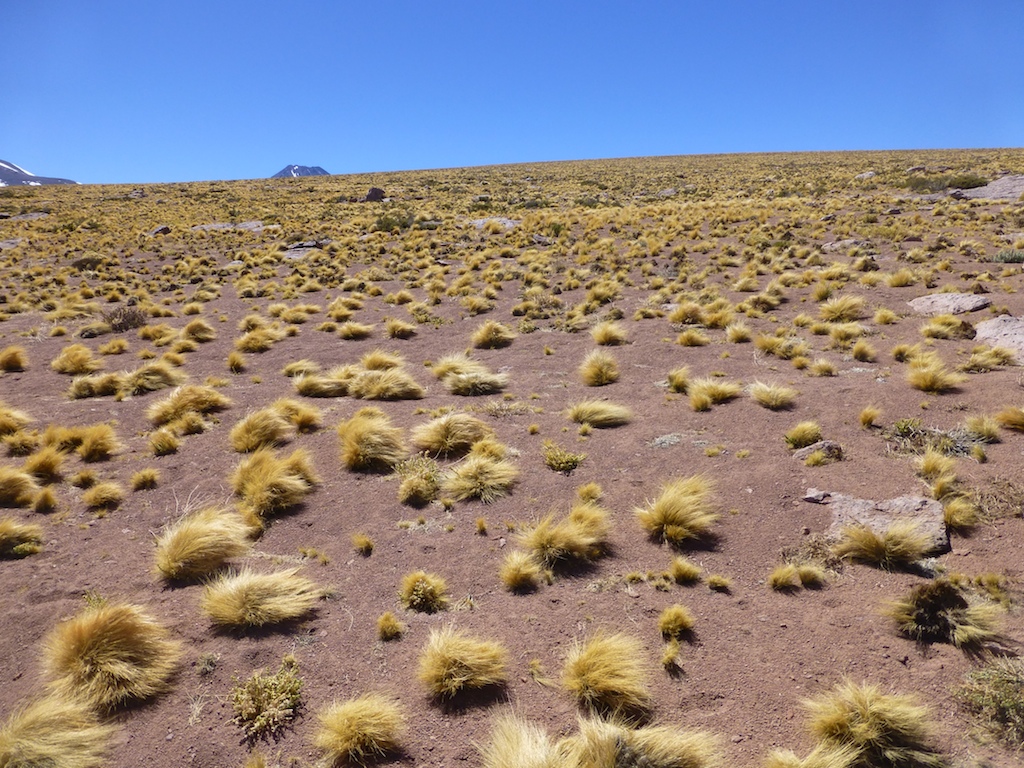
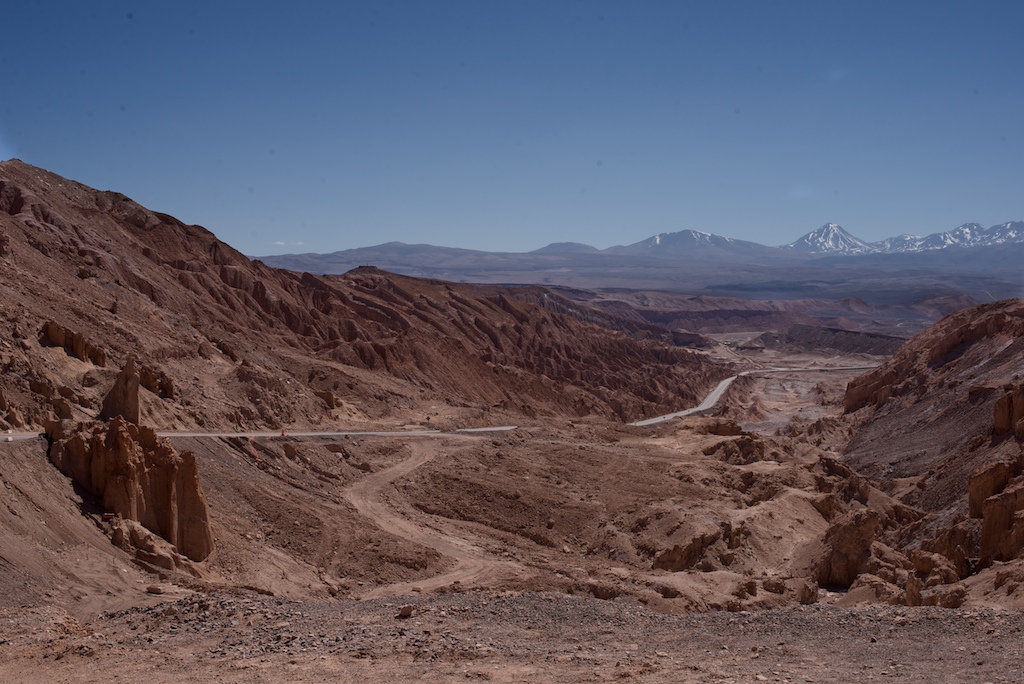
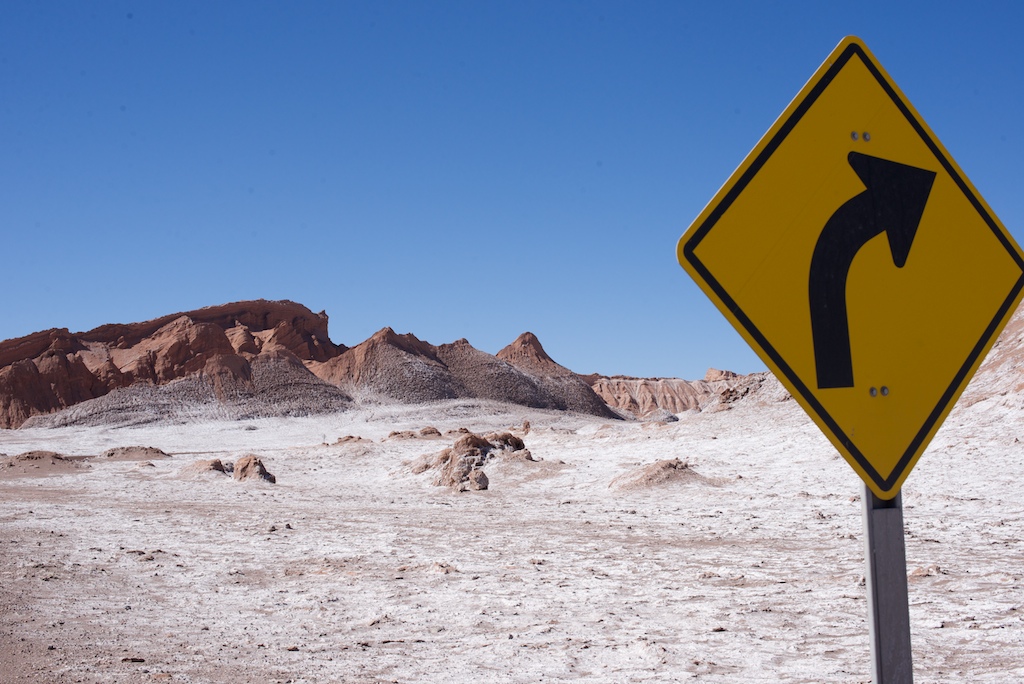
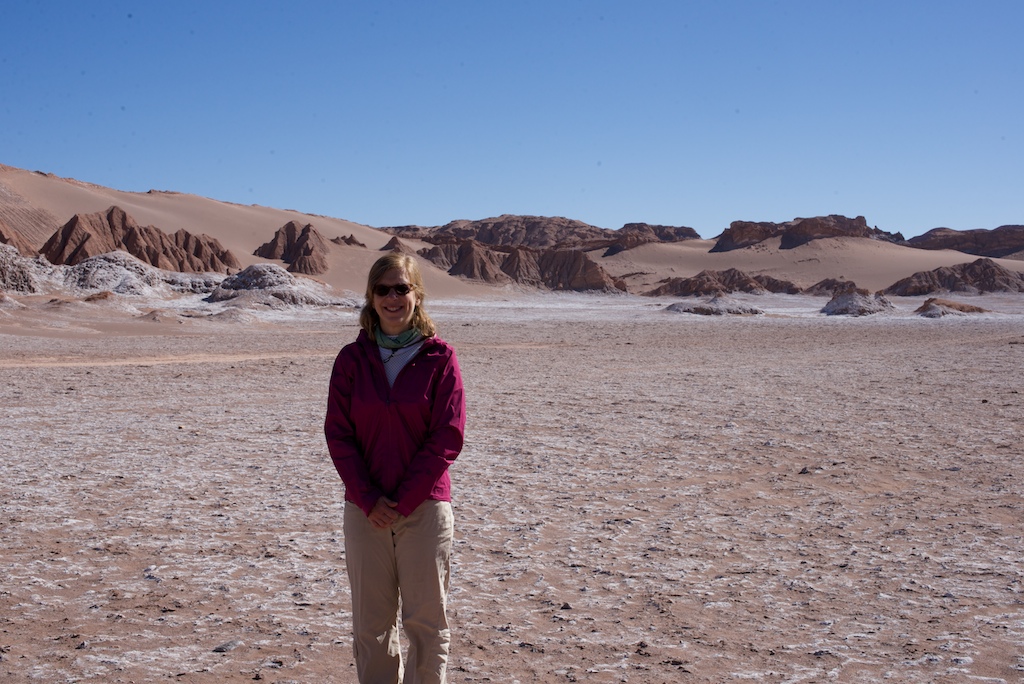
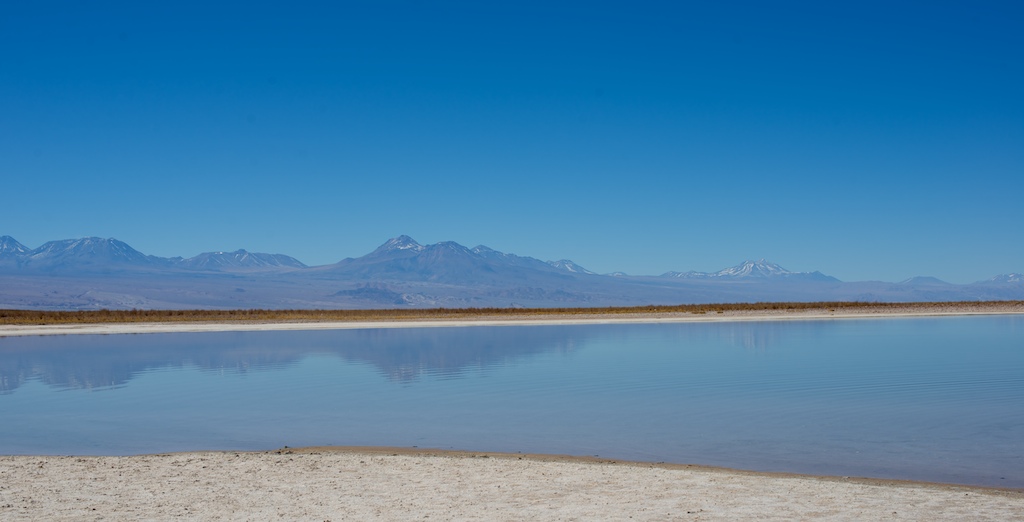
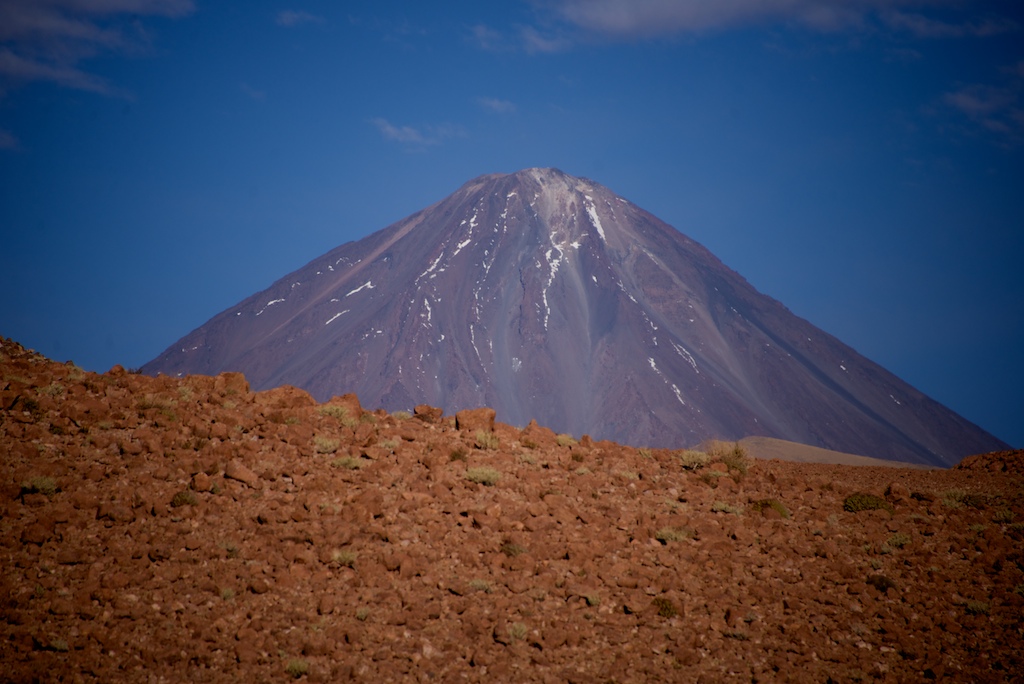
The most striking thing about the landscape is that it goes on forever, and is extremely flat, except for sudden defined mountain ranges, caused by earthquakes and volcanoes. There are large salt flats, made up of salt from the volcanoes; the salt was brought by the water run off and then left when the water evaporated. Its composition is a bit more toxic than table salt so I wouldn’t recommend it.

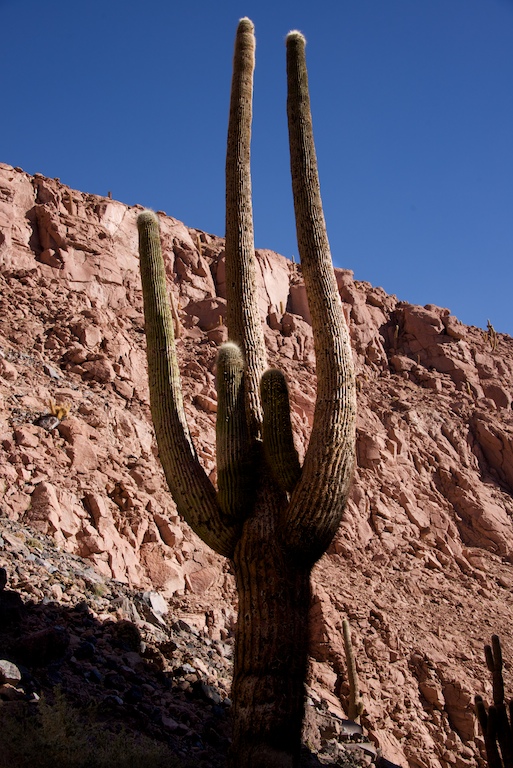
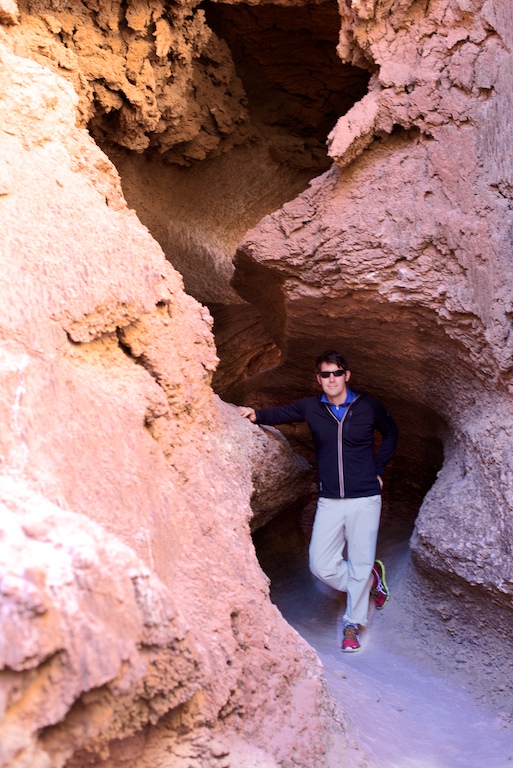
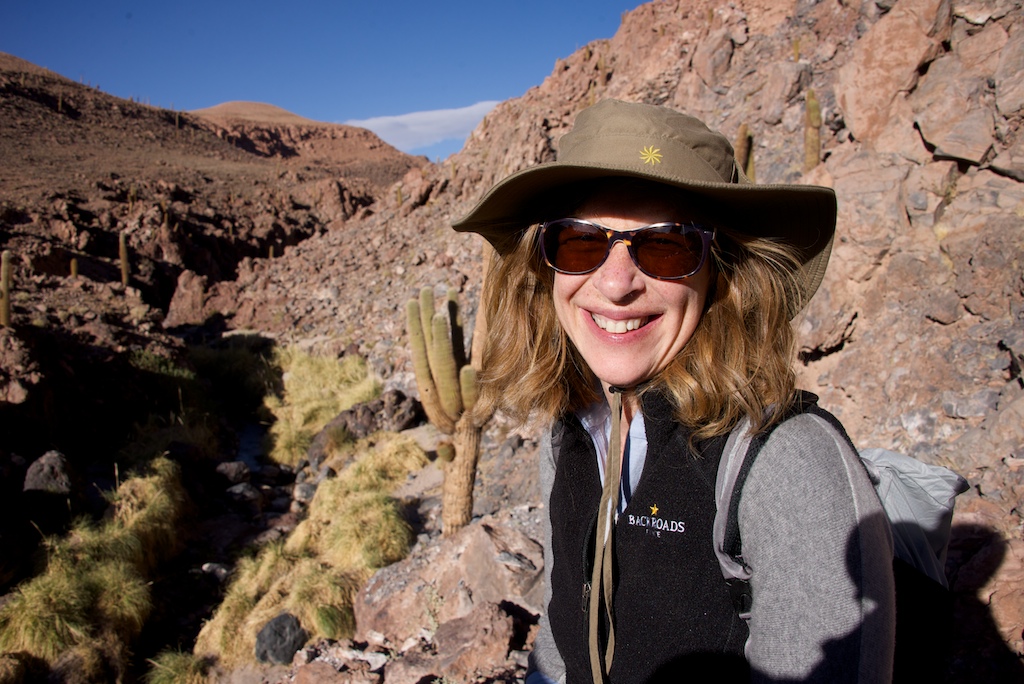
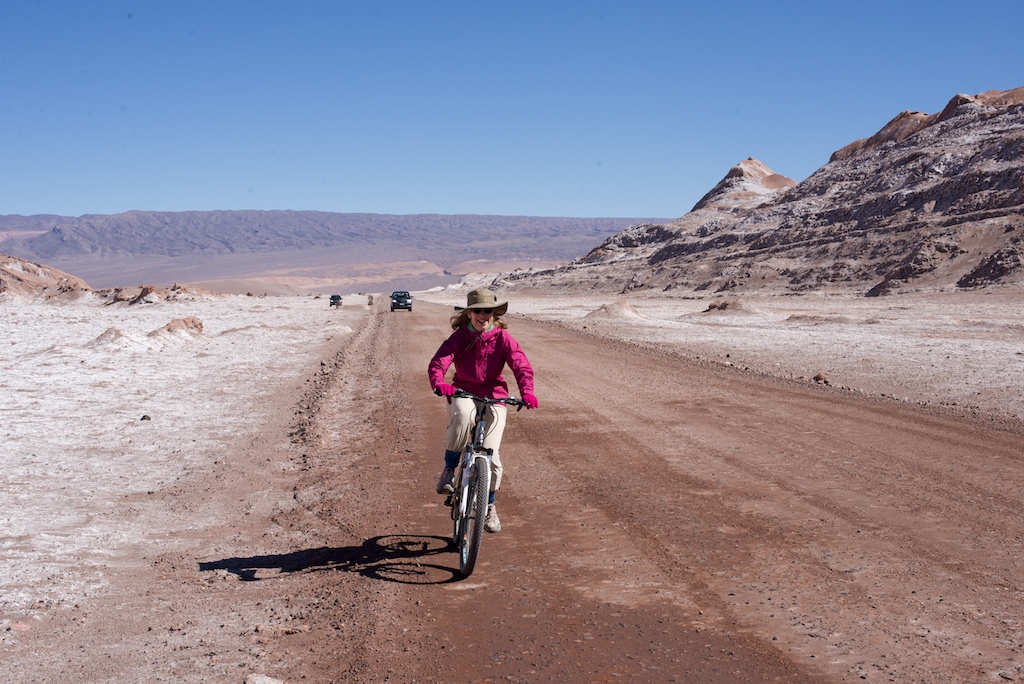
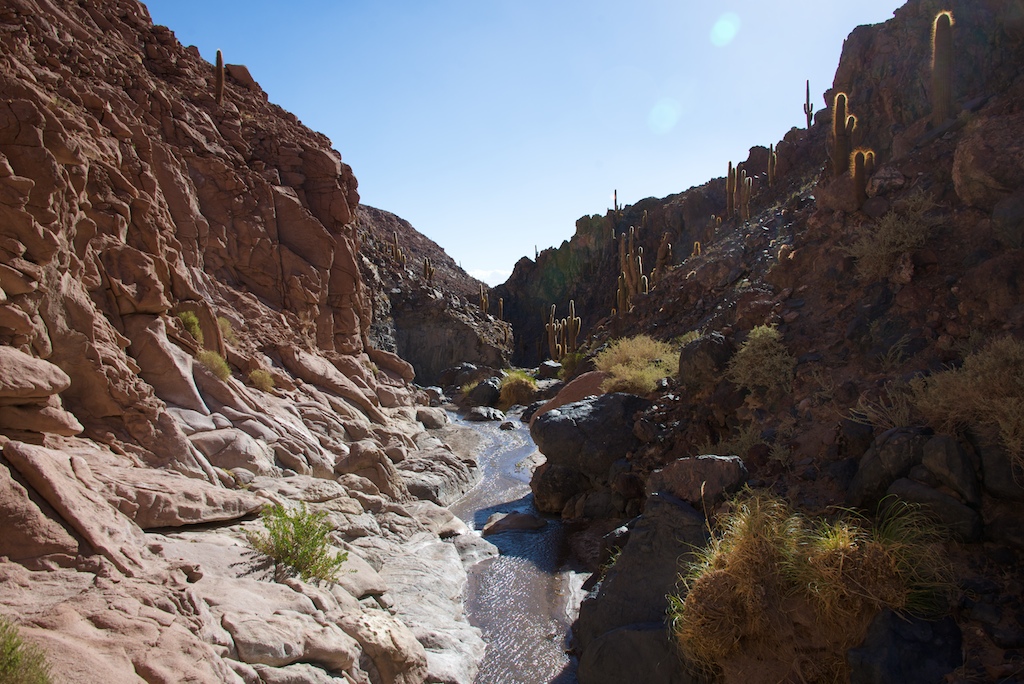
Each morning and afternoon we went for a hike or a bike ride.  We enjoyed hiking in Guatin (translates to Valley of the Cacti) and seeing the tall, several hundred year old cacti with their intricate root systems. At Valle de la Luna, the landscape is formed by crystallized salt, embedded with clay. We walked through areas that were once salt mines, and in the distance could also see abandoned sulfite mines as well as mines from the latest Chilean export, Lithium.

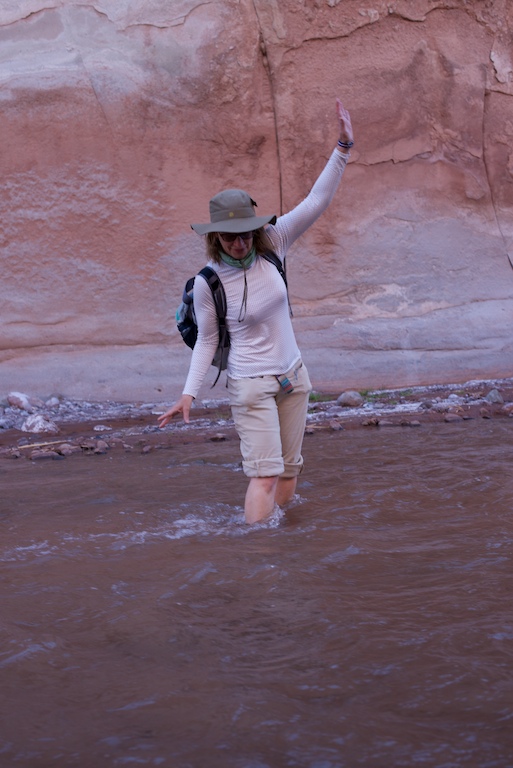
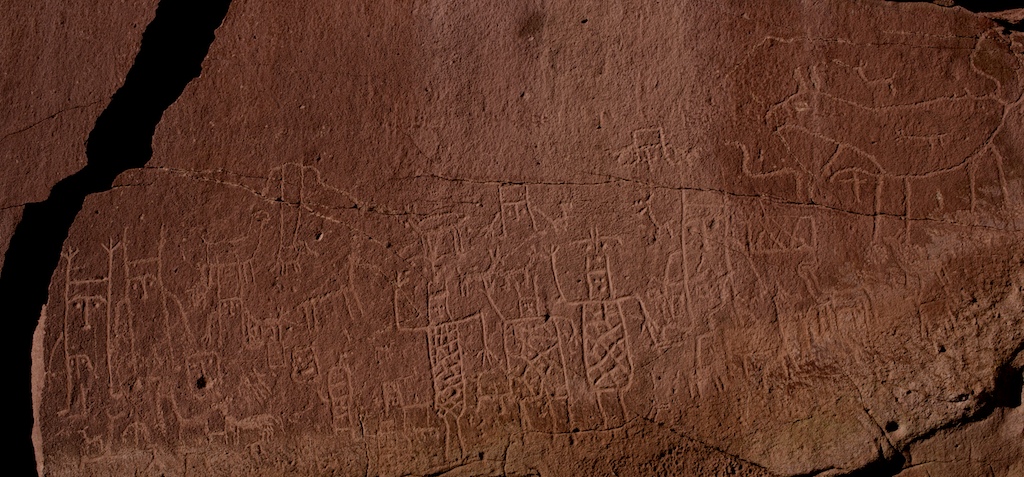
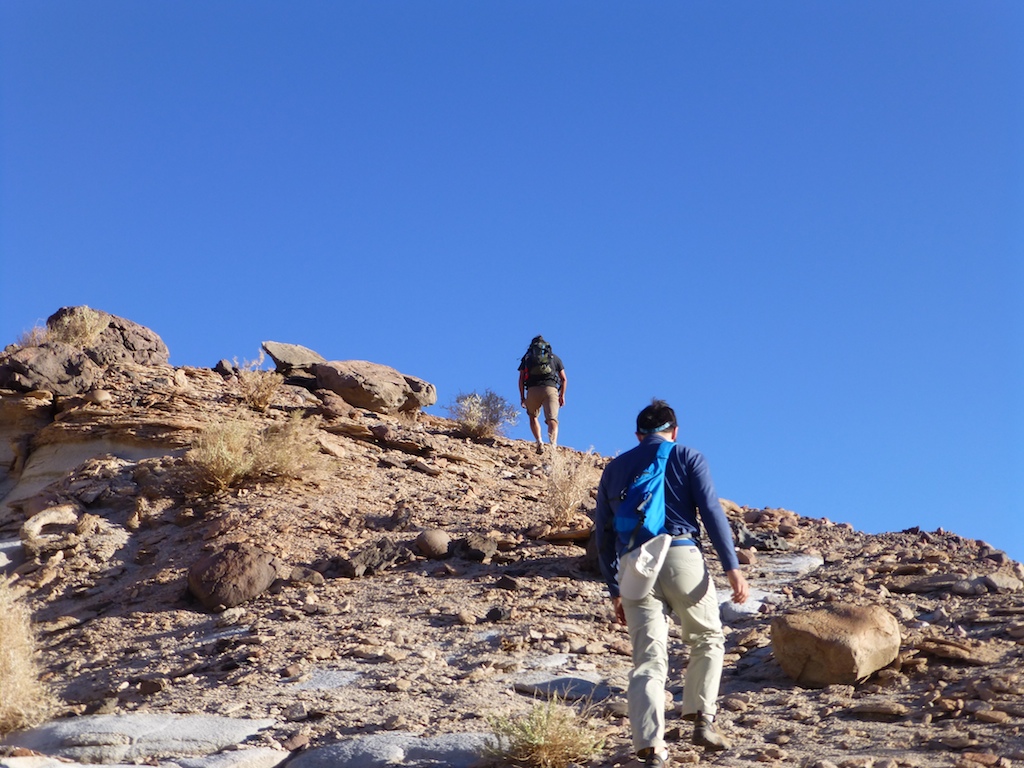
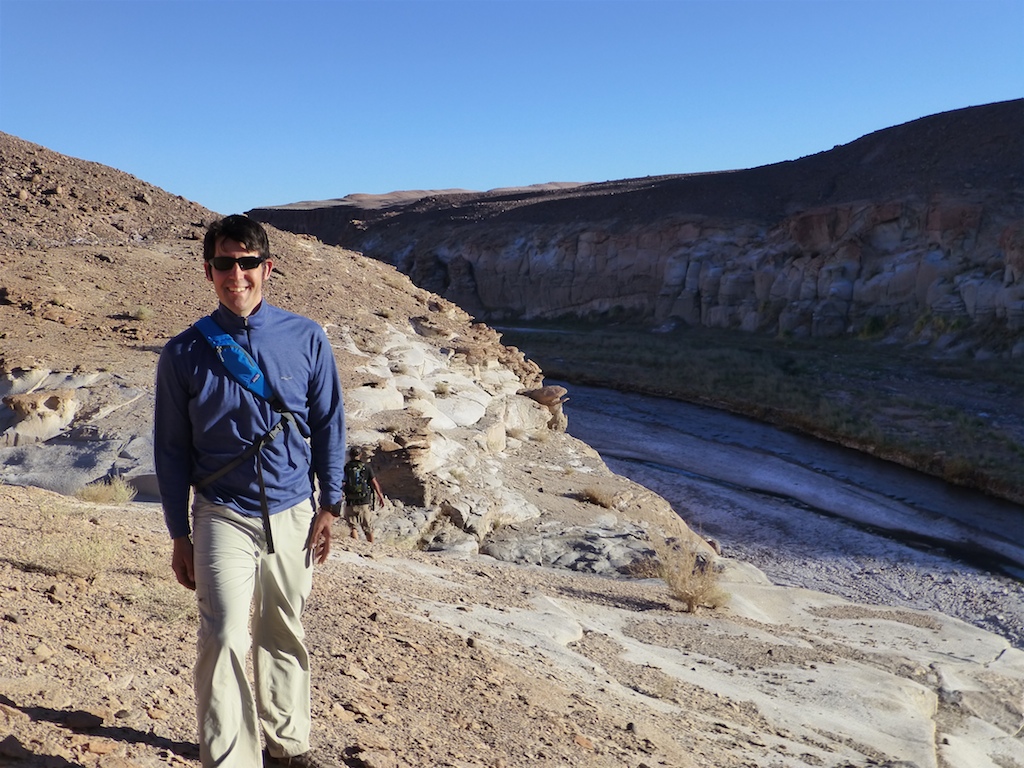
The bike paths were a bit rocky, but the real adventure came one afternoon on the banks of the Rio Grande (the one here is not quite as grande as the on up North). We started off at the petroglyphs, which had been left by the Atacaman Nomads and augmented later by the Incans. There are lots of opinions as to what they represent. Maybe they were messages for following travelers, markers for places to come back to, or told the history of important events? When the nomads were traveling through here, the Rio Grande had animals and vegetation along the banks to sustain them. Despite the smaller size now, Cristobal warned us that we would have to traverse the cold river during the hike. After wading through once, we opted to climb up the steep slope, rather than wade through a second time. Little did we know that we were forging a new, somewhat tricky path along the ledge. It took a bit longer to find a feasible way back down than we had planned for, so by the time we waded through the Rio Grande one last time, the sun was setting and Edwin, our 4×4 driver, was walking the banks wondering whether we had been eaten by a puma.

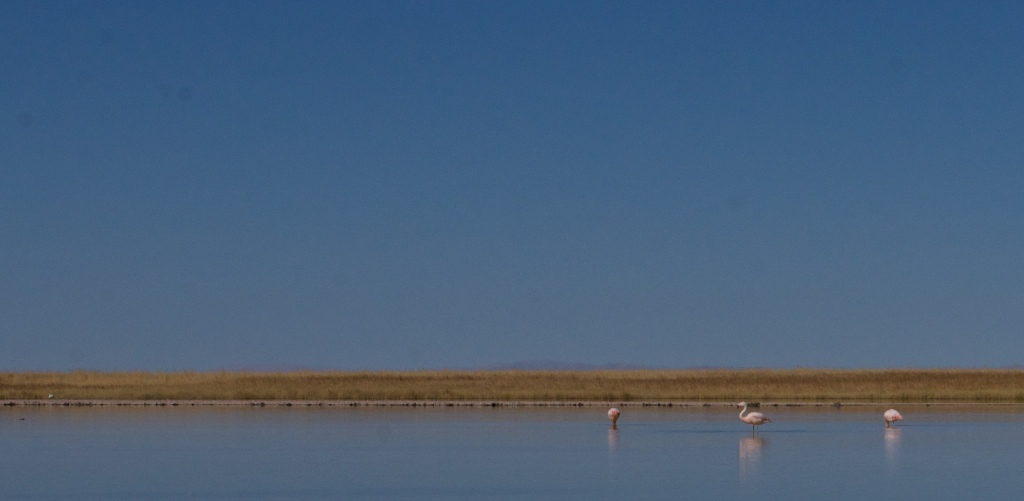
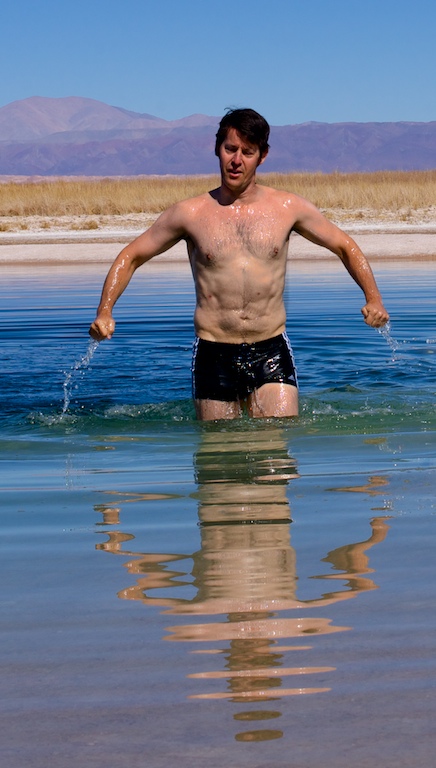
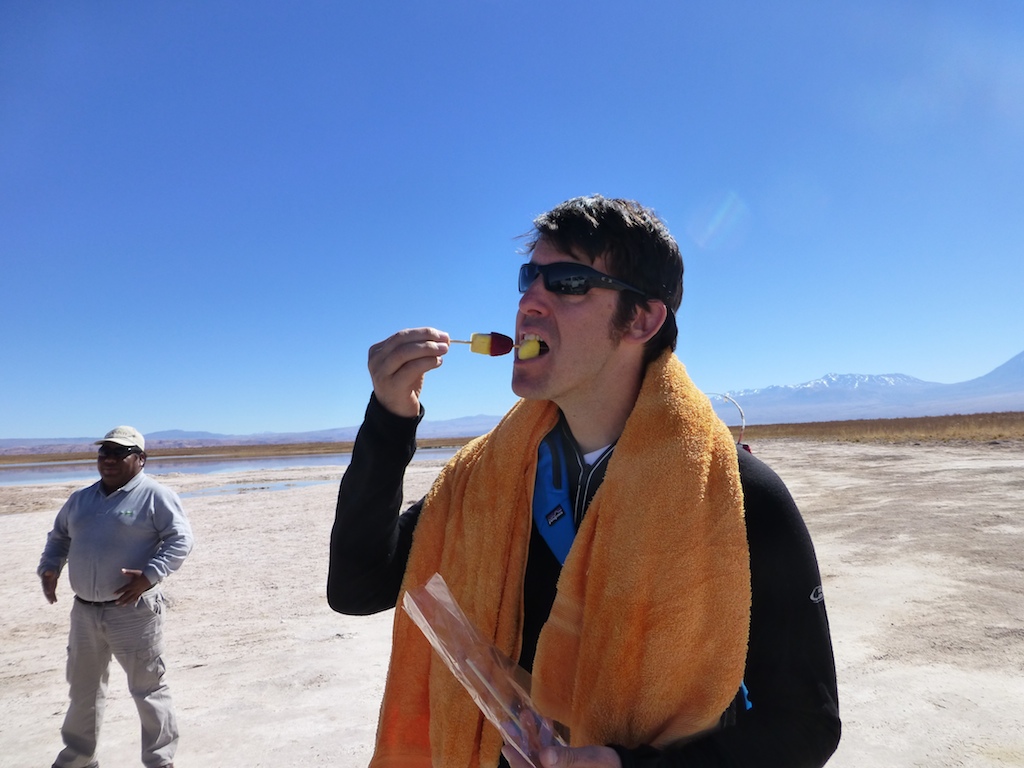
Of course, when we were told about a lake that was so concentrated with salt that one could easily float, the local Polar Bear, aka Jason, had to give the ice-cold water a try.  I stayed onshore and looked at the flamingoes.

We and a few other hotel guests went stargazing with a local guide and astronomy expert. His combination of local and astronomical knowledge together with boundless enthusiasm made for a great evening. Click here to find out more about his efforts.

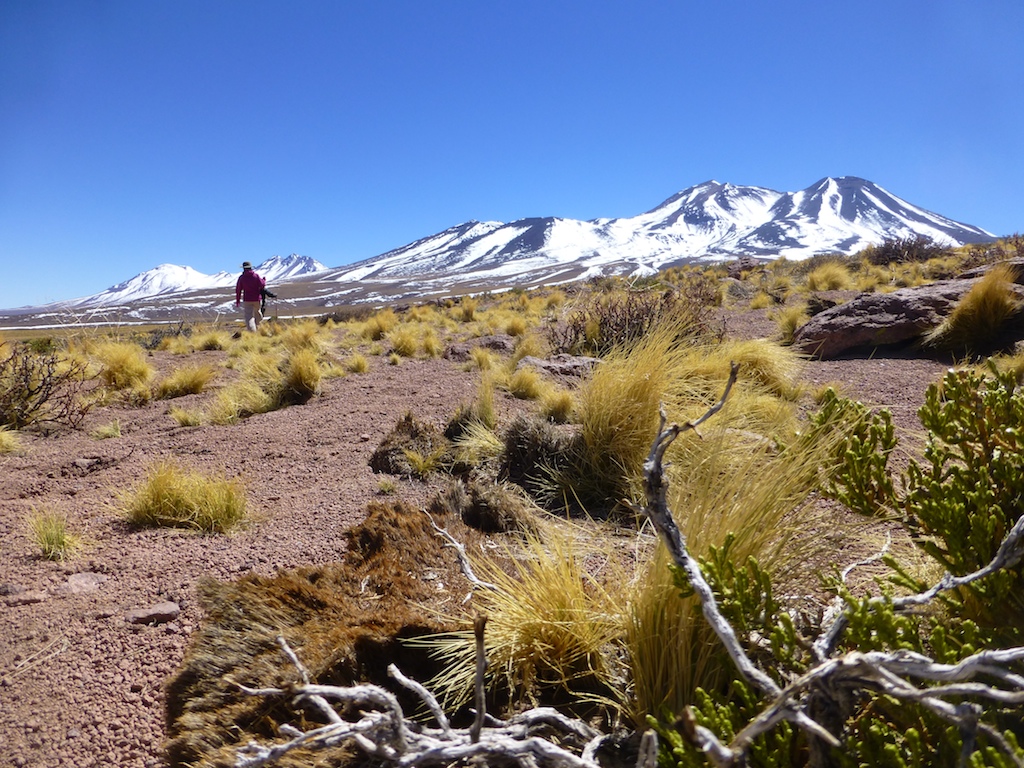
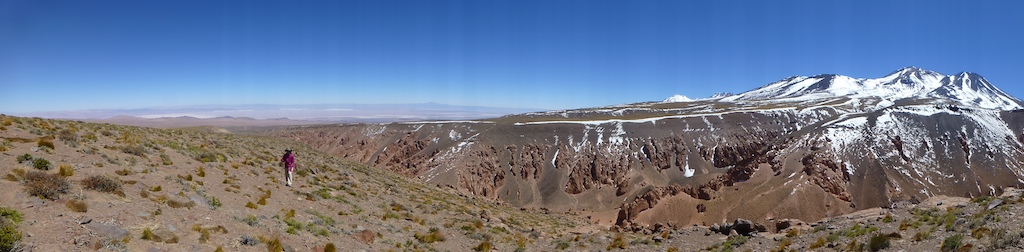
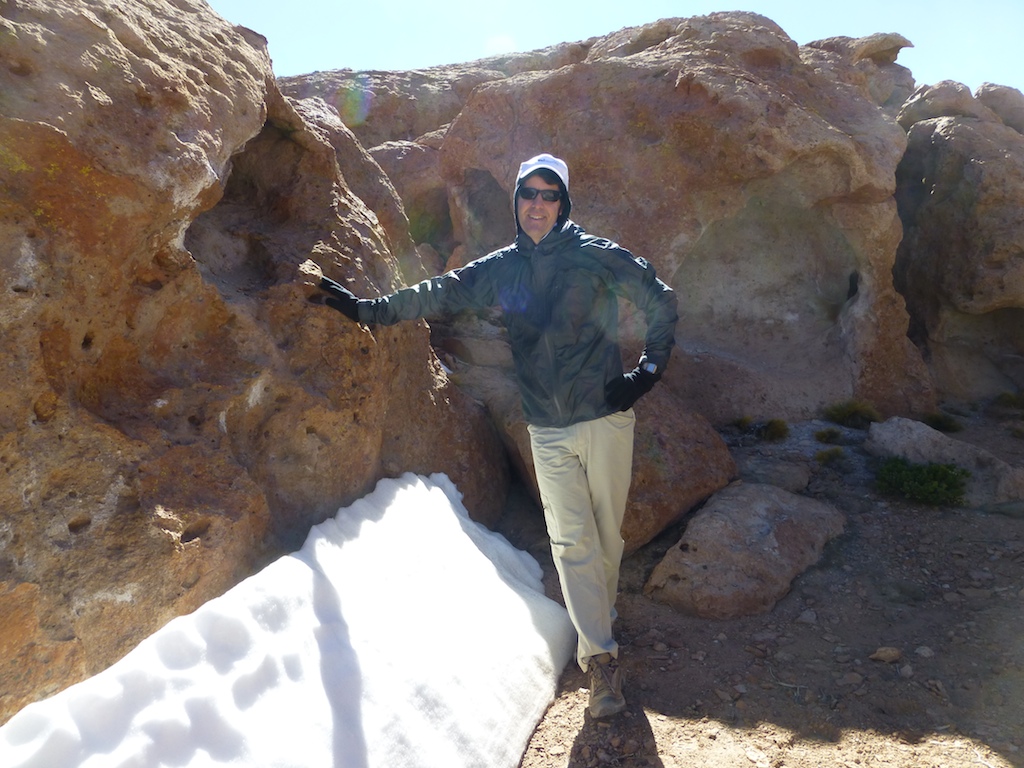
For our final hike, we chose to go to Quebrada de Nacimiento (13,760 Feet Above Sea Level) . The hike started with a rocky uphill climbing from 3000 to 4150 meters. Not quite Everest base camp but I could feel the uphill. Have any of you noticed that when you are the slowest hiker, you often get fewer rests because when you catch up to the others they are ready to move on? At least we all ended at the same spot and I, too, got to sit down and enjoy the view.

Final Hike

Final Hike

Read full story  · Comments { 4 }

Valparaíso, Chile – Port City

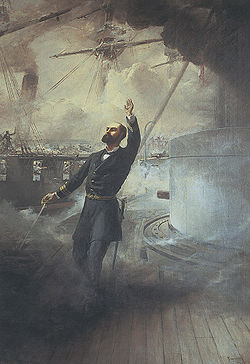
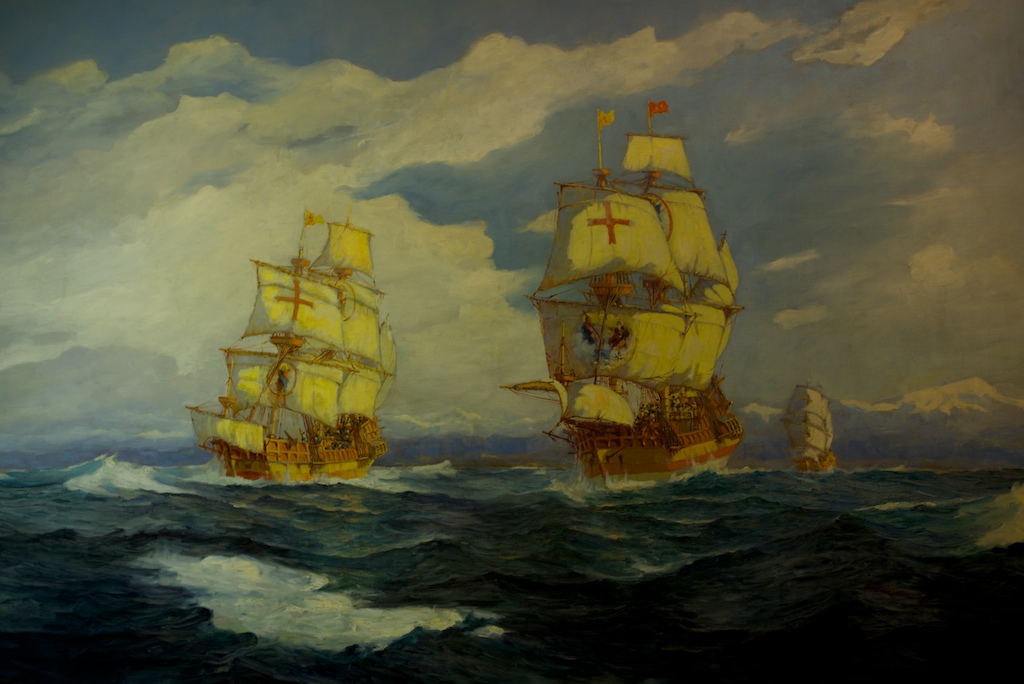
(Left: Painting from Naval Museum of Sailing Ship Rounding Cape Horn)

In 1914 the Panama Canal opened, creating modern shipping.   Like any seismic change, the impact of the canal would be felt half a world away in Valparaíso,  Chile.   The town was booming from the shipping of copper, nitrates, guano and California gold from the Pacific to the Atlantic.   Valparaíso is a wel-situated stop before rounding the dangerous Cape Horn.  The Porteños of  Valparaíso (Port people) became rich.  The term Porteños is used for residents of BA, Valpo and a port city in Costa Rica.    Hmm, may be New Yorkers should join the club.


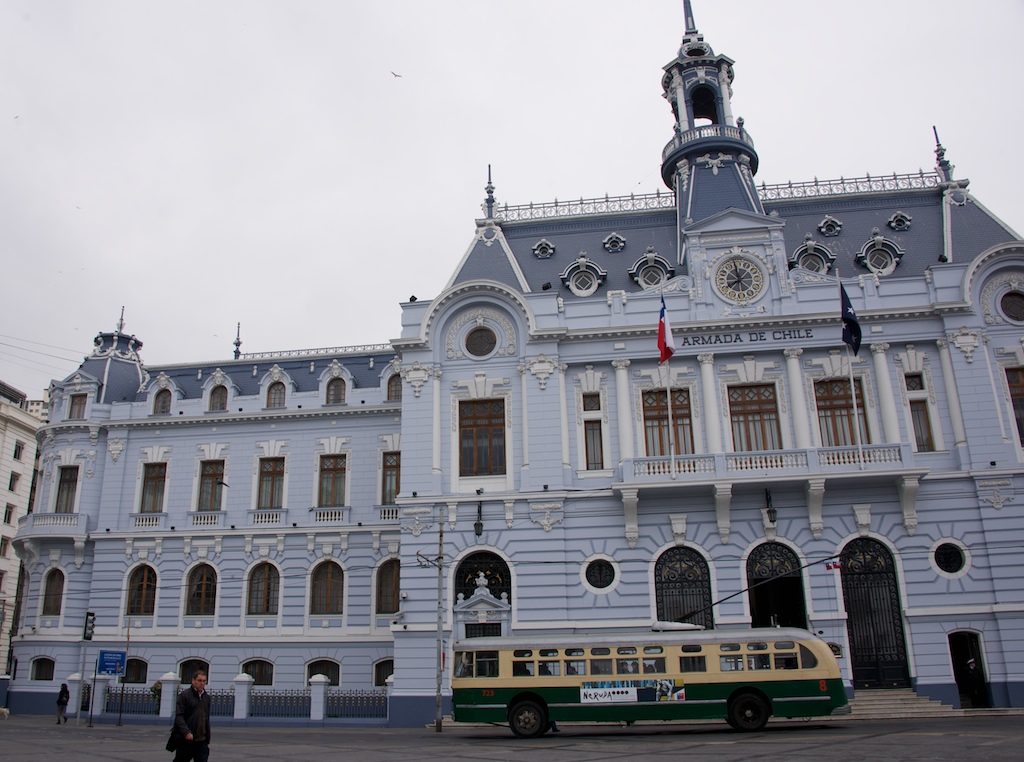
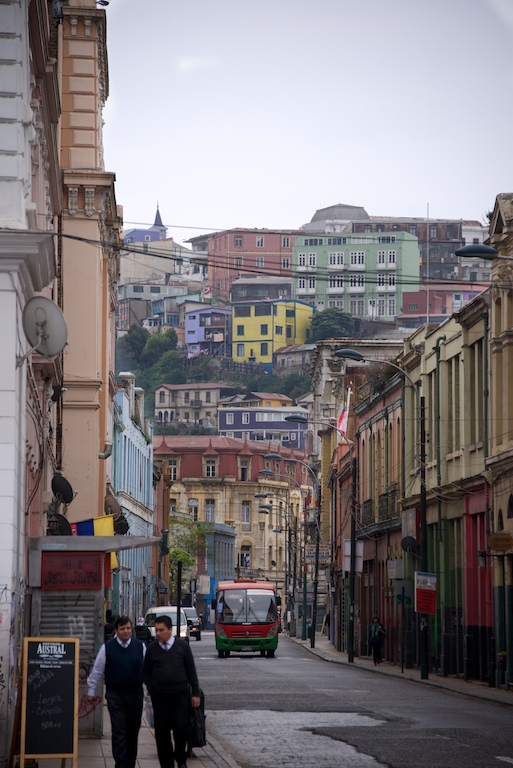
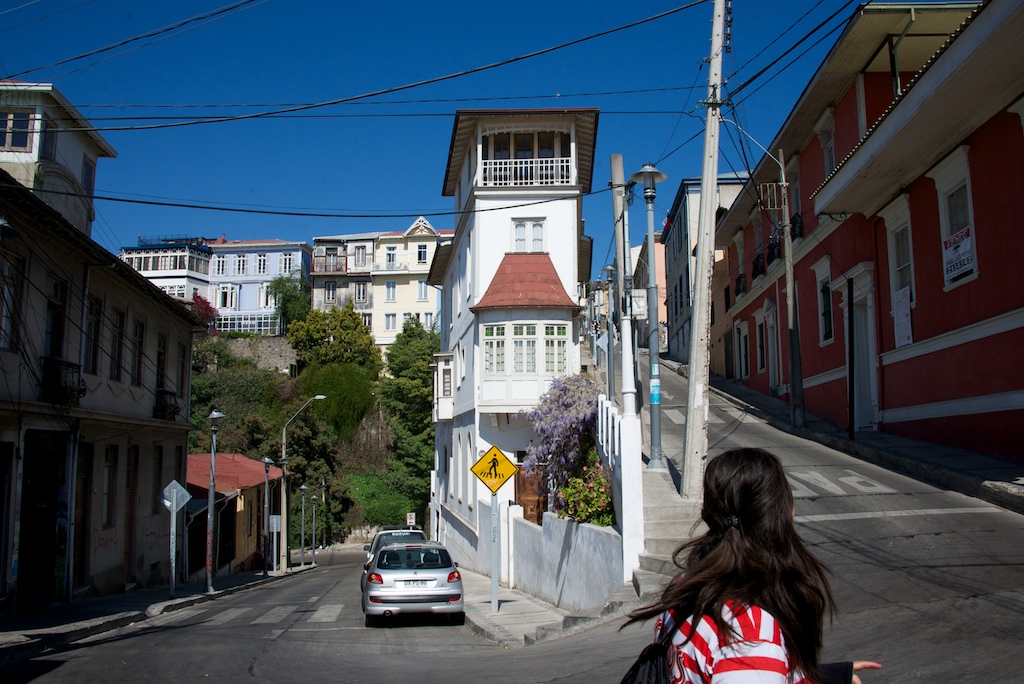
The architecture of Valpo (local speak for Valparaíso) tells its history with grand Italianate public and private buildings built during a period of shipping wealth.  The city has many hills that have created strong neighborhoods – who wants to walk up and down a hill every time for the newspaper?   The locals also made the city flatter by installing dozens of  funiculars.  Only 6 are running today as the rest are hindered by the combination of living on a very active earthquake fault and a less active government maintaince program.   During a ride on a funicular I hoped that the count of active funiculars would stay at 6 and not drop to 5.


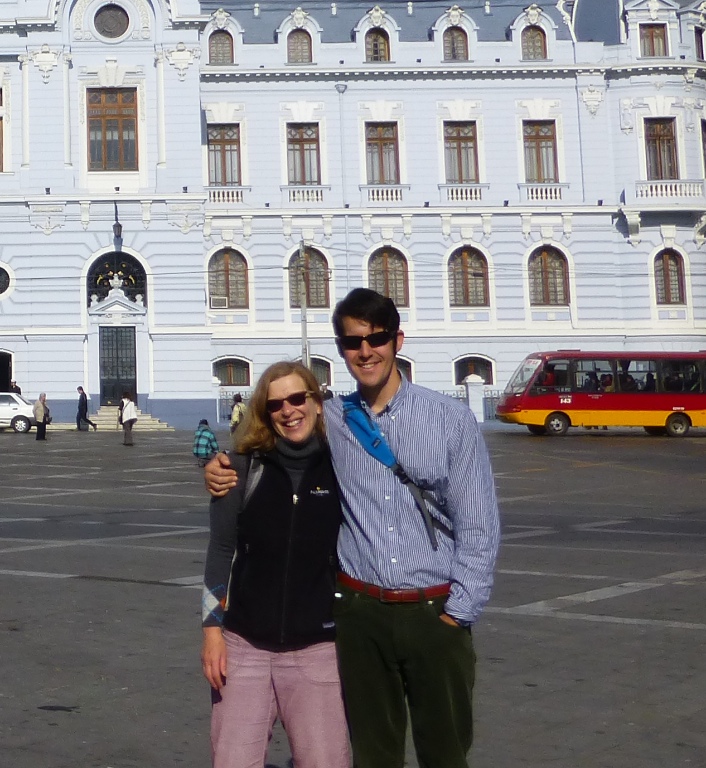
Main Square

Main Square

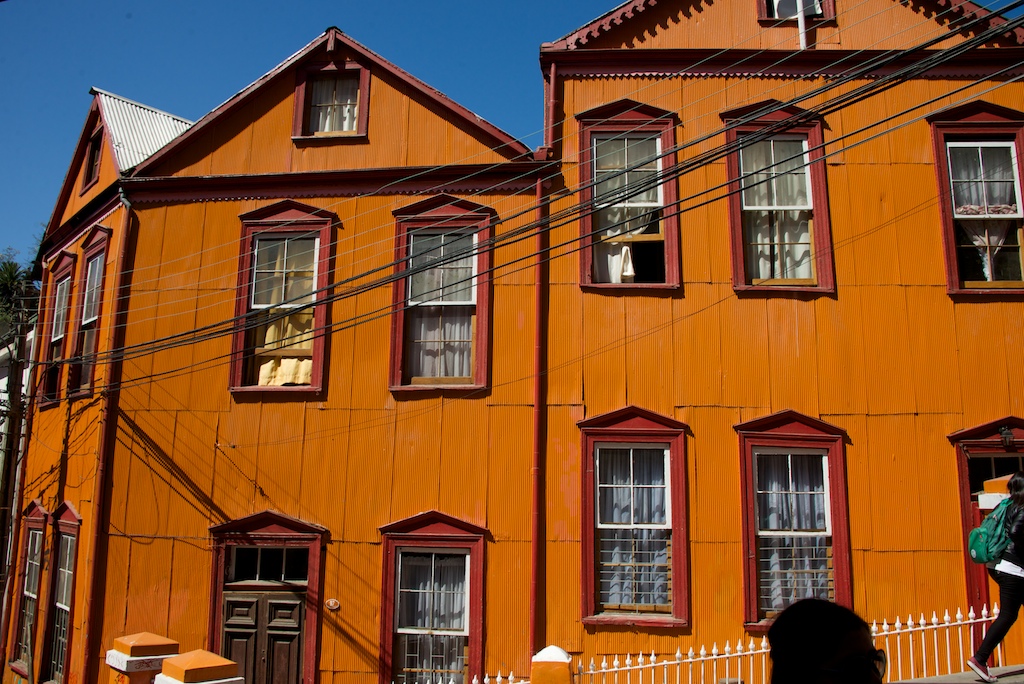
Not all of the architecture of the era was grand, but it still tells the port city’s history.  I was attracted to the houses of the middle class which are clad in brightly painted corrugated metal.   The corrugated metal started its second life as a housing material after serving as ballast holder on empty inbound ships.    The ships would remove the ballast and its corrugated metal holders.   Quick minded Porteños recycled it into the sidings for their dwellings, protecting the adobe bricks from the moist sea air.

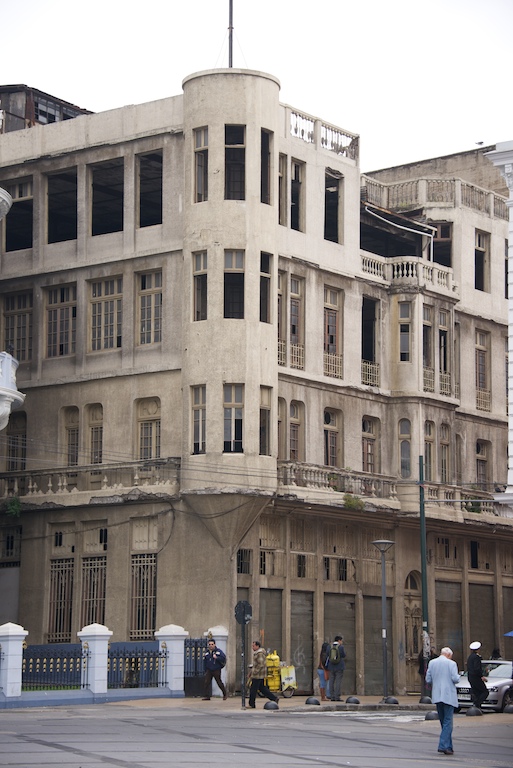
The Panama canal opening hurt the Valparaíso economy and the architecture shows this history of the rich fleeing Valparaíso.  Similar to the 1998 Asian financial crisis, there is a half built hotel in Valparaíso.   The sponsors of the project realized they were throwing good money after bad and left the stone outline of a 4 story hotel that has remained for the last century.


Gateway to Cape Horn

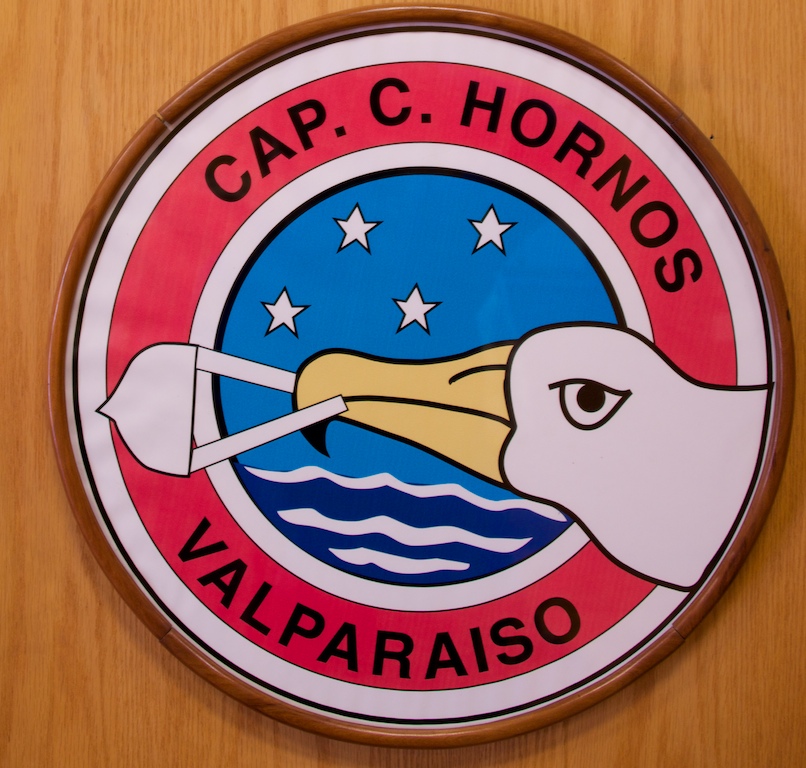
Valpo’s naval museum honors the sailors who have rounded Cape Horn. Rounding this tip of South America is the Mount Everest for sailors. The winds are unfettered by land and are chilled by the South Pole.   The Brotherhood of Captains of Cape Horn, founded by the French in 1937, created a few titles for those that had rounded the Horn.

ALBATROSS: Captain commanding a sailing vessel without using engines.  Two Fish one day?  Not a chance.Cape Horn Symbol

MOLLYHAWK:  Crew that rounded the Horn but were promoted later to the title of Captain.

CAPE PIGEONS:  Crew or passengers who sailed aboard a merchant sailing vessel that rounded the horn.

The system is pretty biased in favor of captains.  Crew in the old sailing ships had to climb 60 feet in the air during a storm, while the Captain sipped his tea.   When they returned to land, the tea sipper is referred to by an elegant creature and the guy who risked his life is called a pigeon.   It sucks not to be Captain.    I, Jason, would like to state for the record that I am the Captain of Two Fish.


Crazy Bike race

Every year some insane folks race down hill the  steep, narrow and bone breaking streets and alleys of Valparaíso.  The race is far too dangerous to be allowed in the US, so that makes it a fan favorite of mine.  Let YouTube take it away …

Arturo Prat – War of the Pacific

Arturo Prat

Arturo Prat

I hope my history lessons do not bore our readers, but learning the area’s history is one of the reasons I enjoy traveling.   I believe history often impacts cultures in profound ways and Chile is no exception.

The Chilean Naval Museum is a shrine to Arturo Prat, there are Prat statues across northern Chile and Prat street is the most common name for a road in Chile.   Why is Arturo Prat such a big deal for the Chileans?

He died in an incredibly heroic fashion while fighting the Peruvians in the Battle of Iquique.  The Chileans lost the Battle, but like the expressions says, won the war.   The story of Prat’s bravery was told around Chile and created an environment where Chileans supported the war financially and volunteered to serve in the military.   This conflict between Chile and Peru/Bolivia was fought in the late 1800’s.   The fight was over the barren land we had just visited, the Atacaman Desert.   This region was owned partly by Peru and partly by Bolivia, but the nitrate mines were run by Chileans.   The Peruvians started to nationalize some of these mines, and the Bolivians levied several large tax increases.   So the Chileans decided they would fight for the land and thus avoid nationalization and taxes.   Money and minerals are  frequent reasons to enter wars, and South America is no exception.   The Chileans were able to defeat the united opposition of Bolivia and Peru.   This huge victory would not have been possible without the inspiration of Prat.    The untapped mineral richness of these lands was unknown at the time.   The Bolivians lost their access to the sea and Peru lost valuable tax revenue.   In the ten years following the war, the national treasury of Chile grew by 900%, driven by nitrate mining revenues from the new lands.   Some years following the expansion the Chilean economy imploded as synthetic nitrate was created in Germany.   This depression in Chile was refered to as the Nitrate Crisis.  Easy come easy go? These days, copper fuels the economy and new demand for lithium and other metals provides a secure future.

So today  the Bolivians and the Peruvians are bitter about their lost land and it still shows.  One example is Bolivia will not allow Argentina’s natural gas to enter Chile.   A piece of advice – do not visit Peru or Bolivia and check into a hotel under the name Prat.


Read full story  · Comments { 7 }

Big Day

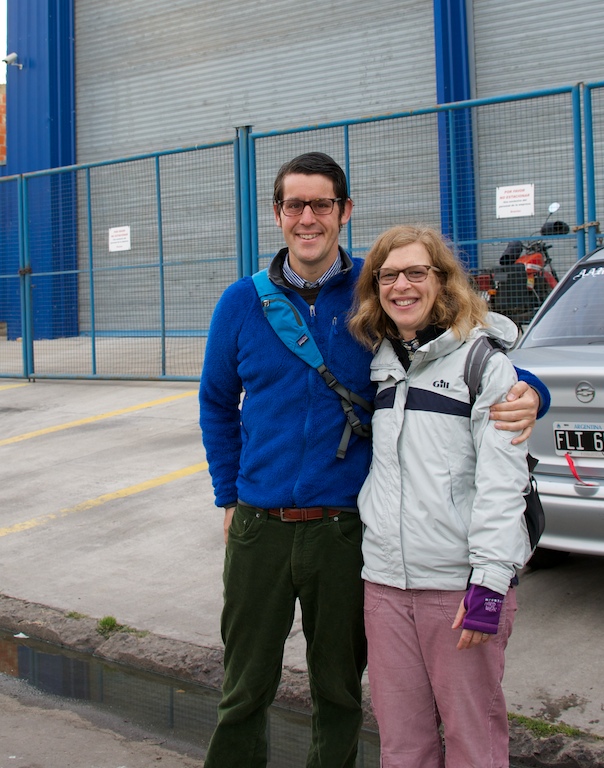
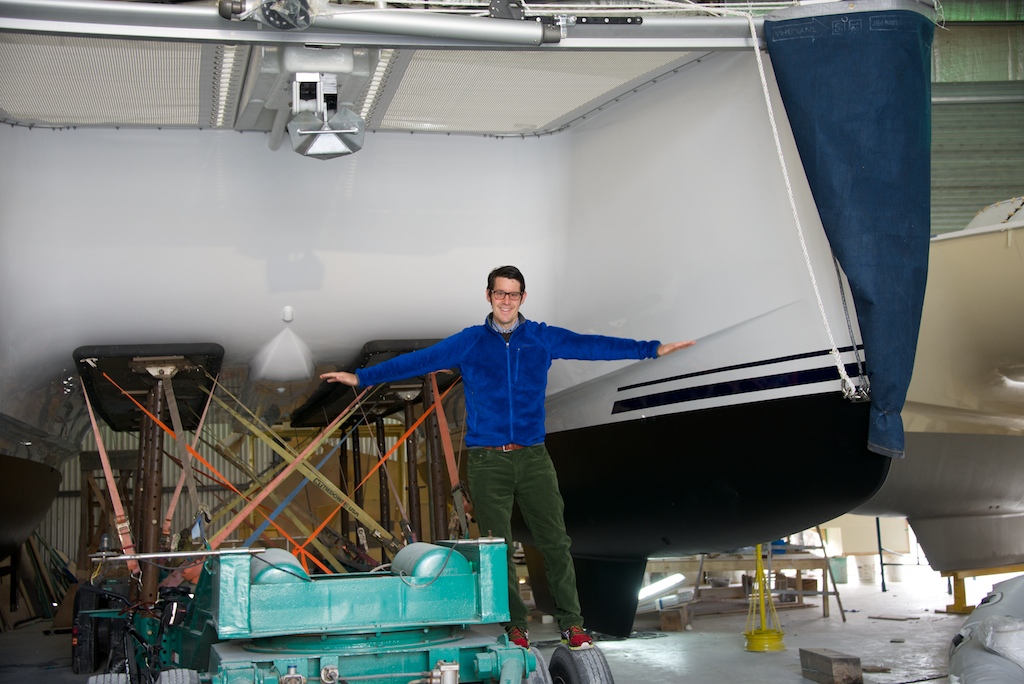
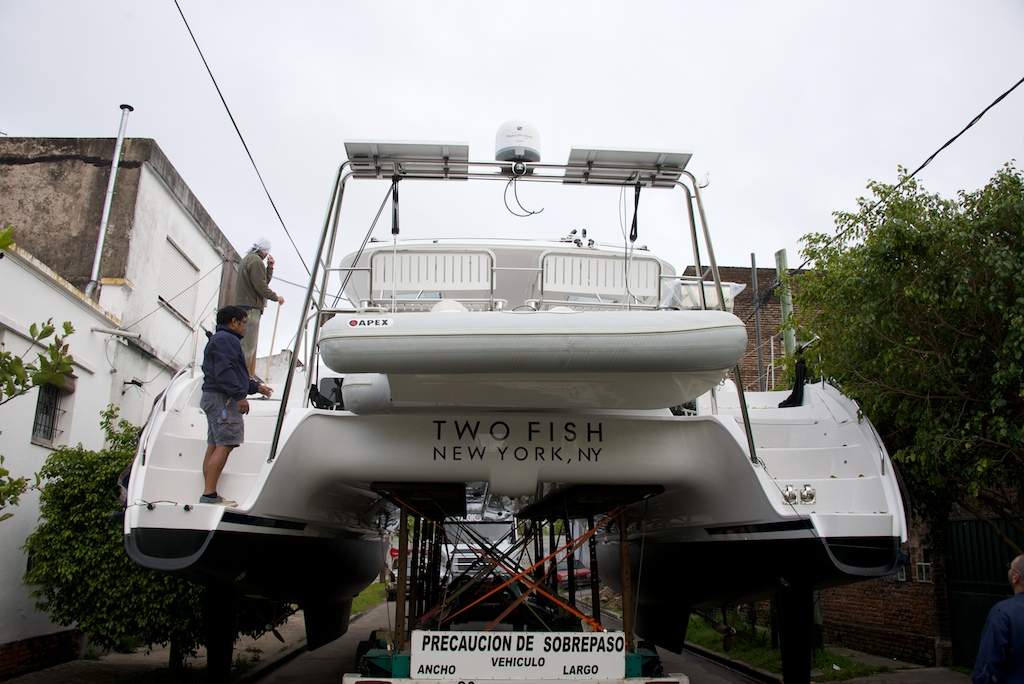
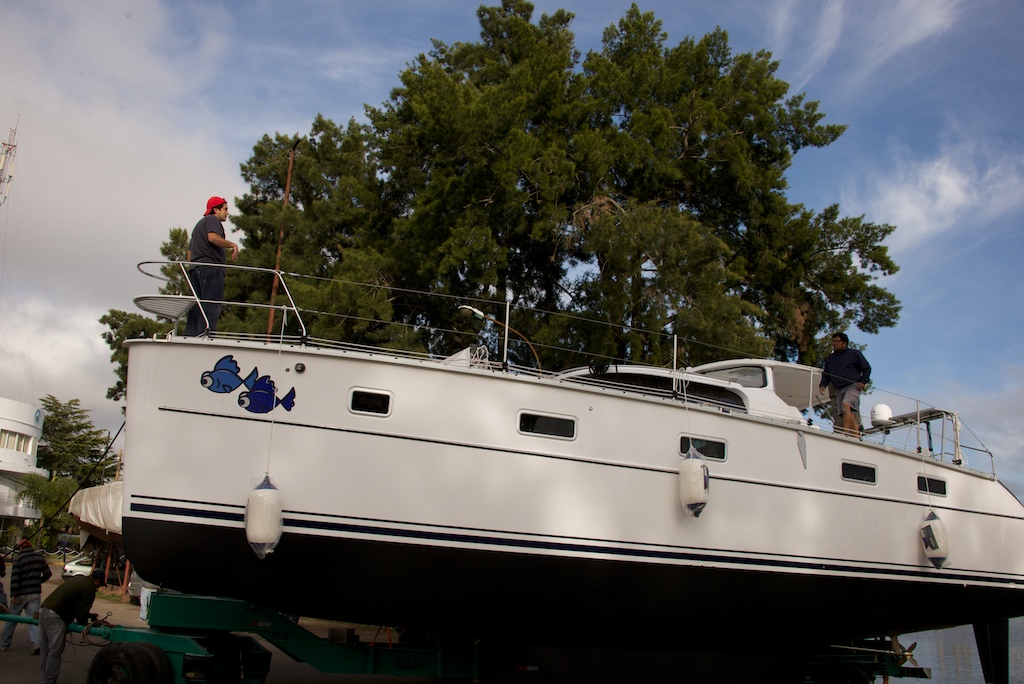
After 10,000 hours of labor, at 8:38 a.m., Two Fish splashed. She weighs 20,000 pounds and 7 ounces and is 528 inches.  Mother, Father and boat are healthy.


Boat Splash from Two Fish on Vimeo.

Everyone woke up early today to put Two Fish in the water. The tides and wind had delayed us for a few days so everyone really wanted to hit the 8am high tide mark. It takes a while to move the boat but remembering the rule of twelfths we knew we had a little bit of leeway. (The rule of twelfths pertains to tide levels. The height does not move down uniformly with every hour from high to low tide. In the first hour it moves down 1/12, second hour 2/12 and so on.)

The streets of San Fernando are not designed to transport a 22 foot wide catamaran. Horizontal clearance during the trip is impeded by cars and recent branch growth. At least the branches can be trimmed with a machete. Vertical clearance is impeded by overhead wires but brave boat builders help to complete the trip.


Read full story  · Comments { 16 }

A Taste of Chile

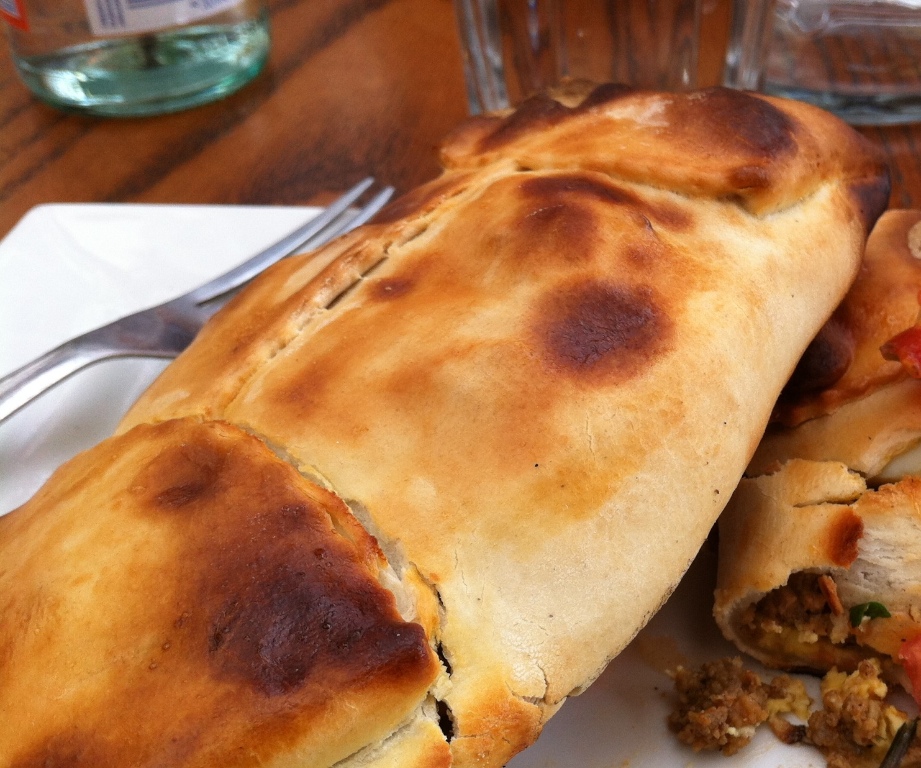
For lunch on our first day, I tried an Empanada Pino. Pino is not pine nuts, nor is it pineapple. It is a mixture of spicy ground beef with stuff thrown in there such as hard-boiled eggs, olives (pits included), raisins and corn.

My Favorite Empanada

My Favorite Empanada

The dough was very floury, in a good way,  and it was baked; for those of you with Eastern European and South African provenance, it was sort of like bobotie in a baked pierogi.

I tasted two others while in Chile,  empanaditos and a fried empanada, and neither was as good as the bobotie pierogi. Jason had a salad – sometimes, I don’t understand him at all. I recently learned the empanadas don’t have a tilde on the n. The verb empanar is to bread something while the verb empañar is to fog up.

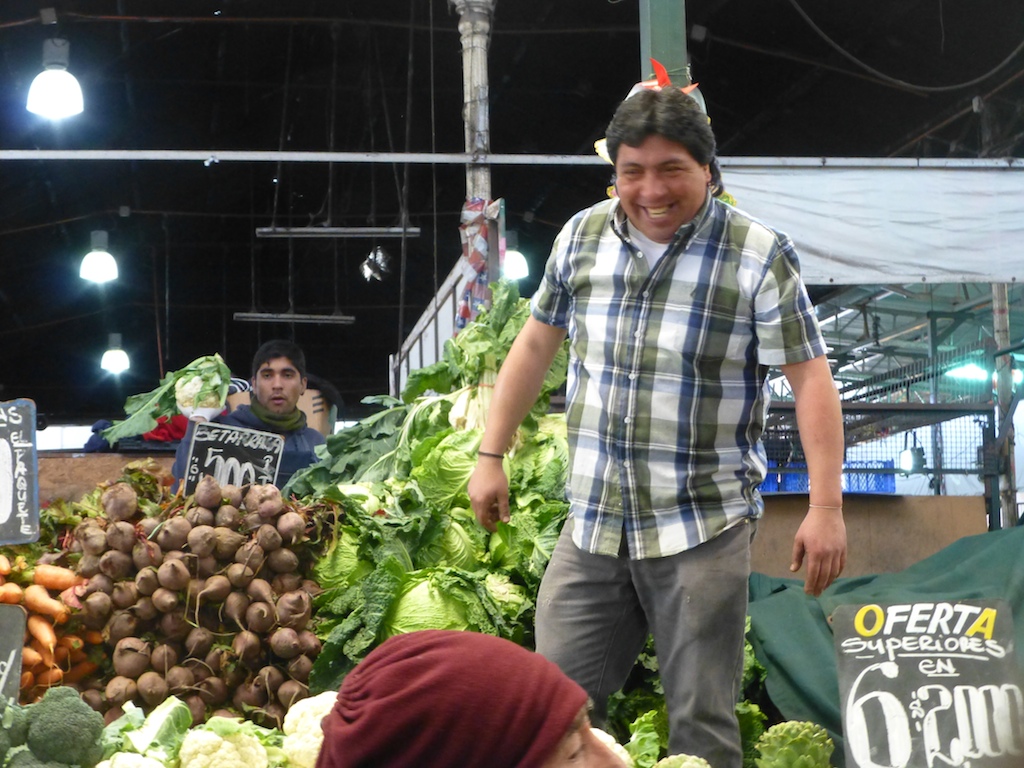
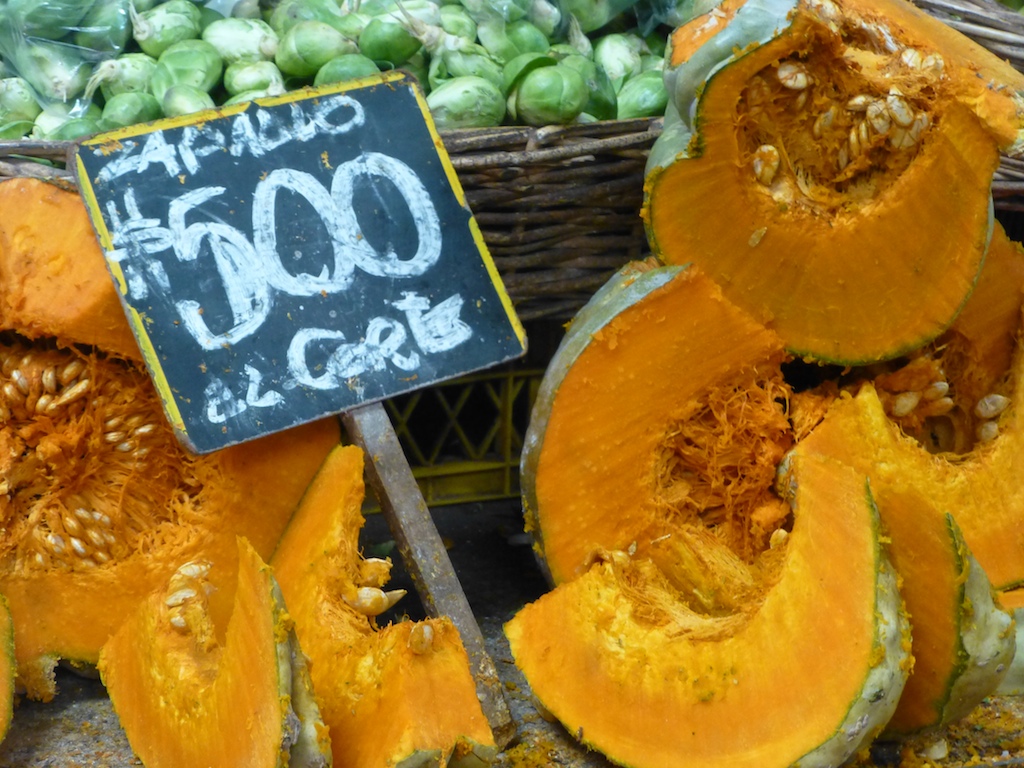
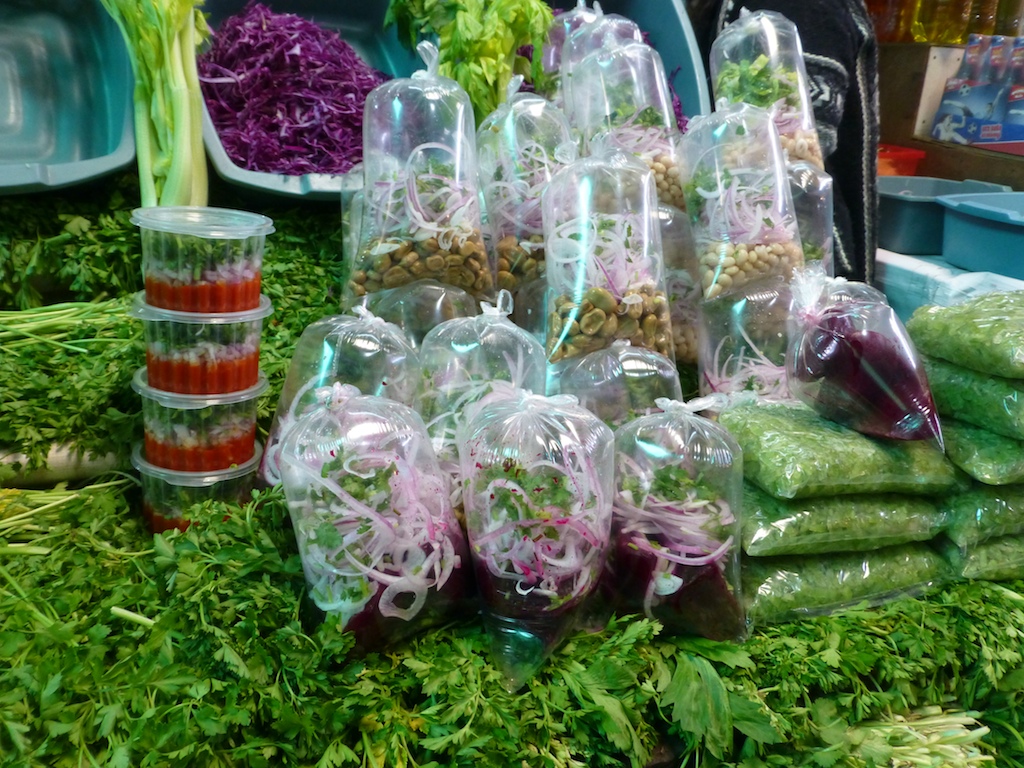
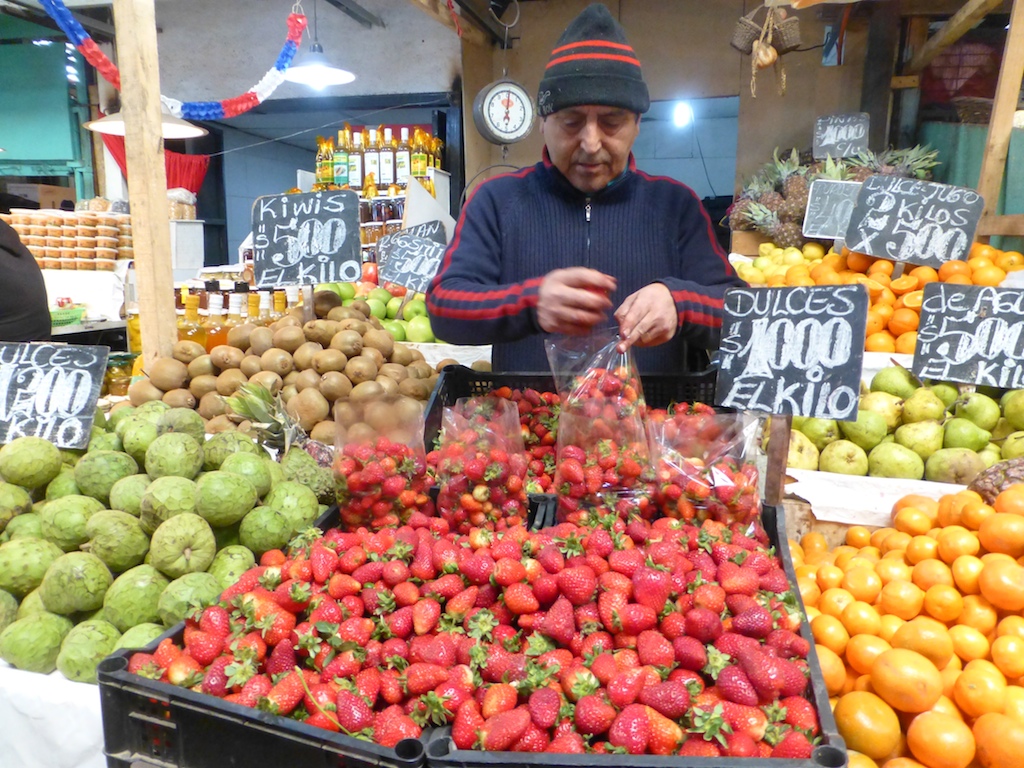
But Chile is more than empanadas. First, the fruit is wonderful-you probably have some Chilean raspberries in your fridge. A nationally loved fruit that you may not know is the cherimoya. If you google it, you will be sure to find people quoting Mark Twain, who supposedly thought it was the best thing ever. Since I never found a direct quote or source, I suspect that someone put the quote on Wikipedia once and everyone copied it. For any US readers, Melissa’s in California  will ship some to you. Or, come to Chile and try Cherimoya juice or Cherimoya Alegre, half cherimoya juice, half Orange Juice. The juice was like nectar and tasted like a combination of the best of pineapple and mango to me. We visited the …. market in Santiago and the fruits and vegetables looked amazing. Piles of strawberries, baby spotted potatoes (looked better than it sounds) and giant stalks of celery were everywhere. Speaking of potatoes, I read that scientists believe that the potato originated in Chile 13,000 years ago.

Another popular vegetable is corn, known as choclo. I am sorry to say that I never tried the supposed national dish, pastel de choclo, a minced-meat mixture with mashed corn on top. I wonder if guidebooks to the USA mention Tuna Casserole as a must try dish as well. I did have cazuelo, a hearty beef soup, with vegetables as well as some scrambled egg. It was excellent but could have benefited from some hot sauce. We have discovered that Chileans and Argentineans aren’t the biggest fans of spicy food. What is called spicy food here is pretty mild, most likely because Chile, unlike Peru, is lacking in any Asian or African influence . We didn’t try is the Chilean hot dog. Looks like a regular hot dog but is seved with avocado and mayonnaise.

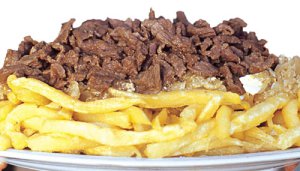
Chorrillana

Chorrillana


We also never tried Chorrillana-a plate of French Fries, topped with beef, eggs and fried onions.

Clearly we need to return to Chile.  I did try the national drink, the pisco sour. Both Peru and Chile claim the pisco sour as their national drink but only Peru has a holiday for it.

Chile, being a long country with lots of ocean exposure, is famous for its seafood. A traditional dish is Congrio (Conger eel soup), which is a white fish cooked with… Very tasty. It is so loved that Pablo Neruda, Chile’s nobel-prize poet, wrote an ode to it. (Click here to read it). Actually, it is not really an eel but is a fish, known as kingclip in some parts of the world. Since we were in Chile during National Week, there were lots of parties going on throughout the night. What is the Chilean hangover recovery food? Ceviche. If you don’t quite see that, you might agree with Jason that when it comes to hangover food, you need to stick with your own country’s traditions.

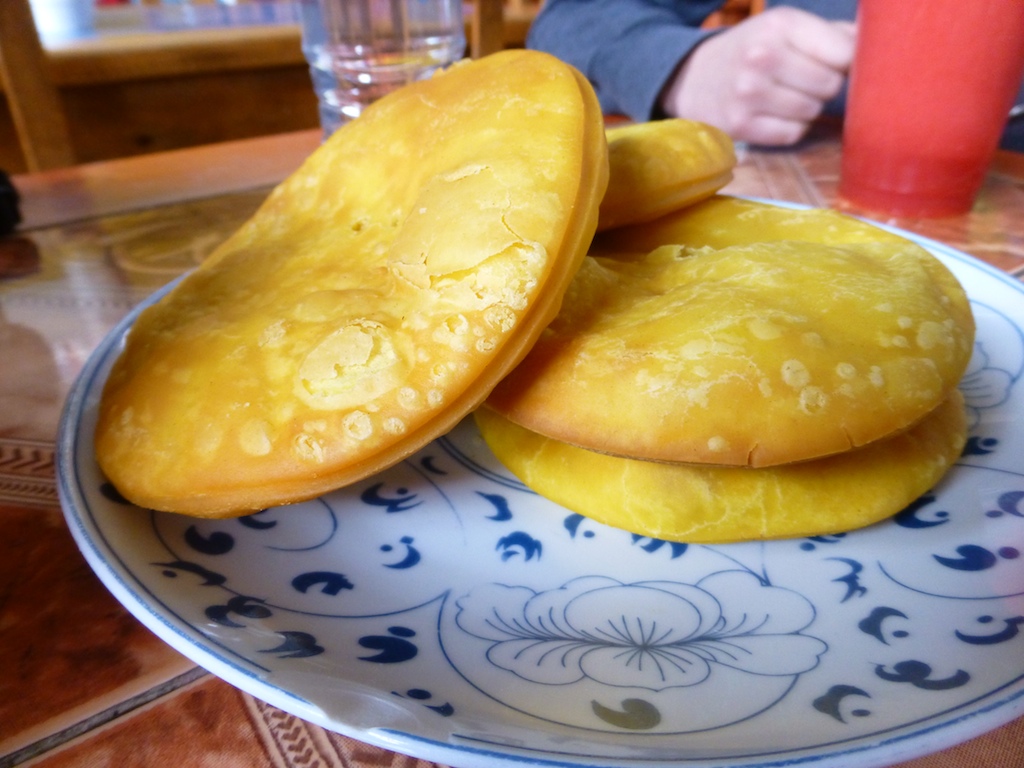
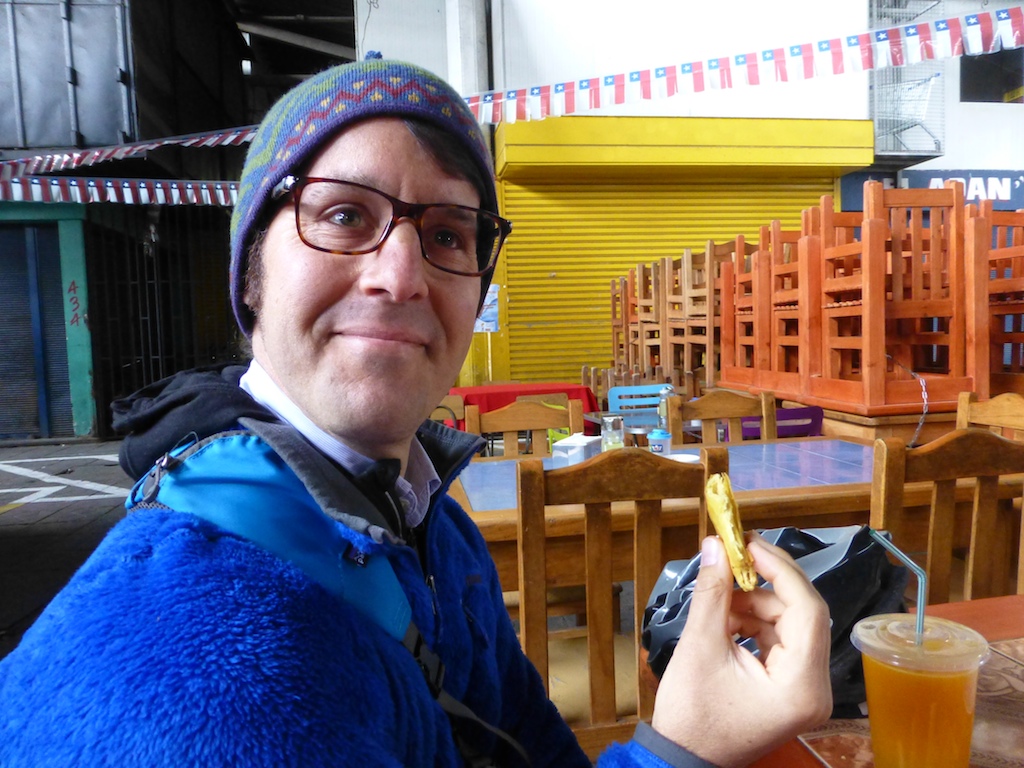
In the grain category, I enjoyed the circular morning biscuit which I can’t remember the name of, bread dipped in chancho en piedra (Chilean salsa),  Sopapilla (pumpkin fritter) dipped in theoretically hot sauce, and, of course, quinoa. But what was my favorite meal? If you know me, you shouldn’t have to ask – the raspberry-mint ice cream at Emporio La Rosa in Valparaiso. Full of raspberry flavor with a hint of real mint, I could have one right now.


Read full story  · Comments { 2 }

Santiago Adventures

“Is the relationship between Sydney and Auckland like that between Buenos Aires and Santiago?” I asked Gail as we began to explore the empty streets of Santiago during Chile’s major holiday week.  I pled my case about rival cities of the Southern hemisphere; conservative vs liberal residents and treatment of the indigenous population.  It was a heap of uninformed baloney as I had not realized there are 6 million residents of Chile.    That is 1.5 times the entire population of New Zealand.   My juxtaposition was way off base and I needed to open my eyes and prepare to enjoy a Santiago that I had not expected.

Our plan was to mimic the format of the NY Times 36 hours articles.  However, we have less energy than the NY Times writers and budgeted 4 days to accomplish this.

Army Day

santiago 12

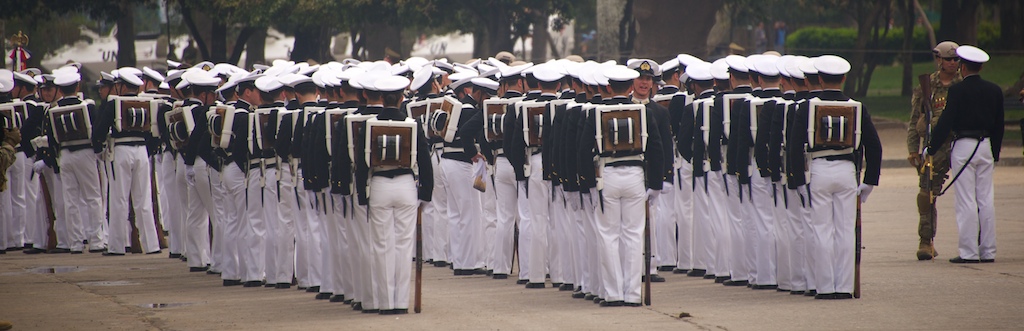
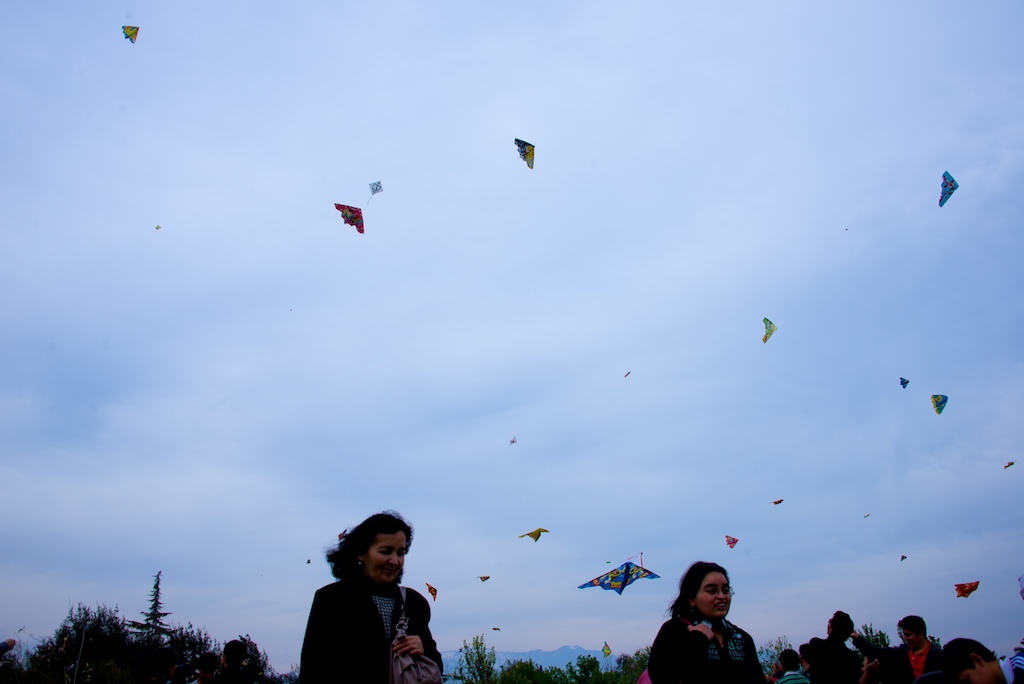
Our first order of duty was to visit the annual Army Day parade.  Army Day is a big deal for the Chileans and the whole country is on vacation, except the guys in the Army who have to march about.  The locals were enjoying  asados (BBQ), flying kites and watching the parade. Picnic foods were hot dogs with avocado, fruit juices, steak sandwich and lots of empanadas.   This is such a big deal that the parade is on TV for hours and they fly many jets over the audience.   Views are pretty limited so it is key to bring a distraction, which most people did by flying kites.  There had to be 100 kites airborn at once!  After the Army parade it was clear Santiagoans are family oriented people, however, I am not sure what they think of the Army.

Subway

Subway

Subway


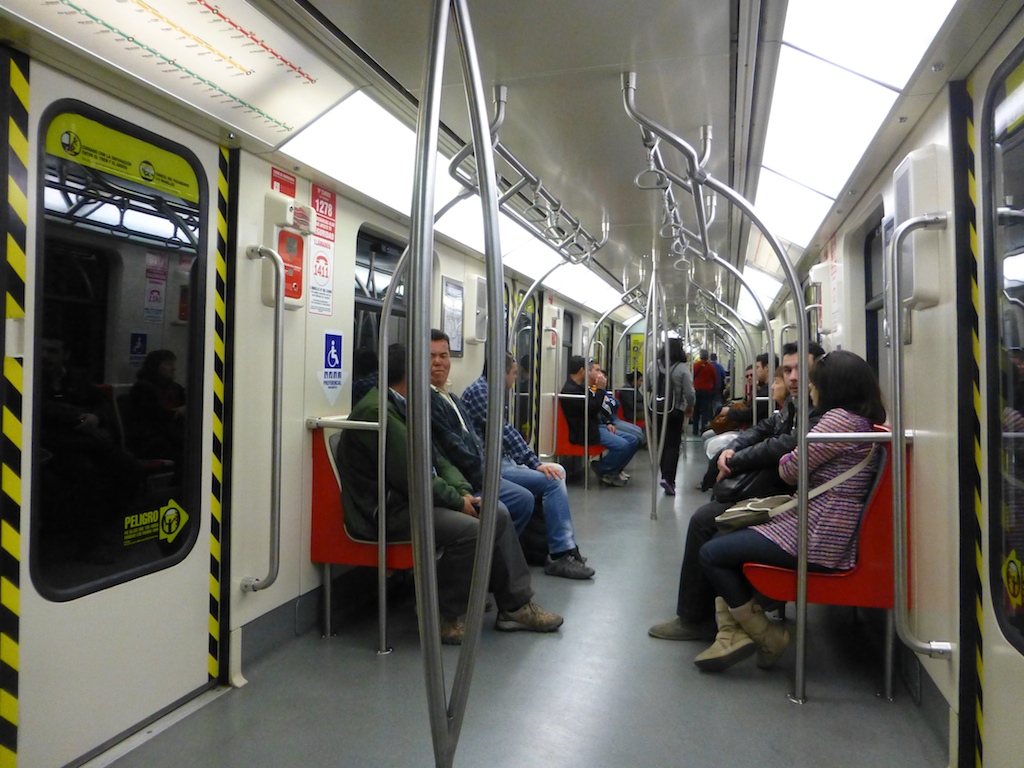
Mass transit is a great way to learn about a city and do some good people watching.   When riding the Russian subway I was amazed by the  beautiful communist art in many of the stations.  And while living in Singapore, I marvelled at their subway technology.    The entire network is air-conditioned and has cell signals.   Chilean trains seemed safe and understated.   Nothing too flashy but efficient.  In one of the stations I did find a model ship of a key early explorer of the Chilean coast.   Pretty cool.


Below: Chilean NightlifeNightlife - Wine, Beer and Music

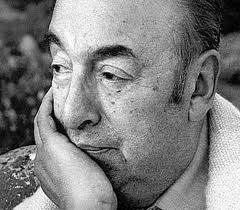
Pablo Neruda – Chilean Poet

“From each crime are born bullets that will one day seek out in you where the heart lies.”

Pablo Neruda

Pablo Neruda

“Take bread away from me, if you wish,take air away, but do not take from me your laughter.” 

“I watch my words from a long way off.They are more yours than mine.They climb on my old suffering like ivy.”

Neruda was the second Chilean to win the Nobel prize for literature, an accomplishment for such a small nation.   The above English translations give you a sample of his work but his full story is a soap opera.  Three wives and a mistress, he was a famous person and very much of a king maker.   He was asked to run for office but preferred putting his weight behind Allende.   When Pinochet took power all of the Allende associates were detained or worse.   Neruda was about to die from cancer and was spared being placed in prison, or so the story goes.   Recently a former Neruda Chauffeur testified that Neruda was poisoned by Pinochet’s men.  The claim was taken seriously and the body was exhumed.  The results of this test have not been released.   The mistress might have been part of this plot.   This sounds like a top-rated soap opera.    Neruda is a legend in Chile for his written work and for supporting the socialist expirement that ended too soon and in the wrong way (Pinochet’s violent hand).

San Cristobal Hill

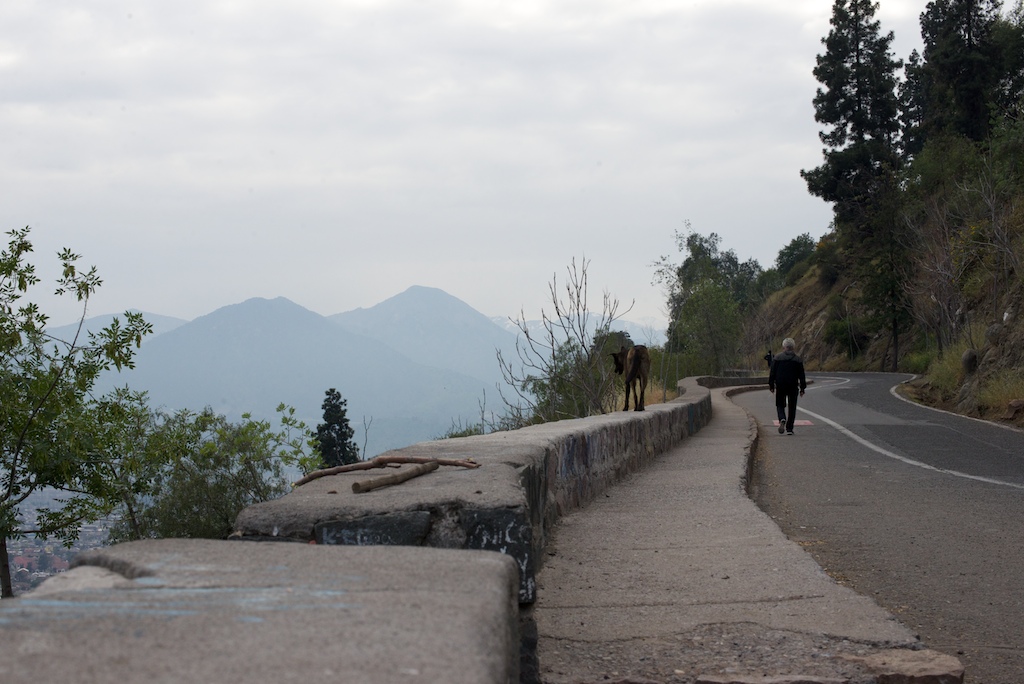
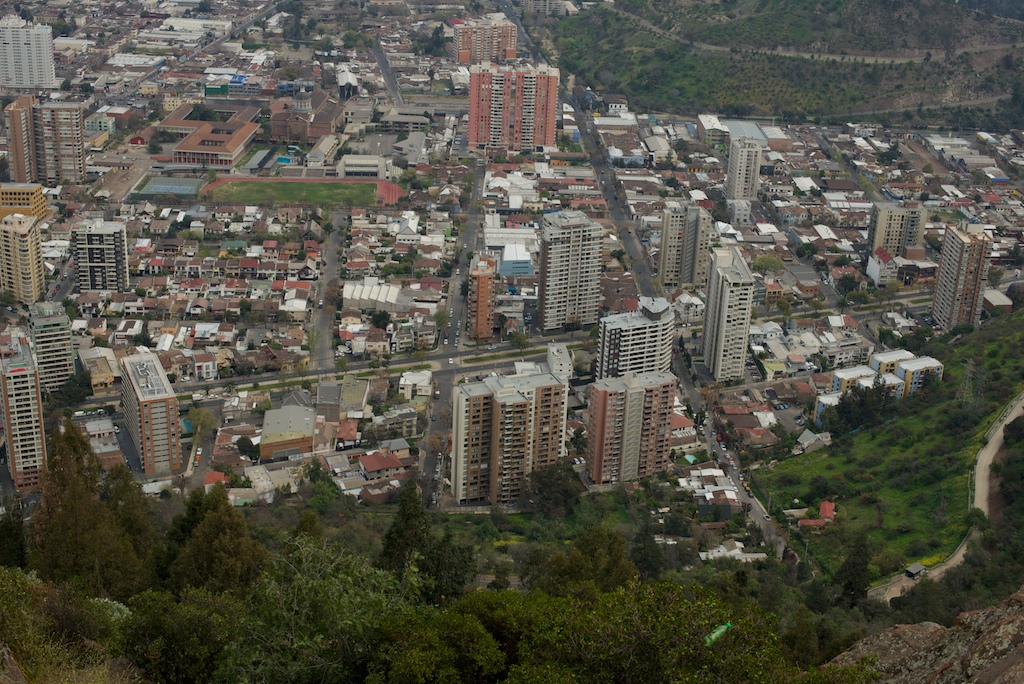
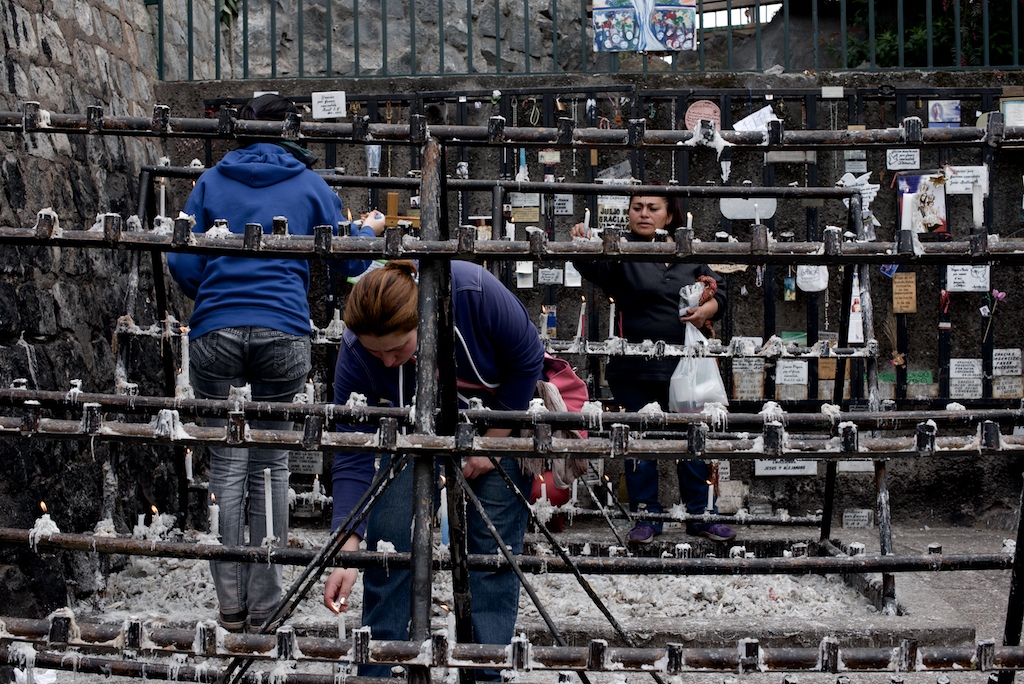
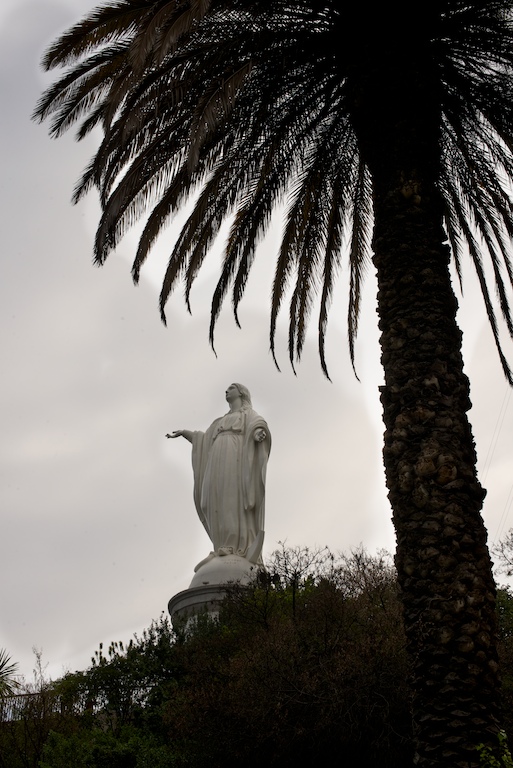
A gentle 7 kilometer walk uphill is the altenative to riding the funicular to summit San Cristobal.   You will be joined by many joggers, bikers and stray dogs.   We started early by Chilean standards, 8am, and thus avoided the crush of people in the afternoon.  The outdoor chapel on the mountain top was a great place to reflect, view the city from above and catch your breath.

Bike Tour of Santiago

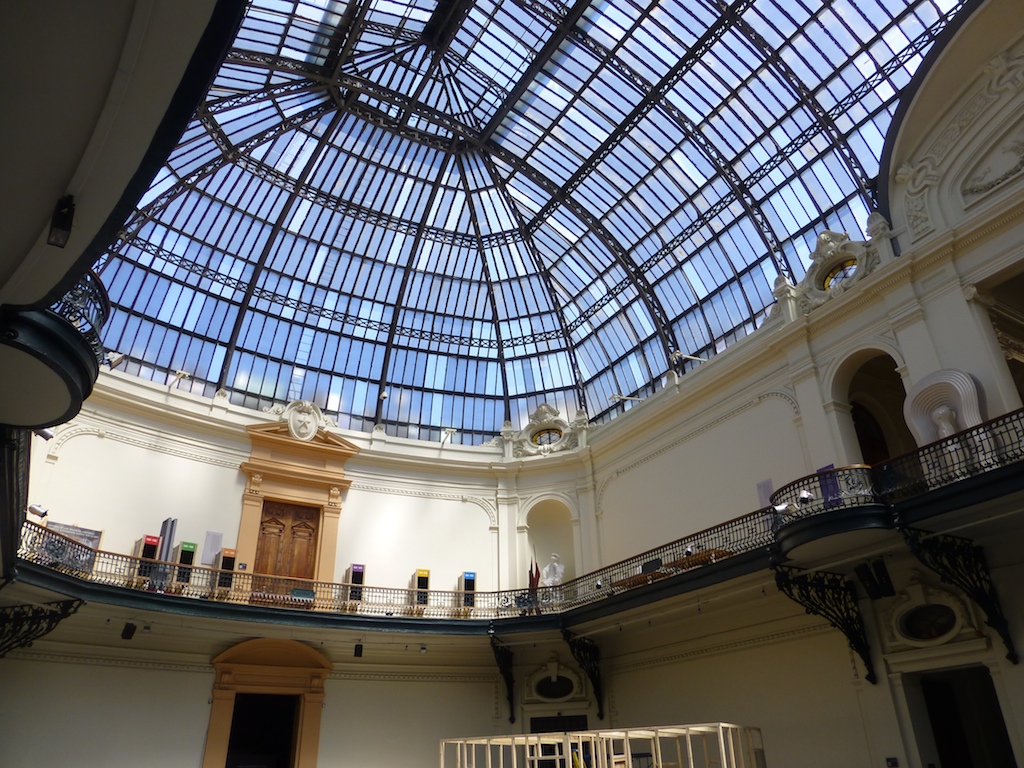
We went on the Bicicleta Verde (green bicycle) tour of Santiago.   Good but not great because we had done much of the tour already on foot.   We did go to two museums and these are some of the images we liked.

Here is a quick highlight reel of our visit:

2 Weeks in Chile from Two Fish on Vimeo.


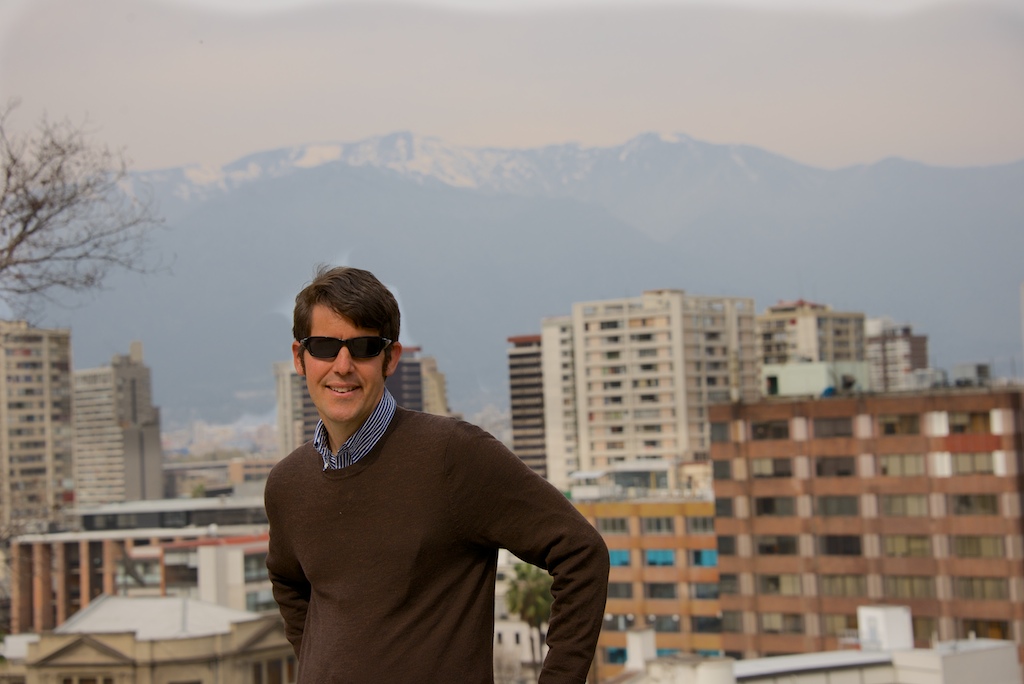
It is hard not to be impressed by Santiago.  The guide books sell it short by writing about smog and bland architecture.   We found neither.

Read full story  · Comments { 1 }

Vacation from a Vacation – A Week in BA

I realize many of our readers have little empathy for the tough life we live.   Our posts probably offer a moment for readers to pause and remember how lucky they are to have conference calls, delayed flights, and the other joys of the working world.  We also realize our lives are rough and decided we needed a bit of a break.  The break came in the form of a week in Buenos Aires.

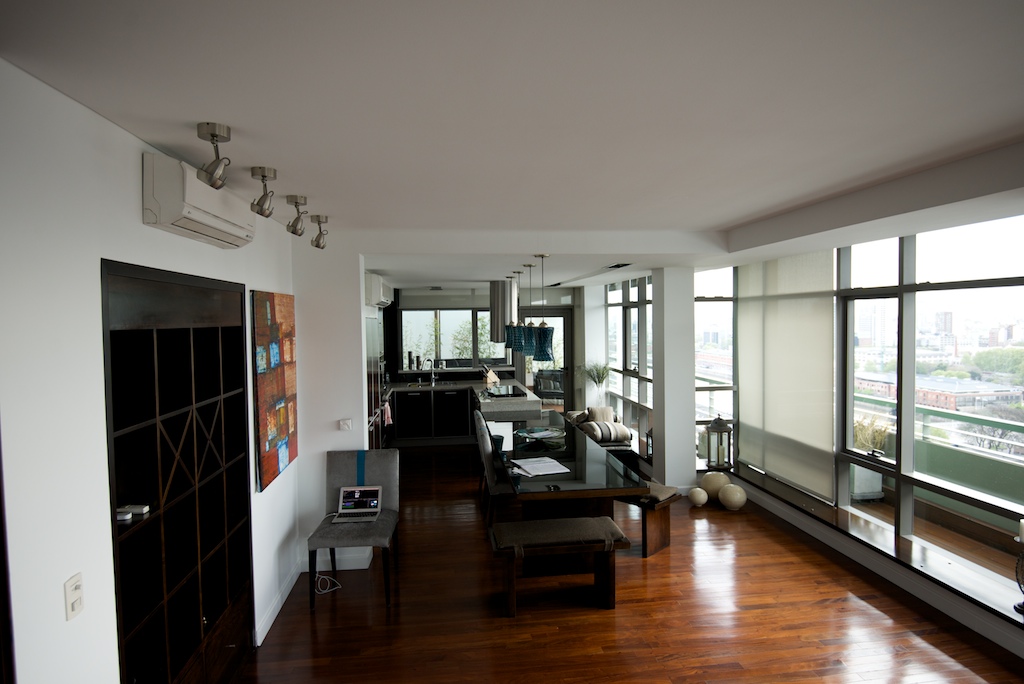
Where we stayed

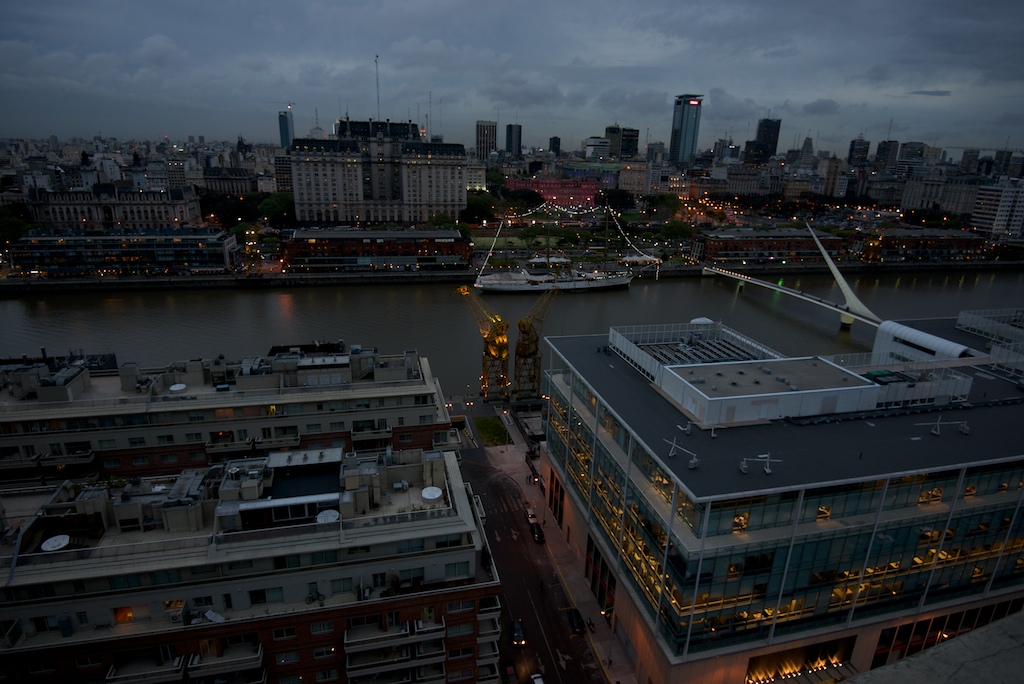
Our temporary neighborhood was nicknamed by me “the island where nothing bad ever happens“.   Despite the catchy ring to the name I gave the neighborhood the locals continue to refer to it as Puerto Madero. For New Yorkers it is Battery Park City or for Londoners it is Canary Wharf.   And for residents of Duluth, it is waterfront reclaimed land with many clean new buildings.   The port area also has the advantage of being policed by the Coast Gauard who have a stronger reputation for crime fighting than the traditional BA police.

Close to Puerto Madero is the Retiro area. We went to BASA(located at Basavilvaso 1328) for a great dinner with some friends who are locals. Knowing we are American, they made the reservation for 9:30pm; most locals were showing up when we finished our meal. We recommend it for some hip and tasty food.


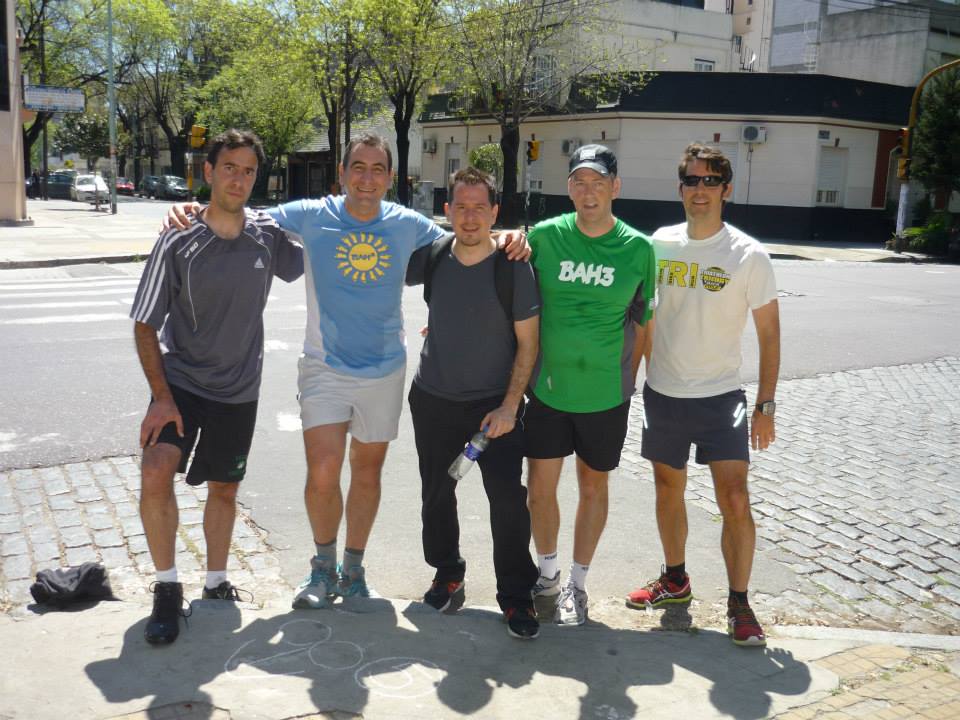
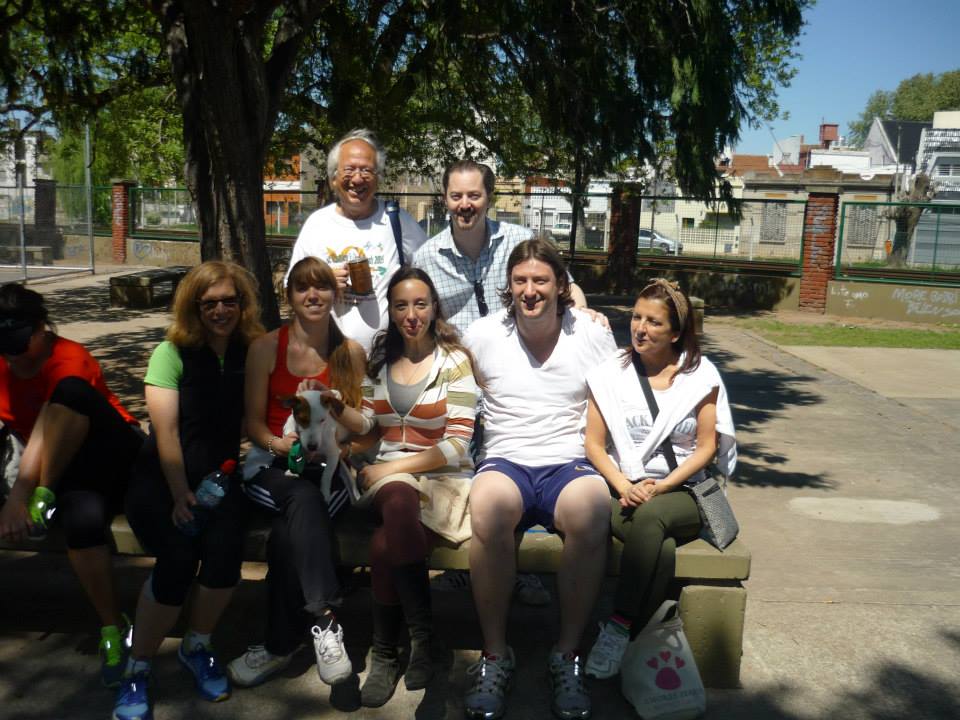
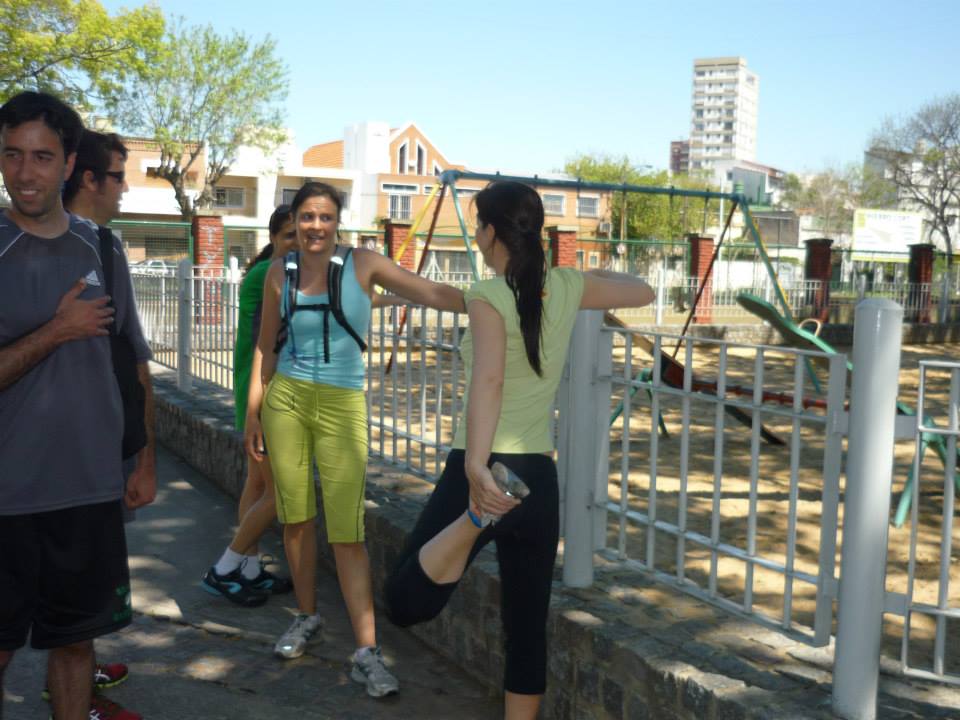
We went to a Hash

This is actually a road running event.   No joke.   The casual running club is a global format with the moto of “a drinking club with a running problem”.   The BA club was started by a few Brits 10 years ago and members are both ex-patriots and porteños.  The format of the run differs from a 10k fun run.   The markings for turns are made with flour sprinkled on the sidewalk.  The markings are often cryptic, and as the lead runners see the markings they yell out in spanish AUN AUN.   No clue what this means.  I asked and was told that it was English!   On On!   Spanish lesson failure #1.

Not to be outdone by my first spanish lesson failure I raised the bar.   While riding the train from Buenos Aires to San Fernando, Gail asked what station we had reached.   I helpfully replied “Billeteria”.   Problem is the next 20 stations were labeled as Billeteria, as it means ticket office.   They are sizing the dunce cap for me now.  Gail’s Spanish is much stronger; this will help us later in the month with the Uruguayan Prefectura.

Back to the Hash.   The flour course markings are sometimes drawn incorrectly on purpose.   This causes the “front running bastards” to have to run extra kilometers and allows the group to stay closer together.   As this is a running event they keep the athletes hydrated.  One guy rides a bike full of beer and twice during the 12.5km jog we were offered libations.   Next time bring your own cup.  After the run is over, more beer, empanadas and drinking songs.   Fantastic group, look one up in your town.


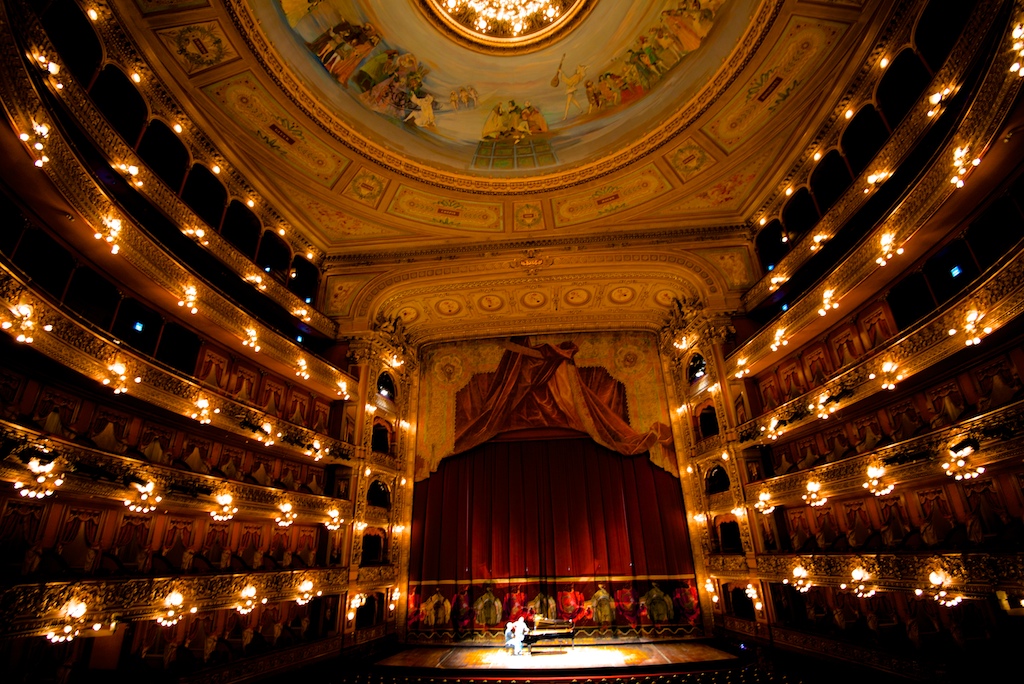
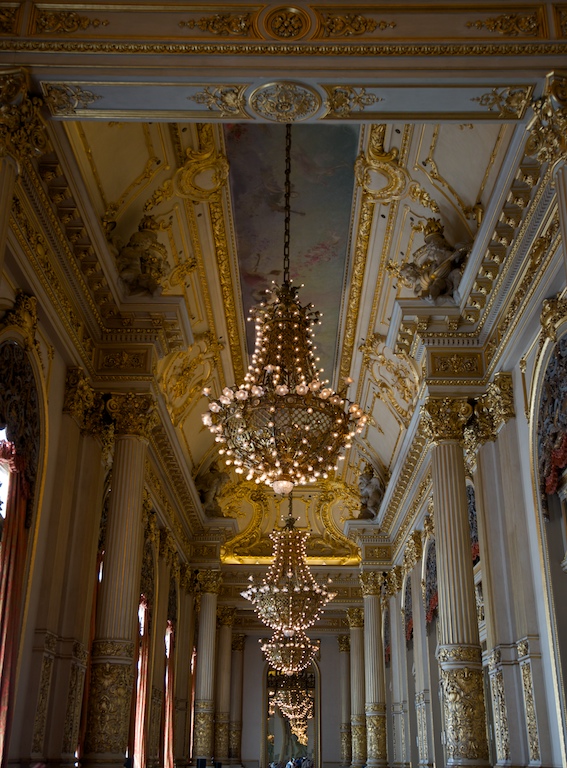
 Teatro Colon and  the number 44

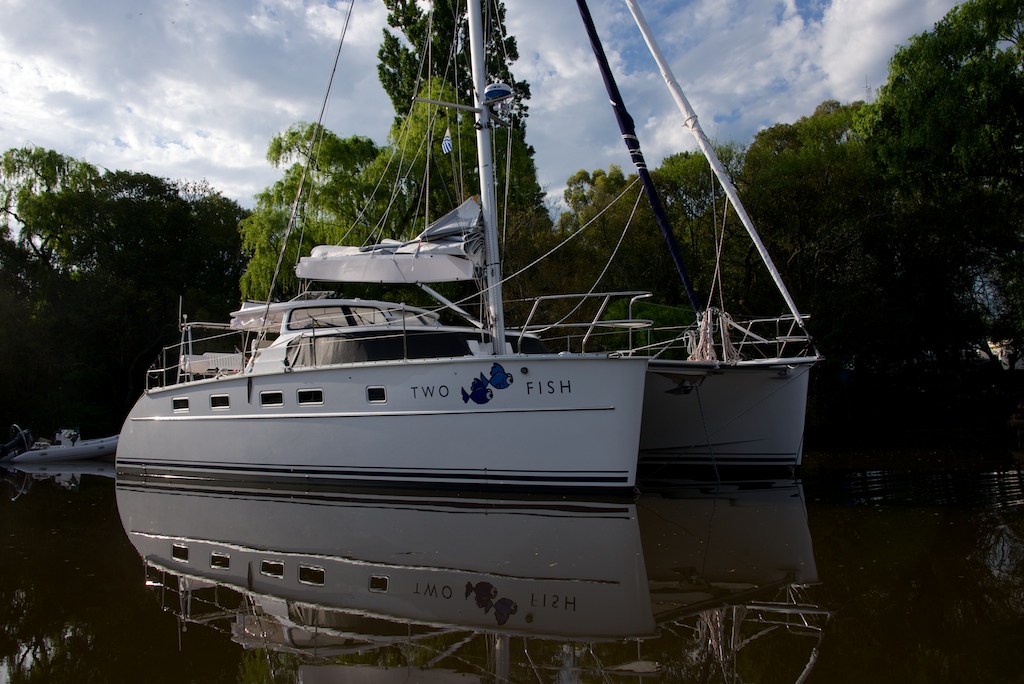
44 is the boat’s magic number for many reasons.  The boat is 44 feet long, it is the 44th hull the boat builders have produced and it has something to do with my age.  You can see the dedication to the number 44 on Two Fish’s Facebook page: her birthday is April, 4 1944.    When we were told on our tour that 44 had significance to the Teatro Colon, I had an eerie feeling.  Three architects were needed to complete the famous opera house.   The first two died when they turned 44 years old.  One died by the gun of a lover’s husband and the other of an illness.   A practical solution was found:  hire an older architect.   And so the theatre was completed.  I dismissed this as being a bad omen as things are upside down in the southern hemisphere.    The theatre just received a thorough renovation and is looking very nice.


Traveler Tips – what not to do

We let our inner Californians take over and rented a car.   Never again.  1 hour to fill out the paperwork seemed excessive at first.  But now, having driven here, I realize that the paperwork process should take 2 hours.   Since the chance of an accident is close to 100%, one should be forced to sign every waiver.   And the driver should buy any insurance.  On our way San Fernando we needed to cross the train tracks used by a regular commuter train.  I would estimate the train travels at 35 miles per hour and weighs a humongous amount. The crossing bars for the train crossing on the road were stuck in the down position. So a long line of cars went one by one over the tracks, each hoping that no trains were near. We made it!

We survived unscathed, and upon return the agent almost seemed disappointed to see the car in one piece.  He wondered why we were returning the car early.

Antares Owners Tips

We bought a dive tank in BA as they are tough to ship down.   ( La Casa del Buceador   www.lacasadelbuceador.com)  We bought 1 tank for about $250 just in case we need to clear the props.  They sell other Scuba Pro stuff at  high prices.   Also bought some old-style bar weights. If you have tanks and weights, you may want to try to bring it down.

Last travel tip is to try the commuter train from BA to San Fernando.   It is almost free and full of commerce.  You can buy all-in-one tools, pirated music, food and clothing.  That is a good thing since the trip takes an hour and sometimes offers additional delays.

(My blog posting is delayed –  I am 3 weeks behind so stay tuned for more updates)


Read full story  · Comments { 4 }

Coming soon…

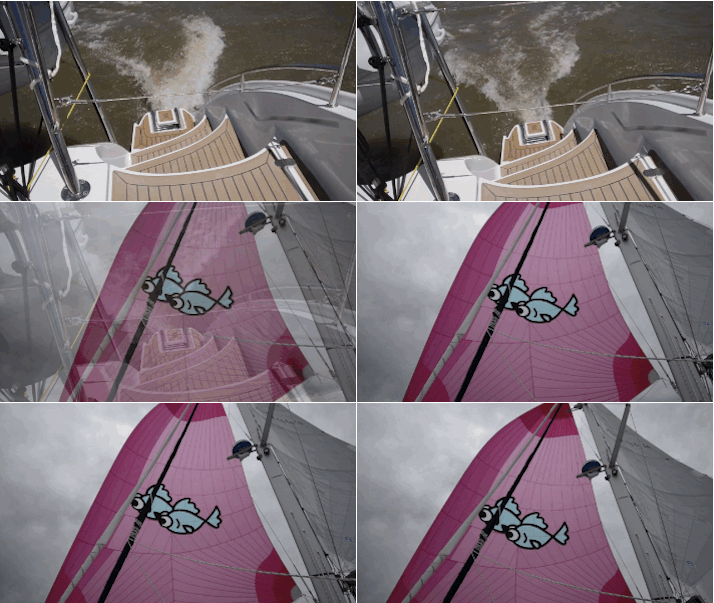
Chute gif

We have some longer posts in the works covering our 2 week Uruguay cruise and tips on sailing the Antares.   In the meantime we thought a few images might provide you with your fix of Two Fish action.

The “movie” is of our spinnaker with our boat logo.   The sail is the size of a NYC two bedroom apartment and takes a bit of skill to put away.


Read full story  · Comments { 4 }

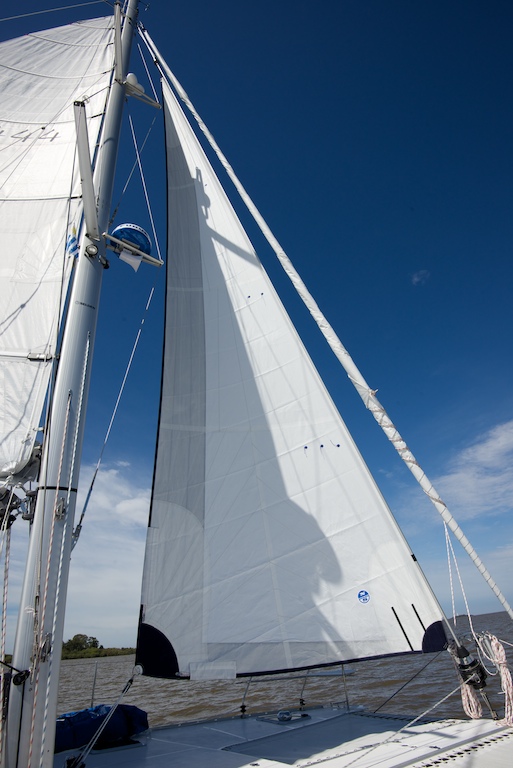
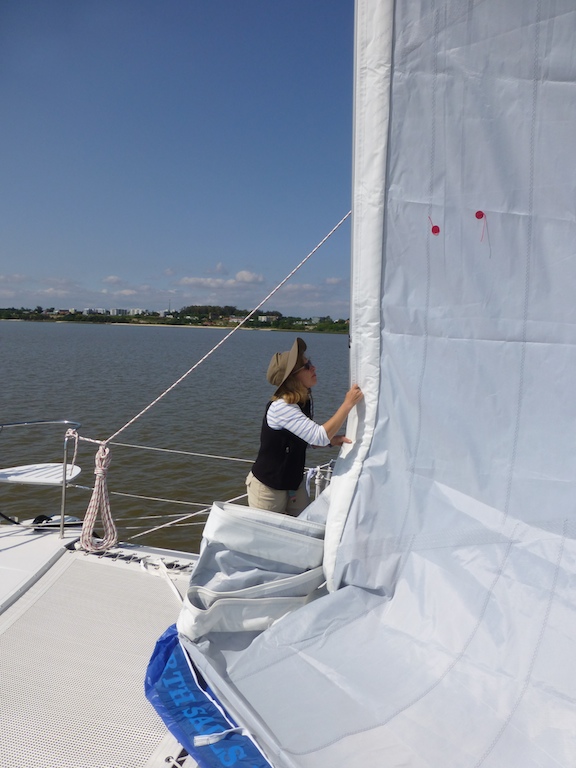
A Review of the Sails During Our Uruguay Cruise

After an enjoyable and busy shakedown cruise in Uruguay, I have some thoughts on the sailing part of the sailboat.  This post will be full of  uneducated preaching on sail handling, so I am eager to hear corrections and comments from sailing veterans.  My target audience for this post is small.   If you are not a sailor, then this post will seem pompous and needlessly technical.   If you are an accomplished sailor, then you will be able to correct this post in my attempt to  teach others.   So, I am looking for that one person who is massively interested in sailing but knows less than me.

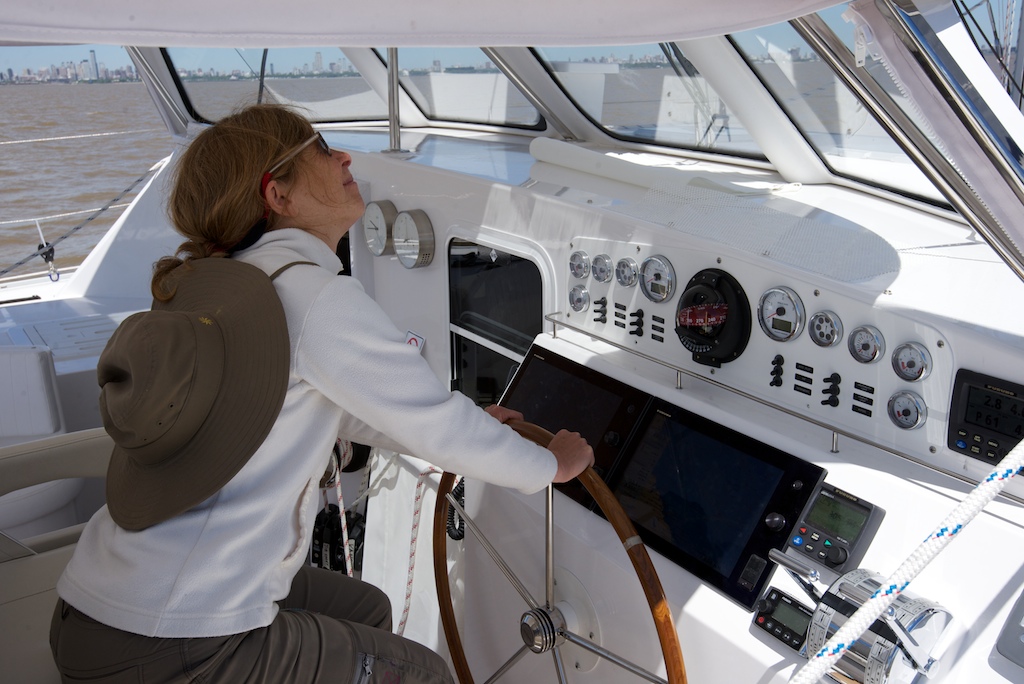
The Antares has fewer lines than a comparably-sized race boat.   No topping lift for the spinnaker pole, no jib cunningham,  no twing lines and only 4 halyards.   The boat moves we need to execute are simple, but we need to be able to do them with one or two crew and in 40 knots.   A dumb move on a Laser in high winds results in a swim but on a large cruising yacht you may lose a finger or two.  Cruising is all about slow and steady.  Do it right every time.  To strengthen our skills, we invited Michael Domican of the BVI to tutor us for two weeks.   His sailing resume is impressive: for the past 12 years he has taught catamaran sailing and prior to that he trimmed the mainsail on the 12 meter UK challenger for the America’s cup.  He is an amazing teacher and we can not thank him enough.  If you are looking for help on how to sail the boat safer, faster and more comfortably, give him a call.   This post is my memory of his lessons.    Any of the smart stuff is credited to Michael and any stupid stuff is credited to my poor memory.

So, imagine you have just motored out from your anchorage location and are ready to enjoy the breeze on a nice, sunny day….

The first sail to go up is the Main Sail and typically with the motors running so as to help keep control of the boat.

Process for raising the Main Sail

    1. The sail needs to be free so “Release the Corners”  (Vang off, Reef #1 and #2 off  (if raising to full Main), and add a bit of slack to the reef lines at the mast for good measure)
    2. Sail Ties off. (sounds simple but easy to forget)
    3. Topping lift.   Before sailing I like to leave it attached to the stanchion out of the way unless the conditions are vang abusive (choppy and light air).  It just is another hazard for raising the main and I hope to get my ideal twist with vang, sheet and traveler.   I put it back on when not sailing to avoid stressing the vang.
    4. If you frapped the halyard while anchored, quickly remove the slack from the main halyard.
    5. Traveler should be on centerline UNLESS this is being done while hove to.   If hove to, move the traveler to align with mainsail. Up to this point, you can take your time as not much is going on to unsettle the boat. After this, don’t be maniacal but don’t daydream either.
    6. Release the mainsheet –  In light air, you may need to manually pull on it a bit near the mast.
    7. Tips on holding a boat head to wind. This is crucial when raising the sails.   Use the boom to determine if you are head to wind.  Skip this if you are hove to. Holding a catamaran head to wind is all about your engine control skills.  It is easier to stay head to wind while maintaining some forward momentum, but often to avoid the prospect of raising the sail in lumpy seas, you are in a protected harbor with limited sea room.  If you go blasting forward at 2 knots you will crash into the pier.  Try these tricks to be a pro:
      • Lock out the wheel with the rudders straight.   Do not use it at all. Stop it – I just saw your hand creep back to the wheel.   Use your engines to steer.
      • Make sure to have a good view of the boom, windex, other boats and the water.   All are great ways to see where the breeze is coming from, assuming there is no current.   Try not to use the electronics.
      • To adjust the boat head to wind use forward on one engine and reverse on the other.    Now look at the background behind the forestay and see how quickly your are turning.   Too much power and you will turn quickly and need to over-correct   Too little and you are not turning at all.   Next, line up a reference point on shore with a nearby stanchion.   Are you moving forward or backward?   If moving forward then your next throttle adjustment might be only a reverse on the appropriate engine. If you can’t find a good lateral reference point on shore, watch the bubbles on the water surface.
      • Practice “holding station” a bunch as this is great skill for raising sails, docking, and being boarded by the Prefectura (the spanish Po Po).
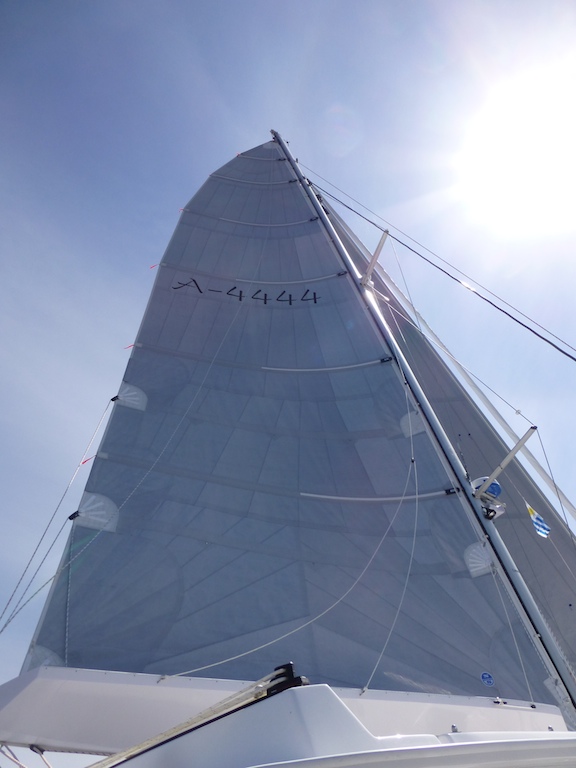
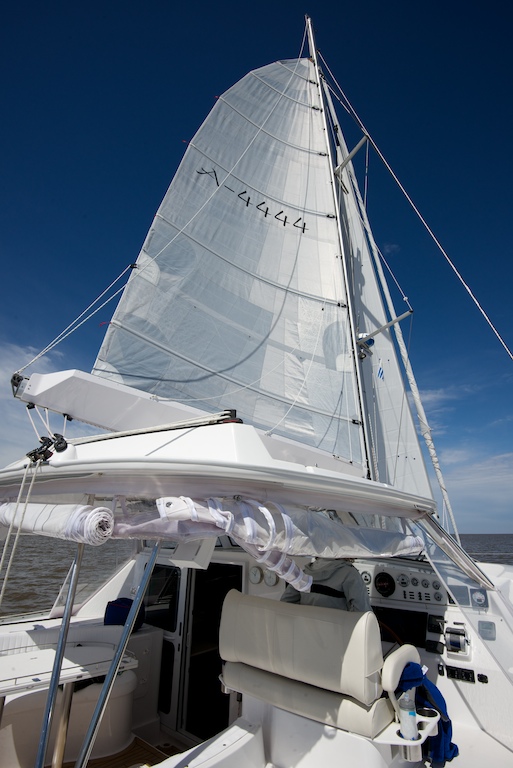
Full Main

Full Main – Two Fish Logo coming soon – Notice reef Blocks sewn in leech

  1. Holding the boat head-to-wind, raise the Mainsail.   I like to use “power Jason” at first, instead of the power winch. I do this to ensure nothing is jammed – the power winch has no subtlety, the two gears are up and rip.  Then I use high gear for the first 90% and low gear for the last 10%.   Keep your eyes on the sail.   First, make sure you are actually raising the main, not using the spin halyard in a mistaken effort to remove a stanchion – a costly move for you, but fun for others to watch.   Then make sure the Main clears the lazy jacks.    Now watch that reef two is coming out cleanly. Did you last sail the boat double reefed and forget to release the clutch?   The reef lines sometimes like to hook around the end of the Park Avenue boom.   The next hazard to watch for is reef one.   A few feet later, I switch to low gear on the power winch.   The helm person can see the luff better and can help get the right luff tension for the current wind speed.   Too taut and the luff has an odd fold.   Way too taut and the ripping noise will be a clue that you made a mistake. Note from Gail – I am too short to see what is going on with the sail while standing by the winch. I like to stand on the aft bench, holding on to the stainless, and use my foot to control the power winch.
  2. Your Main will now look like a sail from a polynesian vessel.   The vang ram will be forcing the boom 2 feet higher than its proper position.   Trim the mainsheet, which will initially act like a Vang and you can now bear away to your proper course.    Now remove the slack from the vang line.  The Vang over-raises the boom because of the design of its peak power point.  When compressed it can handle more loads but when not under load, this creates a bit of the Kon Tiki effect.
  3. One more check that the reef lines are not causing troubles and  remove any slack in them with a light hand.
  4. You can now shut off your leeward engine and get ready for a head sail.   With only the full main up, the boat has a decent amount of weather helm so it is important to keep your windward engine running until a head sail is rolled out.

Head Sail Unfurl / Furl

  1. Rig the Genoa or Code Zero (sometimes called a Screecher) sheets and choose the Jib Car position.    Typically, the Genoa sheets go inside the shrouds and the Code Zero sheets go outside the shrouds.   Wrap both sheets with two wraps around their appropriate winch and remove slack.
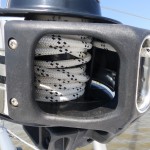
  2. To unfurl a head sail, it is easy to just pull on/grind the sheet. But you will create a future problem at the furling drum.  While furling sails are an established technology, you still need to keep your drum under control:  always have friction or light resistance on the furling line when unfurling.  When the sail is going out, line is going in the drum and can you can create overrides and/or have bunched up line if there is no resistance.

    You are trying to create a tidy-looking drum.  Might be worth checking on your drum once and a while.  If it gets bunched or wrapped you could be unable to furl.   That would suck since it most likely jam half way furled and in a big breeze.   Your only option is cut the sail as dropping the halyard would do nothing.

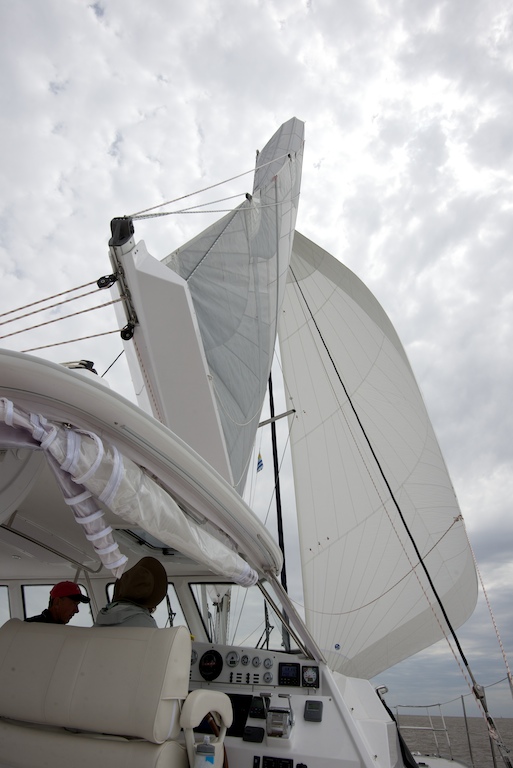
  3. Code Zero

    Code Zero

    The Code Zero does not have a drum to store the furling line; the headstay is turned via a code zero furler – a simple mechanism that looks like a pulley at the foot of the sail. Before furling or unfurling, check the lines and the code zero furler to make sure the lines are taut and the line is well seated in the furler. Don’t just look forward, walk all the way to the furler. (We learned this the hard way). In the cockpit, there are two lines at all times.  One short and one long.  There is no labeling, but it is easy to remember, in all cases pull hard on the short one and lightly ease the long one.   For example,  to unfurl, pull the short end and keep light friction on the long one while someone is using the working code zero sheet to unfurl the sail.  After unfurling, your formerly short line is now long and the long line is short.   To furl, pull the short one and keep friction on the long one.  Easing needs to be controlled to keep the lines neat but the sail not fully loaded.   Even with sailing deep downwind, furling the code zero can require some strong pulling.   The factory supplies you with a pennant line that allows one to lead the Code Zero furling line to the aft power winch.   I would use this as a last resort.   The Code Zero is furled with the shiny side hidden because the other side has UV protection.  If you don’t keep tension on all lines, it is easy for the line to exit the furler.    If this happens you can drop the code zero on the deck by releasing the halyard.  This is not a bail-out option for the Genoa/Jib.   Then, fold in the pole and rethread the furling line.   Cowboys may wish to climb out on the pole to fix it quickly, but this is not recommended by the chief safety officer.

  4. Be kind when you rewind, do it off the wind!   If you are steering 140 degrees apparent wind then the loads on the system are very small.  You will get a nice furl and will have a sail set up for action the next time you need it.    One person uses the helm side power winch to bring in the furling line for the Genoa/Jib.  The other person creates symmetric friction on the two sheets.    I like both sheets with 1 wrap on their respective winches while I am holding the two sheets while standing by the toe rail.   I then have a great view of the sail and can ensure that it is wrapping up neatly.    At the end I allow the clew/sheets to wrap 3 times to keep the genoa nice and closed in case of a storm.   If you are sloppy during this step you have a chance that a storm wind might pry open your genoa.   Not a good thing.   Then flake the sheets and tie them to the seagull striker.
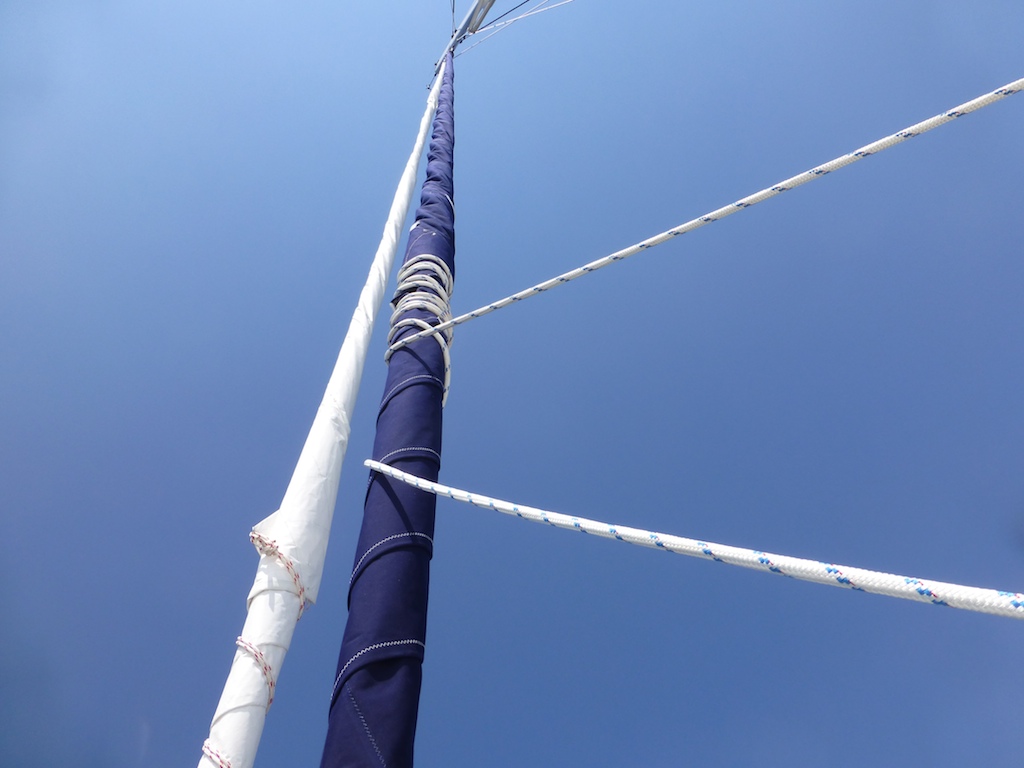
  5. Furled Headsails

    Furled Headsails – Code zero (sloppy) Genoa (clean)

    How tight should you furl?   A really tight furls sounds great but it is hard on the genoa or code zero to be compressed.   The furl should be not too tight but neat so that there are no gaps for a storm to attack.   If you furl extremely tight  then you most likely you are furling the sail under load.   The winch is strong but this is a bad habit that will catch up with you.

  6. Another check is that the furling line should have 4 wraps on it when the sail is furled.   Those extra wraps are there for when you do furl under load.   Stuff does happen where you do not have sea room and need the sail away ASAP.   If you have more than 4 wraps your drum might get crowded when unfurling the jib.
  7. Shut off engines and put the morses in correct position. What is that? It depends on your propellers-folding or feathering. Volvo props and Gori props are folding props-these fold backwards while under sail and centrifugal force opens them when under power. If you have folding props, leave the morses in Neutral or Reverse (according to the Volvo manual). Remember to take them out of gear first. Max-Props are feathering. These have a mechanism to rotate the edge into the water flow while under sail. When under power they rotate into different positions for forward and reverse. If you have Max-Props, once the engines are both in neutral and powered off move the morses to max reverse to stop the blades from spinning. Wait a minute and listen for a change in sound.   Your props are now feathered.  Then move the morses to max forward to avoid the genoa sheets from getting fouled in them during a tack.
  8. One last note: to Reef the Genoa, just furl it in to the desired point rather than furling it in all the way. Your sails might have guides taped on them to help you determine a good first reef and second reef point for these. After a while, you will get a feel for the size of the sail that you are looking for.  The Furlex manual also has some tips on reefing. They propose you unfurl the full sail and then furl back to the reef point to create a tighter luff for sailing.   This tight furl would not be good for storage but gives the sail a finer entry which is useful when sailing to weather.


Reefing the Main

Single Reef in the Main

Single Reef in the Main

  1. There are two ways to skin this cat.   One is to be head to wind and the second is to heave to.   As the latter is more likely let us discuss this process (who wants to be head to wind in 30 knots with the genoa/jib banging when you can heave to instead?).
  2. Heave to by either tacking into it or grinding into it.
    • Tacking into heaving to is to tack but let the Genoa/Jib back-wind by not releasing the jib sheet.   After the tack, while the main is eased, turn the helm to be in opposition of the jib’s force (For example, if you are on starboard tack, you tack to port. The main is on port tack but the  jib is has remained trimmed on starboard, trying to pull the boat more to starboard. Turn the wheel fully to port and lock the wheel. Note from Gail – a simple unsanctioned way to think of it is if you turned the wheel to starboard to tack into heave to, when the jib is backwinded turn the wheel fully in the opposite direction, to port).
    • The grinding into process does not require a tack;  the lazy sheet is ground and the working sheet is eased, such that the sail is now backwinded to windward.   The tacking-into hove-to technique on the Antares is kinder on the Genoa as the radar and diamond strut get in the way of grinding into it.  Either way, this maneuver should be done with a reefed Genoa to allow a better balance of your center of effort and less Genoa interaction with the radar. You still need to turn the wheel in opposition to the Genoa/Jib pull.
  3. Now the boat should be calmer and stable while drifting slowly under hove to.    Ease the main halyard looking for your mark on the halyard that indicates your first reef while also watching the sail.  Ease one foot past the mark and cleat off the main halyard.
  4. Slowly sheet in the first reef line.   Ensure that the reef line is not caught on the aft portion of the main tamer. Then watch as the tack will be pulled down first.   After this is completed the clew will start to be pulled down.   Keep stopping to make sure you have this in clear view to avoid damaging the sail.   When both reef points are snug, engage the reef #1 stopper.
  5. Add main halyard tension to ensure a flatter sail shape than when under full main.   Also, when trimming this sail in high winds you may want to induce more twist to spill wind.
  6. To exit hove to, unlock helm and begin steering while the jib is trimmed properly.   To release the jib and avoid a violent thrashing of the sheet, employ an incremental process.   First, ease 3 feet on the backwinded sheet.   Trim in all the slack on the old lazy sheet (soon to be the working sheet).   Then go back to the backwinded sheet and ease 3 more feet.   Trim in again on the new working sheet.   Yup, just keep doing this until the jib is back in its correct spot.

The Jib

Jib (smallest headsail)

Jib (smallest headsail)

I love this underused sail in the Antares arsenal.   As you can see it is about one-third the size of the full Genoa.   Many owners have told me about sailing in 40 knots with just a scrap of the Genoa unfurled; it is great to know that the Genoa can handle such strong wind.   But my preference would be to have the Jib up in those conditions because: it is made from a sturdier cloth that loves the big breeze, the luff is much thinner than the furled genoa, and, the cut of the sail is flatter.

The only problem is that you must have the forethought to change from the Genoa to the Jib before the breeze gets too strong.    We did a few sail changes in easy conditions, but with a strong breeze and green seas I can imagine this might be a bit more action-packed.   The Jib is also auto-tacking which is great for short-handed crew.    Since the mainsheet and jib sheets are controlled very close to the helm, one person can have plenty of control of the boat.   The cost of the auto-tacking configuration is the process for heaving to.   You either have to go forward and move a stopper that will prevent the jib sheet from auto-tacking or lead a temporary line from the jib blocks aft that will restrain the jib from auto tacking.   A bit more forethought.   I am not a legend in the forethought arena.   Gail will need to help on this one.

The jib sheet is attached to the clew via a harken shackle.   This shackle does not have a captive pin so be careful when attaching or detaching the jib sheet for this smaller sail. (and carry some spares).

Raising Genoa

Raising Genoa


Dropping and Raising Headsails

  1. Dropping – Try to be off the wind so as to use the main sail to block the breeze and make the job easier.
  2. While the sail is not loaded, ease 2 feet of Genoa halyard.  Use the genoa sheet during this process to keep sail close to the boat and to not drop it into the water (keep it inboard of lifelines).
  3. Crew detaches the bottom shackle and and gets the sail out of the headstay groove.   Crew signals for more halyard drop.   Drop as quickly as the crew can consolidate the sail onto the trampoline.    When the head swivel arrives, tie it to the dolphin striker using a sail tie-down.
  4. Detach shackle from head of sail and attach to swivel.
  5. Flake sail and place into sail bag.   If you are dropping the Genoa, then tie the long sail bag to stanchions, to avoid loss of bag.
  6. Raise a new sail by repeating the above process in reverse order.   Make sure the sheet is already cleated in on the appropriate side at loose trim.


You may want to take a break and get a drink now but I am almost done writing.

Tacking

It is more fun to hand steer the boat during a tack or gybe but when short-handed it might be better to let the autopilot take charge, if you have an autotack feature.   Press the turn button and 4 choices should appear (two tacks and two gybes).   The tacks (port to starboard and starboard to port) are programmed to go fast since catamarans like to get caught in irons.   I programmed a wide tacking angle of 110 degrees.   This will not win races, but will make it easier to keep the boat moving.  Furuno autopilots are polite and wait 10 seconds to start the tack after the button is pressed.

Solo tack plan for a Genoa

  1. Ensure sheets are prepared for a tack.   Remove figure 8 coiling of sheet off the active winch.   Flip the pile so the bitter end is on the bottom to ensure a cleaner release.    Ensure that the lazy sheet has two wraps and that the winch handle is near by.
  2. Make sure that where you are tacking to is clear.    Check for other boats and chart for any issues. Even if using the auto feature at the helm, think about where you will be pointing at the end.
  3. Instruct Furuno to tack the boat. (Push the button, fortunately there are no Siri’s in sailing)
  4. Walk safely to the active sheet.
  5. Release the sheet when the headsail has some quantity of back-winding.   Less for windy days and more for light air days.   When releasing the sheet,  first remove sheet from the stripper and keep 4 wraps on winch until you see the backwinding.   Then, remove wraps briskly while ensuring your hand is clear of the winch and you have a clear running sheet.
  6. Sheet in on the new sheet while the winch has two wraps as the sail is crossing over.
  7. Add two more wraps and put the line through the stripper (shiny metal part) before the sail loads up.
  8. Winch in to the appropriate trim. If you are human, utilize low gear(counter-clockwise) when high gear (clockwise) doesn’t work anymore.
  9. Return to helm and check again that you are on a good course and have no obstructions.
  10. You may want to adjust the traveler to fine tune the Mainsail.

Tacking the other head sails

The three headsails require slightly different techniques.   The auto-tacking jib requires nothing as long as the jib sheet car stopper is placed in the correct location for the new tack.  If so then turn the wheel when it is safe to go.   It would be odd to tack the code zero since it is an off wind sail and you would probably be gybing it. The alternative to gybing it is to furl it, gybe the boat and then unfurl it on the new gybe.

Gybing

The risk during gybing is to gybe too quickly, thus damaging the traveler and/or other gear.

  1. Ensure the course you are gybing to is clear.    Check for other boats and look at the chart to find any other issues.
  2. Center the traveler and make sure both traveler controls are not slack.
  3. Instruct Furuno autopilot to gybe the boat.   There will be a 10 second delay if you have programmed that into your Furuno autopilot.
  4. Make sure to select gybe NOT tack.   The boat will turn much slower for a gybe
  5. Start trimming in the main sheet.    The goal is to have the main near  centerline when the apparent wind angle is greater than 140.   Too early and you are fighting the boat, too late and you will not have time for your next maneuver.
  6. Remove the mainsheet from the stripper and be ready to allow the sail to ease when it gybes.   Watch the leech of the main sail.   IGNORE THE JIB.  It most likely will gybe earlier but do not concern yourself with this sail until much later.
  7. POW!!  Main is over but the movement was not violent because the main started at mid-ships and was eased as it changed sides for a “soft” landing.   Do not ease too far or you will cause a violent impact with the shrouds.
  8. Now clean up the jib by using the technique used for exiting the backwinded jib.   Ease 3 feet on the old active sheet and then trim in on the new sheet.   Repeat until you have proper sail trim.
  9. Adjust trim on main sheet and traveler for optimal sail shape.    Keep an eye out for shrouds chaffing the main.

A long post by me, mostly written as a review for Two Fish but hopefully, a few of our Do’s and Don’ts will help you avoid some of our previous mistakes.


Read full story  · Comments { 7 }

Cruising Uruguay

In a sailing log book, one records a destination as something you are sailing towards, not sailing to.   Sailors try to get somewhere, but they do not have to absolutely, positively be there.  Plans can be scuppered by winds, waves and a lack of rum.   We were sailing towards the end of Uruguay – Punta del Este,  but only managed to sail half the distance.   The adventures of the three person crew (Jason, Gail and our friend Michael who is also a sailing instructor) begin here.
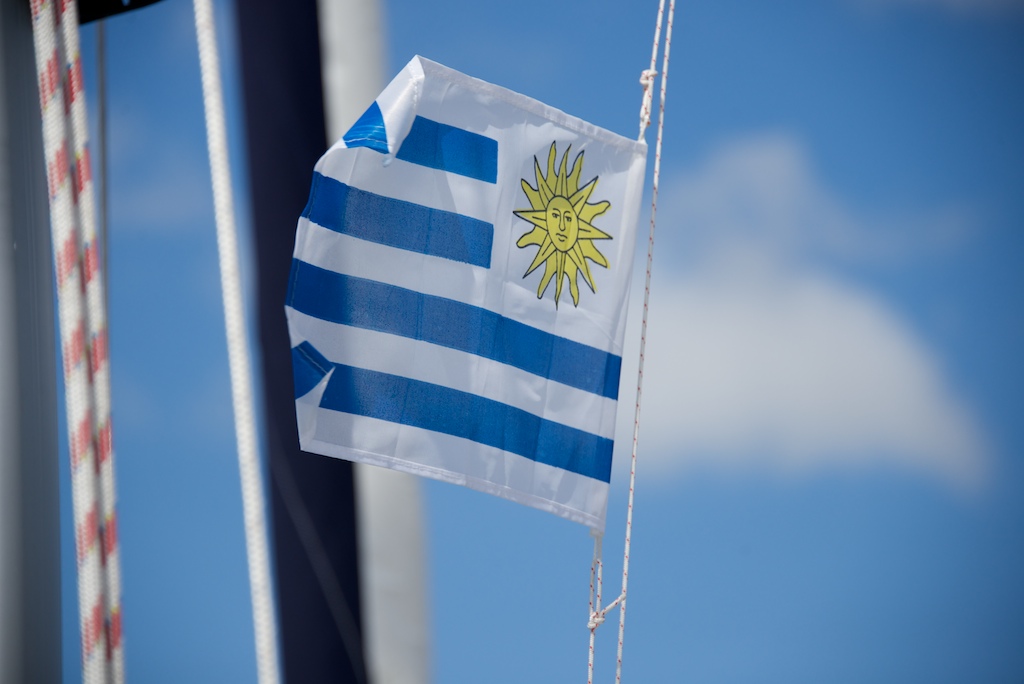
Uruguayan Flag

Uruguayan Flag

Sailing voyage posts can be as exciting as the shipping news.  “Wind was North North East at 17 knots with gusts up to 24 knots. …”     The wind and the waves affect the comfort and performance of the boat and its crew in every possible way.   Cooking in large waves can resemble a knife tossing act from the second ring of the circus.   Bouncy nights at anchorages can leave the crew cantankerous in the morning.  So please excuse sailors for looking like they are on a casting call for the Weather Chanel.
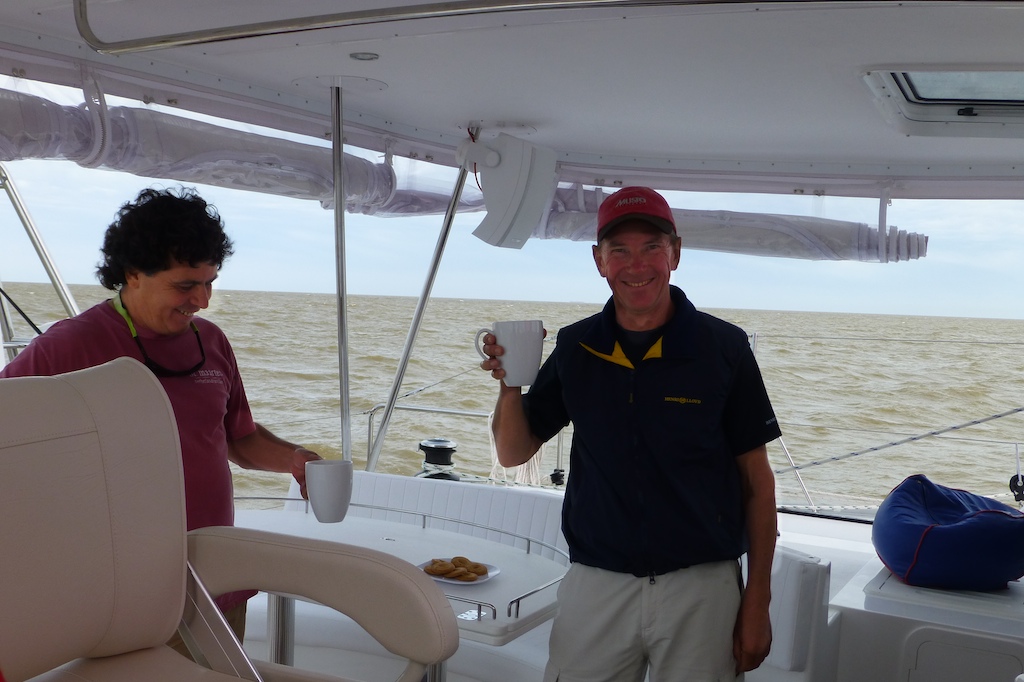
Memo and Domican

Memo and Domican w/ tea

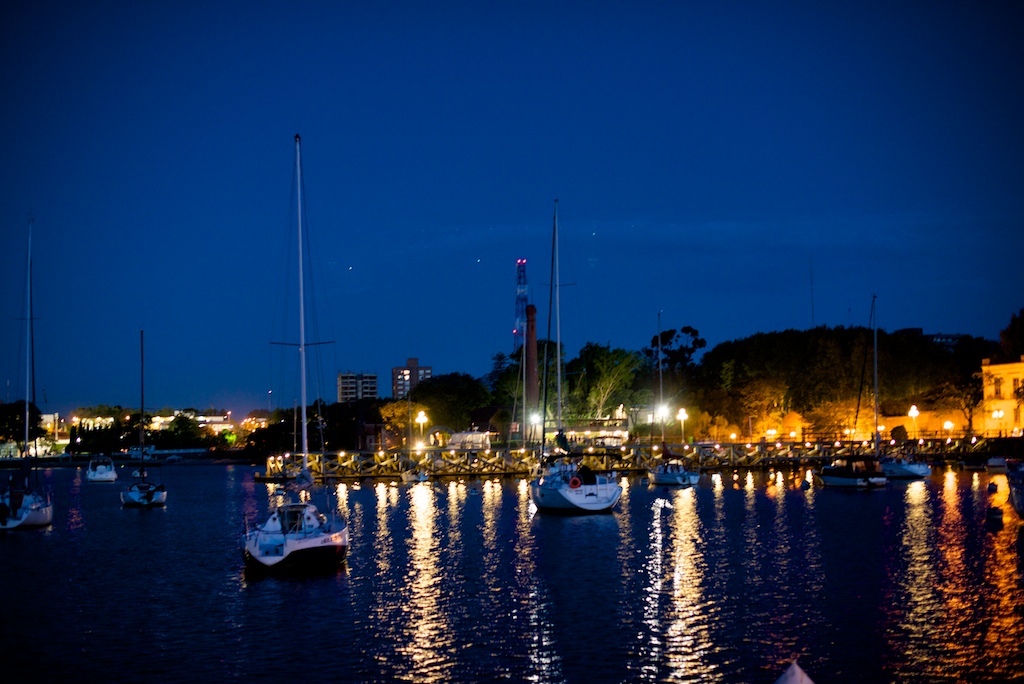
We left San Fernando, Argentina for Colonia, Uruguay.   The night before, Memo, our boat builder, helped me create a route on the chartplotter.   As it is an active delta estuary, the Rio Plata is not a straightforward place to sail.   The 3,000 miles of rivers empty tons of mud into the Plata each year, creating shallow spots miles from land.   Our boat draws a very thin 1.2 meters yet we had to be diligent to avoid running aground.   A straight shot to Colonia would have put Two Fish on the muc.   We opted instead to head south towards Buenos Aires, followed by a Memo-prescribed 90 degrees turn towards Colonia.   All of this was done under the iron genoa (old sailing nickname for the engine).   If we had not had our heads buried in the excitement of the day and our new electronic toys, we might have sensed this as an omen for our 2 week cruise.

The Plata has may wrecks which are littered across the chartplotter display.   The Maria Lisa, the Juan Jose and many others were created when the flat waters turned nasty.  One of the exports from Uruguay to Argentina is rocks.  You will not be surprised to find out that the rock business is not high-margin.   If you work at Google, do not take that job at the Uruguayan Rocks Corporation.  To be competitive in the rock business you have to buy a cheap barge and overload it to the point that the gunnels are 3 centimeters above the water.  On a calm crossing of the Plata, the barge full of rocks arrives in Argentina without an issue.  However, an unexpected breeze will allow the rocks to follow their natural instinct and sink below the waves.  Fortunately, this typically does not result in a loss of life, since it often occurs in 2 meters of water and the newly formed rock pile is a great place to wait for rescue.

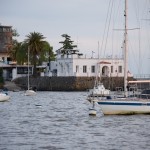
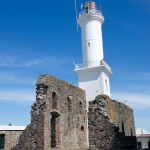
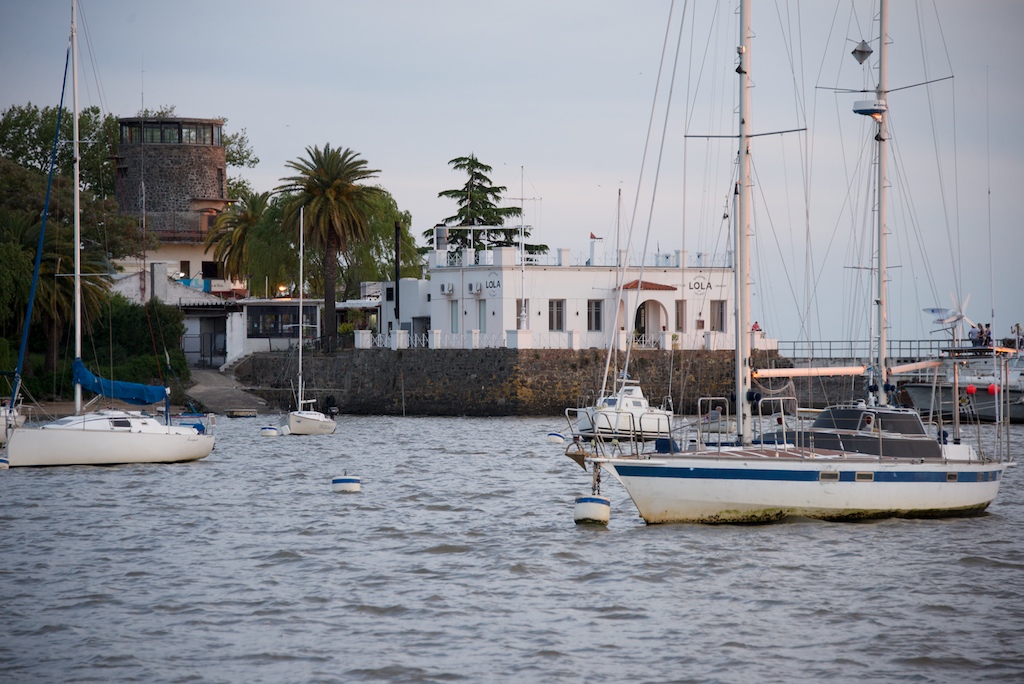
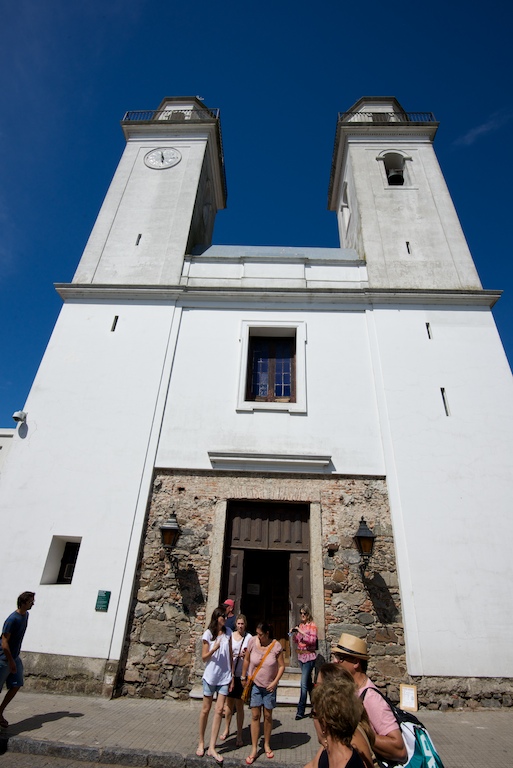
Colonia

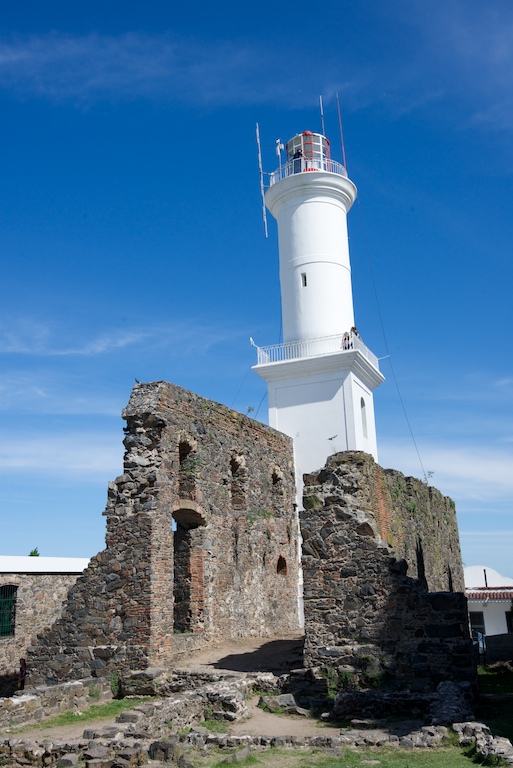
Colonia was traded back and forth between the Portuguese and the Spanish more times than an on the run 5 year treasury.   Here is the history in a few run on sentences.  It was founded in 1680 by the Portuguese, conquered by the Spanish the same year, then returned to the Portugese in 1681.   In 1705, it was snatched again by the Spanish but returned as part of the treaty of Utrecht.    The Spanish failed to take it in 1735.  A blur of changes in 1750 and 1777.  In 1816, it becomes part of Brazil.   Then part of the country Banda Oriental.   A few more changes and now Colonia del Sacremento of Uruguay.

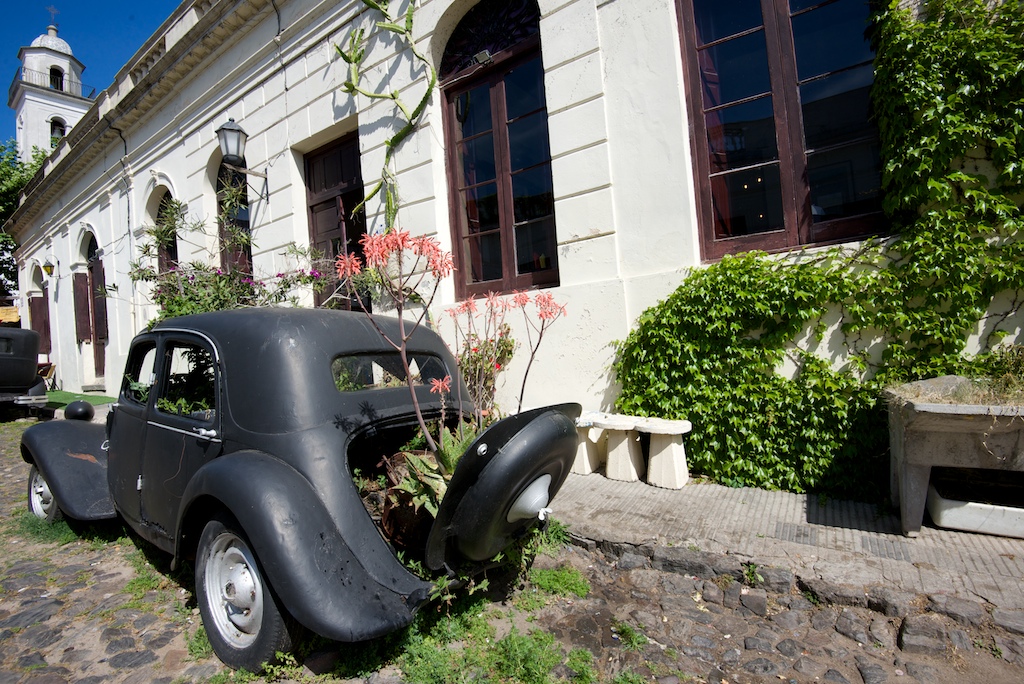
I got the feeling the people in the town were not confused as to whether they were Spanish or Portugese.   Instead they are focused on being great stewards to a world heritage site.   The original downtown is Portuguese colonial style which is an ideal backdrop during an after sail stroll. Be sure to stop by the Tourist center near the Buquebus terminal to pick up a walking tour map and learn some more history.

 Keeping up with the Jones
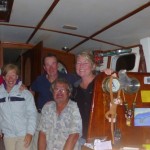
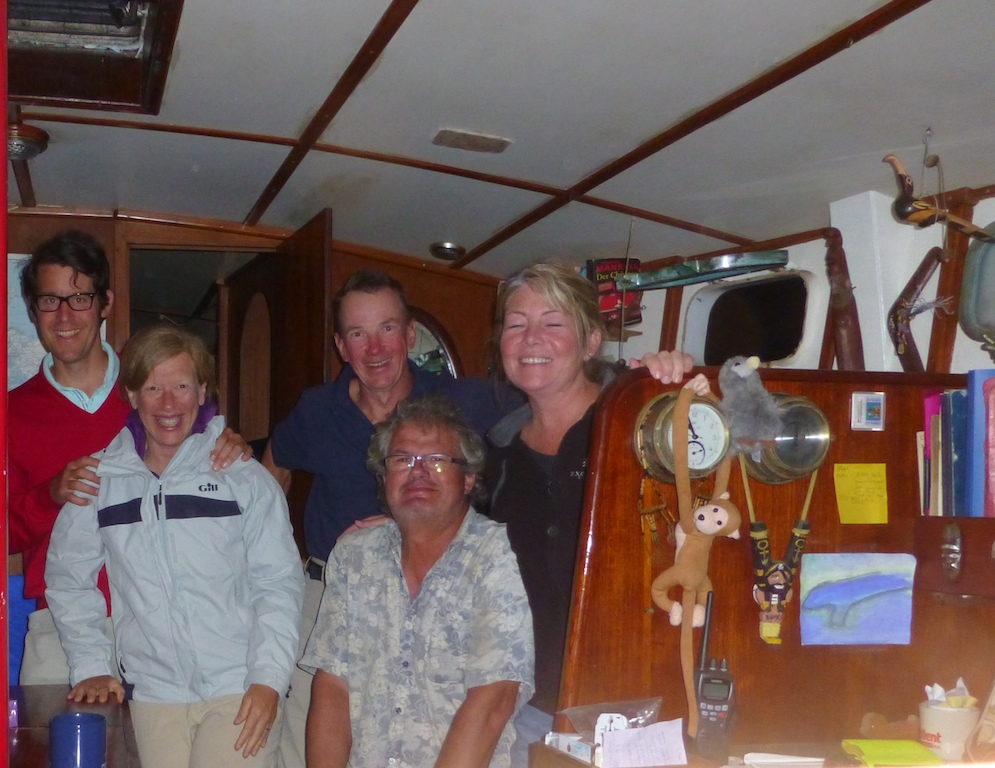
Crew of Momo
Crew of Momo

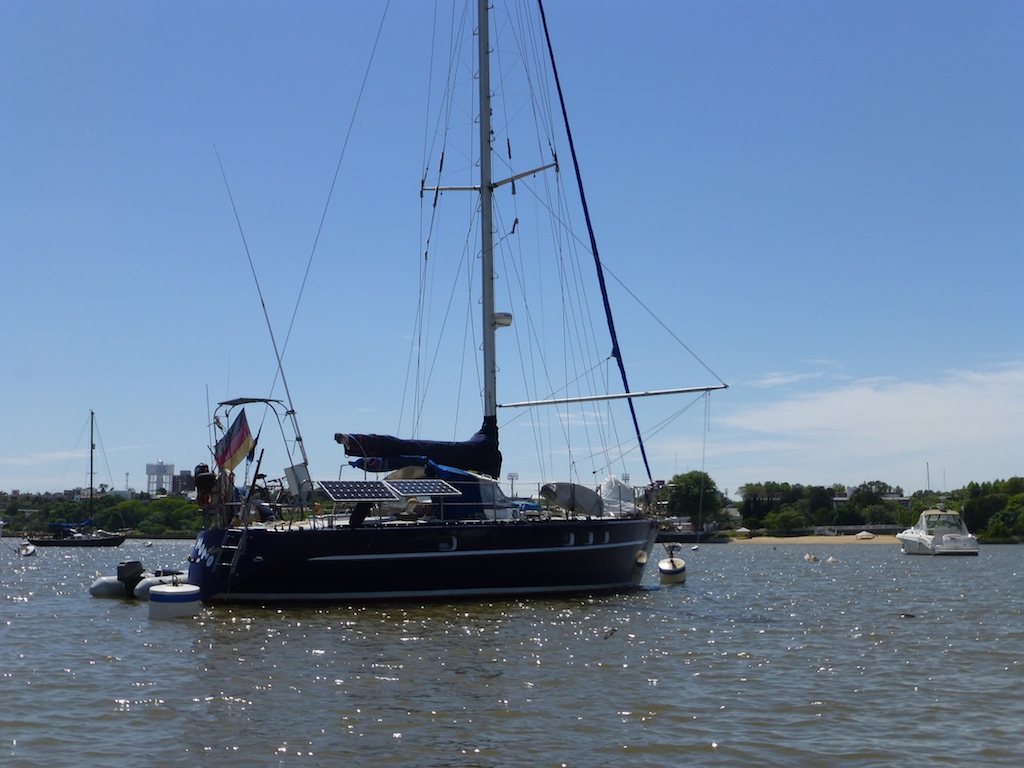
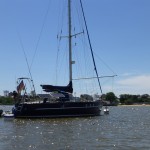
s/v Momo

s/v Momo

We have joined a new, very social group – cruising sailors.  Our induction started out in grand fashion when we met the crew of Momo.    Momo is crewed by a German captain who has been living aboard his boat for 18 years.   His first mate, an American named Jenny, split her youth between the two noncontiguous states: Alaska and Hawaii.  That is the real estate equivalent of sweet and sour pork.   She also once worked as a trucker.   They were very kind and invited us over for homemade delicious beef and spaetzle.   People do such nice things for you when cruising.   We are not in New York City anymore.

The highlight of the evening was Gerald’s stories of his sea dog and other sailing adventures.   Years ago while he was in the French Caribbean he would walk his dog on the beach every night past a group of French-speaking 12 years olds.   Gerarld spoke to his dog in his native German.   On the last evening, he overheard the French 12 year old tell his parents “Mom,  that dog is the smartest.  He also speaks German!”.

During the New Zealand America’s cup, Gerald stayed at the Royal New Zealand Yacht Squadron.   As the formal name implies they held the America’s Cup.    Gerald had been at sea for a decade and had not kept up with the current Cup defender.   As he came to the yacht club bar, he asked some old salts “Why do you guys have a copy of the America’s cup.   The Australians have the real one, right?”.    A few jaws hit the floor.


Two Fish Sails in a Breeze
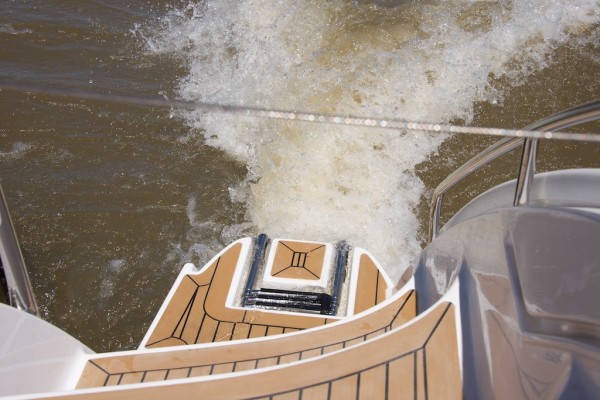
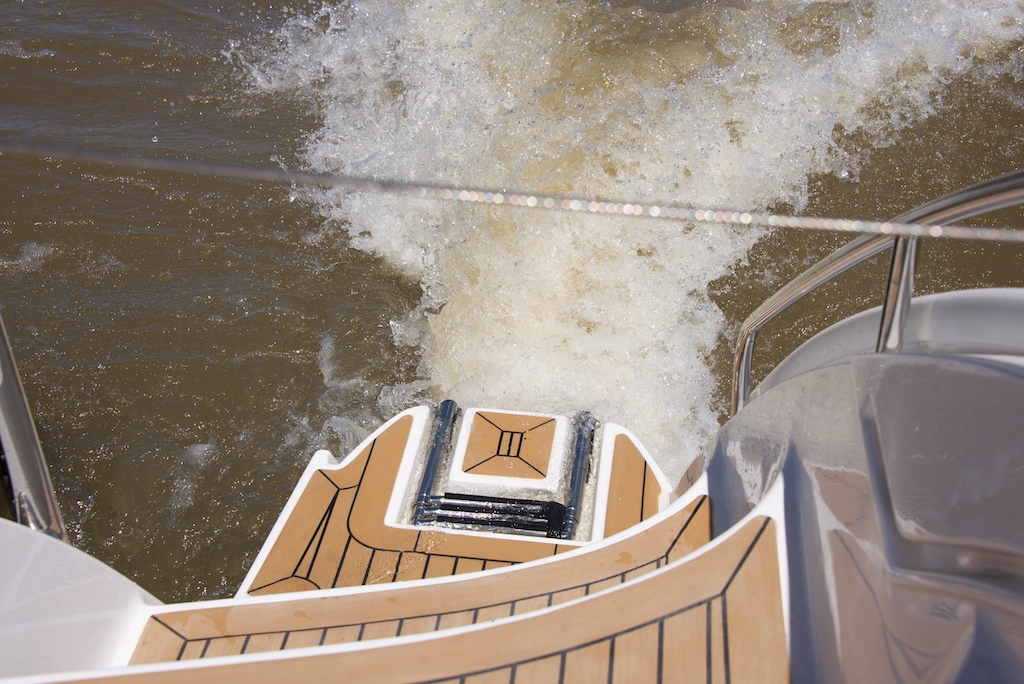
Wake made in the Plata

Wake made in the Plata

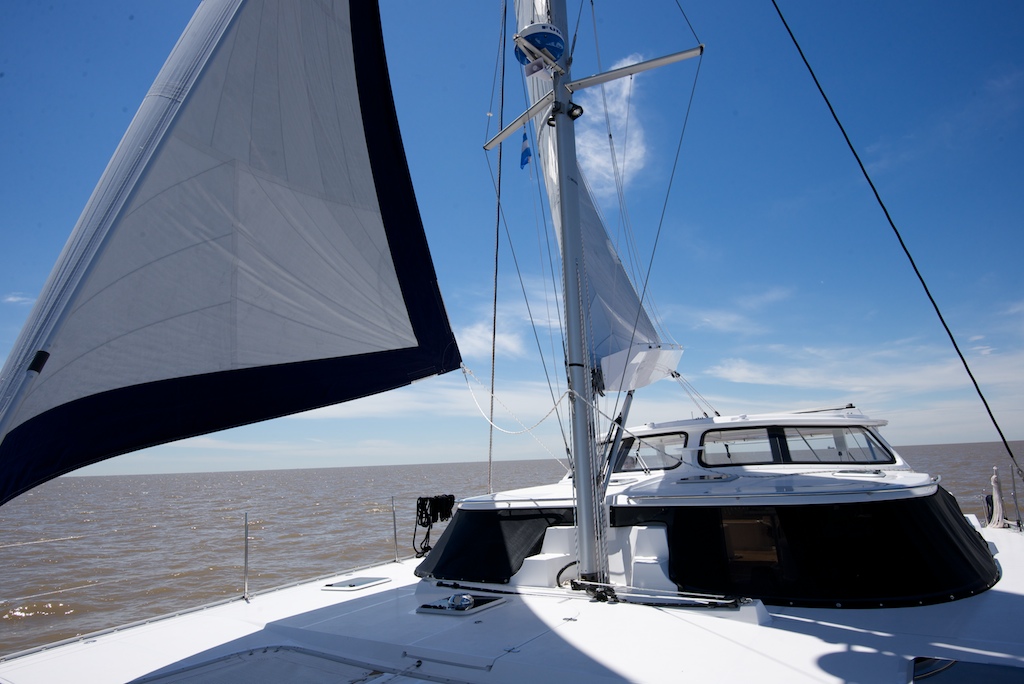
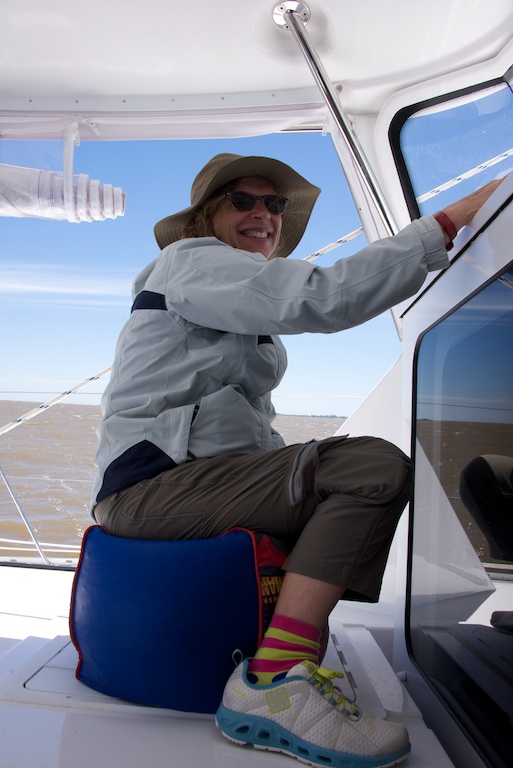
Twice during the 14-day cruise, we experienced 30 knot sustained breezes.  No pictures of this since I was busy sailing and wind never shows up in my photos anyway.  The big breeze was a great workout for the rig and a nice test of the crew.   The boat was easy to sail both into the wind and off the wind.   She tracks nicely and responds well to a stable hand at the helm.  Into the wind, we had two reefs in the main and genoa; this left us with a balanced helm of only 5 degrees of weather helm.  In strong winds, the boat can be enjoyable to sail for new sailors veterans alike.   I kept turning off the autopilot to better understand the boat’s tendencies.    Gail discovered that in the big breeze, she has a favorite position to sit when off watch – her  Spiderman cubic bean bag, that has cost her USD 2.  The Argentines wisely call this a “poof”.

Up a river with a boat (Riachuelo)  and Any Puerto in a Storm (Puerto Sauce)

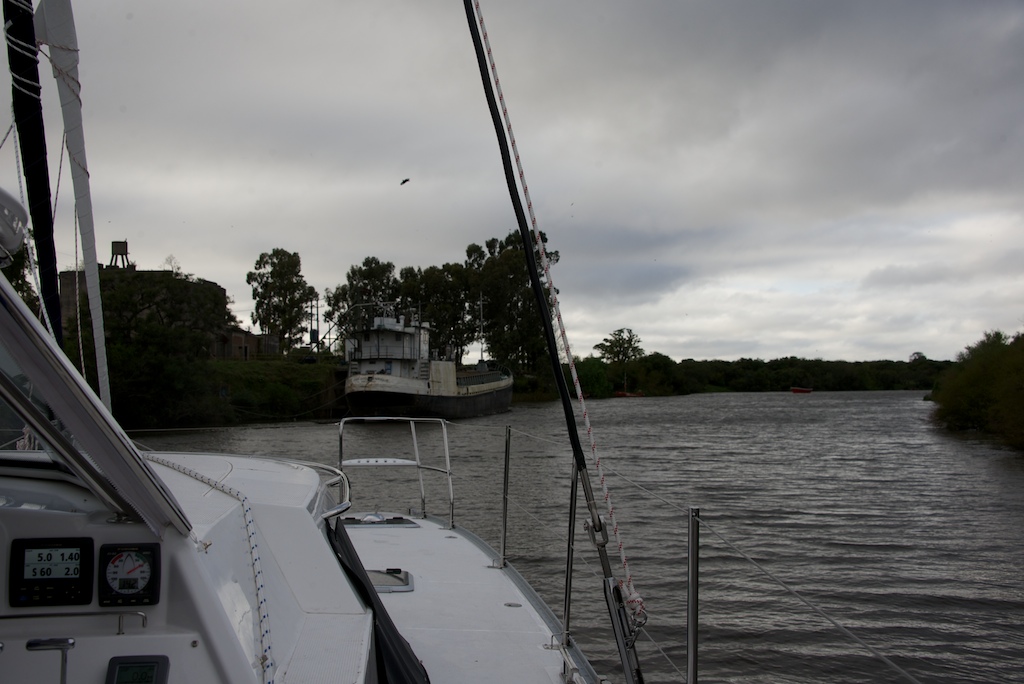
On the fourth night, we chose to anchor up a river that local sailors had recommended.   It seemed like a scene from Heart of Darkness.   There was much tension on board as we were relying on a Spanish language cruising guide to keep us off hidden rocks and shallows as we sailed up the river.  Sailing may not require a sextant anymore, but it does require an iPhone with an English to Spanish dictionary.   Columbus had it so easy compared to us!

After all the hard work, we were rewarded with a wonderful night anchored in the river.   By morning the breeze had increased, testing our simple anchor plus stern tie to the shore system.   We had to leave before more branches from the shore side tree came aboard.  Anchoring in this river really summed up cruising for me.   You find a perfect place that brings you great peace and comfort.  But 12 hours later our paradise was becoming windswept and we were forced to move on.    We left quickly, as we did not have a stern anchor and were defenseless in the  building wind.

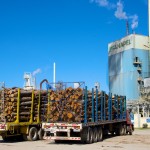
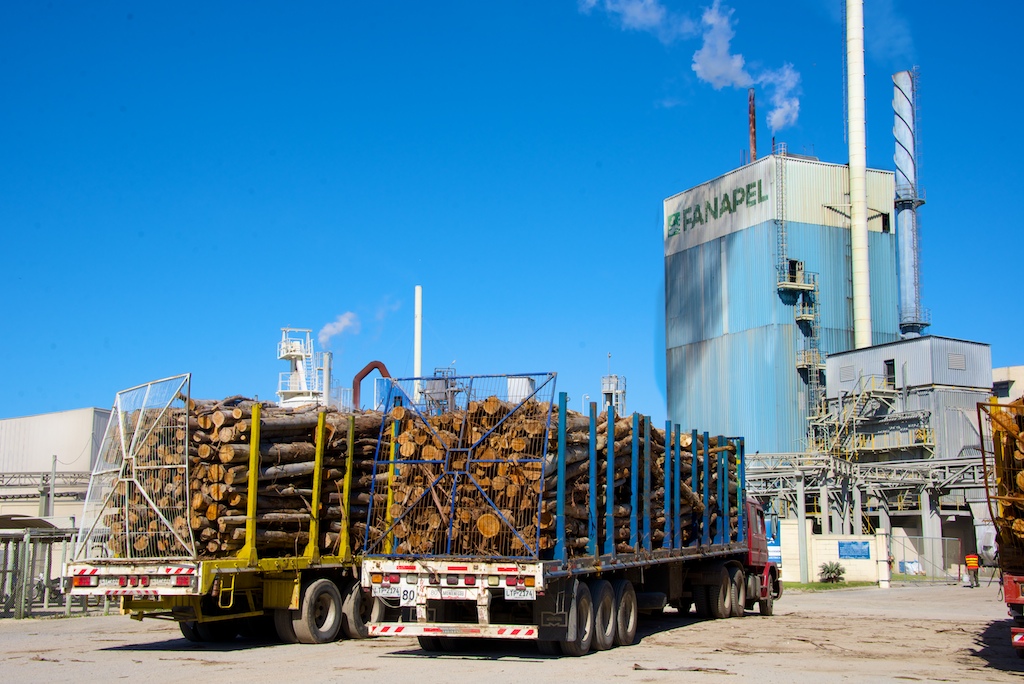
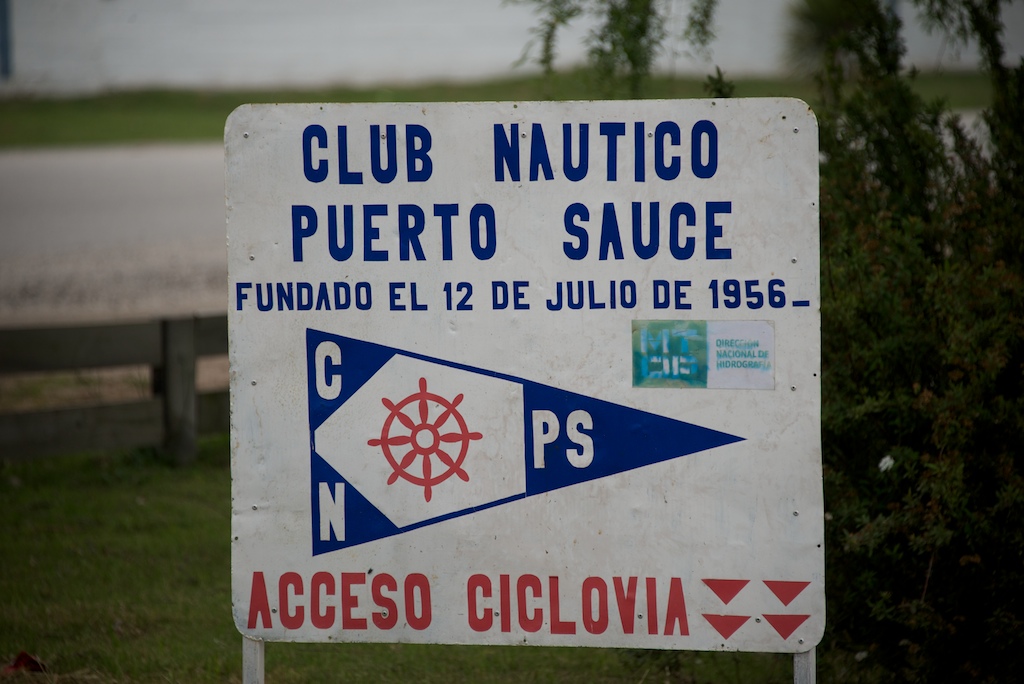
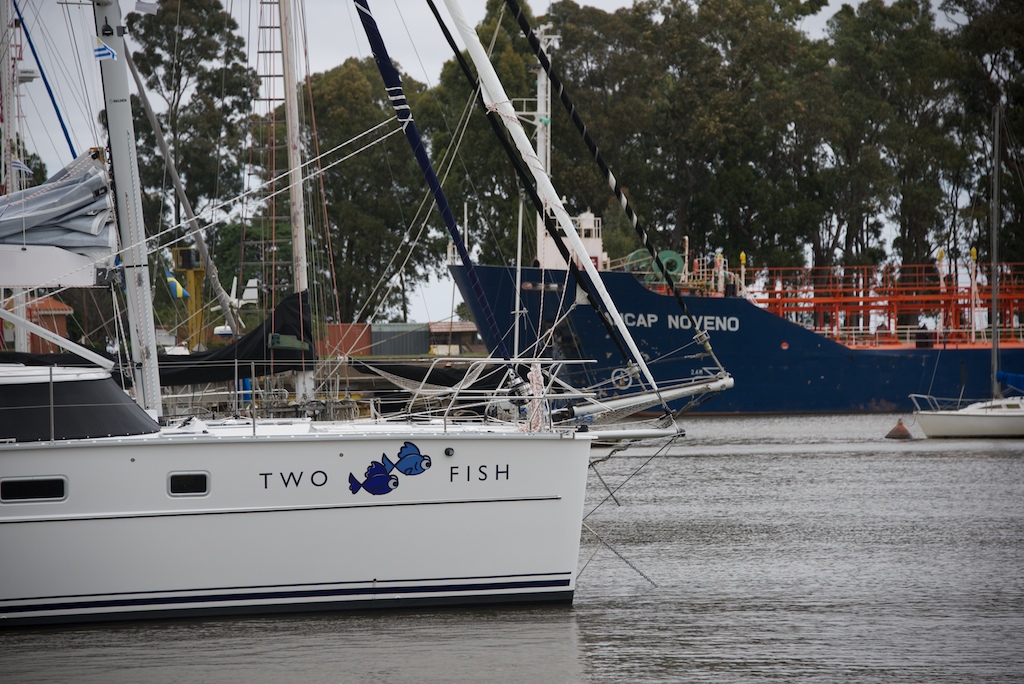
Going to weather in 30 knots becomes annoying for everyone, it is just a matter of how quickly.  Gail has adopted the old sailing slogan “Gentlemen do not go to weather (sailing in the direction of the wind)!”   After a bit of bouncy sailing, Gail hinted that she had her share of going to weather.  We scoured the cruising guide for any port in a storm and found that the nearest was Puerto Sauce.  We we so happy to be in a more protected location, that we did notice immediately that the 24 hour-a-day cellulose plant showered the boat in fumes and noise.

We had a small adventure trying to buy a garden hose for filling our water tanks.   The hurdles to buying a hose were twofold: I did not know the name for garden hose in Spanish and the modest inventory of  retail establishments in Puerto Sauce.  I now know the name for garden hose is manguera.  After 2 days of visits to severals stores in Puerto Sauce, the closest we got was a storekeeper that said it might be possible  that a hose might show up in a few days time.   The hose adventure continued into another town and culminated in a fevered over buying of hose when we finally found a seller. Fortunately, an Italian boat lent us their hose in the interim.


The Po Po (Police or Prefectura) chase down Two Fish

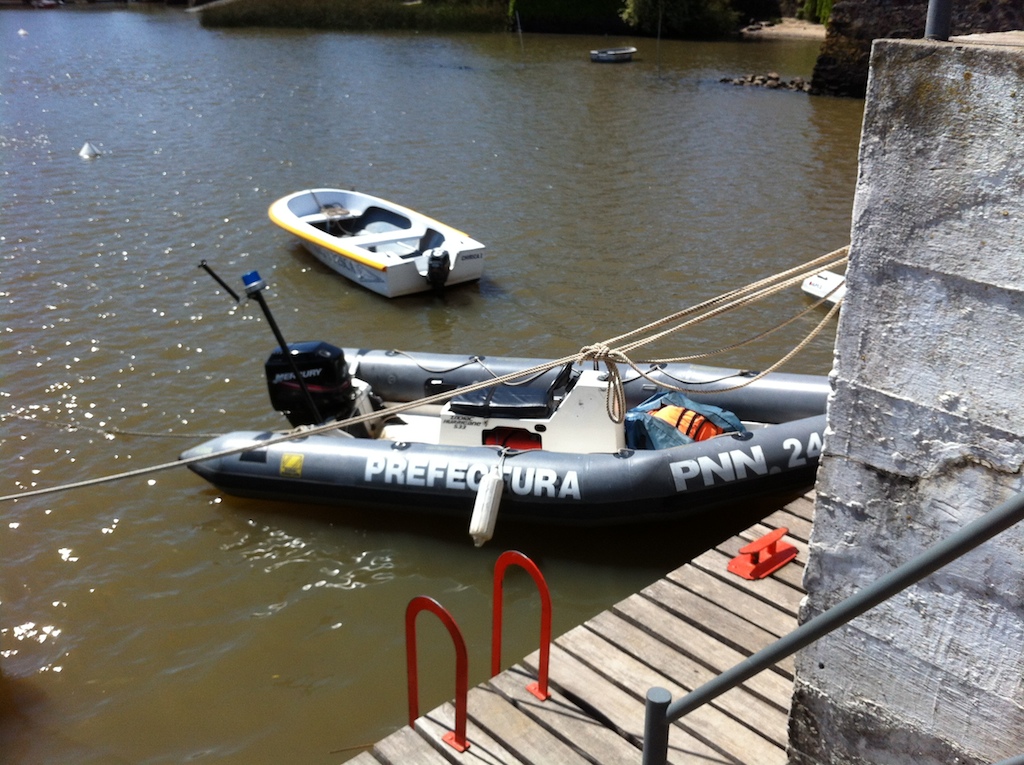
After a week or so in Uruguay we had become regulars of the check in / check out procedures.   We would get on the VHF radio to announce our departure.  “Control, Control esta barque two fish salida para cinco horas”.   This proclamation that we were leaving for 5 hours was greeted with silence.   During one of our departures, Gail and Michael (without asking me) decided that they would forgo the radio check out.  They were emboldened by comments from more seasoned cruisers.   The breeze was blowing over 15 knots and we were marching nicely to windward.   Not as nicely as the mono hull that was out pointing, but nice enough from my purposes.  Gail put up the alert first.  “Jason, that Zodiac is on a collision course with Two Fish!”   I momentarily dismissed the warning until I noticed that the Zodiac was flashing a blue light and chasing us down.   Tensions rose as they were shepherding us to shore on a path that was too close to hazards for my taste.   I was about to turn away when I realized what their concern was.  They thought we had done the yachting equivalent of the dine and ditch.   I yelled over the breeze in my poor Spanish that we were only out for a day sail.   Gail resumed check out procedures the next day, and from then on Control responded with “OK Two Fish”.
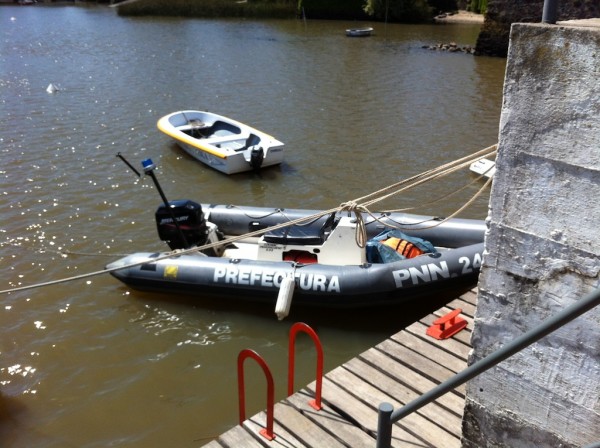
Prefectura

Prefectura Chase boat is faster than Two Fish (Notice the Blue light)


Final Cruise Thoughts

We had a lot on our minds while testing and learning the boat, so I am not sure a review of Uruguayan cruising grounds is fair.   What I did like was the people, the facilities and the food onshore.   The paperwork and somewhat up and down breeze were not perfect.   But any of the shortfalls were made up by the enjoyable crew aboard.


Tips for Uruguay Paper work  (skip if you are not sailing to Uruguay)

1)  You need to fill out 3 copies of the official crew list.

2)  Your first port of call will take one copy forever and return 2 copies when you check out of the port.

3)  On arrival in your first town you need to visit a) Prefectura, b) Immigration (bring 67 pesos in exact change, about 3 USD),  c) Marina billing office, d) Prefecture again.  In Colonia, Immigration is  a 15 minute walk from the pleasure yachts.

4)  On departure, visit only the prefectura to get your 2 crew lists back

5)  For each new town, repeat 3 and 4 but skip Immigration.

6)  On departure from your final Uruguayan town repeat 3 but now surrender your second crew list leaving you with one for your next country.

Budget a few hours for this process.  All friendly and helpful, but a bit slow.
 

Read full story  · Comments { 2 }